

P0404 on 2003-2013 Audi A3 2.0L TDI: EGR Performance Causes and Fixes
On a 2.0L TDI Audi A3, code P0404 almost always points to a clogged or failing EGR valve, often due to heavy carbon buildup. The fix is typically a replacement of the EGR valve and sometimes the associated EGR cooler, a labor-intensive job that can cost over $1,000. A leaking EGR cooler is a common related failure, identified by coolant loss and wet, sludgy soot in the EGR system.
- First, check if your vehicle is covered by the TDI Extended Emissions Warranty. This repair could be free.
- P0404 on this engine is almost always caused by a clogged EGR valve, often complicated by a leaking EGR cooler.
- Symptoms of coolant loss or white smoke are critical signs that the EGR cooler has failed and the vehicle should not be driven extensively.
- The repair is very labor-intensive and expensive. Do not attempt as a first-time DIY project.
- Due to the high labor cost, replacing the complete EGR valve and cooler assembly with a quality part is the recommended approach over cleaning.
What's Unique About the 2003-2013 Audi A3
The 2.0L TDI engine in the Audi A3 is notorious for EGR system issues, which were a central part of the 'Dieselgate' emissions scandal. These diesel engines produce a high volume of soot, which heavily contaminates the EGR valve and EGR cooler. This leads to severe carbon buildup that restricts movement and causes the P0404 code. A common and related failure is the EGR cooler cracking internally, mixing coolant with soot to create a thick sludge that quickly seizes the valve. Owners must always check if their vehicle's VIN is covered by the TDI Extended Emissions Warranty, as this expensive repair may be covered for free by a dealer.
Generation note: The 2003-2013 year range primarily covers the second generation of the Audi A3, known as the 8P (2003-2013). The issues described are highly characteristic of the 2.0L Common Rail TDI engines (engine codes CBEA, CJAA) used in this platform from 2009-2013.
Symptoms You May Notice
- Check Engine Light (CEL) illuminated.
- Rough idling, engine hesitation, or stumbling, especially at low RPM.
- Noticeable loss of engine power and poor acceleration.
- Reduced fuel economy.
- Engine knocking or pinging sounds during acceleration.
- White smoke or steam from the exhaust (a strong sign of EGR cooler failure).
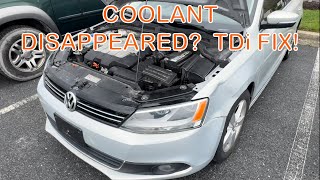
- Mysterious or steady coolant loss with no visible external leaks (indicates internal EGR cooler failure). 🎬 See a breakdown of common EGR cooler failure symptoms and solutions.
- Sweet smell from the exhaust (indicates burning coolant from a failed EGR cooler).
- Replacing only the EGR valve when the EGR cooler has also failed. If the cooler is leaking coolant, the new valve will quickly become clogged with sludge and fail again, often within a few thousand miles.
- Attributing rough idle solely to the EGR valve when failing motor mounts or a bad dual-mass flywheel (DMF) could also be contributing factors.
Most Likely Causes
- Clogged or Sticking EGR Valve 🔴 High Probability Diesel exhaust creates heavy carbon (soot) deposits that build up inside the EGR valve, restricting the movement of its internal pintle.
How to confirm: Remove the EGR valve and visually inspect for heavy, dry soot buildup that prevents the valve from moving freely. Manually try to move the valve pintle; it should move smoothly and not bind.
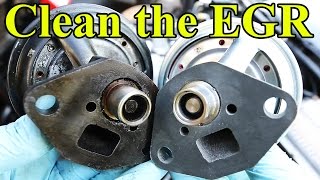
Typical fix: Replacement of the EGR valve. While cleaning is sometimes attempted with solvents, the high failure rate and immense labor involved make replacement a more reliable and recommended repair.
Est. part cost: $150-$450 - Leaking EGR Cooler 🔴 High Probability The EGR cooler is prone to internal cracking from constant thermal stress. This allows engine coolant to leak into the exhaust gas passages, where it mixes with soot.
How to confirm: Check for symptoms like coolant loss without external leaks and white exhaust smoke. When the EGR valve is removed, the carbon buildup will be a wet, gooey sludge instead of dry soot. A definitive test is to pressure test the cooling system; if it loses pressure with no external leaks, the EGR cooler is a primary suspect. 🎬 Watch how to tell if it's a bad cooler or head gasket.
Typical fix: The EGR cooler and EGR valve must be replaced, typically as a single assembly. This is a critical failure that can lead to engine overheating and damage if ignored.
Est. part cost: $250-$600 (for cooler assembly). - Failed EGR Valve Electronics 🟡 Medium Probability The integrated electronic actuator or position sensor on the EGR valve can fail internally, causing it to either not respond to commands or report its position incorrectly to the ECU.
How to confirm: Use a diagnostic scan tool (like VCDS) to command the EGR valve open and closed while monitoring the position sensor data. If the 'Actual Position' does not change or is erratic while 'Commanded Position' changes, the electronics have likely failed.
Typical fix: The entire EGR valve assembly must be replaced.
Est. part cost: $150-$450 - Damaged Wiring or Connectors ⚪ Low Probability Vibrations and extreme heat in the engine bay can, over time, cause damage to the wiring harness or connector for the EGR valve, leading to an intermittent or lost signal.
How to confirm: Visually inspect the wiring harness leading to the EGR valve for any signs of fraying, melting, or corrosion at the connector pins. Perform a continuity and voltage check at the connector with a multimeter.
Typical fix: Repair the damaged section of wiring or replace the connector pigtail.
Est. part cost: $20-$50
Diagnosis Steps
- Check if your vehicle's VIN is covered under the TDI Extended Emissions Warranty. If it is, contact an Audi dealer, as the entire repair may be covered free of charge.
- Scan the vehicle for all fault codes. Note any other EGR-related codes like P0401, P0403, or P047F.
- Monitor the coolant level closely. A steadily dropping level with no visible external leaks is a strong indicator of a failing EGR cooler.
- Observe the exhaust for white, sweet-smelling smoke, especially on startup or acceleration. This also points to a leaking EGR cooler.
- With a diagnostic scan tool (like VCDS), access the live data for the EGR valve. Command the valve to open and close (using Basic Settings or Output Tests) and watch the 'EGR Commanded Position' vs. 'EGR Actual Position' PIDs. If the actual position does not follow the commanded position, the valve is sticking or has failed.
- If an EGR cooler leak is suspected, have a shop perform a cooling system pressure test. If the system loses pressure but no external leaks are found, the EGR cooler is the most likely culprit.
- Perform a visual inspection. This is difficult due to the location of the parts. If the EGR can be accessed or removed, inspect the intake side for either dry, heavy soot (clogged valve) or a wet, sludgy coolant/soot mixture (leaking cooler).
- Inspect the wiring and connector at the EGR valve for any visible damage, corrosion, or loose connections.
Parts You'll Likely Need
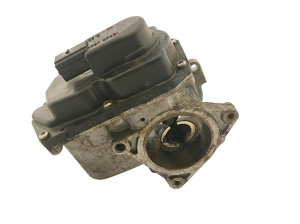
- EGR Valve and Cooler Assembly
(OEM #03L131512AF, 03L131501K (and its revisions: 03L131501G, 03L131501E, 03L131501D). Part number is VIN-specific.)— This is the most common failure point. Carbon buildup clogs the valve, and the cooler is prone to internal leaks that create sludge. Replacing them as an assembly is the most reliable repair.
Trusted brands: Pierburg (OEM supplier), Wahler (OEM supplier), Valeo, Delphi
OEM price range: $450-$700
Aftermarket price range: $250-$500
Related Codes That Often Appear With This One
- P0401 — This code means 'EGR Flow Insufficient'. A sticking or clogged valve that triggers P0404 will often be unable to provide sufficient flow, triggering P0401 as well.
- P0403 — This code indicates an electrical circuit malfunction for the EGR solenoid. An electrical issue within the valve that causes the P0404 performance code can sometimes also be flagged as a general circuit fault.
- P047F — This code means 'Exhaust Pressure Control Valve Stuck Open' and is often related to the exhaust flap assembly, which is part of the same emissions system. TSB 26-12-08 addresses this issue alongside EGR problems.
Technical Service Bulletins (TSBs) & Recalls
- TPI# 2031583 / TSB 26-12-08 (supersedes 26-13-03): Addresses issues with the exhaust flap control module on 2.0L CR TDI engines, which can seize due to corrosion and throw related fault codes like P0401 and P047F. This highlights known weaknesses in the overall exhaust gas management system.
Platform-Specific Known Issues
- TDI Extended Emissions Warranty: As part of the 'Dieselgate' settlement, many of these vehicles have an extended warranty on the entire emissions system, which includes the EGR valve and cooler. Owners must check with an Audi dealer using their VIN to see if this costly repair is covered.
Mechanic-Grade Diagnostic Values
- EGR Valve Solenoid Resistance — expected: 4-12 Ohms. Failure: A reading outside this range indicates a faulty internal coil.
- VCDS - Measuring Blocks - Group 074 (after adaptation) — expected: MVB 074.4 should display 'ADP OK'.. Failure: If the status does not show 'ADP OK' or the adaptation fails to run, it points to a mechanical or electrical fault in the valve.
Scan Tool Commands That Help
- VCDS (VAG-COM): Engine -> Basic Settings -> Group 074 -> Go! — To run the EGR valve adaptation procedure after replacing the valve or cleaning the system. The ECU cycles the valve to learn its new end-stop positions. Failure to adapt can cause persistent P0404 codes.
- VCDS (VAG-COM): Engine -> Output Tests -> Exhaust Gas Recirculation (N18) — To manually command the EGR valve open and closed while observing its mechanical movement (if visible) or monitoring live data. This directly tests the electronic motor and checks for physical binding.
- VCDS (VAG-COM): Engine -> Login -> Enter '12233' -> Adaptation -> Channel for EGR -> Set value to '33768' — This procedure is cited online for performing an 'EGR Delete' adaptation, essentially telling the ECU to close the EGR and not monitor it. This is for off-road use only and requires an ECU tune to prevent other codes, but confirms the ECU can accept adaptation changes.
Wiring & Ground Locations
- EGR Valve Connector — On the EGR valve assembly, located at the rear of the engine, often requiring removal of other components for access.. This is the primary connection point for power, ground, and signal wires to the EGR valve's motor and position sensor. Corrosion or damage here is a direct cause of P0404.
- Ground Point 12 — In the engine compartment, on the left side.. A poor engine ground can cause floating voltages and erratic behavior in sensors and actuators, including the EGR valve, leading to performance/range codes.
- Ground Point 671 — On the front of the left longitudinal member (frame rail).. This is a major chassis ground point. While less direct, a compromised main ground can create widespread electrical issues that manifest as sensor or circuit codes.
Real Owner Repair Stories
- Ross-Tech Forums user kerrytech1986 (2010 Jetta TDI 2.0L (CJAA Engine)) — Vehicle would barely run, then after DPF replacement, it would not accelerate properly.
❌ Tried (didn't work) Replaced the Diesel Particulate Filter (DPF)., Performed DPF adaptations., Replaced the EGR valve (N18).
✅ What actually fixed it The EGR adaptation procedure in VCDS would only work intermittently. The user found that if the adaptation was successful, power was restored until the key was cycled. After replacing the EGR valve to no effect, the ultimate cause was not posted in the thread, but the diagnostic journey highlights that even with a new valve, the P0404/P0403 codes can persist if the adaptation procedure does not complete successfully, pointing to deeper wiring or ECU issues.
OEM Part Supersession History
03L131512 (various early suffixes like AP, AT, BB, BJ, BL, CF, CH, N)→03L131512DQ, 03L131512AF— Revisions to improve reliability and address high failure rates from internal cooler leaks and valve clogging.
Heads up: While many revisions may physically fit, it is critical to use a part number specified for the vehicle's VIN and engine code (CBEA/CJAA) to ensure correct electronic control and flow characteristics.
Model Year Variations Within This Range
- 2009-2013: These years use the 2.0L Common Rail TDI engines (CBEA, CJAA) which have the electronically controlled EGR valve and cooler assembly that is highly prone to the P0404 failure. Earlier TDI engines in the A3 (pre-2009 in North America) used different EGR systems that may have different failure modes.
Diagnostic Flowchart
Other Known Issues on This Vehicle
Issues unrelated to this code that are worth knowing about as an owner of this generation:
- High-Pressure Fuel Pump (HPFP) Failure 🔴 High — Can occur at any mileage, but becomes a more prominent risk after 60,000 miles. Failure can be sudden and requires extensive, costly cleaning of the entire fuel system. (Ref: No official recall, but it is a widely documented failure. A class-action lawsuit was filed regarding this issue.)
- Diesel Particulate Filter (DPF) Clogging 🟠 Medium — Common for vehicles used primarily for short trips, which prevents the DPF from reaching temperature for active regeneration. Often occurs from 70,000 miles onward.
- Dual Mass Flywheel (DMF) Failure 🔴 High — Can fail as early as 50,000 miles, but more commonly begins to show symptoms like rattling at idle or vibration around 100,000-120,000 miles.
- Intake Manifold Flap Motor Failure 🟠 Medium — The flap motor or its position sensor can fail, often due to carbon buildup, leading to fault codes and drivability issues. This is also often covered under the TDI Extended Emissions Warranty.
Used vs. New Parts: Buying Guide for This Vehicle
When a used part is the smart pick: For this specific repair, buying a used EGR valve or cooler assembly is strongly discouraged. The failure is caused by internal carbon and sludge buildup or stress fractures in the cooler, which are wear-and-tear items. A used part has unknown remaining life and is highly likely to fail soon after installation, wasting significant labor costs.
Donor-vehicle mileage cap: roughly under 20000 miles for the part to have meaningful remaining life.
What to inspect on the donor part:
- If considering used against advice, demand proof of very low mileage from the donor car.
- Visually inspect the EGR port for any signs of wet, sludgy residue, which indicates a failed cooler. Only dry, light soot is even remotely acceptable.
- Ask for the part number to verify it's a later revision, not an early, failure-prone version.
OEM-only on this vehicle (don't cheap out):
- EGR Valve and Cooler Assembly
Aftermarket brands forum-validated for this vehicle:
- Pierburg (often the OEM supplier)
- Wahler (also an OEM supplier)
- Valeo
Brands owners have reported issues with on this vehicle:
- Unbranded, no-name parts from online marketplaces. The complexity of the integrated electronics and cooler means cheap copies have a very high failure rate.
Real Owner Stories
Aggregated from forums and TSBs cited above. Mileages and costs reflect what owners reported in those sources.
Audi A3 2.0L TDI (CJAA engine)
Symptoms: Owner reported a P0404 code and was trying to determine if the cause was the EGR cooler or just the valve itself.
What fixed it: The root cause was identified as the EGR cooler, which is a common failure point on this engine requiring replacement of the cooler and valve assembly.
Source hint: TDIClub Forums - 'P0404 EGR code, what to do?'
Audi A3 TDI — ~115000 miles
Symptoms: Owner described symptoms of engine shake and RPM fluctuation at idle, which can be confused with EGR problems.
What fixed it: The issue was ultimately diagnosed as a failed Dual Mass Flywheel (DMF), a known issue on this platform that can present with symptoms similar to a faulty EGR valve.
Source hint: Audi-Sport.net - 'Possible Dual Mass Flywheel (DMF) issue?'
Related OBD-II Codes
Frequently Asked Questions
Is the P0404 EGR valve repair on my 2003-2013 Audi A3 TDI covered by a warranty?
My A3 TDI is losing coolant but I can't find a leak. Could this be related to the P0404 code?
How can I tell if my P0404 code is from a clogged EGR valve or a leaking EGR cooler?
Can I just clean the EGR valve instead of replacing it?
What diagnostic tool is best for troubleshooting the P0404 code on my Audi?
My A3 TDI is shaking and idling rough, but the EGR seems okay. What else could it be?
Does TSB 26-12-08 apply to the P0404 code?
Helpful Videos
We Have This Part in Stock

The information in this article is provided for general reference and educational purposes only. Vehicle specifications, procedures, and part compatibility can vary by production date, trim level, and region. Always consult your vehicle's factory service manual and verify part numbers before purchasing or performing repairs. Safety-critical components such as airbags, seat belts, and braking systems should be installed by a qualified professional.
- Audi A3:
- 🎬 Helpful Videos
- 🛍️ Shop This Part
- What's Unique About the 2003-2013 Audi A3
- Symptoms You May Notice
- Most Likely Causes
- Diagnosis Steps
- Parts You'll Likely Need
- Related Codes That Often Appear With This One
- Technical Service Bulletins (TSBs) & Recalls
- Platform-Specific Known Issues
- Mechanic-Grade Diagnostic Values
- Scan Tool Commands That Help
- Wiring & Ground Locations
- Real Owner Repair Stories
- OEM Part Supersession History
- Model Year Variations Within This Range
- Diagnostic Flowchart
- Other Known Issues on This Vehicle
- Used vs. New Parts: Buying Guide for This Vehicle
- Real Owner Stories
- Audi A3 2.0L TDI (CJAA engine)
- Audi A3 TDI — ~115000 miles
- Related OBD-II Codes
- Frequently Asked Questions
- 🎟️ Get 5% Off