

OBD-II Code P0403: EGR 'A' Control Circuit Malfunction
The Ultimate Guide to What P0403 Means, Why It Triggers, and How to Fix It for Good
- P0403 is strictly an electrical circuit fault, meaning cleaning the EGR valve will not fix it; you must test the solenoid, wiring, and fuses.
- Replacing the EGR valve assembly is the most common fix, costing between $200 and $550 for parts and labor.
- Never replace the EGR valve without first verifying the solenoid resistance (typically 15-60 Ohms) and confirming 12V power at the connector.
- Driving with P0403 guarantees an emissions test failure and reduces fuel economy by up to 10%, while ignoring it for over 6 months risks a $1,500+ catalytic converter replacement.
- Owners of 2020-2023 Ram and Jeep 3.0L EcoDiesel models should check for TSB 18-002-23, as a simple PCM software update often resolves this code without parts.
What Does P0403 Mean?

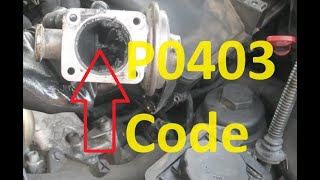
P0403 means the Powertrain Control Module (PCM) detected an electrical fault in the Exhaust Gas Recirculation (EGR) 'A' control circuit. The EGR system recirculates exhaust gas back into the cylinders to lower combustion temperatures and reduce Nitrogen Oxides (NOx). This code points to an open or short in the electrical circuit commanding the EGR valve's solenoid, meaning the computer cannot control the valve.
Technical definition: Exhaust Gas Recirculation 'A' Control Circuit Malfunction. This DTC sets when the PCM detects the commanded state of the EGR control circuit does not match the actual voltage or ground status. On many vehicles, this triggers if the PCM detects an open circuit or an over-temperature condition in the EGR driver for more than a few seconds.
Can I Drive With P0403?
Yes, But With Caution. Yes, you can drive with a P0403 code, but repair it within one to two weeks. The PCM disables the EGR system, causing increased NOx emissions and a guaranteed failed emissions test. Ignoring it long-term causes engine knocking, reduced fuel economy, and catastrophic damage to the catalytic converter from elevated combustion temperatures—a repair costing $945 to $2,500.
Common Causes

- Faulty EGR Valve / Solenoid (Very Common) — The most frequent culprit is a failed electronic solenoid, usually integrated into the EGR valve assembly. The internal coil burns out or develops an open/short circuit, which the PCM detects immediately.
- Wiring Harness or Connector Issues (Common) — Intense engine bay heat and vibration cause EGR wires to become brittle, frayed, or melted. Connector pins also corrode or loosen, causing intermittent or total connection loss.
- Blown Fuse or Faulty Relay (Less Common) — The EGR control circuit is protected by a fuse. A blown fuse cuts all power to the circuit, instantly triggering P0403. This is a simple but frequently overlooked cause.
- Software or Calibration Issues (Less Common) — The PCM's calibration for the EGR valve sometimes becomes corrupted, misinterpreting a valid signal as a fault. A software re-flash from the dealer resolves this, especially on modern Ram and Jeep diesels.
- Carbon Buildup Causing Solenoid Strain (Rare) — While P0403 is an electrical code, severe carbon buildup causes the EGR valve's pintle to stick. This forces the solenoid to draw excessive current, overheating and failing electrically.
- Faulty Powertrain Control Module (PCM) (Very Rare) — The driver circuit inside the PCM that controls the EGR solenoid rarely fails. Consider this only after exhaustively testing wiring, fuses, and the EGR valve.
Symptoms

- Check Engine Light is On — The light illuminates as soon as the PCM detects the electrical fault.
- Rough Idle, Hesitation, or Stalling — If the electrical fault causes the EGR valve to stick open, exhaust gases flood the intake at idle, disrupting the air-fuel mixture and causing the engine to stumble, run rough, or stall.
- Engine Pinging or Knocking — With the EGR disabled, combustion temperatures spike under load. This causes pre-ignition (detonation), sounding like a metallic pinging or knocking.
- Failed Emissions Test — The EGR system is inoperative, leading to a guaranteed failure on any emissions inspection due to high NOx levels and the active check engine light.
- Flashing Glow Plug Light (Diesel VW/Audi) — On Volkswagen and Audi TDI diesel models, a P0403 fault triggers a flashing glow plug light on the dashboard as an additional warning indicator.
- Abnormal EGR Commanded vs. Actual Values (scan-tool only — no driver-felt sign) — On a scan tool with live data, the PID for 'EGR Commanded' shows a percentage, but the 'EGR Actual' or 'EGR Error' PID shows no change or a 100% error, confirming the PCM cannot control the valve.
Diagnostic Flowchart
Tap your situation to follow the diagnostic path that matches what you're seeing on this code.
Common Fixes & Costs
- Replace EGR Valve Assembly — Parts: $100-$300, Labor: $100-$250, ~1.5 hr book time (Intermediate)
- Repair Wiring or Replace Connector Pigtail — Parts: $15-$70, Labor: $120-$280, ~1.8 hr book time (Intermediate)
- Replace Blown Fuse — Parts: $1-$10, Labor: $0-$60, ~0.1 hr book time (DIY)
- Update or Re-flash Powertrain Control Module (PCM) — Parts: $0, Labor: $100-$250, ~1.0 hr book time (Professional)
DIY vs Professional
- Replace EGR Valve Assembly — Beginner:
- Repair Wiring or Replace Connector Pigtail — Beginner:
- Replace Blown Fuse — Beginner:
Used vs. New Parts: Buying Guide
When a used part is worth it: Buying a used EGR valve is not recommended due to the high failure rate of the internal solenoid. Only buy used if the vehicle is over 15 years old, new parts are unavailable, and you accept the risk of premature failure.
Donor-vehicle mileage cap: roughly under 50000 miles for the part to have meaningful remaining life.
Donor quality checklist:
- Verify the donor vehicle was not scrapped for engine or emissions-related problems.
- Inspect the electrical connector on the used part for any signs of corrosion, melting, or broken pins.
- Match the part number exactly. Internal electronics differ between model years even if the exterior is identical.
Decision logic:
- If The vehicle is less than 10 years old and the new part costs under $300 → Always buy a new aftermarket or OEM part. The reliability and warranty are worth the cost.
- If The vehicle is very old (>15 years) and a new part is unavailable or prohibitively expensive → A used part from a low-mileage, accident-damaged donor is a reasonable gamble.
- If You are paying a mechanic for labor → Buy a new part. The risk of paying for labor twice if the used part fails outweighs the initial savings.
Warranty tradeoff: Used parts from a salvage yard typically come with a 30-90 day warranty covering only the part. New aftermarket parts offer a 1-year to limited lifetime warranty. New OEM parts offer a 1-2 year warranty.
Worst-case if a used part fails: 300-600. If a used EGR valve fails after installation, you pay for the replacement part and the installation labor a second time.
What Happens If You Wait — Timeline
- 0-2 weeks: Check Engine Light is on with code P0403. The PCM disables the EGR system. No other symptoms are likely to be perceived by the driver. Vehicle fails an OBD-II emissions test. (MPG impact: 0-3%% · Added cost: $0)
- 2 weeks - 3 months: A noticeable drop in fuel economy of 3-8% occurs. Under specific load conditions, light engine pinging or knocking is heard as combustion temperatures rise without EGR flow. (MPG impact: 3-8%% · Added cost: $50-150 in wasted fuel)
- 3-8 months: Sustained high combustion temperatures stress the catalytic converter. The internal honeycomb substrate overheats, reducing its efficiency. Engine knocking becomes frequent and noticeable under acceleration. (MPG impact: 5-10%% · Added cost: $400-900 (Risk of early-stage catalytic converter damage increases significantly))
- 8+ months: High risk of catalytic converter failure. The internal substrate melts or fractures from prolonged thermal stress, leading to a severe exhaust blockage. This causes a major loss of power, stalling, and potential engine damage. (MPG impact: 10-20%+% · Added cost: $1200-2800 (Full catalytic converter replacement is highly likely, plus potential for other engine damage))
Cost of Not Fixing It
- 0-1 Month: Guaranteed failure of any state emissions test. A drop in fuel economy of 5-10% occurs. (Added cost: 50-100)
- 1-6 Months: Sustained high combustion temperatures from the disabled EGR system stress the catalytic converter, increasing the risk of overheating. Engine knocking under load becomes frequent. (Added cost: 0)
- 6+ Months: Catastrophic failure of the catalytic converter becomes highly likely. The internal substrate melts, leading to severe exhaust restriction, loss of power, and significant engine damage. (Added cost: 1200-2800)
Diagnosis Steps
- Scan for Codes and Review Freeze Frame Data
Use an OBD-II scanner to confirm P0403 is present. Check for related codes (e.g., P0401, P0404-P0406). Review the freeze frame data to see the engine conditions (speed, temperature, load) when the code set.
Tools: OBD-II Scanner (Beginner) - Check the EGR Circuit Fuse
Consult your owner's manual to locate the EGR circuit fuse. Visually inspect it; if blown, replace it. If it blows again immediately, you have a short circuit.
Tools: Fuse Puller or Pliers (Beginner) - Perform a Thorough Visual Inspection
Inspect the EGR valve's electrical connector for corrosion, pushed-out pins, or melting. Trace the wiring harness for frayed or burnt sections near hot engine components.
Tools: Flashlight (Beginner) - Test EGR Solenoid Resistance
Disconnect the EGR connector. Use a multimeter set to Ohms (Ω) to measure resistance between the power and ground terminals on the valve. Most solenoids read 15-60 ohms. Infinite resistance (OL) means an open circuit; near zero means a short. Both require valve replacement.
Tools: Multimeter (Intermediate) - Check for Voltage and Ground at the Connector
Turn the ignition 'ON' (engine off). Using a multimeter set to DC Volts, check the EGR connector's supply wire for battery voltage (~12V). A lack of voltage points to a wiring harness or fuse box problem.
Tools: Multimeter, Vehicle-specific wiring diagram (Intermediate) - Perform a Bidirectional Scan Tool Test
Command the EGR solenoid to activate (e.g., 0% to 100%) using a bidirectional scan tool. Listen for an audible click. If the engine is idling, commanding the valve open causes the engine to stumble or stall. If it clicks and the engine stumbles, the valve and circuit are functional, pointing to an intermittent issue.
Tools: Bidirectional Scan Tool (Advanced) - Pro Tip: Perform a 'Wiggle Test'
If the fault is intermittent, have a helper gently wiggle the wiring harness and connector for the EGR valve while you monitor circuit voltage on a live data scanner. A sudden drop or spike indicates a hidden break or short.
Tools: OBD-II Scanner with Live Data, Multimeter (Advanced) - Advanced: Check EGR Position Sensor Voltage
On EGR valves with a position sensor, monitor the 'EGR_POS' PID. With the valve closed at idle, voltage is typically 0.7V to 1.5V. As the EGR is commanded open, voltage rises smoothly to 3.5V-4.5V. A stuck or erratic voltage indicates a faulty position sensor.
Tools: Scan Tool with Live Data, Multimeter (Advanced) - Pro Tip: Use an Oscilloscope for Waveform Analysis
Connect an oscilloscope to the EGR control wire. When commanded on, you see a clean square wave pattern or a sharp drop to ground. A noisy or absent waveform points to a wiring issue or a failing PCM driver.
Tools: Oscilloscope, Wiring Diagram (Expert)
When This Code Triggers (Freeze-Frame Conditions)
- Engine Coolant Temp: 175-210°F (Engine is fully warmed up to normal operating temperature.)
- RPM: 1500-3000 RPM (Steady cruising speed, not during heavy acceleration or deceleration.)
- Engine Load: 20-70% (Light to moderate load, typical of highway cruising or maintaining speed on a level road.)
- Vehicle Speed: 45-65 mph (Sustained highway or freeway driving conditions where the EGR system is most active.)
Related Codes
- P0401 — Indicates 'Insufficient EGR Flow.' A P0403 fault causes a P0401 because the electrical problem prevents the valve from opening. Fix P0403 first. If P0401 disappears, the electrical fault was the sole cause.
- P0404 — Indicates 'EGR Control Circuit Range/Performance.' The PCM sees the valve's position sensor moving, but it's not where it should be. P0403 is a hard electrical open/short, while P0404 is a performance/logic fault.
- P0405 / P0406 — P0405 ('EGR Sensor A Circuit Low') and P0406 ('Circuit High') point to an electrical fault in the EGR valve's position sensor circuit. A damaged harness or connector easily causes these codes to appear alongside P0403.
- P0402 — Indicates 'Excessive EGR Flow.' This is the opposite of P0401 and is much less common with a P0403 fault. It typically only occurs if the electrical fault causes the valve to become stuck wide open.
Climate & Environmental Factors
- Road Salt / High Humidity: In regions with heavy road salt use or high humidity, corrosion is a major contributor to P0403 failures. Salt and moisture accelerate the corrosion of the EGR valve's electrical connector pins and degrade the wiring harness, leading to open circuits or shorts.
- Extreme Cold Weather: Very cold temperatures exacerbate existing issues. Moisture inside the EGR solenoid or connector freezes and expands, breaking internal connections or cracking the housing. Wiring becomes brittle in the cold, making it susceptible to breaking during engine vibration.
How to Talk to a Mechanic About This Code
Say this: "I have a P0403 code, which I know is for the EGR control circuit. I'd like to book a diagnostic appointment. Before replacing the EGR valve, please test the solenoid's resistance, and check for power and ground at the connector to confirm if the fault is the valve itself or the wiring."
This signals you've done your research and understand that P0403 is an electrical code. It directs the mechanic to perform specific, necessary diagnostic steps instead of immediately replacing the most expensive part.
Avoid saying:
- 'My check engine light is on, can you just fix it?' (This is too vague and leads to unnecessary upselling).
- 'I think I need a new EGR valve.' (Don't diagnose the car for the mechanic; describe the code and symptoms).
- 'Just do whatever you think is best.' (This gives up your control over the repair process and cost).
Questions to ask before authorizing the repair:
- Did you test the EGR solenoid? What was its resistance reading?
- Did you confirm there is correct voltage and a good ground at the EGR valve connector?
- If you are recommending a wiring repair, can you show me where the damage is?
- What is the warranty on the parts and labor for this specific repair?
Where to Take It: Dealer vs Independent vs Chain
- Dealer:
Best for: Vehicles under a powertrain or emissions warranty., Newer vehicles with known manufacturer TSBs for P0403, which require a software update., Complex electrical issues on European brands like BMW or VW, where specialized tools are required.
Downsides: Typically the highest labor rates., Defaults to replacing an entire assembly rather than performing a targeted, cheaper wiring repair. (Typical cost: +50% vs. baseline) - Independent Shop:
Best fit for most out-of-warranty vehicles. A good independent shop with strong electrical diagnostic skills resolves a P0403 fault effectively and more affordably than a dealer.
Best for: Out-of-warranty vehicles where cost is a major factor., Diagnosing common electrical faults like P0403, provided the shop has ASE-certified technicians specializing in diagnostics.
Downsides: Diagnostic skill and equipment vary widely from shop to shop., Lacks access to the latest manufacturer-specific software updates. (Typical cost: +0% vs. baseline) - Chain Shop:
Use with caution. While they can read the code and replace an EGR valve, they are less likely to correctly diagnose a nuanced wiring or connector issue, leading to repeat repairs.
Best for: Simple, routine maintenance like oil changes or tire rotations.
Downsides: Technician skill varies dramatically., Not equipped for in-depth electrical diagnostics., Business model pressures technicians to replace parts rather than perform detailed diagnostic work. (Typical cost: -10% vs. baseline)
When to Walk Away From the Repair
If the repair cost exceeds 40-50% of the vehicle's private-party value, sell it as-is or trade it in.
- Car worth $4000, fix is $700: Fix it. This repair is well below the 40-50% threshold and is a reasonable cost to keep a functional vehicle on the road.
- Car worth $3000, fix is $1500: Walk away. The repair cost is 50% of the car's value. It's very likely that other age-related repairs will be needed soon. You are better off putting that $1,500 toward a more reliable vehicle.
- Car worth $8000, fix is $600: Fix it. The repair cost is a small fraction of the vehicle's value.
What Scan Tool You Need for This Code

Minimum: A scanner that can read and clear codes, and view live data PIDs for the EGR system.
A basic $20 code reader only gives you the P0403 code. It cannot help you determine *why* the circuit failed. To properly diagnose this, you need to see live data and ideally have bidirectional control to test the component directly.
Budget: BlueDriver Pro (~$100) — Connects to your smartphone via Bluetooth. It reads the code, provides freeze-frame data, and displays live data for EGR commanded position vs. actual position. This is often enough to see if the valve responds to commands.
Mid-range: Foxwell NT510 Elite / NT530 (~$180) — This is a powerful handheld tool. Its key feature for P0403 is bidirectional control (active test), allowing you to manually command the EGR solenoid to open and close. You can listen for the solenoid's 'click' or see the engine stumble, definitively proving if the valve and wiring function.
Professional: Autel MaxiCOM MK808 / XTOOL D7 (~$450-600) — These professional-grade tablets offer full bidirectional control, advanced live data graphing, and access to all vehicle modules. They quickly perform active tests on the EGR solenoid and provide detailed data streams to pinpoint whether the fault is the component, the wiring, or the PCM driver.
Rent vs buy: Many auto parts stores read your code for free, but their tools cannot perform the bidirectional tests needed for a full diagnosis. Buying at least a budget-level scanner with live data is a smart investment. For a one-time, in-depth diagnosis, paying a shop for one hour of diagnostic time is more cost-effective than buying a pro-level tool.
How to Clear the Code After You Fix It
- Use an OBD-II scan tool to formally clear the P0403 trouble code.
- Perform a complete OBD-II drive cycle to allow the vehicle's computer to re-run its self-tests.
- Check the I/M Readiness status on the scan tool to confirm the EGR monitor has completed.
Drive cycle (~30 minutes): To set the EGR readiness monitor, perform a cold start and let the engine idle for 2-3 minutes. Drive in stop-and-go traffic for 5 minutes. Follow this with 10-15 minutes of steady-state driving on a highway between 55-65 mph. Finally, allow the vehicle to coast down and drive for another 5 minutes in city traffic.
Readiness monitors affected: EGR System, Catalyst (CAT), Oxygen (O2) Sensor
Before emissions retest: drive at least 100 miles to fully set monitors.
Watch out for:
- Disconnecting the battery clears the code but resets all readiness monitors to 'Incomplete', guaranteeing an emissions test failure.
- The code returns immediately if the underlying electrical fault was not properly repaired.
- Some vehicles have specific drive cycle requirements; a generic cycle fails to set all monitors.
Will This Fail Emissions / State Inspection?
Yes — this code typically fails an OBD-II emissions inspection.
- California: A P0403 code results in an automatic smog check failure. After repair, all readiness monitors must be 'Ready' (2000 and newer models can have one 'Not Ready'). It takes over 100 miles of driving to complete the drive cycle.
- New York: The NYS DMV inspection includes an OBD-II scan. An active P0403 code is an automatic failure. After repair, the readiness monitors must be set before the vehicle can be re-inspected.
- Texas: In the 17 counties requiring emissions testing, a vehicle with an active P0403 code fails the OBD portion of the inspection. Clearing the code right before the test results in a failure due to 'Not Ready' monitors.
- Arizona: A vehicle is rejected from emissions testing if more than one monitor is 'Not Ready' on a 2001 or newer model. An active P0403 code is an automatic failure.
Most Commonly Affected Vehicles
- Ford F-150 / Explorer / Escape (2004-2024) — Ford trucks with V8 engines are notorious for P0403 due to EGR valve electrical failure. For 2004-2008 F-150 models, checking the wiring harness for chafing near the back of the cylinder head is critical. Escape models often suffer from a corroded pigtail connector.
- Dodge / Ram Ram 1500 / Charger (especially with 5.7L Hemi) (2008-2022) — Often caused by an internal failure of the EGR valve solenoid. For 2020-2022 models with the 3.0L EcoDiesel, TSB 18-002-23 points to a required PCM software update to resolve this code.
- Jeep Wrangler (JK and EcoDiesel) (2007-2023) — On the 2007-2011 Wrangler JK with the 3.8L V6, a poor engine ground connection causes this code even after replacing the valve. For 2020-2023 3.0L EcoDiesel models, multiple TSBs indicate a PCM software update is the most common fix.
- Chevrolet / GM Silverado / Captiva (2007-2024) — The PCM is sensitive to circuit integrity and sets P0403 if an open circuit is detected for more than 3 seconds. The wiring harness near the valve is a common failure point due to heat exposure.
- Honda Accord / Civic (2003-2017) — EGR valve solenoid failures are a very common issue, making valve replacement a frequent and effective fix for P0403 on these models.
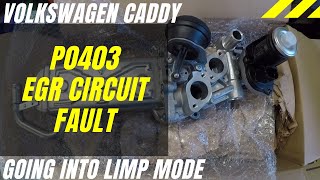
- Volkswagen Golf / Jetta / Caddy (TDI models) (2010-2015) — Extremely common on TDI diesel engines, presenting with a flashing glow plug light. The failure is almost always the electronic actuator on the EGR valve, requiring replacement of the entire EGR valve and cooler assembly.
- Hyundai Santa Fe (2.2L diesel) (2010-2014) — On these diesel models, the PCM is highly sensitive and sets the P0403 code if the EGR actuator motor circuit is detected as open for as little as one second.
- BMW Various Diesel Models (e.g., 3-series, 5-series) (2008-2018) — P0403 is frequently seen on higher-mileage BMW diesel engines due to an electrical failure within the EGR valve itself. An ECU software update is sometimes required to correct over-sensitive fault detection.
Manufacturer-Specific Notes

- Chrysler / Dodge / Jeep: For modern engines like the 3.0L EcoDiesel and 5.7L Hemi, investigate P0403 by checking for Technical Service Bulletins (TSBs). A PCM software update is a well-documented fix that dealers perform, resolving the code without parts replacement.
- Ford: On Powerstroke diesel engines, a P0403 code is often a precursor to a failing EGR cooler. The intense heat from a clogged cooler cooks the electronics on the nearby EGR valve, causing premature failure.
- GM: GM's programming is sensitive to the temperature of the internal PCM driver that controls the EGR valve. The PCM sets a P0403 if it detects an over-temperature condition in its own circuitry, even if the external wiring is okay.
- Volkswagen / Audi: On TDI diesel engines, a P0403 is almost always accompanied by a flashing glow plug light. The repair requires replacing the entire EGR valve and cooler assembly, as the electronic actuator is not sold separately.
- BMW: A major safety recall (NHTSA 21V-907) was issued for 2013-2018 US diesel models due to EGR coolers leaking coolant. While not a direct cause of P0403, a leaking cooler creates conditions that damage the EGR valve.
Real Owner Stories
2007 Dodge Ram 1500 5.7L Hemi at 155K miles
Check engine light for P0403 appeared intermittently for months, eventually staying on. No major driveability issues, but a slight rough idle was noticeable.
What they tried:
- Initially ignored the code since it would come and go.
- Replaced the EGR valve and the EGR tube.
- Cleaned the throttle body while the other parts were disassembled.
Outcome: After replacing the EGR valve/solenoid and cleaning the throttle body, the code cleared and did not return. The truck's idle became smooth again.
Lesson: For high-mileage trucks, if you're replacing the EGR valve, it's a good opportunity to clean the throttle body, as carbon buildup in both areas contributes to rough idling.
2005 Nissan Maxima at ~120K miles
Car suddenly went into limp mode (would not rev past 2700 RPM) while driving on the highway. Scanner showed P0403 (EGR Circuit Malfunction) and P0505 (IACV). P0403 returned instantly after clearing.
What they tried:
- Checked EGR tube for blockage (it was clean).
- Tested EGR solenoid resistance (it was good).
- Swapped the identical IACV connector to the EGR solenoid, which then functioned perfectly, proving the solenoid was not the issue.
- Performed a continuity test from the ECM harness connector to the EGR connector.
Outcome: A continuity test revealed a broken wire (an open circuit) in the ECM wiring harness for one of the EGR stepper motor signals. Running a new wire to bypass the break fixed the P0403 code and limp mode.
Lesson: Don't assume the part is bad. If a new part doesn't fix the code, or if you can prove the part works (like by swapping a known-good connector), the problem is in the wiring. A continuity test pinpoints a broken wire, saving you from replacing a perfectly good PCM.
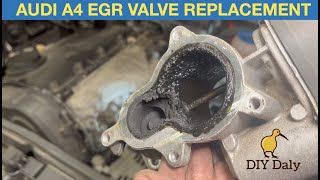
2006 Audi A4 2.0 TDI at 107K miles
Car went into limp mode with a flashing glow plug light. Restarting the car temporarily fixed it, but it happened again. Scanner showed P0403 (EGR Circuit - Intermittent) and P0234 (Turbo Overboost - Intermittent).
What they tried:
- Posted on a forum seeking advice on where to start diagnosis.
Outcome: Experienced forum members advised that the first step should be cleaning the EGR valve, but warned that on VAG vehicles, aftermarket EGR valves are often poor quality and a genuine part should be used. They also noted the turbo code could be related to sticking vanes.
Lesson: On many European diesel cars, a P0403 is accompanied by a flashing glow plug light and limp mode. Address the EGR fault first, as the two systems are related. Be prepared to replace it with a high-quality OEM part if cleaning doesn't solve the electrical fault.
How to Prevent This Code From Triggering
- Use high-quality fuel with detergents (Every fill-up) — Fuels with effective detergent additives keep the fuel and intake system cleaner, reducing the formation of carbon deposits that stress and clog the EGR system.
- Perform periodic highway driving (Monthly for 20-30 minutes) — Sustained highway driving allows the engine to reach optimal operating temperature, burning off soft carbon deposits from the EGR valve and passages.
- Avoid long periods of idling (Daily habit) — Extended idling, especially in diesel engines, leads to incomplete combustion and lower exhaust temperatures, accelerating the buildup of soot and carbon in the EGR system.
- Use a fuel system or EGR cleaner additive (Every 5,000-10,000 miles) — Pour-in fuel tank additives or aerosol intake cleaners dissolve and remove early-stage carbon and varnish deposits from the intake manifold and EGR valve.
- Install an oil catch can (especially on direct-injection or turbo engines) (One-time installation) — An oil catch can intercepts oil vapors from the PCV system before they enter the intake manifold. This prevents oil from mixing with EGR soot to form thick, sludgy carbon buildup.
Frequently Asked Questions
What is the most common mistake when diagnosing P0403?
The biggest mistake is immediately replacing the EGR valve without performing basic electrical tests. The fault is often a simple blown fuse, a corroded connector, or a broken wire in the harness. Always test for power, ground, and solenoid resistance before buying parts.
Can I just clean the EGR valve to fix a P0403 code?
No, cleaning the EGR valve will almost never fix a P0403 code. This code indicates an electrical circuit failure, not a flow blockage. If heavy carbon buildup caused the valve to stick and fry the electronics, the valve is already ruined and must be replaced.
Why did P0403 come back after replacing the EGR valve?
If a new valve doesn't fix the code, the problem is almost certainly in the wiring harness or its connector. You have an intermittent open or short in a wire, or corrosion deep inside the connector. Re-verify power and ground and perform a 'wiggle test' on the harness.
What is the difference between P0403 and P0401?
P0403 is an electrical circuit code, while P0401 is a performance code for 'Insufficient Flow'. A P0403 always causes a P0401 because the broken circuit prevents the valve from opening. Always fix the electrical code (P0403) first.
Is it safe to drive with the P0403 code?
It is safe for short-term driving, but you should get it repaired promptly. Your vehicle will fail an emissions test, and you experience reduced fuel economy and engine pinging. Long-term driving risks expensive damage to the catalytic converter.
How much does it cost to fix a P0403 code?
A DIY repair typically costs between $100 and $300 for a new EGR valve. A professional repair at a shop ranges from $200 to $550, depending on the vehicle, which includes parts and labor.
Will disconnecting the battery clear a P0403 code?
Disconnecting the battery temporarily clears the Check Engine Light, but since P0403 is a 'hard' electrical fault, the PCM detects the problem again immediately upon startup. The underlying issue must be repaired.
Key Takeaways
- P0403 is strictly an electrical circuit fault, meaning cleaning the EGR valve will not fix it; you must test the solenoid, wiring, and fuses.
- Replacing the EGR valve assembly is the most common fix, costing between $200 and $550 for parts and labor.
- Never replace the EGR valve without first verifying the solenoid resistance (typically 15-60 Ohms) and confirming 12V power at the connector.
- Driving with P0403 guarantees an emissions test failure and reduces fuel economy by up to 10%, while ignoring it for over 6 months risks a $1,500+ catalytic converter replacement.
- Owners of 2020-2023 Ram and Jeep 3.0L EcoDiesel models should check for TSB 18-002-23, as a simple PCM software update often resolves this code without parts.
Helpful Videos

The information in this article is provided for general reference and educational purposes only. Vehicle specifications, procedures, and part compatibility can vary by production date, trim level, and region. Always consult your vehicle's factory service manual and verify part numbers before purchasing or performing repairs. Safety-critical components such as airbags, seat belts, and braking systems should be installed by a qualified professional.
- 🎬 Helpful Videos
- What Does P0403 Mean?
- Can I Drive With P0403?
- Common Causes
- Symptoms
- Diagnostic Flowchart
- Common Fixes & Costs
- DIY vs Professional
- Used vs. New Parts: Buying Guide
- What Happens If You Wait — Timeline
- Cost of Not Fixing It
- Diagnosis Steps
- When This Code Triggers (Freeze-Frame Conditions)
- Related Codes
- Climate & Environmental Factors
- How to Talk to a Mechanic About This Code
- Where to Take It: Dealer vs Independent vs Chain
- When to Walk Away From the Repair
- What Scan Tool You Need for This Code
- How to Clear the Code After You Fix It
- Will This Fail Emissions / State Inspection?
- Most Commonly Affected Vehicles
- Manufacturer-Specific Notes
- Real Owner Stories
- 2007 Dodge Ram 1500 5.7L Hemi at 155K miles
- 2005 Nissan Maxima at ~120K miles
- 2006 Audi A4 2.0 TDI at 107K miles
- How to Prevent This Code From Triggering
- Frequently Asked Questions
- What is the most common mistake when diagnosing P0403?
- Can I just clean the EGR valve to fix a P0403 code?
- Why did P0403 come back after replacing the EGR valve?
- What is the difference between P0403 and P0401?
- Is it safe to drive with the P0403 code?
- How much does it cost to fix a P0403 code?
- Will disconnecting the battery clear a P0403 code?
- Key Takeaways
- 🎟️ Get 5% Off