

OBD-II Code P0401: Exhaust Gas Recirculation (EGR) Flow Insufficient
The Ultimate Guide to What P0401 Means, Why It Triggers, and How to Fix It for Good
- P0401 indicates insufficient exhaust gas recirculation flow, caused by carbon buildup blocking the EGR valve or intake manifold passages in 80% of cases.
- Expect an immediate check engine light, automatic emissions test failure, and a metallic engine pinging sound during acceleration.
- Fix P0401 within 200 miles to prevent uncontrolled detonation from destroying your pistons and melting your catalytic converter, which adds up to $2,500 in secondary repairs.
- Avoid the common trap of blindly replacing the $150 EGR valve; thoroughly clean the intake ports first, or test the DPFE sensor if driving a 1997-2010 Ford.
What Does P0401 Mean?

The P0401 code means the Engine Control Module (ECM) detects insufficient exhaust gas recirculating into the cylinders. The EGR system lowers combustion temperatures below 2,500°F to minimize smog-causing nitrogen oxides (NOx). When the ECM commands the EGR valve open but sees no flow change for two consecutive drive cycles, it triggers the check engine light.
Technical definition: Exhaust Gas Recirculation (EGR) "A" Flow Insufficient Detected. The ECM detects via pressure, temperature, or position sensors that the EGR system is not flowing the required volume of exhaust gas when commanded open.
Can I Drive With P0401?
Yes, But With Caution. You can drive safely for 100-200 miles. Ignoring P0401 raises combustion temperatures, causing engine knock (pinging) that damages pistons and valves over time. This excess heat also destroys the catalytic converter, adding an $800-$2,500 repair to your bill. Your vehicle will automatically fail any emissions test.
Common Causes

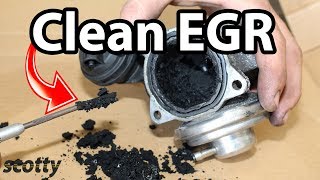
- Clogged EGR passages or ports (Very Common) — Carbon and soot build up and physically block the EGR valve, connecting pipes, or intake manifold ports. This is the most frequent cause of P0401 across all makes.
- Faulty or stuck EGR valve (Very Common) — The EGR valve's internal pintle or diaphragm gets jammed closed by hard carbon deposits, preventing it from opening to allow exhaust gas flow.
- Faulty DPFE sensor (Ford) (Common) — This sensor measures EGR flow by comparing pressure in two spots. It frequently fails from internal moisture and corrosion, sending false low-flow readings to the ECM even when flow is perfect.
- Cracked Diesel Particulate Filter (VW/Audi TDI) (Common) — On 2009-2015 VW/Audi TDI engines, a cracked DPF allows excessive soot to bypass the filter and completely clog the downstream low-pressure EGR filter.
- Faulty MAP Sensor (Less Common) — Modern systems infer EGR flow by monitoring the Manifold Absolute Pressure (MAP) sensor. A sluggish or faulty MAP sensor incorrectly reports no change in manifold pressure, triggering a false P0401.
- Damaged EGR temperature sensor (Less Common) — Systems using a temperature sensor to confirm flow trigger this code if the sensor fails or gets insulated by a thick layer of soot, preventing it from detecting hot exhaust gases.
- Vacuum line leaks or faulty control solenoid (Less Common) — On vacuum-operated EGR systems, cracked rubber hoses or a dead electronic vacuum solenoid prevent the EGR valve from receiving the vacuum required to pull it open.
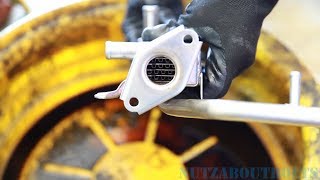
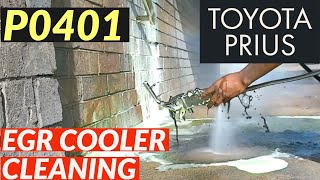
- Clogged EGR cooler (Rare) — On diesels and hybrids (like the Toyota Prius), the EGR cooler becomes internally choked with soot, severely restricting flow and increasing engine temperatures.
- Exhaust System Leaks or Restrictions (Rare) — An exhaust leak upstream of the EGR pickup or a clogged catalytic converter alters the backpressure required to push exhaust gases through the EGR system.
- PCM Software Issue (Rare) — The Powertrain Control Module (PCM) has overly sensitive parameters for detecting EGR flow. Manufacturers release software updates (reflashes) to correct this, such as Ford TSB 19-2343.
Symptoms

- Check Engine Light is on — The primary and often only immediate symptom.
- Failed emissions test — The vehicle automatically fails a smog check due to high NOx emissions and an active check engine light.
- Engine pinging or knocking (detonation) — A metallic rattling sound during acceleration or uphill climbs, caused by excessively high combustion temperatures.
- Reduced power and poor acceleration — The vehicle feels sluggish, hesitates, or stumbles when pressing the gas pedal.
- Rough idle or stalling — The engine runs unevenly or stalls at low speeds or when stopped at a light.
- Decreased fuel economy — Engine inefficiency causes a noticeable drop in miles per gallon.
Diagnostic Flowchart
Tap your situation to follow the diagnostic path that matches what you're seeing on this code.
Common Fixes & Costs
- Cleaning EGR valve and passages — Parts: $10-$30, Labor: $150-$500, ~1.5 hr book time (Intermediate)
- EGR Valve Replacement — Parts: $120-$400, Labor: $100-$300, ~1.5 hr book time (Intermediate)
- DPFE Sensor Replacement (Ford) — Parts: $40-$120, Labor: $50-$100, ~0.8 hr book time (DIY)
- EGR Control Solenoid Replacement — Parts: $40-$100, Labor: $50-$150, ~0.7 hr book time (DIY)
- EGR Temperature Sensor Replacement — Parts: $50-$150, Labor: $75-$150, ~1.0 hr book time (DIY)
DIY vs Professional
- Cleaning EGR valve and passages — Beginner: No
- EGR Valve Replacement — Beginner: Yes
- DPFE Sensor Replacement (Ford) — Beginner: Yes
- EGR Control Solenoid Replacement — Beginner: Yes
Used vs. New Parts: Buying Guide
When a used part is worth it: For a simple, accessible, vacuum-operated EGR valve on an older vehicle, a used OEM part is cost-effective. For electronic valves or hard-to-access components, the risk of premature failure outweighs the savings.
Donor-vehicle mileage cap: roughly under 60000 miles for the part to have meaningful remaining life.
Donor quality checklist:
- Verify the donor vehicle was not scrapped for engine or emissions failures.
- Inspect the part for heavy carbon buildup or corrosion.
- Match the part number exactly to ensure correct internal calibration.
Decision logic:
- If The part is a sensor with high failure rates (e.g., Ford DPFE sensor) → Buy new OEM. Aftermarket and used versions are highly unreliable.
- If The part is an electronic EGR valve and labor is expensive → Buy new OEM or premium aftermarket to avoid paying for labor twice.
- If Vehicle is over 150,000 miles and budget is tight → A used OEM part is acceptable, but expect a shorter lifespan.
Warranty tradeoff: Salvage yard parts have a 30-90 day warranty. New aftermarket parts offer 1-year to lifetime warranties. New OEM parts carry a 1-2 year warranty.
Worst-case if a used part fails: $300-$800 if a used part fails, primarily due to repeated labor costs.
What Happens If You Wait — Timeline
- 0-1 month: Check Engine Light illuminates. Vehicle automatically fails emissions tests. Occasional engine pinging under heavy load. (MPG impact: 0-3%% · Added cost: $0)
- 1-4 months: Engine pinging (detonation) becomes frequent during acceleration. Fuel economy drops. Higher combustion temperatures begin thermally stressing the catalytic converter. (MPG impact: 3-8%% · Added cost: $50-$150 in wasted fuel)
- 4-12 months: Persistent detonation causes premature wear on piston rings. The catalytic converter substrate overheats, reducing efficiency and starting to melt internally. (MPG impact: 8-15%% · Added cost: $1200-$2800 for catalytic converter replacement.)
- 12+ months: Severe engine damage occurs, including burned exhaust valves or cracked pistons. Catalytic converter failure is guaranteed. Vehicle runs rough with significant power loss. (MPG impact: 15-25%% · Added cost: $2500-$7000+ for catalytic converter and engine top-end repairs.)
Cost of Not Fixing It
- 0-1 month: Failed emissions test, noticeable engine pinging under acceleration, and a 5% drop in fuel economy. (Added cost: Negligible, other than increased fuel cost.)
- 1-6 months: Persistent engine knock scores cylinder walls. High combustion temperatures overheat and melt the catalytic converter. (Added cost: $1200-$2800 for catalytic converter replacement.)
- 6+ months: Catastrophic engine damage, including cracked pistons or burned exhaust valves, due to prolonged detonation. (Added cost: $2500-$7000+ for engine rebuild and catalytic converter.)
Diagnosis Steps
- Read Codes and Freeze Frame Data
Use an OBD-II scanner to confirm P0401 and check for related codes (e.g., P0325). Record the freeze frame data to see the exact engine conditions (RPM, load, temp) when the fault triggered.
Tools: OBD-II Scanner (Beginner) - Visual Inspection
Inspect the EGR valve, vacuum lines, and wiring. Look for cracked, disconnected, or collapsed rubber hoses and corroded connectors. On Fords, check the two small hoses routing to the DPFE sensor for blockages or melting.
Tools: Flashlight, Inspection Mirror (Beginner) - Test EGR Valve Functionality
With the engine idling, use a hand-held vacuum pump to manually apply vacuum to a vacuum-operated EGR valve. The engine must stumble or stall. If nothing happens, the valve is stuck closed or passages are 100% blocked. For electronic valves, command it open with a bi-directional scanner to verify the same stumbling effect.
Tools: Hand-held vacuum pump, Bi-directional scan tool (Intermediate) - Inspect and Clean EGR Passages
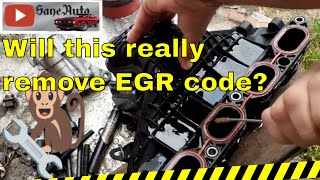
Remove the EGR valve and inspect the engine and intake manifold passages. Use a small wire brush, flexible pipe cleaners, and carburetor cleaner to scrape out carbon buildup. On Hondas, this requires removing the intake manifold to access the clogged ports.
Tools: Basic hand tools, carburetor cleaner, wire brushes, gaskets (Intermediate) - [PRO TIP] Test DPFE Sensor Voltage (Ford)
With Key On, Engine Off (KOEO), back-probe the DPFE sensor's signal wire with a multimeter. Voltage must be 0.5V-1.2V. A reading near 0V or above 1.5V confirms a dead sensor. Start the engine and apply vacuum to the EGR valve; a healthy DPFE voltage rises smoothly up to 4.0-5.0V.
Tools: Multimeter, back-probe pins (Advanced) - [PRO TIP] Analyze Scan Tool Live Data PIDs
Using an advanced scan tool, command the EGR valve open 25%, 50%, and 75%. On MAP-based systems, the MAP reading must drop as the valve opens. On DPFE systems, the 'DPFE Voltage' PID must increase. If commanded state changes but feedback PIDs do not respond, you have a flow or sensor failure.
Tools: Advanced scan tool with live data graphing (Advanced) - Check the EGR Control Solenoid
Verify battery voltage at the EGR control solenoid connector with the key on. Command the solenoid on and off with a scan tool to listen for a click. Connect a vacuum gauge between the solenoid and EGR valve to confirm it holds and releases vacuum when commanded.
Tools: Multimeter, professional scan tool, vacuum gauge (Advanced) - [PRO TIP] Test EGR Temperature Sensor Resistance
Unplug the temperature sensor and measure resistance. A typical sensor reads 2,000-3,000 Ω at 70°F. Use a heat gun to warm the tip; resistance must drop smoothly. If it reads out of spec, doesn't change, or shows open loop (OL), replace it.
Tools: Multimeter, Heat Gun, Service Manual for specs (Advanced) - Inspect Downstream Components (Diesels)
On VW TDIs, check for soot inside the tailpipe—this confirms a cracked DPF and clogged low-pressure EGR filter. On Ford Power Strokes, remove and inspect the EGR cooler for heavy soot blockages.
Tools: Basic hand tools, flashlight (Intermediate)
When This Code Triggers (Freeze-Frame Conditions)
- Engine Coolant Temp: 180-210°F (82-99°C) (Engine is fully warmed up and operating in closed loop.)
- RPM: 1500-2500 RPM (Steady cruising speed, not at idle or full throttle.)
- Engine Load: 20-60% (Light to moderate acceleration or steady-state cruising.)
- Vehicle Speed: 40-60 mph (64-97 km/h) (Sustained highway or city cruising speed.)
Related Codes
- P0400 — A general 'EGR Flow Malfunction' code. P0401 is specific to 'Insufficient' flow, pointing directly to a blockage or stuck-closed valve.
- P0402 — The exact opposite of P0401, indicating 'Excessive' flow caused by a valve stuck open or a misrouted vacuum line.
- P0325 — A 'Knock Sensor' code triggered because insufficient EGR flow causes high combustion temperatures and engine detonation. Fixing P0401 resolves P0325.
- P1491 (Honda/Acura) — Indicates 'EGR Valve Insufficient Lift'. Points specifically to a failed internal position sensor within the EGR valve assembly, requiring valve replacement.
Climate & Environmental Factors
- Humidity and Moisture: High humidity causes moisture to corrode the internal diaphragm of Ford DPFE sensors, triggering false P0401 codes.
- Cold Weather: Moisture in the EGR system freezes, causing temporary blockages or sticking valves on cold starts.
- Short Trip Driving: Failing to reach full operating temperature prevents the system from burning off carbon and moisture, accelerating EGR clogging.
How to Talk to a Mechanic About This Code
Say this: "I have a P0401 code for insufficient EGR flow. I'd like a diagnosis to determine if it's a clogged passage, a bad valve, or a faulty sensor. Please check for carbon buildup in the intake passages before recommending a new EGR valve."
This signals you understand the most common cause is a blockage, not a failed part. It directs the technician to perform a proper diagnosis instead of just replacing the most expensive component.
Avoid saying:
- 'Just fix whatever's wrong'
- 'My check engine light is on, can you look at it?'
- 'Whatever you recommend'
Questions to ask before authorizing the repair:
- Did you inspect the EGR passages in the intake manifold for carbon blockage?
- What test confirmed the EGR valve itself has failed?
- If you are recommending a valve replacement, does the estimate include the labor to clean the intake passages?
- For my Ford, did you test the DPFE sensor's voltage to rule it out?
- What is your warranty on this specific repair, and will it cover the code returning?
Where to Take It: Dealer vs Independent vs Chain
- Dealer:
Best for: Vehicles still under powertrain or emissions warranty (e.g., VW TDI, Toyota Prius), Diagnosing known manufacturer-specific software issues (TSBs), Complex modern diesel systems (BMW, Ford Power Stroke)
Downsides: Highest labor rates, often $150-$250 per hour., Defaults to replacing entire assemblies (e.g., EGR cooler and valve) when only cleaning is needed. (Typical cost: +50% vs. baseline) - Independent Shop:
Best fit. A reputable independent shop is more willing to perform the labor-intensive cleaning that is often the correct fix, rather than just replacing parts.
Best for: Most out-of-warranty vehicles., Common P0401 issues on popular models (Honda, Ford, GM)., Cost-conscious owners who want a thorough diagnosis and cleaning.
Downsides: Quality varies. Vet shops by looking for ASE certifications and positive reviews related to engine work. (Typical cost: +0% vs. baseline) - Chain Shop:
Avoid for diagnosis. Only use if you have diagnosed the problem yourself as a simple part swap (like a Ford DPFE sensor).
Best for: Simple, pre-diagnosed part replacements like an easily accessible sensor.
Downsides: High pressure to upsell., Technicians may lack the diagnostic experience for P0401., Likely to replace the EGR valve without cleaning the passages, leading to the code's return. (Typical cost: -10% vs. baseline)
When to Walk Away From the Repair
If the estimated repair cost exceeds 40-50% of the car's private-party value, seriously consider not fixing it.
- Car worth $5000, fix is $600: Fix it. This is a standard repair cost well below the threshold.
- Car worth $3000, fix is $1200: Borderline. The repair is 40% of the car's value. Get a second opinion.
- Car worth $2000, fix is $1600: Walk away. The repair cost is 80% of the car's value. It is not economically sensible.
What Scan Tool You Need for This Code

Minimum: A scanner with live data graphing AND bidirectional control is strongly recommended to properly diagnose P0401.
A basic $20 code reader only tells you P0401 exists. To find the root problem, you must command the EGR valve open and close while watching sensor data (MAP, DPFE) to see if the system responds. Without bidirectional control, you are guessing.
Budget: BlueDriver Pro (~$99) — Reads freeze frame and graphs live sensor data. Lacks bidirectional control, so you cannot command the EGR valve open.
Mid-range: Foxwell NT510 Elite / Xtool D7 (~$350) — Provides full bidirectional control to command the EGR valve open and closed. This is the key function needed to test the valve and passages.
Professional: Autel MaxiCOM MK808 (~$500) — Offers full OEM-level diagnostics, bidirectional control, advanced data graphing, and special functions for EGR system adaptation.
Rent vs buy: Free tool rental programs at auto parts stores offer basic code readers only. To diagnose P0401 correctly, you must buy a scanner with bidirectional capabilities or take it to a shop.
How to Clear the Code After You Fix It
- Reconnect the battery if disconnected.
- Use an OBD-II scan tool to manually clear the P0401 code.
- Perform the specific EGR monitor drive cycle to confirm the fix and set the readiness monitor.
Drive cycle (~20 minutes): 1) Cold start and idle for 3 minutes. 2) Accelerate to 45-55 mph and hold steady for 5 minutes. 3) Coast down to 20 mph without braking. 4) Repeat steps 2 and 3 three times.
Readiness monitors affected: EGR System, Catalyst (Catalytic Converter), Oxygen (O2) Sensor
Before emissions retest: drive at least 50 miles to fully set monitors.
Watch out for:
- Disconnecting the battery clears the code but resets all readiness monitors to 'Not Ready', causing an automatic emissions failure.
- The code returns within two drive cycles if the root cause (e.g., clogged passages) was not fully resolved.
- Failing to complete the exact drive cycle prevents the EGR readiness monitor from setting to 'Ready'.
Will This Fail Emissions / State Inspection?
Yes — this code typically fails an OBD-II emissions inspection.
- California: P0401 is an automatic failure. After repair, all readiness monitors must be set to 'Ready' before passing.
- New York: An active P0401 code results in an immediate failure of the NYS DMV OBD-II inspection.
- Texas: In emissions-testing counties, an active P0401 code fails the OBD-II portion of the test.
Most Commonly Affected Vehicles
- Ford F-150, Explorer, Ranger, Focus (1997-2010) — Extremely common due to DPFE sensor failure. On 1997-2004 F-150s, throttle body EGR ports must be manually cleaned.
- Honda Accord, Civic, Odyssey (1998-2007) — Prone to complete carbon blockage of the intake manifold EGR port, requiring manifold removal to clean (TSB 99-085).
- Toyota Camry, Corolla, Prius (2000-2015) — Prius models (2010-2015) suffer from clogged EGR coolers, contributing to premature head gasket failure.
- Chevrolet / GM Silverado, Equinox, Malibu (1999-2013) — Typically caused by a stuck electronic EGR valve or severe carbon blockage in the EGR tube.
- Hyundai / Kia Sonata, Santa Fe, Tucson (2020-2024) — Common on 2.5L GDI engines due to carbon buildup in the EGR valve and cooler (TSB 23-EE-009H).
- Volkswagen / Audi (TDI) Jetta, Golf, Beetle, A3 (2009-2015) — P0401 indicates a cracked DPF clogging the low-pressure EGR filter. Both require replacement.
- Nissan Altima, Maxima, Frontier (2002-2012) — Caused by a soot-insulated EGR temperature sensor or a carbon-clogged EGR tube.
- BMW 3-Series, 5-Series, X5 (Diesel) (2009-2018) — Highly susceptible to heavy soot buildup in the EGR valve and cooler, leading to flow problems and leaks.
Manufacturer-Specific Notes

- Ford: The DPFE sensor is the primary failure point. Always test KOEO voltage (0.5-1.2V) before replacing the EGR valve.
- Honda: The intake manifold EGR port clogs with a hard carbon plug. Cleaning requires removing the manifold and drilling/scraping out the carbon.
- Toyota: On 2010-2015 Prius models, a clogged EGR cooler causes P0401 and leads to head gasket failure. The entire system must be cleaned.
- Volkswagen (TDI): On 2009-2015 2.0L TDIs, P0401 guarantees the DPF is cracked. Replacing only the EGR filter results in the code returning immediately.
- Hyundai/Kia: 2.5L GDI engines suffer rapid carbon buildup in the EGR valve and cooler, addressed under warranty via TSB 23-EE-009H.
Real Owner Stories
2002 Ford F-150 4.6L - The Misdiagnosis Loop
Check Engine Light with P0401. Truck ran fine but failed state emissions.
What they tried:
- Replaced the DPFE sensor.
- Replaced the EGR valve.
- Replaced the EGR control solenoid.
Outcome: The actual problem was severe carbon buildup in the EGR passages inside the throttle body elbow. The owner had to remove the throttle body and manually scrape hard carbon out of the channel to restore flow.
Lesson: On Ford trucks, replacing the DPFE sensor and EGR valve is rarely enough. The passages inside the throttle body are a choke point and must be manually cleaned.
1998 Honda Accord 2.3L - The Labor-Intensive Cleaning Fix
P0401 code. After cleaning the upper intake, a P1491 (EGR Insufficient Lift) code appeared.
What they tried:
- Removed the upper intake plenum to clean the main EGR port.
- Removed and cleaned the EGR valve.
Outcome: The correct fix required removing the entire intake manifold to access and scrape out all clogged ports. The P1491 code indicated the valve was damaged during the initial cleaning.
Lesson: On Honda engines, P0401 is almost always caused by completely blocked intake manifold ports. Plan for a labor-intensive cleaning job requiring intake manifold removal.
2016 Mazda 6 Diesel - The Professional Repair Nightmare
P0401 code appeared. Taken to a mechanic for professional repair.
What they tried:
- Mechanic replaced the EGR valve and EGR cooler. Code returned in 50 miles.
- Dealership performed a thorough system cleaning. Code returned in 50 miles.
Outcome: The code continued to return, indicating a deeper issue like a cracked DPF or software glitch, leaving the owner in a loop of failed repairs.
Lesson: On modern diesels, P0401 is extremely difficult to diagnose. Even after replacing major components, the root cause is often a cracked DPF or software issue.
GMT400 Truck (Chevy/GMC) - Bad Out-of-the-Box Part
P0401 code appeared immediately after installing a new EGR valve to fix a misfire.
What they tried:
- Installed a new Delphi EGR valve.
Outcome: The brand new Delphi EGR valve was faulty out of the box. Replacing it with an AC Delco (OEM) part immediately solved the P0401 code.
Lesson: Be cautious of aftermarket electronic parts. If a code appears immediately after a part replacement, the new part is the primary suspect.
How to Prevent This Code From Triggering
- Perform regular highway driving (At least once a week) — Sustained driving at 2,500+ RPM allows the engine to reach optimal temperature, burning off soft carbon deposits and moisture from the EGR system.
- Use high-quality, Top Tier gasoline (Every fill-up) — Top Tier fuels contain detergents that prevent deposits, promoting complete combustion and reducing soot that forms hard carbon in the EGR system.
- Avoid short trips and excessive idling (Daily habit) — Short trips prevent the engine from warming up, causing moisture accumulation. Extended idling creates low exhaust pressure, allowing soot to settle in EGR passages.
- Perform periodic professional intake/EGR cleaning (Every 50,000-60,000 miles) — Professional services use specialized equipment to dissolve hard-to-reach deposits without full disassembly, restoring flow and preventing P0401.
- Use the correct engine oil (Every oil change) — Manufacturer-specified oil, especially low-ash oil in diesels, reduces vapor and particulate matter entering the intake, slowing carbon buildup.
Frequently Asked Questions
Can I just clean the EGR valve to fix P0401?
Yes. Carbon buildup is the primary cause, so thoroughly cleaning the valve and intake manifold passages often restores flow and resolves the code. However, if the valve's diaphragm is ruptured or electronics failed, cleaning won't help.
Will a P0401 code cause me to fail an emissions test?
Yes. The EGR system reduces NOx emissions. P0401 indicates a fault in this critical emissions control system, resulting in an automatic failure of any OBD-II smog check.
I replaced the EGR valve, but the P0401 code came back. What now?
This classic misdiagnosis means the blockage is elsewhere. The most likely culprits are carbon-clogged EGR passages in the intake manifold or a failed sensor (like the Ford DPFE) misreporting flow.
Will P0401 clear itself?
No. The underlying mechanical or electrical issue, such as carbon buildup or a faulty sensor, must be repaired. Once fixed, the code clears after several successful drive cycles or manually with a scanner.
What's the most common mistake when diagnosing P0401?
The most common mistake is 'parts-swapping'—replacing the EGR valve without cleaning the associated intake manifold passages. The new valve cannot flow gas through clogged ports, causing the code to return immediately.
Can a bad O2 sensor cause a P0401 code?
No. O2 sensors measure exhaust oxygen content and trigger their own codes (e.g., P0130-P0167). P0401 specifically relates to EGR flow rates measured by the MAP, DPFE, or EGR temperature sensors.
Is an EGR delete kit a good way to fix P0401?
No. While a delete kit prevents the code, it significantly increases NOx emissions and is illegal for on-road vehicles. It guarantees an emissions test failure and should be avoided.
Key Takeaways
- P0401 indicates insufficient exhaust gas recirculation flow, caused by carbon buildup blocking the EGR valve or intake manifold passages in 80% of cases.
- Expect an immediate check engine light, automatic emissions test failure, and a metallic engine pinging sound during acceleration.
- Fix P0401 within 200 miles to prevent uncontrolled detonation from destroying your pistons and melting your catalytic converter, which adds up to $2,500 in secondary repairs.
- Avoid the common trap of blindly replacing the $150 EGR valve; thoroughly clean the intake ports first, or test the DPFE sensor if driving a 1997-2010 Ford.
Helpful Videos

The information in this article is provided for general reference and educational purposes only. Vehicle specifications, procedures, and part compatibility can vary by production date, trim level, and region. Always consult your vehicle's factory service manual and verify part numbers before purchasing or performing repairs. Safety-critical components such as airbags, seat belts, and braking systems should be installed by a qualified professional.
- 🎬 Helpful Videos
- What Does P0401 Mean?
- Can I Drive With P0401?
- Common Causes
- Symptoms
- Diagnostic Flowchart
- Common Fixes & Costs
- DIY vs Professional
- Used vs. New Parts: Buying Guide
- What Happens If You Wait — Timeline
- Cost of Not Fixing It
- Diagnosis Steps
- When This Code Triggers (Freeze-Frame Conditions)
- Related Codes
- Climate & Environmental Factors
- How to Talk to a Mechanic About This Code
- Where to Take It: Dealer vs Independent vs Chain
- When to Walk Away From the Repair
- What Scan Tool You Need for This Code
- How to Clear the Code After You Fix It
- Will This Fail Emissions / State Inspection?
- Most Commonly Affected Vehicles
- Manufacturer-Specific Notes
- Real Owner Stories
- 2002 Ford F-150 4.6L - The Misdiagnosis Loop
- 1998 Honda Accord 2.3L - The Labor-Intensive Cleaning Fix
- 2016 Mazda 6 Diesel - The Professional Repair Nightmare
- GMT400 Truck (Chevy/GMC) - Bad Out-of-the-Box Part
- How to Prevent This Code From Triggering
- Frequently Asked Questions
- Can I just clean the EGR valve to fix P0401?
- Will a P0401 code cause me to fail an emissions test?
- I replaced the EGR valve, but the P0401 code came back. What now?
- Will P0401 clear itself?
- What's the most common mistake when diagnosing P0401?
- Can a bad O2 sensor cause a P0401 code?
- Is an EGR delete kit a good way to fix P0401?
- Key Takeaways
- 🎟️ Get 5% Off