

P0401 on 2016-2017 Chevrolet Volt: EGR Flow Insufficient Causes and Fixes
On a 2016-2017 Chevy Volt, code P0401 is almost always caused by a clogged EGR cooler, not a bad EGR valve. The most common fix is to clean or replace the EGR cooler. An OEM replacement cooler costs about $350, while a professional cleaning might cost $800. Do not replace the expensive EGR valve unless cleaning/replacing the cooler fails to resolve the code. A shorted EGR valve can blow the F03/F23 fuse, disabling the water pump and causing sudden overheating.
- For a P0401 code on a 2016-2017 Volt, your first and most likely problem is a clogged EGR cooler.
- Do not replace the expensive EGR valve unless you have first cleaned or replaced the EGR cooler and confirmed all passages are clear, or if you have circuit-related codes and a blown fuse.
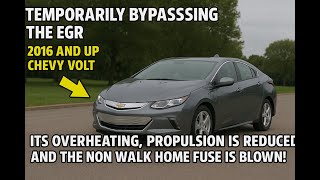
- If your car suddenly overheats and shows a 'Reduced Propulsion' message, immediately check the F03/F23 15A fuse in the under-hood fuse box. If it's blown, unplug the EGR valve's electrical connector before replacing the fuse to get the car running safely.
- DIY cleaning of the EGR cooler is possible and can save thousands of dollars. Several methods exist, including full removal or in-place cleaning.
- When ordering a replacement EGR cooler, ensure you are getting the latest superseded part number (12704364) for the best results.
What's Unique About the 2016-2017 Chevrolet Volt

For the second-generation Chevy Volt (2016-2019), this code is overwhelmingly linked to a specific design issue rather than a simple part failure. The EGR cooler is highly prone to clogging with carbon deposits, especially on higher-mileage vehicles. This is so common that General Motors issued a Technical Service Bulletin (TSB 18-NA-089) advising technicians to suspect a plugged EGR cooler as the primary cause. A unique and severe symptom on the Volt is that a stuck or shorted EGR valve can blow the 15-amp F03 or F23 'Non Walk Home' fuse, which is shared with the engine's water pump control module, causing sudden overheating and a 'Reduced Propulsion' warning. NHTSA ODI #11692401 notes that this is an extremely well-documented issue on Gen2 Volts, particularly when the EGR system triggers the P0401 check engine light.
Symptoms You May Notice
- Check Engine Light is on
- Vehicle fails an emissions test
- Sudden engine overheating accompanied by temperature warnings
- "Reduced Propulsion Power" message on the dashboard
- Engine pinging or knocking, especially under load
- Rough idle or stalling
- Multiple other seemingly unrelated trouble codes appearing at once if the fuse blows
- Unusual fuel management behavior, such as the car using gas before electricity is empty, as reported in NHTSA ODI #11695498
- Replacing the EGR valve first. On the Gen 2 Volt, the problem is almost always the clogged EGR cooler. Replacing the expensive EGR valve without first addressing the cooler will not solve the P0401 flow code.
Most Likely Causes

- Clogged EGR Cooler 🔴 High Probability The design of the EGR cooler on the 1.5L engine makes it susceptible to accumulating carbon and sludge, especially in vehicles that run on the gas engine infrequently. This is a well-documented issue acknowledged by GM in TSB 18-NA-089.
How to confirm: Remove the EGR cooler and visually inspect its internal passages for heavy carbon buildup. A borescope can also be used. A completely clogged cooler will not allow any air to pass through it.
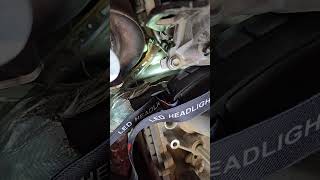
Typical fix: The cooler can be removed and cleaned with solvents like Purple Power or carb cleaner, or replaced entirely. Some owners have successfully cleaned the cooler without full removal by injecting cleaner into the EGR temperature sensor port. 🎬 See this hack for cleaning the cooler without removing it. Dealerships will almost always replace the part with the updated version.
Est. part cost: $260-$525 - Clogged EGR Passages or EGR Valve 🟡 Medium Probability The same carbon that clogs the cooler can also build up in the passages leading to and from the cooler, as well as on the EGR valve pintle itself, causing it to stick or fail to open fully. NHTSA ODI #11650026 describes a P0401 error where the EGR valve was not receiving enough fuel flow/exhaust gas.
How to confirm: After confirming the cooler is clean, inspect the EGR valve and the ports on the intake and exhaust manifolds for carbon blockage. The valve can be removed for bench cleaning and inspection. 🎬 Watch: A complete guide to flushing the cooler and valve.
Typical fix: Clean the EGR valve and all associated passages. Soaking the valve in a strong solvent can dissolve heavy buildup. If the valve's electronic components have failed (often causing a blown fuse) or it is seized internally, it must be replaced.
Est. part cost: $0 (if cleaning) or $450-$2100 (if replacing)
Rare But Worth Checking
- Failed EGR Valve (Electrical): While less common than clogging, the EGR valve itself can fail electronically, causing an internal short circuit. This is the primary cause of the blown 'Non Walk Home' fuse. TSB 21-NA-116 addresses this specific failure mode. This should be considered a last resort due to the high cost of the part.
- Faulty EGR Temperature Sensor: The EGR system uses temperature probes to help monitor flow. If a probe is heavily coated in carbon or has failed, it may contribute to an incorrect flow diagnosis. These probes should be cleaned during any EGR service.
Diagnosis Steps

- Scan for codes. If only P0401 is present, the issue is flow-related (clogging). If other circuit codes like P0403 are present, suspect an electrical failure in the EGR valve.
- Check the F03/F23 15A 'Non Walk Home' fuse in the under-hood fuse box. If it is blown, the EGR valve has likely shorted internally. As a temporary measure to make the car drivable, unplug the EGR valve's electrical connector and replace the fuse.
- Following TSB 18-NA-089, the primary suspect for P0401 is a clogged EGR cooler.
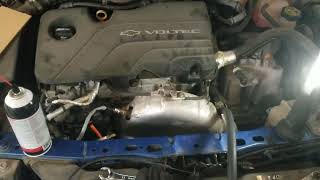
- Gain access to the EGR system at the back of the engine. This may require removing heat shields.
- Remove and inspect the EGR cooler for carbon blockage. The passages are small and can become completely blocked.
- If the cooler is clogged, either clean it thoroughly or replace it. DIY cleaning often involves soaking in Purple Power or carb cleaner. An in-place cleaning can be attempted by removing the EGR temp sensor and spraying cleaner into the port.
- While the system is apart, remove and clean the EGR valve and inspect all connecting ports and pipes for restrictions.
- Reassemble the system using new gaskets to prevent exhaust leaks.
- Clear the trouble codes. Note that P0401 can be a 'permanent' code that will only clear after the ECM successfully runs a specific and complex drive cycle to verify the repair.
- Perform the GM drive cycle: This involves a sequence of idling, holding specific speeds (e.g., 55 mph for 3 minutes), coasting down, and accelerating at 3/4 throttle. This may need to be done multiple times.
- If the P0401 code returns after confirming all passages are clear, the EGR valve itself may have an internal mechanical or electronic fault and require replacement.
Parts You'll Likely Need
- EGR Cooler
(OEM #12704364 (supersedes 12677086, 12671961))— This is the most common failure point for code P0401 on this vehicle, as confirmed by GM TSB 18-NA-089.
Trusted brands: GM Genuine, ACDelco
OEM price range: $330-$525
Aftermarket price range: $260-$320 - EGR Valve
(OEM #19436521 (also see 12691147 referenced in TSBs))— This is the secondary cause, replaced if cleaning doesn't work or if it has shorted out electrically, blowing a fuse.
Trusted brands: GM Genuine
OEM price range: $1360-$2400
Aftermarket price range: $450-$650 - EGR Cooler Gaskets
(OEM #12682142 (Outlet), 12682143 (Inlet))— These single-use gaskets must be replaced any time the EGR cooler or associated pipes are removed to prevent exhaust leaks.
Trusted brands: GM Genuine, ACDelco
OEM price range: $1-$6
Aftermarket price range: $1-$5
Related Codes That Often Appear With This One
- P0403, P0405, P0489 (EGR Control Circuit codes, often seen when the valve shorts and blows a fuse)
- P0030, P0031, P0443, P0597 (Other circuit codes that can appear when the shared F03/F23 fuse is blown)
- P0B9A (Hybrid/EV Battery Voltage Sense Circuit, which has been observed alongside P0401 in cases of propulsion power loss as noted in NHTSA ODI #11695498)
Technical Service Bulletins (TSBs) & Recalls

- 18-NA-089: Diagnostic Tip for Check Engine Light On, DTC P0401 Set. Recommends inspecting/replacing the EGR cooler as the first step for a flow code.
- 21-NA-116: Addresses a blown F3UA fuse caused by an internal short in the EGR valve, resulting in various circuit codes (P0403, P0405, etc.). Recommends replacing the EGR valve if the wiring harness is intact.
Platform-Specific Known Issues
- A stuck/shorted EGR valve can blow the F03/F23 fuse for the engine water pump, causing the engine to overheat rapidly and display a 'Reduced Propulsion Power' message.
- GM Technical Service Bulletin 18-NA-089 directly addresses P0401 on 2016-2018 Volts and Malibus, identifying a plugged EGR cooler as the likely cause on higher mileage vehicles.
- Due to the nature of a plug-in hybrid, the infrequent use of the gasoline engine can exacerbate carbon buildup in the EGR system from short, incomplete heating cycles.
- NHTSA ODI #11656896 confirms that a P0401 code can trigger the "propulsion power is reduced" warning while driving at highway speeds, forcing drivers to find a safe place to pull off.
Mechanic-Grade Diagnostic Values
- EGR Valve DC Motor Resistance — expected: Approximately 8-11 Ohms between the two outer pins of the valve connector.. Failure: An open circuit (infinite resistance) or a dead short (near zero resistance) indicates a failed motor.
- EGR Valve Position Sensor Voltage (KOEO) — expected: Approximately 0.7V with the valve closed.. Failure: Voltage significantly higher (e.g., 5V) or lower (0V) than expected indicates a sensor or wiring fault.
- EGR Valve Position Sensor Voltage (Commanded Open) — expected: Voltage should sweep smoothly upwards towards 4.0-4.7V as the valve is commanded open with a scan tool.. Failure: No change in voltage, erratic jumps, or voltage that doesn't correspond to the commanded position suggests a faulty sensor or sticking pintle.
- Normal Engine Coolant Temperature — expected: Should typically operate under 220°F (104°C).. Failure: Consistently running at 230°F (110°C) or higher can be an early symptom of a clogged EGR cooler or a failing EGR valve about to blow the shared water pump fuse.
Scan Tool Commands That Help
- GM GDS2 (or equivalent professional scan tool): EGR Control / Output Control — This bidirectional command is used to manually open the EGR valve in increments (e.g., 25%, 50%, 100%) while the engine is idling. A functional EGR system with clear passages will cause the engine to stumble, run rough, or stall as exhaust gas is introduced. This directly tests the valve's mechanical and electrical operation and confirms if the passages are clear enough to affect idle quality.
- GM GDS2 (or equivalent professional scan tool): Clear All DTCs / Reset Functions — After the physical repair (cleaning or replacement) is complete, this function is used to clear the active and permanent trouble codes. Note that for P0401, a specific and complete GM drive cycle must be performed before the permanent DTC will clear from the ECM's memory.
Wiring & Ground Locations
- B37 - EGR Valve Connector — Front and center of the engine, easily visible.. This 5-pin connector provides power, ground, and control signals to the EGR valve. Testing for voltage and resistance at these pins is critical for diagnosing an electrical fault vs. a clog. A common failure is an internal short in the valve, which can be isolated by testing at this connector.
- B37 EGR Valve - Probable Pinout — On the EGR valve itself.. Understanding the pin functions is essential for testing. Based on common GM 5-wire designs: Pins 1 & 5 (outer pins) are for the DC motor control. Pins 2, 3, & 4 (inner pins) are for the position sensor: 5V Reference, Low Reference (Ground), and Signal. A user reported that adding an inline fuse to the violet/blue wire can protect the main F03 fuse from blowing if the valve shorts.
- F03 / F23 Underhood Fuse — In the under-hood fuse block, typically a 15A mini fuse in the top-left corner.. This fuse, often labeled 'Non Walk Home', powers both the EGR valve and the engine water pump control module. When the EGR valve shorts internally, this fuse blows, cutting power to the water pump and causing immediate engine overheating.
- G101 / G106 — Main engine grounds located on the lower front of the engine block and the frame cross rail under the crank pulley.. These are the primary grounds for the K20 Engine Control Module (ECM). A poor connection here can cause a wide range of erratic behavior and false codes, though it is not a common cause for P0401 specifically.
Real Owner Repair Stories
- Reddit user r/volt (2018 Chevrolet Volt with 175,000km) — Check Engine Light with EGR codes.
❌ Tried (didn't work) Took the valve out and cleaned it with carb cleaner. The light came back the next day.
✅ What actually fixed it The owner performed an in-place cleaning of the EGR cooler using carb cleaner, which made the code go away. This confirms the cooler, not the valve, was the source of the flow issue. - Reddit user r/volt (2016 Chevrolet Volt with 169,000 miles) — P0401 code returned after a previous repair.
❌ Tried (didn't work) The user had previously cleaned the EGR system to resolve the code.
✅ What actually fixed it The user notes that at 169k miles, it was time to replace the EGR cooler *again*. This indicates that for high-mileage vehicles, cleaning is a temporary fix and the cooler should be considered a recurring maintenance item. - Reddit user r/volt (2017 Chevrolet Volt) — Check Engine Light, Propulsion Power is Reduced, overheating.
❌ Tried (didn't work) Pleading with the dealership, who initially claimed the EGR valve was not an emissions device and therefore not covered under the PZEV warranty.
✅ What actually fixed it The user had to source a replacement valve from China due to a worldwide shortage of the part from GM. The final fix was replacing the EGR valve, which had shorted internally and was blowing the fuse. The user strongly asserts that cleaning does nothing for an electrical short. - NHTSA ODI #11613414 — An owner reported receiving a check engine light with error code P0401 at 96,500 miles, indicating an issue with the EGR Valve which was subsequently confirmed by a dealership.
OEM Part Supersession History
12671961, 12642619→12677086 (and potentially 12704364)— GM regularly updates service parts to integrate new materials or technologies. While not explicitly stated, updates to the cooler are likely intended to improve resistance to carbon buildup.12691147→19436521 (Remanufactured: 19436113)— The original valve was prone to internal electrical failure. The part went through a period of extreme shortage, leading to a remanufacturing program and eventually a new service part number.
Heads up: Be cautious of wildly varying prices online. The original part number became associated with extremely high costs ($2000+) due to scarcity, while newer service parts and aftermarket versions are significantly cheaper ($450-$700).
Diagnostic Flowchart
Real Owner Stories
Aggregated from forums and TSBs cited above. Mileages and costs reflect what owners reported in those sources.
2017 Chevrolet Volt — 75000 miles
Symptoms: Check engine light with P0401 code.
What fixed it: A Chevrolet technician removed, cleaned and reinstalled the EGR cooler pipe.
Cost: $800
Source hint: Reddit r/volt - 2016 Volt - P401 EGR?
2017 Chevrolet Volt
Symptoms: Check engine light with a P0401 code.
What fixed it: Initially, the EGR cooler was replaced under warranty. When the CEL returned, a stuck EGR valve was diagnosed as the subsequent issue.
Cost: $2600
Source hint: Reddit r/volt - EGR headache
2016-2017 Chevrolet Volt
Symptoms: P0401 code present; cleaning the EGR valve alone did not resolve the issue.
What fixed it: Performed an in-place cleaning of the EGR cooler following a YouTube guide.
Source hint: Reddit r/volt: P0401 EGR valve cooler fix
2016-2017 Chevrolet Volt
Symptoms: Received a 'Propulsion power reduced' message during a road trip due to a failed EGR valve blowing the fuse.
What fixed it: Unplugged the EGR valve and replaced the blown fuse as a temporary fix to continue driving.
Source hint: Reddit r/volt: "Propulsion power reduced" Think my EGRV valve finally bought the farm...
Documented NHTSA Reports
NHTSA ODI #11656896
Symptoms: The P0401 code caused the vehicle to display a “propulsion power is reduced” message while on the highway, necessitating an emergency stop.
NHTSA ODI #11695498
Symptoms: Owner reported codes P0401 and P0B9A, resulting in a loss of propulsion power on the highway and issues shifting to park.
Related OBD-II Codes
Frequently Asked Questions
Does TSB 18-NA-089 apply to my 2016-2017 Chevrolet Volt?
Why did my Volt suddenly overheat and display a 'Reduced Propulsion Power' message?
How can I temporarily drive my Volt if the EGR valve keeps blowing the F03/F23 fuse?
Can I clean the EGR cooler myself, or does it need to be replaced?
Why is the 1.5L engine in the Volt so prone to EGR cooler clogging?
Will clearing the P0401 code turn off the check engine light permanently?
Helpful Videos


The information in this article is provided for general reference and educational purposes only. Vehicle specifications, procedures, and part compatibility can vary by production date, trim level, and region. Always consult your vehicle's factory service manual and verify part numbers before purchasing or performing repairs. Safety-critical components such as airbags, seat belts, and braking systems should be installed by a qualified professional.
- Chevrolet Volt:
- 🎬 Helpful Videos
- What's Unique About the 2016-2017 Chevrolet Volt
- Symptoms You May Notice
- Most Likely Causes
- Rare But Worth Checking
- Diagnosis Steps
- Parts You'll Likely Need
- Related Codes That Often Appear With This One
- Technical Service Bulletins (TSBs) & Recalls
- Platform-Specific Known Issues
- Mechanic-Grade Diagnostic Values
- Scan Tool Commands That Help
- Wiring & Ground Locations
- Real Owner Repair Stories
- OEM Part Supersession History
- Diagnostic Flowchart
- Real Owner Stories
- 2017 Chevrolet Volt — 75000 miles
- 2017 Chevrolet Volt
- 2016-2017 Chevrolet Volt
- 2016-2017 Chevrolet Volt
- Documented NHTSA Reports
- NHTSA ODI #11656896
- NHTSA ODI #11695498
- Related OBD-II Codes
- Frequently Asked Questions
- 🎟️ Get 5% Off