

OBD-II Code P0404: EGR 'A' Control Circuit Range/Performance
The Ultimate Guide to Diagnosing and Fixing P0404
- Carbon buildup inside the EGR valve causes over 70% of P0404 codes, making a $20 DIY cleaning with EGR solvent the most effective first step.
- Always scrub the intake manifold's EGR passages with a wire brush during repairs; replacing the valve without clearing these ports guarantees the code will return.
- Limit driving with a P0404 code to under 2 weeks to prevent a stuck-open EGR valve from overheating and destroying your catalytic converter, a repair exceeding $1,500.
- Check for manufacturer Technical Service Bulletins (TSBs) before buying parts; Nissan and Chrysler vehicles frequently trigger false P0404 codes requiring a 30-minute dealership PCM software update.
What Does P0404 Mean?
The P0404 code signifies the Powertrain Control Module (PCM) detected a performance issue with the Exhaust Gas Recirculation (EGR) valve. The EGR system reduces harmful NOx gases by redirecting a metered amount of exhaust back into the combustion chambers to lower temperatures. This code triggers when the EGR valve's actual position, reported by its sensor, mismatches the PCM's commanded position 🎬 Watch: A beginner's guide to understanding and fixing P0404. by more than 10% for a set period.
Technical definition: The official SAE/OBD-II definition for code P0404 is "Exhaust Gas Recirculation (EGR) 'A' Control Circuit Range/Performance". This indicates the PCM determined the EGR valve's learned position, or its response to being opened or closed, falls outside the expected range. The valve is either not moving when commanded, moving too slowly, or the position sensor is providing an irrational signal relative to the command.
Can I Drive With P0404?
Yes, But With Caution. Yes, you can drive short distances, but do not exceed 1-2 weeks. Driving with P0404 causes a 5-10% drop in fuel economy, engine stalling in traffic, and engine knocking. Prolonged elevated combustion temperatures damage internal engine components, and a malfunctioning EGR system destroys the catalytic converter—a repair costing $800 to $2,500.
Common Causes

- Clogged or Dirty EGR Valve (Very Common) — Carbon and soot from exhaust gases physically restrict the EGR valve's pintle (the moving pin), causing it to stick, move slowly, or fail to seal properly.
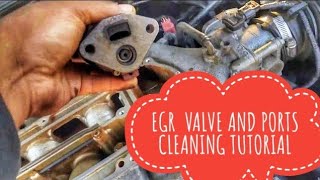
- Clogged EGR Passages (Common) — The tubes and passages leading to and from the EGR valve, including ports in the intake manifold, clog with carbon. This restricts exhaust flow and triggers a performance code even if the valve itself is clean. 🎬 See how to clean the EGR valve and intake ports.
- Faulty EGR Valve (Internal Failure) (Common) — The EGR valve fails internally due to a broken spring, ruptured diaphragm, or burnt electrical motor. 🎬 Watch this step-by-step EGR valve replacement for Chevy and GMC trucks. Occasionally, foreign debris from a failing catalytic converter breaks off and permanently jams the valve's pintle.
- Faulty EGR Position Sensor (Common) — The EGR position sensor, often integrated into the valve assembly, tells the PCM the exact position of the valve. A faulty sensor sends incorrect data, making the PCM think the valve is in the wrong position.
- Wiring or Connector Issues (Less Common) — The electrical circuit connecting the EGR valve and its sensor to the PCM suffers from frayed wires, corroded connector pins, a poor ground connection, or water intrusion, disrupting the signal.
- PCM Software or Calibration Fault (Rare) — The vehicle's Powertrain Control Module (PCM) contains outdated software that misinterprets the EGR sensor's signal. On certain Nissan models, freezing temperatures cause sluggish valve movement that the PCM falsely flags as a hard failure, requiring a software reflash.
- Vacuum System Leaks (Older Vehicles) (Rare) — Older vehicles use a vacuum-operated EGR valve. A cracked, disconnected, or leaking vacuum hose connected to the EGR valve or its control solenoid prevents the valve from opening and closing correctly.
- Faulty EGR Temperature Sensor (Rare) — Some vehicles use an EGR temperature sensor to verify flow. If the sensor fails to detect a temperature change when the EGR valve is commanded open, it contributes to setting a performance-related code like P0404.
Symptoms
- Check Engine Light On — The Check Engine Light illuminates on the dashboard. This is the most common and often the first symptom.
- Rough Idle or Stalling — If the EGR valve is stuck open, it allows too much exhaust gas into the engine at idle, disrupting the air-fuel mixture and causing a rough, unstable idle or stalling.
- Poor Engine Performance and Hesitation — The vehicle feels sluggish, hesitates during acceleration, or lacks power due to the EGR valve opening or closing at the wrong times.
- Reduced Fuel Economy — An improperly functioning EGR system leads to inefficient engine operation, resulting in burning 5-10% more fuel than normal.
- Engine Pinging or Knocking — If the EGR valve is stuck closed, combustion temperatures rise significantly, leading to engine knock (detonation) during acceleration or under load.
- Smell of Unburned Fuel or Exhaust Fumes — A valve stuck open leads to incomplete combustion, causing a noticeable smell of raw fuel from the exhaust. A leak in the EGR plumbing causes exhaust fumes in the cabin.
- Vehicle Enters 'Limp Mode' — On modern diesels and certain Nissan models, a persistent P0404 fault causes the PCM to enter a reduced power mode to protect the engine, limiting RPM.
Diagnostic Flowchart
Tap your situation to follow the diagnostic path that matches what you're seeing on this code.
Common Fixes & Costs
- Cleaning the EGR Valve and Passages — Parts: $10-$30, Labor: $100-$200, ~1.5 hr book time (DIY)
- Replacing the EGR Valve
— Parts: $150-$400, Labor: $100-$250, ~1.2 hr book time
(Intermediate)
: OEM
: OEM
: OEM - Replacing the EGR Position Sensor — Parts: $50-$150, Labor: $50-$150, ~0.8 hr book time (Intermediate)
- Repairing Wiring or Connectors — Parts: $5-$50, Labor: $120-$300, ~2 hr book time (Professional)
- Replacing the EGR Cooler (Diesel Engines)
— Parts: $400-$1000+, Labor: $500-$1500+, ~6 hr book time
(Professional)
: OEM
Used vs. New Parts: Buying Guide
When a used part is worth it: For a common, externally mounted EGR valve on an older, high-mileage vehicle where the budget is the primary concern. A used OEM part from a low-mileage vehicle is a viable short-term solution.
Donor-vehicle mileage cap: roughly under 70000 miles for the part to have meaningful remaining life.
Donor quality checklist:
- Verify the donor vehicle was not scrapped for engine or emissions-related failures.
- Inspect the part for heavy carbon buildup, corrosion, or physical damage.
- Match the part number exactly, as slight variations cause compatibility issues.
Decision logic:
- If The labor to access the part requires removing the intake manifold → Buy new. The risk of a used part failing and requiring repeat expensive labor is too high.
- If The vehicle is over 150,000 miles and the budget is extremely tight → A used OEM part is a reasonable risk, but expect a shorter lifespan.
- If The part is an electronic sensor or integrated valve/sensor assembly → Buy new. Used electronic parts suffer from 'signal drift' or hidden internal wear causing persistent issues.
Warranty tradeoff: Used parts typically come with a 30-90 day warranty covering the part only. New aftermarket parts offer 1-year to limited lifetime warranties. New OEM parts carry a 1-2 year warranty.
Worst-case if a used part fails: $200-$500, representing the cost of repeated labor for installation plus the cost of another replacement part if the used one fails prematurely.
What Happens If You Wait — Timeline
- 0-1 month: Check Engine Light illuminates with code P0404. The vehicle passes an initial emissions test if the monitor runs and passes intermittently. Often, there are no noticeable driving symptoms. (MPG impact: 0-5%% · Added cost: $0-$25 in wasted fuel)
- 1-4 months: Symptoms become consistent. If stuck closed, a slight engine ping or knock is heard under load. If stuck open, a rough or 'looping' idle appears, especially when cold. Fuel economy loss is noticeable. (MPG impact: 5-12%% · Added cost: $50-$150 in wasted fuel)
- 4-8 months: If stuck closed, prolonged high combustion temperatures cause engine knocking, damaging piston rings and valve seats. If stuck open, excess exhaust gases overheat and foul the catalytic converter substrate. (MPG impact: 10-15%% · Added cost: $250-$1500 (risk of catalytic converter damage becomes high))
- 8+ months: Severe and potentially irreversible damage occurs. A stuck-closed valve leads to significant engine knocking and potential piston/valve damage. A stuck-open valve destroys the catalytic converter. The vehicle runs poorly, stalls frequently, and has a major loss of power. (MPG impact: 15-25%% · Added cost: $1500-$4000+ (catalytic converter replacement plus potential for internal engine repairs))
Cost of Not Fixing It
- 0-1 month: Reduced fuel economy by 5-10%, rough idle, and stalling. Vehicle fails emissions tests. (Added cost: Negligible, other than increased fuel costs.)
- 1-6 months: If the valve is stuck closed, high combustion temperatures cause engine knocking, damaging pistons and valves. If stuck open, it fouls spark plugs and overheats the catalytic converter. (Added cost: $1200-$2800 for catalytic converter replacement.)
- 6+ months: Prolonged engine knocking and overheating cause severe internal engine damage, such as warped cylinder heads or cracked engine blocks, requiring a complete engine replacement. (Added cost: $3000-$8000+ for major engine repair or replacement.)
Diagnosis Steps

- Read the Code and Freeze Frame Data
Use an OBD-II scanner to confirm the P0404 code is present and check for related codes. Analyze the freeze-frame data to see the engine conditions (speed, temperature, load) when the code was set.
Tools: OBD-II Scanner (Beginner) - Analyze Live Data with Scan Tool
Observe the live data PIDs for `EGR Commanded` and `EGR Actual Position`. At idle, both should read 0%. While driving, `Actual` must closely follow `Commanded`. A discrepancy greater than 10% for several seconds indicates a fault.
Tools: OBD-II Scanner with Live Data (Intermediate) - Test EGR Valve with Bidirectional Scan Tool
Command the EGR valve to open and close in increments (10%, 25%, 50%). Observe the live data from the EGR position sensor PID. A valve that doesn't move, responds slowly, or reports a mismatched position is stuck or faulty.
Tools: Bidirectional OBD-II Scanner (Intermediate) - Visual Inspection
Thoroughly inspect the EGR valve, its electrical connector, and all related wiring. Look for obvious signs of damage like burnt wires, corroded connections, or cracked vacuum lines.
Tools: Flashlight, Inspection Mirror (Beginner) - Clean the EGR Valve and Passages
Remove the EGR valve. Inspect it and the mounting passages for heavy carbon buildup. Use a dedicated EGR cleaner and a brush to meticulously remove all carbon deposits. Ensure the passages in the intake manifold are completely clear.
Tools: Socket set, wrenches, EGR cleaner, wire brushes, gasket scraper (Intermediate) - Test the EGR Position Sensor Circuit (Voltage)
Using a multimeter, back-probe the EGR position sensor connector with the key on, engine off. Verify a 5-volt reference wire (4.8V-5.2V) and a ground wire (< 0.1V). The signal wire should read low voltage when closed (0.5V-1.0V) and sweep smoothly to a higher voltage (4.0V-4.5V) as the valve opens.
Tools: Digital Multimeter (DMM), vehicle-specific wiring diagram (Advanced) - Test EGR Solenoid/Motor Circuit (Resistance)
With the EGR valve unplugged, measure the resistance across the terminals for the control solenoid or motor. A reading of infinite resistance (OL) indicates an open circuit, while near zero indicates a short. Compare to service manual specifications.
Tools: Digital Multimeter (DMM), vehicle-specific service manual (Advanced) - Check for PCM Updates
For Dodge/Chrysler and Nissan models, a PCM software update is a known fix for an erroneous P0404 code caused by overly sensitive monitoring logic. This requires a visit to a dealership or shop with J2534 programming capabilities.
Tools: Professional scan tool with programming capabilities (Professional) - Manually Test Vacuum-Operated EGR Valve
For older vacuum-style valves, attach a hand vacuum pump. Apply 5-10 inHg of vacuum. The valve should open smoothly and the engine's idle should become rough or stall. If it leaks down, the diaphragm is ruptured.
Tools: Hand vacuum pump (Intermediate) - Check EGR Waveform with Oscilloscope
Connect an oscilloscope to the EGR position sensor's signal wire. Command the valve open and closed. A good sensor produces a clean, linear waveform. Glitches or dropouts confirm a sensor failure.
Tools: Oscilloscope, bidirectional scanner (Professional)
When This Code Triggers (Freeze-Frame Conditions)
- Engine Coolant Temp: 170-230°F (80-110°C) (The engine must be fully warmed up to its normal operating temperature.)
- RPM: 1500-3000 RPM (The EGR monitor runs during steady-state cruising or light acceleration, not at idle or heavy throttle.)
- Engine Load: 20-60% (The test is performed under light to moderate engine load, consistent with highway cruising.)
- Vehicle Speed: 45-65 mph (A steady speed is required for the PCM to accurately test the EGR valve's response to commands.)
Related Codes
- P0401 — Indicates insufficient EGR flow. This often appears with P0404 because a stuck or clogged valve (P0404) cannot provide enough exhaust flow (P0401).
- P0402 — Indicates excessive EGR flow. This is the opposite of P0401 and is caused by an EGR valve stuck open, which also triggers a P0404 performance code.
- P0403 — Points to an electrical circuit malfunction (open or short) in the EGR control solenoid. An electrical fault here prevents the valve from being commanded, leading to a performance code like P0404.
- P0405 — Signals that the EGR sensor 'A' circuit voltage is too low. This specific electrical fault causes P0404 because the PCM receives an out-of-range low signal, making it impossible to determine the valve's true position.
- P0406 — Signals that the EGR sensor circuit voltage is too high. This is a specific electrical fault that causes the P0404 performance code because the PCM receives an out-of-range high signal.
Climate & Environmental Factors
- Cold Weather: In temperatures below freezing (32°F/0°C), moisture within the EGR valve freezes, causing the pintle to become sluggish. The PCM detects this slow response time as a performance error, triggering P0404. This is a known issue on certain Nissan models, which have TSBs for a software update to correct the overly sensitive logic.
- High Altitude: High altitude operation reduces air density, forcing the EGR system to adjust its parameters. A marginal or partially clogged EGR system that functions adequately at sea level fails to meet the PCM's performance targets at altitude, causing a P0404 code.
- High Humidity: Prolonged operation in humid climates contributes to rapid corrosion of electrical connectors and pins in the EGR circuit. Moisture mixes with exhaust byproducts to form acidic compounds, accelerating carbon buildup over the long term.
How to Talk to a Mechanic About This Code
Say this: "I have a P0404 code and I'd like to schedule a diagnostic. I'd like you to check for carbon buildup in the EGR valve and passages, and also test the valve's electronic response before recommending a replacement part."
This signals you know that cleaning is a valid repair and that the problem could be more than just the valve itself. It encourages a thorough diagnosis rather than an immediate, expensive part replacement.
Avoid saying:
- 'Just fix whatever's wrong'
- 'My check engine light is on, can you look at it?' (too vague — invites upsell)
- 'Whatever you recommend'
Questions to ask before authorizing the repair:
- Did you test the valve's movement with a bidirectional scan tool to see if it's stuck or just slow to respond?
- If I'm paying for a new valve, does the labor charge include cleaning the carbon from the intake manifold passages to prevent the code from returning?
- Did you check for any Technical Service Bulletins (TSBs) for my vehicle? I've read that some models fix this with a PCM software update.
- What is the warranty on the new EGR valve and the labor for this repair?
Where to Take It: Dealer vs Independent vs Chain
- Dealer:
Necessary for software-related fixes or complex, vehicle-specific issues. Overkill for a simple carbon cleaning.
Best for: Vehicles under warranty, Vehicles with known TSBs for a P0404 software update (e.g., certain Chrysler, Nissan models), Complex diesel EGR cooler issues (e.g., Ford Powerstroke)
Downsides: Highest labor rates, typically 1.5-2x more than independent shops, Defaults to replacement over cleaning (Typical cost: +50% vs. baseline) - Independent Shop:
Best fit for most P0404 situations. A good independent shop with ASE-certified technicians handles diagnosis, cleaning, and replacement effectively.
Best for: Most out-of-warranty vehicles, Common gasoline engines where P0404 is a frequent and well-understood issue, Customers seeking a balance of cost and expertise
Downsides: Quality and diagnostic capability vary widely; ensure they have modern scan tools, May not have access to the latest manufacturer TSBs or software flashing tools (Typical cost: +0% vs. baseline) - Chain Shop:
Use with caution. Acceptable if you have already diagnosed a bad valve yourself and it's an easy replacement. AVOID for initial diagnosis, as they miss nuances like clogged passages or wiring faults.
Best for: Price-shopping for a straightforward, easily accessible EGR valve replacement
Downsides: Technician skill varies dramatically, High pressure to meet sales targets leads to upselling or rushed diagnostics, Less likely to perform thorough cleaning of related passages (Typical cost: -10% vs. baseline)
When to Walk Away From the Repair
If the estimated repair cost exceeds 40-50% of the car's private-party value, you should pause and evaluate your options.
- Car worth $3500, fix is $450: Fix it. This is a reasonable cost relative to the car's value and makes it sellable and safe.
- Car worth $4000, fix is $2200: Walk away. This repair cost is over half the car's value. This is likely a complex diesel EGR cooler failure.
- Car worth $15000, fix is $700: Fix it. The repair cost is well below the threshold and preserves the value of the vehicle.
What Scan Tool You Need for This Code
Minimum: A scanner that can read and graph live data, specifically 'Commanded EGR' and 'Actual EGR Position' PIDs.
A basic $20 code reader only gives you the P0404 code. It cannot show you if the valve is actually stuck or if the sensor is just reporting bad data, leading you to guess and potentially replace the wrong parts.
Budget: BlueDriver Pro (~$100) — Connects to your smartphone and reads freeze frame data and graphs the critical 'Commanded' vs 'Actual' EGR PIDs in its live data function, which is enough to confirm a performance discrepancy.
Mid-range: Foxwell NT510 Elite (~$180) — Adds bidirectional control. This allows you to command the EGR valve to open and close directly from the scan tool, which is the definitive test to see if the valve is physically stuck or has an electrical control problem.
Professional: Autel MaxiCOM MK808 / MK808S (~$500) — Offers full bidirectional control for EGR tests, plus the ability to perform system-wide diagnostics and service resets. Some higher-end Autel models perform PCM software updates, which is the required fix for some vehicles.
Rent vs buy: If this is a one-time diagnosis, auto parts stores rent scanners for free with a deposit. However, these are often basic readers. For P0404, buying a budget pick with live data is a worthwhile investment. Buy a mid-range tool if you plan to do more advanced DIY repairs.
How to Clear the Code After You Fix It
- Use an OBD-II scan tool to formally clear the diagnostic trouble codes.
- Perform a complete OBD-II drive cycle to allow the vehicle's readiness monitors to run.
- Check the readiness monitor status with a scan tool to confirm the EGR monitor has completed.
Drive cycle (~30 minutes): Start with a cold engine (below 122°F). Idle for 2-3 minutes with electrical loads on (A/C, defroster). Accelerate to 55 mph and hold steady for 3-5 minutes. Coast down to 20 mph without using the brakes. Accelerate again to 55-60 mph and hold for 5 minutes. Decelerate to a stop.
Readiness monitors affected: EGR System, Catalyst, O2 Sensor, Comprehensive Component
Before emissions retest: drive at least 100 miles to fully set monitors.
Watch out for:
- Disconnecting the battery clears the code but resets all readiness monitors to 'Not Ready', causing an automatic emissions test failure.
- The code returns immediately if the underlying mechanical or electrical fault is not fixed.
- Failing to drive the specific conditions required (steady cruise, deceleration) prevents the EGR monitor from running.
Will This Fail Emissions / State Inspection?
Yes — this code typically fails an OBD-II emissions inspection.
- California: An illuminated Check Engine Light results in an automatic smog check failure. All readiness monitors must be 'Ready'. After a repair, a specific drive cycle must be completed before re-testing.
- New York: A vehicle with an illuminated Check Engine Light automatically fails the emissions portion of the state inspection. After clearing codes, a full drive cycle is required before the vehicle can be inspected.
- Texas: In the 17 counties requiring emissions testing, an illuminated Check Engine Light is an automatic failure. For 2001+ vehicles, only one readiness monitor is allowed to be 'Not Ready'.
Most Commonly Affected Vehicles
- Dodge/Chrysler/Jeep Ram, Grand Caravan, Wrangler, Town & Country (2005-2014) — Often caused by carbon buildup or a software issue requiring a PCM update. Stalling and rough idle are very common symptoms. The EGR valve and sensor are typically a single unit.
- Ford F-150, Explorer, 6.0L & 6.7L Powerstroke Diesels (2003-2015) — The 6.0L Powerstroke is notorious for EGR cooler and valve issues. On F-150s with 4.6L and 5.4L engines, clogged intake manifold passages are as common as a bad valve.
- Chevrolet/GMC Silverado, Equinox, Sierra, Malibu (2002-2013) — Wiring harness corrosion and carbon buildup are common culprits. On early 2000s models with a 5-wire EGR, the two outer pins control the solenoid coil and the center pin is the position signal.
- Honda Accord, Civic, Odyssey, Pilot, Fit (2003-2017) — Carbon buildup in the EGR passages inside the intake manifold is a very frequent issue; cleaning only the valve is not enough. On 2011-2017 Odyssey models, a resistance check across specific pins should be >100 kilo-ohms.
- Hyundai Santa Fe, i40, ix35 (especially CRDi diesel models) (2010-2016) — Commonly triggers when the EGR actuator is detected as stuck open or closed. Diagnosis often involves monitoring Mass Air Flow (MAF) sensor data, as the PCM uses it to infer EGR flow.
- Kia Sportage, Sorento, Optima (especially CRDi models) (2011-2017) — Often presents with a sticking EGR valve lever due to carbon. Causes the vehicle to enter 'limp mode,' limiting engine RPM to around 3,000.
- Volkswagen/Audi (VAG) Jetta, Golf, Passat (especially TDI models) (2009-2015) — Highly susceptible to carbon buildup in both the EGR valve and the associated EGR cooler, causing flow and performance issues that lead to a P0404 code.
- SAAB 9-5 (2003) — On these specific models, a P0404 code indicates the EGR circuit is shorted to B+ (battery positive voltage), pointing directly to an electrical fault.
Manufacturer-Specific Notes

- Chrysler/Dodge/Jeep: A P0404 code on these vehicles, especially with the 3.3L/3.8L V6, is often resolved with a Powertrain Control Module (PCM) software update. Check for TSB 18-003-08, which addresses overly sensitive monitoring logic and must be checked before replacing parts.
- Ford: On 6.0L Powerstroke diesel engines, P0404 is a symptom of a failing EGR cooler, which leaks coolant into the exhaust and causes repeated EGR valve failures due to sludge buildup. Replacing the valve will not solve the root cause.
- Honda: P0404 is very commonly caused by clogged EGR passages inside the intake manifold, not just the valve itself. Cleaning the valve without cleaning these ports with brushes or picks guarantees the code returns.
- Nissan: On models like the 2019-2022 Altima and 2020-2022 Sentra, a P0404 code is triggered by cold weather (below 32°F/0°C). Nissan issued Technical Service Bulletins (TSBs) NTB22-097 and NTB22-067 to address this with a PCM software update.
Real Owner Stories
2004 Dodge Ram 1500 Hemi at ~100K miles
Check engine light came on, accompanied by a noticeable 'looping' or surging idle below 1500 RPM and reduced gas mileage.
What they tried:
- Owner located the EGR valve at the front of the engine on the passenger side cylinder head.
- Removed the valve and found it heavily caked with carbon deposits.
- Cleaned the valve thoroughly with carburetor cleaner and reinstalled it.
Outcome: Cleaning the carbon buildup from the valve resolved the rough idle and sluggish performance. The code was cleared and did not return, representing a successful DIY fix for under $20.
Lesson: For high-mileage vehicles, especially trucks, a P0404 with rough idle is very often just a heavily carbon-fouled EGR valve. A simple, cheap cleaning is the best first step before buying a new part.
2020 Honda Fit at 2,500 miles
Check engine light appeared on a nearly brand-new car with no history of issues. Owner noticed a sudden 5 MPG drop in fuel economy.
What they tried:
- Took the vehicle to the Honda dealership since it was under warranty.
Outcome: The dealership diagnosed a faulty EGR valve. Due to the extremely low mileage, carbon buildup was ruled out, and the cause was determined to be a defective part from the factory. The dealer ordered and installed a new EGR valve under warranty, which fixed the problem.
Lesson: If P0404 appears on a very new vehicle (under 10,000 miles), do not assume it's a carbon issue. It is almost certainly a defective part or a software problem that should be handled by the dealership under the vehicle's warranty.
2008 Jeep Wrangler at 100K+ miles
Check engine light with code P0404 appeared. Owner took it to a mechanic who replaced the EGR valve. Three months later, the same code returned.
What they tried:
- First, a mechanic replaced the EGR valve, which temporarily fixed the issue.
- When the code returned, the owner took it back to the same shop.
Outcome: The shop cleared the code and suggested a piece of carbon jammed the new valve. The code returned because the root cause was clogged EGR passages in the manifold, a wiring issue, or a vacuum leak, not the valve itself.
Lesson: If a P0404 code returns shortly after replacing the EGR valve, the valve itself was likely not the sole problem. Investigate secondary causes like clogged intake manifold passages, wiring harness integrity, or vacuum leaks before replacing the valve again.
2019 Nissan Altima
Vehicle displayed an 'Engine Malfunction. Power Reduced. Service now' message and entered limp mode. A scan revealed code P0404.
What they tried:
- The light cleared on its own but returned weeks later with the Check Engine Light.
- The Nissan dealer reprogrammed the EGR valve (likely a PCM update), but the warning started appearing even more frequently.
- The dealer could not find any active codes during subsequent visits.
Outcome: The issue persisted. The root cause on these specific Nissan models is related to a known software glitch triggered by cold weather, addressed by TSB NTB22-097. The problem requires replacing the valve in conjunction with the software update for a permanent fix.
Lesson: On specific modern vehicles (especially Nissan and Chrysler), P0404 is a software issue. Always check for manufacturer Technical Service Bulletins (TSBs) related to P0404 before replacing parts, as a simple PCM update is often the entire fix.
How to Prevent This Code From Triggering
- Use Top-Tier Certified Gasoline (Every fill-up) — Top-Tier gas contains a higher concentration of detergent additives than the EPA minimum. These detergents prevent and remove carbon deposits from fuel injectors and intake valves, leading to cleaner combustion and less soot sent to the EGR system.
- Perform Regular Highway Driving (At least once a week) — Sustained highway driving at higher RPMs and engine temperatures burns off soft carbon deposits and moisture from the EGR valve and exhaust system. This contrasts with short, stop-and-go trips which cause the EGR to accumulate soot faster.
- Proactive EGR System Cleaning (Every 30,000-50,000 miles) — Periodically removing and cleaning the EGR valve and its passages with a dedicated cleaner prevents heavy carbon buildup from causing the valve to stick. This is especially important for diesel engines and direct-injection gasoline engines.
- Use High-Quality Engine Oil and Change it On Schedule (Per manufacturer's schedule) — Engine oil vapors are vented into the intake via the PCV system and contribute to carbon buildup. Using high-quality oil and changing it on time limits contaminants and blow-by that accelerate the fouling of the intake and EGR system.
- Install an Oil Catch Can (Advanced) (One-time installation) — An oil catch can is installed in the PCV line to capture oil and water vapors before they enter the intake manifold. This keeps the intake air cleaner and drier, significantly reducing the sticky film that allows carbon to accumulate.
Frequently Asked Questions
Can I fix a P0404 code myself?
Yes, if the cause is a dirty or carbon-clogged EGR valve, it is a straightforward DIY job for someone with basic mechanical skills. It involves removing the valve, cleaning it thoroughly with EGR cleaner, and reinstalling it with new gaskets.
What happens if I don't fix a P0404 code?
Ignoring P0404 causes failed emissions tests, rough running, stalling, and poor fuel economy. In the long term, it causes engine knocking, damages pistons and valves from high temperatures, and destroys your catalytic converter.
Will a P0404 code clear itself?
No, a P0404 code is a 'hard' fault and will not clear itself. The underlying mechanical or electrical issue must be repaired first. After the repair, clear the code with an OBD-II scanner and complete a drive cycle.
Why did the P0404 code come back after I replaced the EGR valve?
The code returns if the root cause wasn't the valve itself. Common reasons include clogged EGR passages in the intake manifold, a wiring problem, a vacuum leak, or the need for a PCM software update.
Will a P0404 code fail an emissions or smog test?
Yes, absolutely. The Check Engine Light being on is an automatic failure in most jurisdictions. Furthermore, a malfunctioning EGR system produces excessive NOx emissions, causing a tailpipe failure.
What is an EGR delete and can it fix P0404?
An EGR delete involves physically removing the EGR valve and using software to tune it out of the PCM. While this prevents P0404, it is illegal for vehicles used on public roads in North America. It causes automatic emissions inspection failures and hefty fines.
Is it better to clean or replace the EGR valve?
Cleaning is a cost-effective first step and solves the problem if it's just carbon buildup. However, if the valve is internally damaged, has a failed motor, or is a sealed unit, replacement is the only solution.
What are the most common misdiagnoses for a P0404 code?
A common mistake is replacing the EGR valve without checking for clogged intake manifold passages, vacuum leaks, or wiring faults. The code frequently returns if debris from a failing catalytic converter jams the new valve. Always check for PCM software updates on Chrysler or Nissan vehicles before replacing hardware.
How often should I clean my EGR valve to prevent P0404?
Inspect and clean the EGR valve every 30,000 to 50,000 miles, especially for vehicles that do a lot of short-trip, stop-and-go driving which accelerates carbon buildup.
Can a bad gas cap cause a P0404 code?
No. A bad or loose gas cap triggers a code related to the EVAP (Evaporative Emission Control) system, such as P0455 or P0457. It has no connection to the EGR system or the P0404 code.
Key Takeaways
- Carbon buildup inside the EGR valve causes over 70% of P0404 codes, making a $20 DIY cleaning with EGR solvent the most effective first step.
- Always scrub the intake manifold's EGR passages with a wire brush during repairs; replacing the valve without clearing these ports guarantees the code will return.
- Limit driving with a P0404 code to under 2 weeks to prevent a stuck-open EGR valve from overheating and destroying your catalytic converter, a repair exceeding $1,500.
- Check for manufacturer Technical Service Bulletins (TSBs) before buying parts; Nissan and Chrysler vehicles frequently trigger false P0404 codes requiring a 30-minute dealership PCM software update.
Helpful Videos


The information in this article is provided for general reference and educational purposes only. Vehicle specifications, procedures, and part compatibility can vary by production date, trim level, and region. Always consult your vehicle's factory service manual and verify part numbers before purchasing or performing repairs. Safety-critical components such as airbags, seat belts, and braking systems should be installed by a qualified professional.
- 🎬 Helpful Videos
- What Does P0404 Mean?
- Can I Drive With P0404?
- Common Causes
- Symptoms
- Diagnostic Flowchart
- Common Fixes & Costs
- Used vs. New Parts: Buying Guide
- What Happens If You Wait — Timeline
- Cost of Not Fixing It
- Diagnosis Steps
- When This Code Triggers (Freeze-Frame Conditions)
- Related Codes
- Climate & Environmental Factors
- How to Talk to a Mechanic About This Code
- Where to Take It: Dealer vs Independent vs Chain
- When to Walk Away From the Repair
- What Scan Tool You Need for This Code
- How to Clear the Code After You Fix It
- Will This Fail Emissions / State Inspection?
- Most Commonly Affected Vehicles
- Manufacturer-Specific Notes
- Real Owner Stories
- 2004 Dodge Ram 1500 Hemi at ~100K miles
- 2020 Honda Fit at 2,500 miles
- 2008 Jeep Wrangler at 100K+ miles
- 2019 Nissan Altima
- How to Prevent This Code From Triggering
- Frequently Asked Questions
- Can I fix a P0404 code myself?
- What happens if I don't fix a P0404 code?
- Will a P0404 code clear itself?
- Why did the P0404 code come back after I replaced the EGR valve?
- Will a P0404 code fail an emissions or smog test?
- What is an EGR delete and can it fix P0404?
- Is it better to clean or replace the EGR valve?
- What are the most common misdiagnoses for a P0404 code?
- How often should I clean my EGR valve to prevent P0404?
- Can a bad gas cap cause a P0404 code?
- Key Takeaways
- 🎟️ Get 5% Off