

P0366 on 2005-2008 Audi A4 3.2L V6: Causes for Camshaft Position Sensor Fault
This code indicates a fault with the Bank 1 exhaust camshaft position sensor. The fix can be a simple sensor replacement (around $40-$100 for the part), but on the 3.2L V6, it can also be an early warning for serious timing chain tensioner problems, a repair that can cost thousands. A rattling noise on startup is the key symptom to watch for.
- P0366 on a 3.2L Audi A4 refers to the exhaust camshaft position sensor on the passenger-side (Bank 1).
- Before replacing any parts, listen for a rattling noise from the engine on startup. A rattle strongly suggests a serious timing chain problem.
- A likely cause that is often overlooked is a jammed camshaft adjustment solenoid, which can be diagnosed by swapping it with another one.
- If there is no engine rattle, the most probable fix is replacing the camshaft position sensor itself, which is a moderately easy DIY job.
- Due to the known timing chain issues with this engine, do not ignore this code, as it could be an early warning of a potential engine-destroying failure.
What's Unique About the 2005-2008 Audi A4
The B7 generation Audi A4 with the 3.2L FSI V6 engine (engine codes BKH, CALA) uses a complex timing chain system with four chains located at the rear of the engine, against the firewall. While P0366 can be triggered by a simple sensor failure, this engine is known for premature failure of its plastic timing chain guides and hydraulic tensioners. Therefore, unlike on many other vehicles, this code must be treated with extra caution. A distinct rattling noise from the engine, especially on startup, accompanying this code is a strong indicator of a developing mechanical timing issue. 🎬 Listen to the specific rattling sound of a failing timing chain. Due to the engine's rear-mounted timing system, this is an extremely labor-intensive and expensive repair requiring engine and transmission removal.
Symptoms You May Notice
- Check Engine Light is on
- Rough or fluctuating idle
- Noticeable loss of engine power and hesitation during acceleration
- Engine misfires, which may trigger other codes like P0300, P0301, P0302, P0303
- Engine stalls unexpectedly, especially at idle
- Rattling, slapping, or grinding noise from the back of the engine, especially on cold starts for 2-5 seconds
- Difficulty starting the engine (long crank times)
- Immediately replacing the camshaft position sensor without listening for engine noises or considering other causes. If a chain rattle is present, the sensor is almost certainly not the root cause of the problem, but rather the messenger reporting the mechanical fault.
- Confusing the camshaft position sensor (G300) with the camshaft adjustment solenoid (N318). They are separate components located near each other.
Most Likely Causes
- Faulty Camshaft Position Sensor (G300) 🔴 High Probability The sensors are located at the back of the engine, where they are exposed to significant heat cycles. Oil leaks from the valve cover or upper timing covers can also contaminate the sensor and its connector, causing failure. The plastic housing can become brittle and crack.
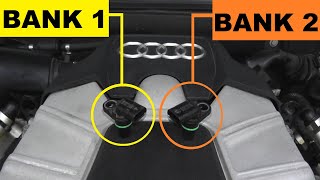
How to confirm: After checking wiring, replacing the sensor is a common diagnostic step. Given its relatively low cost compared to other potential causes, it's often replaced as a primary measure. A multimeter can be used to test for 5V reference power at the connector, but resistance tests on the sensor itself 🎬 See how these camshaft position sensors and Hall senders function. are not considered reliable for these Hall-effect sensors.
Typical fix: Replace the Bank 1 exhaust camshaft position sensor.
Est. part cost: $40-$130 - Failing Timing Chain Tensioner or Stretched Chain 🟡 Medium Probability The 3.2L FSI V6 is widely documented to have issues with its plastic timing chain guides becoming brittle and breaking, and its hydraulic tensioners failing or losing oil pressure at rest. This allows the timing chain to become slack, causing a rattling noise on startup and incorrect camshaft timing that the sensor reports as a fault.
How to confirm: Listen for a distinct rattling or chain-slapping noise from the rear of the engine, most prominent for a few seconds on a cold start. A mechanic can use a scan tool (like VCDS by Ross-Tech) to check camshaft phase deviation in Measuring Block 93. The sum of intake and exhaust values for a bank should not exceed 7-8 degrees. A definitive diagnosis requires physical inspection of the timing components, which is an engine-out procedure.
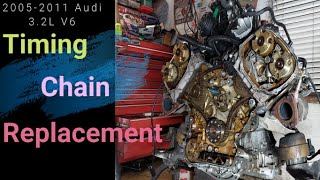
Typical fix: This is a major repair that involves removing the engine and transmission to replace all timing chains, tensioners, and guides. It is not a DIY-friendly job. 🎬 Watch this advanced walkthrough of the timing chain and guide replacement. Costs at an independent shop can range from $4000-$6000.
Est. part cost: $800-$1500 for a full timing kit - Jammed or Faulty Camshaft Adjustment Solenoid (N318) 🟡 Medium Probability An Audi Technical Service Bulletin (TSB 2012630 / 15-07-02) notes that debris or contamination in the engine oil can cause the hydraulic camshaft adjustment solenoids to jam or fail. This prevents the camshaft from adjusting its timing correctly, leading to a 'performance' fault.
How to confirm: A good diagnostic step is to swap the Bank 1 exhaust solenoid with the intake solenoid on the same bank, or with the exhaust solenoid from Bank 2. Clear codes and run the engine. If the fault code follows the solenoid (e.g., changes to P0346 for Bank 2), the solenoid is the problem. They can also be removed and tested with a 9V or 12V source to see if they actuate (click).
Typical fix: Remove and clean or replace the affected camshaft adjustment solenoid. It is often referred to as the N205 valve, though technically on this bank it is N318.
Est. part cost: $50-$150
Rare But Worth Checking
- Wiring Harness or Connector Damage: The wiring to the sensor can become brittle from heat and age. Inspect the harness for cracks, and check the connector for corrosion, backed-out pins, or oil contamination before replacing parts. Electromagnetic interference from nearby ignition components can also disrupt the signal if shielding is compromised.
- Low Oil Level or Pressure: The camshaft adjusters and timing chain tensioners are hydraulically operated by engine oil. Low oil level, incorrect oil viscosity, or pressure issues (e.g., from a clogged oil pickup tube) can cause them to function improperly, leading to timing deviation codes like P0366.
- Faulty Engine Control Module (ECM): While very rare, it is possible for the ECM itself to have a driver circuit failure for the camshaft position sensor. This should only be considered after all other possibilities have been exhaustively ruled out.
Diagnosis Steps
- Read all fault codes using an OBD-II scanner with Audi-specific capabilities (e.g., VCDS). Note any other codes present, especially timing, misfire, or oil pressure codes.
- On a cold start, listen carefully for any rattling or chain-slapping sounds coming from the back of the engine near the firewall. A 2-5 second rattle is a classic sign of a timing tensioner issue. The absence of noise makes a sensor or solenoid issue more likely.
- Check engine oil level and condition. Low or dirty oil can cause issues with the hydraulic tensioners and adjusters.
- Inspect the Bank 1 (passenger side) exhaust camshaft position sensor (G300) and its electrical connector for any signs of damage, corrosion, or oil contamination. Ensure the connector is fully seated.
- Inspect the wiring harness leading to the sensor for brittleness, cracks, or breaks.
- A common and effective diagnostic step is to swap the Bank 1 exhaust camshaft adjustment solenoid (N318) with the Bank 2 exhaust solenoid. Clear codes, drive the car, and see if the fault code moves to Bank 2 (e.g., P0391). If it does, the solenoid is faulty.
- If no noise is present and the solenoid swap has no effect, replace the camshaft position sensor (G300). Clear the codes and perform a test drive.
- If the code returns or a rattle is present, the issue is likely mechanical. The next step is a professional diagnosis using VCDS to check Measuring Block 93 for camshaft deviation. If the deviation is out of spec (over ~7-8 degrees), it confirms a timing chain system problem requiring engine removal for repair.
Parts You'll Likely Need
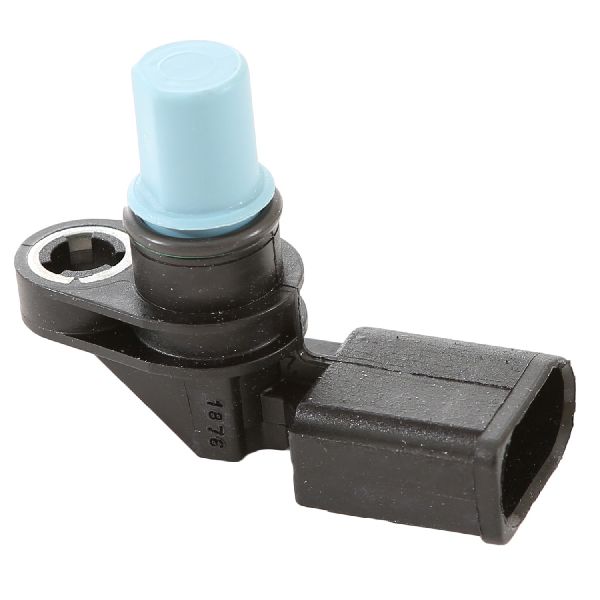
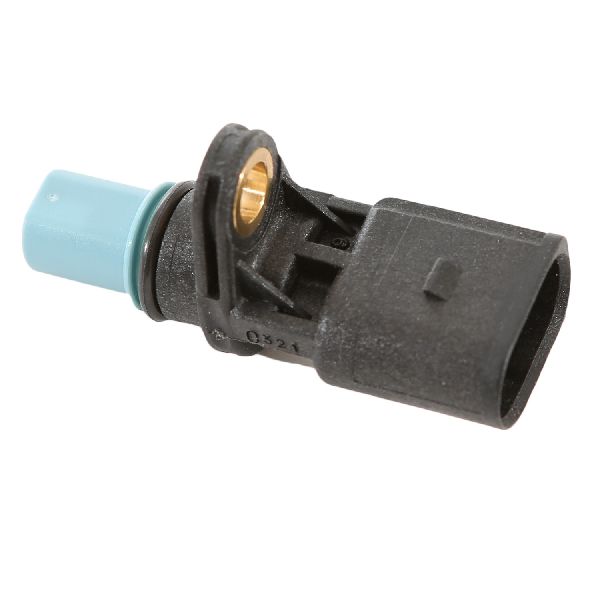
- Camshaft Position Sensor (Bank 1 Exhaust)
(OEM #06E905163)— This sensor is the most common and least expensive part to fail, directly causing the P0366 code.
Trusted brands: Bosch, Hella, NTK, Genuine Audi
OEM price range: $90-$130
Aftermarket price range: $40-$80 - Camshaft Adjustment Solenoid
(OEM #06E109257P)— This solenoid can get stuck due to oil debris or electrical failure, causing timing performance issues as noted in Audi TSBs.
Trusted brands: INA, Pierburg, URO Parts
OEM price range: $120-$180
Aftermarket price range: $50-$150
Related Codes That Often Appear With This One
- P0014 — This code means '"B" Camshaft Position - Timing Over-Advanced or System Performance (Bank 1)'. It often appears with P0366 because a mechanical timing issue or faulty adjuster solenoid is causing the exhaust cam to be out of its specified position.
- P0341 — This is the equivalent 'Range/Performance' code for the intake camshaft sensor on Bank 1. If both appear, it could point to a broader issue like a stuck camshaft adjuster or a significant timing problem on that bank.
- P0346 — This is the equivalent code (P0346 - Camshaft Position Sensor 'A' Circuit Range/Performance Bank 2) for the other side of the engine. If you swap a suspected faulty solenoid from Bank 1 to Bank 2 and this code appears, you have confirmed the solenoid is the issue.
- P0300, P0301, P0302, P0303 — These are random and specific cylinder misfire codes for Bank 1. Incorrect camshaft timing directly affects valve operation and combustion, leading to misfires on the affected bank.
Technical Service Bulletins (TSBs) & Recalls
- TPI 2012630 (or 15-07-02): Addresses issues with camshaft adjusters binding or being sluggish. Recommends checking the solenoids (N205, N318) for contamination or failure. This TSB is frequently referenced in forums as a key diagnostic step for timing-related fault codes.
Platform-Specific Known Issues
- The 3.2L FSI V6 engine is notorious for failures in its timing chain system. The upper timing chain tensioners are a common failure point, leading to a loud rattle on startup.
- Due to the timing components being at the rear of the engine, replacement is a very high-labor job, often costing over $5,000 at a dealership or specialist.
- Forum discussions frequently advise potential buyers of this specific engine to be wary of any startup noises or to have a pre-purchase inspection that specifically checks camshaft deviation values.
Mechanic-Grade Diagnostic Values
- Camshaft Position Sensor (G300) Connector Voltage — expected: 5V reference between Pin 1 (power) and Pin 3 (ground) with key on, engine off.. Failure: Voltage significantly lower than 5V or absent indicates a wiring or ECM power supply issue.
- Camshaft Position Sensor (G300) Signal Wire Voltage — expected: Approximately 5V with key on, engine off. When cranking, an oscilloscope should show a clear 0-5V square wave.. Failure: A flat line or erratic waveform on an oscilloscope during cranking indicates a failed sensor or damaged reluctor ring.
- Camshaft Adjustment Solenoid (N318) Resistance — expected: Approximately 5.0 to 15.0 Ohms. (Value is typical for VVT solenoids, specific Audi value not definitively documented).. Failure: An open circuit (infinite resistance) or a direct short (near zero resistance) indicates a failed solenoid coil.
- VCDS Measuring Block 093 - Camshaft Phase Deviation — expected: The sum of the intake and exhaust values for Bank 1 should be between 0 and -8 degrees at warm idle. Values closer to 0 are ideal.. Failure: A value more negative than -8 degrees (e.g., -9, -10) strongly indicates a stretched timing chain or failing tensioners.
Scan Tool Commands That Help
- VCDS (Ross-Tech): Engine -> Measuring Blocks -> Group 093 — This is the primary method for quantifying timing chain stretch without engine disassembly. Used when a startup rattle is heard or to rule out mechanical timing issues after replacing sensors/solenoids.
- VCDS (Ross-Tech): Engine -> Output Tests -> Camshaft Adjustment Solenoids — This function allows the user to command the N318 solenoid to actuate. You should hear an audible click from the solenoid. This can help determine if the solenoid is completely dead, but it may not identify a solenoid that is mechanically stuck or slow to respond.
Wiring & Ground Locations
- G300 Sensor Connector — On the passenger side (Bank 1) cylinder head, at the rear of the engine near the firewall. It is the exhaust camshaft sensor.. This is the primary connector to inspect for damage, oil contamination, or backed-out pins. The 3-pin connector is often labeled 1J0973723.
- G300 Pinout — On the sensor connector harness.. Pin 1: 5V Power Supply (from ECM). Pin 2: Signal (to ECM). Pin 3: Ground (to ECM). Knowing the pinout is essential for testing voltage and signal integrity with a multimeter or oscilloscope.
- Engine Ground Strap — A primary engine-to-chassis ground strap is typically located on the passenger side of the engine bay, connecting the engine block near the starter/alternator area to the chassis frame rail.. A poor engine ground can cause floating voltages and reference issues for many sensors, including the camshaft position sensor, leading to erratic signal codes like P0366.
- ECM Ground — The ECM has ground connections in the main dash panel wiring harness. A key ground point is often located behind the driver's side kick panel (G44).. Since the sensor's ground path completes at the ECM, a fault in the ECM's own ground can cause this code. This is rare but important to check if direct sensor wiring tests are inconclusive.
Real Owner Repair Stories
- Reddit user J0EYAH in r/MechanicAdvice (Vehicle year/model not specified, but symptoms match the A4 3.2L issue.) — Car stalling, throwing P0366 and misfire codes.
❌ Tried (didn't work) Not specified, but the user was considering replacing the sensor.
✅ What actually fixed it The user updated their post stating the final fix was replacing a stretched timing chain. - AudiWorld Forums user 'dreadlocks' (2006 Audi A6 3.2L (same engine family and issue)) — P0366 and other codes, rough running.
❌ Tried (didn't work) The user was initially focused on sensor or solenoid issues.
✅ What actually fixed it The user performed an 'electroshock therapy' on the N318 solenoid by pulsing it with 12V directly from the battery. This freed up the sticky solenoid and resolved the incorrect camshaft adjustment angle, clearing the codes. This was seen as a temporary fix, with replacement being the long-term solution.
OEM Part Supersession History
06E109257F, 06E109257J→06E109257P— Internal design improvements to prevent sticking and improve oil flow characteristics.
Heads up: All revisions (F, J, P) are physically and electrically compatible, but using the latest 'P' revision is highly recommended for longevity.
Model Year Variations Within This Range
- 2005-2008: The 3.2L V6 engine was available under two codes in this platform: BKH and CALA. While the fundamental design and P0366 causes are the same, there can be minor differences in vacuum line routing or connector styles. However, for the purpose of diagnosing P0366, the procedures for the sensor, solenoid, and timing system are identical.
Diagnostic Flowchart
Other Known Issues on This Vehicle
Issues unrelated to this code that are worth knowing about as an owner of this generation:
- Intake Valve Carbon Buildup 🔴 High — Considered inevitable on FSI (direct injection) engines. Typically requires cleaning every 40,000-60,000 miles to restore performance and prevent misfires.
- High-Pressure Fuel Pump (HPFP) Cam Follower Wear 🔴 High — The cam follower is a small tappet that can wear through, causing damage to the HPFP and the intake camshaft. It's a maintenance item that should be inspected/replaced every 20,000-30,000 miles.
- Thermostat Failure 🟠 Medium — The thermostat can fail, leading to overheating or the engine not reaching operating temperature. Replacement is labor-intensive as it is located behind the intake manifold.
- PCV Valve Failure 🟠 Medium — The Positive Crankcase Ventilation (PCV) valve can fail, leading to excessive oil consumption, rough idle, and oil leaks.
- Oil Consumption 🟠 Medium — These engines can consume oil, often related to the PCV system or piston rings. Owners frequently report needing to top off oil between changes.
Used vs. New Parts: Buying Guide for This Vehicle
When a used part is the smart pick: For this specific fault, buying used parts is generally not recommended due to the nature of the failures. The only exception might be a wiring harness connector pigtail if the original is damaged, as this is not a wear item.
Donor-vehicle mileage cap: roughly under 80000 miles for the part to have meaningful remaining life.
What to inspect on the donor part:
- For a connector pigtail, ensure the plastic is not brittle and the locking tab is intact.
- Ensure there are several inches of wire to allow for proper splicing.
OEM-only on this vehicle (don't cheap out):
- Timing Chain Kit (Chains, Tensioners, Guides): The labor is too expensive to risk using used or low-quality aftermarket parts. Use a reputable OEM supplier like IWIS for chains and Genuine Audi or OEM-supplier parts for guides/tensioners.
- Camshaft Position Sensor: While aftermarket sensors exist, OEM (Bosch, Hella) or Genuine Audi sensors are recommended to avoid signal quality issues that can cause persistent problems.
Aftermarket brands forum-validated for this vehicle:
- Camshaft Adjustment Solenoid: INA, Pierburg (often the OEM supplier)
- Camshaft Position Sensor: Bosch, Hella, NTK
Brands owners have reported issues with on this vehicle:
- Unnamed, no-brand 'white box' sensors and solenoids from online marketplaces. These often have poor quality control and can be dead on arrival or fail prematurely.
Real Owner Stories
Aggregated from forums and TSBs cited above. Mileages and costs reflect what owners reported in those sources.
2006 Audi A6 3.2L V6
Symptoms: Check Engine Light on with codes P0366 and P0014.
What fixed it: Diagnosed and replaced the faulty camshaft adjuster solenoid after confirming it was the culprit by swapping it with another one.
Source hint: AudiWorld Forums: 2006 Audi A6 3.2Q Codes: P0366 and P0014 Repair
2006 Audi A4 3.2L
Symptoms: Owner experienced a timing chain system failure requiring a major engine-out service.
What fixed it: Replaced the timing chains and gaskets.
Cost: $4000-$6000
Source hint: Reddit r/Audi: Replacing the timing chain and gaskets on my 2006 3.2L A4
Audi A4 3.2L
Symptoms: Experienced the well-known timing chain issue, which is a common cause of P0366.
What fixed it: A full timing chain service, which is an engine-out job.
Cost: $4000-$6000
Source hint: Audi-Sport.net: 3.2 Timing Chain.
Related OBD-II Codes
Frequently Asked Questions
I hear a rattling noise from the back of my engine on startup. Is this related to my P0366 code?
How expensive is the timing chain repair for a P0366 code on this Audi A4?
My mechanic mentioned TSB 2012630. How does that relate to my car's P0366 fault?
Can I just replace the camshaft position sensor (G300) to fix this code?
How can I tell if the problem is the sensor or the camshaft adjustment solenoid?
I have an Audi A6 with the 3.2L engine and the same code. Is this information applicable?
Helpful Videos
We Have This Part in Stock


The information in this article is provided for general reference and educational purposes only. Vehicle specifications, procedures, and part compatibility can vary by production date, trim level, and region. Always consult your vehicle's factory service manual and verify part numbers before purchasing or performing repairs. Safety-critical components such as airbags, seat belts, and braking systems should be installed by a qualified professional.
- Audi A4:
- 🎬 Helpful Videos
- 🛍️ Shop This Part
- What's Unique About the 2005-2008 Audi A4
- Symptoms You May Notice
- Most Likely Causes
- Rare But Worth Checking
- Diagnosis Steps
- Parts You'll Likely Need
- Related Codes That Often Appear With This One
- Technical Service Bulletins (TSBs) & Recalls
- Platform-Specific Known Issues
- Mechanic-Grade Diagnostic Values
- Scan Tool Commands That Help
- Wiring & Ground Locations
- Real Owner Repair Stories
- OEM Part Supersession History
- Model Year Variations Within This Range
- Diagnostic Flowchart
- Other Known Issues on This Vehicle
- Used vs. New Parts: Buying Guide for This Vehicle
- Real Owner Stories
- 2006 Audi A6 3.2L V6
- 2006 Audi A4 3.2L
- Audi A4 3.2L
- Related OBD-II Codes
- Frequently Asked Questions
- 🎟️ Get 5% Off