

OBD-II Code P0014: Exhaust Camshaft Position Timing - Over-Advanced (Bank 1)
The Ultimate Guide to What P0014 Means, Why It Triggers, and How to Fix It for Good
- Check your engine oil level and condition immediately, as low, dirty, or incorrect oil causes the majority of P0014 codes.
- Swap the Bank 1 exhaust VVT solenoid with the intake solenoid; if the code changes to P0011, you have definitively identified a faulty $50-$150 solenoid.
- Stop driving immediately if the Check Engine Light flashes or the engine rattles, as this indicates severe misfires or timing chain failure that causes $4,000+ in engine damage.
- Expect repair costs to range from an $80 synthetic oil change to a $2,500+ timing chain replacement, making accurate step-by-step diagnosis critical before buying parts.
What Does P0014 Mean?

The P0014 code means your car's Engine Control Module (ECM) detects that the exhaust camshaft on 'Bank 1' is positioned further ahead in its rotation ('over-advanced') than commanded. This disrupts the engine's ability to efficiently expel exhaust gases, directly degrading engine performance, fuel economy, and emissions.
Technical definition: The official SAE/OBD-II definition is "'B' Camshaft Position - Timing Over-Advanced or System Performance (Bank 1)". 'B' refers to the exhaust camshaft, and 'Bank 1' is the side of the engine containing cylinder #1. The ECM sets this code when the actual camshaft position angle, reported by the camshaft position sensor, differs from the desired angle by a specified amount (e.g., more than 5 degrees) for a set period (e.g., over 5 seconds).
Can I Drive With P0014?
yes_but_not_recommended. You can drive for a short period, but it is strongly discouraged. Continuing to drive causes rough idling, poor performance, stalling in traffic, and significantly worse fuel economy. If the Check Engine Light flashes, it indicates a severe misfire that quickly destroys the catalytic converter by dumping unburned fuel into it—an $800-$2500 repair. In interference engines, ignoring the code risks complete timing failure, causing pistons and valves to collide and resulting in catastrophic engine damage.
Common Causes

- Low, Dirty, or Incorrect Viscosity Engine Oil (Very Common) — The Variable Valve Timing (VVT) system is hydraulic and relies entirely on clean oil at the correct pressure. Low oil levels, sludge contamination, or using the wrong oil weight prevents the system from operating and is the leading cause of P0014. 🎬 See how neglected oil changes cause these VVT failures
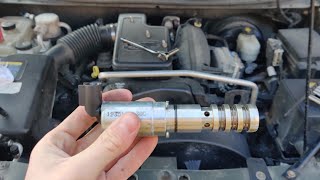
- Faulty VVT Solenoid (Oil Control Valve - OCV) (Common) — This solenoid directs oil flow to the camshaft phaser. It fails electronically, gets stuck open mechanically, or clogs with sludge, forcing the cam timing into an over-advanced state. 🎬 Watch: How to test and replace the camshaft solenoid
- Worn Timing Chain or Failed Tensioner (Common) — Over time, timing chains stretch, guides wear, and hydraulic tensioners fail. This alters the fundamental mechanical timing between the crankshaft and camshafts, creating a permanent deviation the VVT system cannot overcome.
- Clogged Oil Passages or VVT Screens (Less Common) — Engine sludge blocks the microscopic oil passages leading to the VVT components. This includes tiny filter screens located under the VVT solenoids or inside banjo bolts, starving the system of hydraulic pressure.
- Faulty Camshaft Phaser (Actuator) (Less Common) — The phaser is the gear on the camshaft that rotates it. It suffers from internal seal failure, clogs with debris, or mechanically breaks and locks in the advanced position.
- Faulty Camshaft Position Sensor (Less Common) — This sensor reports the camshaft's exact position to the ECM. If it provides an inaccurate or delayed signal, the ECM sets a P0014 code even if the mechanical timing is perfectly aligned.
- Failing Oil Pump or Systemic Low Oil Pressure (Rare) — A worn-out oil pump or a clogged oil pickup tube results in system-wide low oil pressure, preventing the VVT phasers from actuating correctly across the entire engine.
- Wiring or Connector Issues (Rare) — Damaged, frayed, or corroded wiring or a loose connection at the VVT solenoid or camshaft position sensor interrupts electrical signals, triggering the code.
- Faulty Powertrain Control Module (PCM/ECU) (Very Rare) — The engine computer itself suffers a software glitch or internal hardware failure, causing it to misinterpret sensor data and set a false P0014 code. A software update or replacement is required.
Symptoms

- Check Engine Light is On or Flashing — A solid light indicates a detected fault. A flashing light indicates a severe, active misfire that damages the catalytic converter.
- Rough Idle, Stalling, or Hard Starting — The engine runs unevenly, shakes, stalls at stoplights, or cranks for an extended period because the valve timing is incorrect for low-speed operation.
- Rattling or Knocking Noise from Engine — A distinct rattling or tapping sound, particularly on startup or during acceleration, points directly to a failing timing chain, tensioner, or camshaft phaser.
- Reduced Engine Power and Poor Acceleration — The vehicle feels sluggish, hesitates, and lacks responsiveness when pressing the gas pedal, making merging and passing difficult.
- Decreased Fuel Economy — An inefficiently running engine consumes significantly more fuel, dropping MPG by 5-15%.
- Failed Emissions Test — Incorrect valve timing leads to incomplete combustion, increasing harmful emissions and causing an automatic failure of a smog test.
Diagnostic Flowchart
Tap your situation to follow the diagnostic path that matches what you're seeing on this code.
Common Fixes & Costs

- Engine Oil and Filter Change — Parts: $40-$100 (DIY), Labor: $80-$150 (Parts & Labor at a shop), ~0.5 hr book time (DIY)
- Clean VVT Solenoid and Oil Passages — Parts: $10-$20 (Cleaner spray), Labor: $100-$200 (Parts & Labor at a shop), ~1 hr book time (Intermediate)
- Replace VVT Solenoid (Oil Control Valve) — Parts: $25-$150, Labor: $150-$300 (Parts & Labor at a shop), ~1.0 hr book time (Intermediate)
- Replace Camshaft Position Sensor — Parts: $30-$100, Labor: $100-$250 (Parts & Labor at a shop), ~0.8 hr book time (DIY)
- Replace Timing Chain, Tensioner, and Phasers — Parts: $400-$800, Labor: $1500-$3000+ (Parts & Labor at a shop), ~8.5 hr book time (Professional)
DIY vs Professional
- Engine Oil and Filter Change — Beginner:
Tools: Wrench for drain plug, oil filter wrench, drain pan, funnel. - Replace VVT Solenoid — Beginner:
Tools: Basic socket/wrench set, torque wrench, rags. - Replace Camshaft Position Sensor — Beginner:
Tools: Basic socket/wrench set. - Replace Timing Chain, Tensioner, and Phasers — Beginner:
Tools: Extensive mechanic's tool set, engine-specific timing tools (cam holders, crank holding tool), torque wrenches, valve cover and timing cover gaskets, sealants.
Used vs. New Parts: Buying Guide
When a used part is worth it: For the most common fix, the VVT solenoid, buying used is never recommended. The part is inexpensive new, and a used solenoid is likely clogged or near the end of its electronic life.
Donor-vehicle mileage cap: roughly under 40000 miles for the part to have meaningful remaining life.
Donor quality checklist:
- Verify the donor vehicle was not scrapped for engine-related issues.
- Visually inspect the part for corrosion, damage, or clogged screens.
- Match the part number exactly, as similar-looking solenoids have different operational specs.
Decision logic:
- If The part is a VVT solenoid or camshaft position sensor → Buy new. The cost savings on a used part are minimal compared to the risk of premature failure and repeated labor costs.
- If The part is a complete timing chain kit or phaser → Always buy new. These are wear items and installing used timing components is extremely high-risk.
- If Budget is the absolute primary concern and the vehicle's value is low → A used solenoid from a low-mileage, verified source is a possibility, but accept the high risk of it failing soon.
Warranty tradeoff: Used parts from a salvage yard typically have a 30-90 day warranty. Aftermarket new parts often have a 1-year to limited lifetime warranty. OEM new parts carry a 12-month/12,000-mile warranty.
Worst-case if a used part fails: 400-600. If a used solenoid fails after installation, you pay for the diagnostic time and labor costs all over again, plus a new part.
What Happens If You Wait — Timeline
- 0-1 month: Code P0014 is set, and the Check Engine Light is on. The driver notices a slightly rough idle or no symptoms at all. (MPG impact: 0-5%% · Added cost: $0)
- 1-4 months: Symptoms become consistent: noticeable rough idle, hesitation during acceleration, and a clear drop in fuel economy. The engine stalls at low speeds. (MPG impact: 5-15%% · Added cost: $50-200 in wasted fuel)
- 4-9 months: Constant improper timing causes misfires, dumping unburned fuel into the exhaust. This overheats and damages the catalytic converter. The engine produces audible rattling noises as timing components wear further. (MPG impact: 15-25%% · Added cost: $800-$2500 for a new catalytic converter)
- 9+ months: If the root cause is a stretching timing chain, it eventually jumps a tooth or breaks. In an interference engine, this causes the pistons to collide with the valves, resulting in catastrophic engine failure. (MPG impact: N/A (Engine Failure)% · Added cost: $4000-$8000+ for a replacement engine or full rebuild)
Cost of Not Fixing It
- Short-Term (0-3 Months): Noticeable drop in fuel economy (5-15%), rough idle, and poor engine performance. Increased emissions cause a failed smog test. (Added cost: 50-150)
- Medium-Term (3-12 Months): A flashing check engine light indicates misfires dumping unburned fuel into the exhaust, which overheats and destroys the catalytic converter. Increased strain on internal engine components occurs due to improper timing. (Added cost: 1200-2800)
- Long-Term (12+ Months): If caused by a failing timing chain, complete failure occurs. In an interference engine, this leads to pistons colliding with valves, causing catastrophic engine damage requiring a full engine replacement. (Added cost: 4000-8000+)
Diagnosis Steps

- Check Engine Oil Level and Condition
Pull the dipstick, wipe it, re-insert, and check the level. Note if the oil is below the 'add' line, appears thick and sludgy, or smells burnt. This is the most common cause and the easiest to verify.
Tools: Rag or paper towel (Beginner) - Scan for Codes and Review Freeze Frame Data
Use an OBD-II scanner to confirm P0014 and look for related codes like P0011, P0016, or P0300. Analyze the 'freeze frame' data to see the exact engine RPM, temperature, and load when the code triggered.
Tools: OBD-II Scanner (Beginner) - Swap the Intake and Exhaust Solenoids
On many engines, the intake and exhaust VVT solenoids are identical. Swap the Bank 1 exhaust solenoid (P0014) with the intake solenoid (P0011). Clear the codes and drive. If the code changes to P0011, you definitively proved the solenoid is faulty.
Tools: Wrench/socket set (Intermediate) - Inspect VVT Solenoid and Cam Sensor Wiring
Visually inspect the wiring harnesses and connectors for the VVT solenoid and the camshaft position sensor on Bank 1. Look for melted wires, corrosion, or loose pins.
Tools: Flashlight (Beginner) - Test the VVT Solenoid (Electrical and Mechanical)
Remove the solenoid. Check its electrical resistance with a multimeter (typically 5-15 Ohms). Perform a mechanical test by applying 12V from the battery to its terminals; you must hear a distinct 'click' as the internal plunger moves.
Tools: Wrench/socket set, Multimeter, Jumper wires (Intermediate) - Command VVT Actuation with a Bi-Directional Scanner
Use a bi-directional scan tool to command the VVT solenoid on and off while the engine idles. If the engine stumbles or stalls when activated, the solenoid and oil passages are working. If nothing happens, it points to a bad solenoid or a blockage.
Tools: Bi-directional OBD-II Scanner (Advanced) - Check Live Data for Cam Angle Deviation
Monitor the live data PIDs for 'Bank 1 Exhaust Camshaft Position Commanded' and 'Actual'. At idle, these values must be within 1-2 degrees. If the 'Actual' value is consistently higher than commanded by more than 5 degrees under load, it confirms the over-advanced condition.
Tools: Advanced OBD-II Scanner (Advanced) - Check Engine Oil Pressure
Connect a mechanical gauge to the oil pressure sending unit port and compare readings to manufacturer specifications (e.g., minimum 15 PSI at hot idle). Low pressure points to a failing oil pump or clogged pickup tube.
Tools: Oil pressure gauge kit, Wrench/socket set (Advanced) - Inspect Timing Components
Remove the valve cover and timing cover to visually inspect the timing chain for excessive slack, check the tensioner's integrity, and examine the phaser for visible damage.
Tools: Extensive mechanic's tool set (Advanced) - Test Camshaft Phaser with Compressed Air
With the valve cover removed, locate the advance and retard oil passages in the camshaft. Apply regulated, low-pressure compressed air to the 'advance' passage. The phaser must rotate smoothly. If it binds, replace it.
Tools: Compressed air source with regulator, Rubber-tipped air nozzle (Expert) - Analyze Cam/Crank Waveform with an Oscilloscope
Graph the signals from the crankshaft position sensor and the Bank 1 exhaust camshaft position sensor. Compare the waveform to a known-good pattern to reveal subtle timing deviations or stretched chains that scanners miss.
Tools: Automotive Oscilloscope, Sensor-appropriate probes (Expert)
When This Code Triggers (Freeze-Frame Conditions)
- Engine Coolant Temp: 180-210°F (The engine is fully warmed up to normal operating temperature.)
- Engine RPM: 1500-3000 RPM (During steady-state cruise or light acceleration, when the VVT system actively adjusts timing.)
- Engine Load: 25-70% (The engine is under a moderate load, not idling but not at full throttle.)
- Vehicle Speed: 30-60 MPH (Occurs during city or highway driving when the ECM commands a change in cam timing for efficiency.)
Related Codes
- P0011 — This is the direct counterpart to P0014, but for the 'Intake 'A' Camshaft' on the same bank. Having both P0011 and P0014 strongly suggests a problem affecting the entire bank, like low oil pressure or a jumped timing chain, rather than a single component.
- P0015 — This is the opposite of P0014: 'Exhaust 'B' Camshaft Position - Timing Over-Retarded (Bank 1)'. Seeing P0014 and P0015 together points to a mechanically broken phaser, an extremely erratic VVT solenoid, or severe oil sludge causing unpredictable movement.
- P0016 — This code indicates a 'Crankshaft Position - Camshaft Position Correlation' error. P0014 flags a VVT performance issue, whereas P0016 indicates a fundamental mechanical timing misalignment between the cam and crank. P0016 is definitive for a stretched/jumped timing chain.
- P0300 — This is a 'Random Misfire Detected' code. Incorrect exhaust cam timing (P0014) traps exhaust gases in the cylinders, disrupting the air/fuel mixture for the next combustion cycle. Fixing the P0014 issue is the necessary first step to resolving the P0300.
Climate & Environmental Factors
- Cold Weather: Cold temperatures significantly increase oil viscosity. This delays oil flow on startup, preventing the VVT system from functioning correctly until the engine warms up, triggering P0014. Using the manufacturer-specified 'W' (Winter) grade oil is critical.
- Extreme Heat: High operating temperatures accelerate oil degradation, leading to sludge formation and a decrease in viscosity. Degraded oil fails to provide sufficient pressure to operate the VVT phasers correctly.
- High Altitude: Altitude itself does not directly cause P0014. However, lower air density reduces engine power, making the symptoms of an existing P0014 code (like sluggish performance) more noticeable.
How to Talk to a Mechanic About This Code
Say this: "I have an OBD-II code P0014 for the exhaust camshaft timing on Bank 1. I've already confirmed the engine oil is full and clean. I'd like to book a diagnostic appointment to test the VVT system, starting with the solenoid."
This signals you are an informed customer who has done basic checks. It directs the technician to follow a logical diagnostic path (oil -> solenoid -> wiring -> phaser) and prevents them from immediately quoting an expensive, worst-case repair like a timing chain replacement.
Avoid saying:
- 'My check engine light is on, can you just fix it?'
- 'I think I need a new timing chain.'
- 'Just do whatever you think is best.'
Questions to ask before authorizing the repair:
- What were the results of the electrical test on the VVT solenoid?
- Did you try swapping the exhaust and intake solenoids to see if the fault code moved to P0011?
- Can you provide a printout of the freeze-frame data and the live data showing the commanded vs. actual cam angle deviation?
- If you are recommending a timing chain, what was the specific failure you found during visual inspection (e.g., slack, broken guide)?
- What is the warranty on the parts and labor for this specific repair?
Where to Take It: Dealer vs Independent vs Chain
- Dealer:
Recommended only if the vehicle is under warranty or has a known, complex issue specific to the manufacturer that an independent shop might not be equipped to handle.
Best for: Vehicles still under powertrain warranty., Known manufacturer-specific issues covered by a TSB or warranty extension (e.g., VW/Audi timing tensioners, Ford 5.4L phasers)., Complex electrical diagnostics or when an independent shop is unable to find the cause.
Downsides: Highest labor rates, often 1.5x to 2x more than independent shops., Recommends larger, more expensive assemblies instead of replacing a single failed component. (Typical cost: +50% vs. baseline) - Independent Shop:
Best fit for most P0014 repairs. This is a common code and a reputable independent mechanic has extensive experience diagnosing it cost-effectively, starting from the cheapest fixes first.
Best for: Out-of-warranty vehicles where cost is a factor., Diagnosing and repairing common causes of P0014 like VVT solenoids, oil pressure issues, and sensors., Most timing chain and phaser replacements.
Downsides: Shop quality and technician skill vary widely. Look for ASE certifications and positive reviews., Lacks access to the very latest manufacturer-specific software updates or tools. (Typical cost: +0% vs. baseline) - Chain Shop:
Use with caution. Acceptable for a simple oil change or if you have already self-diagnosed a bad solenoid. AVOID for initial diagnosis or any repair more complex than a simple bolt-on part.
Best for: An oil and filter change if you suspect that is the cause., Replacing a very accessible VVT solenoid or camshaft position sensor.
Downsides: Technician skill and diagnostic equipment are inconsistent., High pressure to upsell services; recommends unnecessary flushes or parts., Not equipped for in-depth timing work like phaser or timing chain replacement. (Typical cost: -10% vs. baseline)
When to Walk Away From the Repair
If the estimated repair cost exceeds 40-50% of the car's private-party market value, seriously consider selling or trading in the vehicle instead of repairing it.
- Car worth $3000, fix is $2500: Walk away. The repair cost is over 80% of the car's value. It is not a sound investment.
- Car worth $12000, fix is $400: Fix it. The repair is a small fraction of the car's value and restores its performance and reliability.
- Car worth $5000, fix is $2500: Borderline. The repair cost is exactly 50% of the car's value. Get a second opinion and carefully consider the car's overall condition before proceeding.
What Scan Tool You Need for This Code
Minimum: A scanner that reads and graphs live data, specifically the 'Commanded' vs. 'Actual' camshaft position PIDs.
A basic $20 code reader only shows the P0014 code, but lacks the live data needed to determine if the problem is a sensor, a solenoid, or a mechanical issue. You will guess and replace the wrong parts.
Budget: BlueDriver Pro (~$100) — Connects to your smartphone to read freeze-frame data and graph live data PIDs, including camshaft position. This shows the deviation between commanded and actual angles to confirm the fault.
Mid-range: Foxwell NT710 / Kingbolen K7 (~$300-400) — Offers bi-directional control. This allows you to command the VVT solenoid on and off to test its mechanical function directly from the tool, quickly confirming or ruling out a bad solenoid.
Professional: Autel MaxiCOM MK808 / Launch X431 series (~$500-1200) — Provides full bidirectional controls, OEM-level diagnostics, and advanced functions like ECU coding. These tools offer comprehensive data and testing capabilities essential for diagnosing complex or intermittent issues.
Rent vs buy: If this is a one-time repair, major auto parts stores like AutoZone and O'Reilly offer a free tool loaner program. You pay a deposit for a scanner, use it to diagnose your car, and get the full deposit back when you return it. Buy a scanner only if you plan to do your own car repairs regularly.
How to Clear the Code After You Fix It
- Use an OBD-II scan tool to clear the diagnostic trouble codes.
- Perform a complete drive cycle to allow the engine computer to re-learn and check the system.
- Check for pending codes after the drive cycle to confirm the fix was successful.
Drive cycle (~20 minutes): A typical drive cycle involves a cold start, idling for 2-3 minutes, followed by 10-15 minutes of mixed city and highway driving (including steady speeds and acceleration/deceleration), and then allowing the engine to cool down completely.
Readiness monitors affected: Comprehensive Component Monitor, Misfire Monitor, Catalyst Monitor, EVAP System Monitor
Before emissions retest: drive at least 50 miles to fully set monitors.
Watch out for:
- Simply disconnecting the battery clears the code but resets all readiness monitors, causing an immediate emissions test failure.
- The code returns if the root cause (e.g., dirty oil, faulty solenoid) is not properly addressed.
- Not completing a full drive cycle leaves readiness monitors 'Not Ready', preventing an emissions test from running.
Will This Fail Emissions / State Inspection?
Yes — this code typically fails an OBD-II emissions inspection.
- California: An active P0014 code causes an automatic smog check failure. All readiness monitors must be set to 'Ready' before a test passes, requiring 50-100 miles of driving after a repair.
- New York: The NYS DMV inspection includes an OBD-II scan. A check engine light with code P0014 results in an automatic failure.
- Texas: In counties requiring emissions testing, a vehicle fails the OBD-II portion of the inspection if the check engine light is on for code P0014.
Most Commonly Affected Vehicles
- Chevrolet/GMC Equinox, Malibu, Silverado, Sierra, Tahoe (2007-2017) — The 2.4L Ecotec engine is highly prone to this code due to oil consumption or solenoid failure. The 5.3L/6.2L V8s are also common, with issues linked to the Active Fuel Management (AFM) system and oil pressure.
- Ford F-150, Expedition, Mustang GT (2004-2010) — The 5.4L 3V Triton V8 is infamous for P0014 due to a complex phaser design and oil passages prone to clogging. TSB 06-19-8 addresses VVT and phaser noise issues.
- Nissan Altima, Rogue, Sentra (2013-2018) — Vehicles with the 2.5L (QR25DE) engine frequently exhibit this code, caused by a faulty exhaust valve timing control solenoid. It is standard practice to replace all related VVT solenoids at once.
- Toyota/Lexus Camry, Corolla, RAV4, Highlander, ES350 (2009-2018) — Commonly seen on the 2.5L (2AR-FE) and 3.5L (2GR-FE) engines. The cause is a failed VVT solenoid or sludge buildup from extended oil change intervals.
- Hyundai/Kia Sonata, Optima, Sportage, Santa Fe (2011-2019) — The 2.0L and 2.4L GDI engines are susceptible to this code, stemming from oil sludge issues, solenoid failure, or premature timing chain wear.
- Honda/Acura Civic, CR-V, Accord, RDX (2016-2022) — On newer models with the 1.5L Turbo engine, P0014 indicates a malfunction in the VTC (Variable Timing Control) system, pointing to the VTC oil control solenoid valve.
- Subaru Outback, Forester, Impreza, Legacy (2010-2017) — Subaru's AVCS (Active Valve Control System) triggers this code. Common causes include a failed oil control solenoid or clogged mesh filters inside the banjo bolts supplying oil to the system.
- BMW 3-Series, 5-Series, X3, X5 (2006-2013) — BMW's VANOS system is their version of VVT. Solenoid failure is a very common cause for this code on E90 and E60 chassis. Technicians swap the intake and exhaust solenoids to confirm the fault.
- Volkswagen/Audi Jetta, Golf, Passat, A4 (TSI/FSI Engines) (2008-2015) — On VW's direct-injection engines, this code is a serious warning for a stretched timing chain or failing chain tensioner. It is also caused by a faulty camshaft adjuster magnet (solenoid).
Manufacturer-Specific Notes
- General Motors (GM): On many 2.4L Ecotec engines, the VVT solenoids sit under small mesh screens that frequently clog with sludge. Cleaning or replacing the solenoid and screen resolves the code. GM issued Special Coverage Adjustments (SCA) for excessive oil consumption on 2010-2013 Equinox and Terrain models.
- Ford: The 5.4L 3V Triton engine is extremely sensitive to oil pressure and filter type. Using a low-quality oil filter without a proper anti-drainback valve causes oil pressure to bleed off at startup, leading to phaser rattle and setting this code. Always use the OEM-specified filter.
- Subaru: If a new oil control solenoid doesn't fix the code, check the banjo bolt filters. These tiny mesh screens in the oil supply lines for the AVCS (VVT) system are notorious for clogging with debris, starving the solenoids of oil.
- BMW: A common diagnostic trick for BMW's VANOS system is to swap the intake and exhaust solenoids, as they are identical. If the fault code moves from the exhaust side (P0014) to the intake side (P0011), it provides 100% confirmation that the solenoid failed.
- Volkswagen/Audi: For certain 2008-2014 TSI engines, VW/Audi offered a warranty extension to 10 years or 100,000 miles for failed timing chains and tensioners, a common cause of this code. Check with a dealer using the vehicle's VIN to confirm coverage.
Real Owner Stories
2015 Chevy Equinox at 191K miles with intermittent P0014
Owner noticed the P0014 code appeared when the engine oil was low. The car had high oil consumption, and the code triggered, then cleared by adding oil and performing an oil change.
What they tried:
- Repeatedly topped off oil to make the light go away.
- Performed more frequent oil changes.
- Eventually, the code returned even with a full oil level, with 'muddy looking oil' on the dipstick.
Outcome: The underlying issue was not just low oil, but sludge buildup from the high-mileage engine's oil consumption problem. The initial 'fix' of adding oil was only a temporary symptom mask. The final repair involved replacing VVT components.
Lesson: If P0014 is associated with low oil, it's a major warning sign. Don't just top it off; investigate the cause of oil loss. Sludge builds up and causes the code to return permanently, even after an oil change.
2016 Kia Sportage 2.4L with a flashing Check Engine Light
Engine would not rev above 2,000 RPM, made a loud rattling noise, and the CEL went from solid to flashing.
What they tried:
- Discovered the engine oil was almost empty and added 4 quarts.
- Cleaned and tested the exhaust VVT solenoid, which appeared to function correctly.
- Replaced the camshaft position sensor.
Outcome: Despite replacing the sensor and cleaning the solenoid, the problem persisted. The owner concluded the severe oil starvation caused internal engine damage to cam phasers and timing components that a simple sensor replacement could not fix.
Lesson: A flashing CEL with rattling is a 'stop driving immediately' situation. If caused by severe oil starvation, replacing sensors is a misdiagnosis; the root cause is mechanical damage requiring an expensive repair.
2015 Hyundai Sonata with P0014 and conflicting shop advice
Check engine light came on. An independent shop scanned P0014 and immediately condemned the engine, advising a dealership visit. The dealership quoted $1100 of service before beginning a warranty claim for the engine.
What they tried:
- The owner discovered the engine had only a half-quart of oil.
- The dealer's proposed work included replacing a cover, spark plugs, a hose, and a gasket to address a potential oil leak before proceeding with an oil consumption test.
Outcome: The owner was caught between one shop's immediate 'new motor' diagnosis and the dealer's expensive 'pre-warranty' repair requirements, all stemming from a P0014 code caused by severe oil loss.
Lesson: A P0014 code with very low oil leads to drastically different and confusing advice. Always verify the oil level yourself first. Be wary of shops jumping to extreme conclusions without basic diagnostics.
2011 Chevy Equinox 2.4L with a 'sticky' P0014 fix
P0014 code present. Live data on a scan tool showed the exhaust camshaft position stuck at 0 degrees, not matching the desired angle.
What they tried:
- Tested the original solenoid, which seemed okay.
- Used Seafoam in the oil and drove it hard, then changed the oil and filter.
- Replaced the VVT solenoid with a new one when the code persisted.
Outcome: The new solenoid did not fix the issue. The owner discovered that after a long drive (20+ minutes), the cam angle started working correctly, but stuck at 0 again after shutting the engine off. The issue was sludged-up oil passages or a sticking cam phaser that only freed up with heat.
Lesson: A 'good' solenoid cannot operate if oil cannot reach it or the phaser is stuck. If a new solenoid fails to work, but the system functions after the engine is very hot, it strongly points to a sludge or mechanical binding issue.
How to Prevent This Code From Triggering
- Use the manufacturer-specified engine oil viscosity and change it on schedule. (Per vehicle's maintenance schedule (e.g., 5,000-7,500 miles)) — The VVT system is hydraulic and highly sensitive to oil quality and pressure. Clean, correct-viscosity oil prevents sludge from clogging tiny passages in the VVT solenoids and cam phasers.
- Use high-quality full-synthetic oil. (Every oil change) — Synthetic oils resist thermal breakdown and oxidation, the primary chemical reactions creating engine sludge. They contain advanced detergents that keep contaminants suspended.
- Always replace the oil filter with a high-quality unit. (Every oil change) — A quality filter with an anti-drainback valve prevents contaminated oil from draining out of the VVT system when the engine is off, ensuring proper pressure is available immediately on startup.
- Regularly check the engine oil level between changes. (Monthly) — Many P0014 issues begin when the oil level drops too low, starving the VVT system of pressure. This is critical on engines known for oil consumption.
- Avoid excessive short trips; allow the engine to reach full operating temperature. (Weekly) — Short drives fail to heat the engine oil enough to burn off moisture and fuel contaminants. This mixture of condensation and oil is a primary contributor to sludge formation.
Frequently Asked Questions
Can I just clear the code and keep driving?
You can clear the code with a scanner, but it returns within a few drive cycles if the underlying mechanical or electrical problem persists. This is not a solution and allows a potentially damaging condition to worsen. Fix the root cause to keep the code away permanently.
Can a recent oil change cause the P0014 code?
Yes. Using the incorrect oil viscosity (e.g., 5W-30 instead of 5W-20) or installing a low-quality oil filter that restricts flow triggers P0014. The VVT system requires precise hydraulic pressure to function.
What is the most common misdiagnosis for P0014?
The most frequent mistake is immediately replacing the camshaft position sensor without performing basic checks. The problem is almost always related to the engine oil (level, condition, type) or a dirty VVT solenoid. Always start diagnosis by checking the dipstick.
What is 'Bank 1' and how do I find it?
Bank 1 is the side of the engine containing the #1 cylinder. On an inline engine, there is only one bank. On a V-engine, it is typically the bank located further forward in the engine bay.
Is an engine flush a good idea to fix P0014?
It is a high-risk solution. Chemical flushes dislodge hardened carbon deposits that block critical oil passages, causing catastrophic engine failure. Instead, perform two short-interval (1,000-mile) oil changes using high-quality synthetic oil.
What is the difference between P0014 and P0016?
P0014 indicates a VVT performance problem where the camshaft phaser fails to reach its commanded position due to oil flow or solenoid issues. P0016 indicates a correlation problem where the camshaft's base timing is physically out of sync with the crankshaft. P0016 strongly suggests a stretched chain or jumped tooth.
Can I just replace the camshaft position sensor to fix P0014?
While a faulty sensor causes this code, it is one of the least likely culprits. Replacing it without proper diagnosis wastes money. The sensor simply reports the timing error; it rarely causes it.
What does a blinking check engine light with P0014 mean?
A flashing check engine light signals a severe, active engine misfire. The over-advanced timing disrupts combustion, dumping unburned fuel into the exhaust and destroying the catalytic converter in minutes. Pull over and shut off the engine immediately.
Is this an expensive fix?
Costs vary dramatically based on the root cause. Fixing low or dirty oil costs under $100, while replacing a VVT solenoid runs $150-$300 at a shop. However, replacing a stretched timing chain and failed phasers easily exceeds $2,500.
Can low oil pressure cause P0014?
Yes, low oil pressure directly causes P0014. The VVT system depends entirely on specific oil pressure to actuate the camshaft phasers. Any systemic issue causing low pressure disables the VVT system and triggers this code.
Key Takeaways
- Check your engine oil level and condition immediately, as low, dirty, or incorrect oil causes the majority of P0014 codes.
- Swap the Bank 1 exhaust VVT solenoid with the intake solenoid; if the code changes to P0011, you have definitively identified a faulty $50-$150 solenoid.
- Stop driving immediately if the Check Engine Light flashes or the engine rattles, as this indicates severe misfires or timing chain failure that causes $4,000+ in engine damage.
- Expect repair costs to range from an $80 synthetic oil change to a $2,500+ timing chain replacement, making accurate step-by-step diagnosis critical before buying parts.
Helpful Videos


The information in this article is provided for general reference and educational purposes only. Vehicle specifications, procedures, and part compatibility can vary by production date, trim level, and region. Always consult your vehicle's factory service manual and verify part numbers before purchasing or performing repairs. Safety-critical components such as airbags, seat belts, and braking systems should be installed by a qualified professional.
- 🎬 Helpful Videos
- What Does P0014 Mean?
- Can I Drive With P0014?
- Common Causes
- Symptoms
- Diagnostic Flowchart
- Common Fixes & Costs
- DIY vs Professional
- Used vs. New Parts: Buying Guide
- What Happens If You Wait — Timeline
- Cost of Not Fixing It
- Diagnosis Steps
- When This Code Triggers (Freeze-Frame Conditions)
- Related Codes
- Climate & Environmental Factors
- How to Talk to a Mechanic About This Code
- Where to Take It: Dealer vs Independent vs Chain
- When to Walk Away From the Repair
- What Scan Tool You Need for This Code
- How to Clear the Code After You Fix It
- Will This Fail Emissions / State Inspection?
- Most Commonly Affected Vehicles
- Manufacturer-Specific Notes
- Real Owner Stories
- 2015 Chevy Equinox at 191K miles with intermittent P0014
- 2016 Kia Sportage 2.4L with a flashing Check Engine Light
- 2015 Hyundai Sonata with P0014 and conflicting shop advice
- 2011 Chevy Equinox 2.4L with a 'sticky' P0014 fix
- How to Prevent This Code From Triggering
- Frequently Asked Questions
- Can I just clear the code and keep driving?
- Can a recent oil change cause the P0014 code?
- What is the most common misdiagnosis for P0014?
- What is 'Bank 1' and how do I find it?
- Is an engine flush a good idea to fix P0014?
- What is the difference between P0014 and P0016?
- Can I just replace the camshaft position sensor to fix P0014?
- What does a blinking check engine light with P0014 mean?
- Is this an expensive fix?
- Can low oil pressure cause P0014?
- Key Takeaways
- 🎟️ Get 5% Off