

P0345 on 2005-2011 Audi A6 4.2L V8: Camshaft Sensor Causes and Fixes
P0345 on a 2005-2011 Audi A6 4.2L V8 indicates a fault with the Camshaft Position Sensor 'A' on Bank 2 (driver's side). The most common fix is replacing the sensor itself, which is a DIY-friendly job with the part costing between $30 and $185. However, this code can also be an early warning for more serious timing chain issues, a known and very expensive failure point on this engine.
- P0345 points to the camshaft position sensor on the driver's side (Bank 2).
- The most likely fix is replacing the sensor, a simple DIY job that requires a T30 Torx bit.
- Before replacing parts, check if the cam sensor connector was swapped with the nearby intake manifold tuning valve connector, especially after recent repairs.
- Always use a quality OEM-supplier brand like Bosch for critical sensors to avoid premature failure.
- Be alert for a rattling noise on startup; it could mean the code is a symptom of a much more serious and expensive timing chain problem requiring engine removal.
- A good diagnostic step is to swap the Bank 1 and Bank 2 sensors to see if the fault code follows the sensor.
What's Unique About the 2005-2011 Audi A6
The 2005-2011 Audi A6 (C6 generation) with the 4.2L V8 (engine codes like BAT or BNK) uses a timing chain system located at the rear of the engine, against the firewall. While the P0345 code is often just a failed sensor, it's crucial to be aware that these engines are known for catastrophic issues with their plastic timing chain tensioners and guides. A camshaft position sensor code can be the first symptom of the camshaft timing becoming incorrect due to a stretching chain or failing tensioner. An owner with a 2005 A6 4.2L at 188k miles reported getting timing codes and confirmed upon disassembly that the guides were 'toast'. This repair requires engine removal and can cost anywhere from $4,500 to over $15,000.
Symptoms You May Notice
- Check Engine Light is on
- Engine is difficult to start or cranks for a long time
- Engine stalls unexpectedly
- Rough idle
- Poor acceleration and loss of power
- Reduced fuel efficiency
- Rattling noise from the back of the engine, especially on cold starts
- Replacing the crankshaft position sensor. While they work together, P0345 specifically points to the camshaft sensor circuit for Bank 2.
- Assuming the sensor is always the problem without checking for timing chain rattle, which could indicate a much more severe issue.
- Not checking for swapped electrical connectors after recent engine work, leading to unnecessary replacement of sensors.
Most Likely Causes
- Failed Camshaft Position Sensor (Bank 2) 🔴 High Probability The sensor operates in a high-heat environment at the back of the engine, leading to eventual electronic failure over time. It is one of the most common failures on these engines.
How to confirm: Swap the Bank 1 and Bank 2 sensors. They are identical parts. If the code changes to P0340 (Bank 1), the sensor is bad. If the P0345 code returns, the problem is in the wiring or timing system.
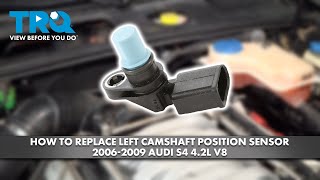
Typical fix: Replace the Bank 2 Camshaft Position Sensor. It is held by a single T30 Torx bolt. 🎬 Watch this walkthrough on how to replace the sensor.
Est. part cost: $30-$185 - Wiring Harness or Connector Issue 🟡 Medium Probability Engine vibrations and heat can cause wires to become brittle and crack, or the connector can become loose or contaminated with oil. The wiring harness runs in a tight space at the rear of the engine.
How to confirm: Visually inspect the wiring and connector for damage, corrosion, or oil. Use a multimeter to test for 5V power at the connector with the ignition on. The sensor has three wires going to the ECM.
Typical fix: Repair the damaged wiring or clean/replace the connector.
Est. part cost: $5-$50 - Swapped Electrical Connectors 🟡 Medium Probability The electrical connector for the camshaft position sensor is identical to the one for the intake manifold tuning valve, located nearby. It is very easy to mix these two connectors up after performing other maintenance like replacing valve cover gaskets.
How to confirm: If work was recently performed, check if the connectors for the Bank 2 cam sensor and the intake manifold tuning valve are swapped. Swapping them back will immediately resolve the issue if this is the cause. This often presents with both P0345 and P2075 codes.
Typical fix: Swap the connectors back to their correct components.
Est. part cost: $0 - Failing Timing Chain Tensioner or Stretched Chain ⚪ Low Probability The plastic guides on the timing chain tensioners for the 4.2L V8 are a well-documented failure point. As they wear and break apart, the chain loses tension, which can cause camshaft timing to deviate and trigger a sensor code.
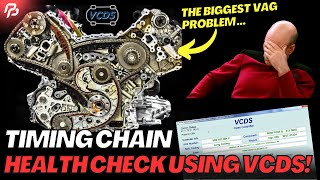
How to confirm: Listen for a 'death rattle' from the rear of the engine on a cold start. If a new sensor and correct wiring don't fix the code, a professional diagnosis of the timing system is required. This can be checked via VCDS measuring blocks (e.g., 091, 093) to see cam phase deviation. 🎬 See how to check timing chain stretch using VCDS. Physical inspection is an engine-out service.
Typical fix: Replace timing chains, tensioners, and guides. This is a very expensive, professional-only job. Many owners upgrade to the more durable metal guides from the RS4.
Est. part cost: $1500-$5000+
Rare But Worth Checking
- Failing Engine Control Module (ECM): This is extremely rare. Before condemning the ECM, all other possibilities, including wiring and mechanical timing, must be exhaustively ruled out.
- Damaged Camshaft Reluctor Wheel: The sensor reads a toothed wheel on the camshaft. If this wheel is bent, cracked, or has missing teeth, the sensor will generate an incorrect signal, triggering P0345 even with a good sensor. This would require removing the valve cover to inspect.
- Clogged Oil Passages / Faulty Camshaft Adjuster: Related TSBs point to issues where debris from failing filter screens in the camshaft bridge can clog oil passages to the camshaft adjusters (phasers). This starves the adjuster of oil pressure, preventing it from changing cam timing correctly and potentially setting a fault. The adjuster itself can also fail mechanically.
Diagnosis Steps
- Read the codes with an OBD-II scanner. Confirm P0345 is present and note any other codes, especially timing correlation codes (P00xx) or P2075.
- If recent work was done, immediately check if the Bank 2 camshaft sensor connector and the intake manifold tuning valve connector have been swapped. They are identical and easily confused.
- Locate the Camshaft Position Sensor on Bank 2 (driver's side). On the 4.2L V8, it is located at the rear of the cylinder head, near the firewall, held by a T30 Torx screw.
- Inspect the sensor's electrical connector and wiring. Look for loose connections, corrosion, oil contamination, or physical damage.
- If the wiring looks good, test the connector for power. With the ignition on (engine off), use a multimeter to verify there is a 5-volt reference, a ground, and a signal wire.
- If power is present, the easiest way to test the sensor is to swap it with the Bank 1 (passenger side) sensor. Clear the codes, run the engine, and see if the code returns as P0345 or changes to P0340 (for Bank 1).
- If the code changes to P0340, the sensor you moved is faulty and needs replacement.
- If the P0345 code returns after the swap, the problem lies in the Bank 2 wiring or the engine's mechanical timing.
- Listen carefully for a rattling sound from the back of the engine during a cold start. This is a classic sign of failing timing chain guides.
- Using a diagnostic tool like VCDS, check the measuring blocks for camshaft adaptation (e.g., Block 093). Large deviation values point towards a mechanical timing issue.
- If a timing issue is suspected, a possible next step before engine removal is to inspect the oil control valve screens in the camshaft bridges for debris, as per TSB 2045732/1.
- If all else fails, professional diagnosis is required as it is an engine-out service to inspect the timing components.
Parts You'll Likely Need
- Camshaft Position Sensor (Bank 2)
(OEM #07L905163C)— This is the most common cause of a P0345 code. The sensor fails due to heat and age. This part number supersedes 07L905163B, 7L905163A, and 7L905163.
Trusted brands: Bosch, Hella, Vemo, Genuine Audi
OEM price range: $150-$185
Aftermarket price range: $30-$90
Related Codes That Often Appear With This One
- P0340 — If you swap the Bank 1 and Bank 2 sensors for diagnosis, you may see this code appear, confirming the sensor itself is faulty.
- P0018, P0016, P0021 — These codes indicate a correlation issue between the crankshaft and camshaft, strongly suggesting the problem is with the mechanical timing (chain/tensioners/adjusters) rather than just the sensor. An owner reported P0011 and P0021 before undertaking a full timing chain job.
- P2075 — This code for the Intake Manifold Tuning Valve Position Sensor may appear with P0345 if their identical electrical connectors have been accidentally swapped during a repair.
Technical Service Bulletins (TSBs) & Recalls
- TSB 2045732/1: Notes that a screen housing on a non-return valve in the camshaft bridge can fail. Debris can be cleaned out, potentially restoring proper oil flow to cam adjusters without replacing the entire bridge.
Platform-Specific Known Issues
- The 4.2L V8 in the C6 A6 platform is known for the eventual failure of its plastic timing chain guides. A P0345 code can be an early indicator of this much larger problem if the timing has begun to shift. A rattling noise on startup is a key symptom to watch for.
- The electrical connectors for the camshaft position sensor and the intake manifold tuning valve are identical and located near each other, creating a high probability of being swapped during maintenance, which will trigger this code.
Mechanic-Grade Diagnostic Values
- Camshaft Position Sensor (G163) Connector Voltage — expected: Approximately 5.0V DC between Pin 1 (Power) and Pin 3 (Ground) with ignition on, engine off.. Failure: No voltage indicates a wiring issue, blown fuse, or ECM fault. Significantly lower voltage can indicate a wiring problem.
- VCDS Engine Measuring Block 093 - Camshaft Adjustment — expected: At warm idle, the sum of the values for 'Intake Bank 1 Phase' and 'Exhaust Bank 1 Phase' should be less than 7-8 degrees. The same applies to Bank 2.. Failure: A total deviation for either bank exceeding 8 degrees (e.g., -5 intake and -4 exhaust = -9 total) strongly indicates a mechanical timing issue (stretched chain or failed tensioner/adjuster).
- Camshaft Adjuster Solenoid Resistance — expected: Approximately 13 ohms.. Failure: A reading of 2-3 ohms or an open circuit (infinite resistance) indicates a failed solenoid.
Hidden / Shadow Codes Worth Checking
- 17934: This is the Audi factory fault code equivalent for a P1526, which indicates a camshaft position actuator circuit malfunction, often a short to voltage. While P0345 points to the sensor circuit, a related actuator fault can sometimes set a misleading sensor code. (see via VCDS (VAG-COM) or other dealer-level diagnostic tools.)
Scan Tool Commands That Help
- VCDS (VAG-COM): Engine -> Measuring Blocks -> Group 093 — This is a critical step after verifying the sensor and wiring are good. It allows you to see the live camshaft phase deviation in degrees for both banks. It's the primary non-invasive way to check for mechanical timing stretch before committing to an engine-out service.
Wiring & Ground Locations
- G163 Connector (Bank 2 Cam Sensor) — Rear of the driver's side (Bank 2) cylinder head, near the firewall.. This is the main connector for the sensor in question. Pin 1 is 5V power from the ECM, Pin 2 is the signal wire back to the ECM, and Pin 3 is the ground.
- Ground Point 12 — In the engine compartment, on the front of the left longitudinal member.. A poor engine ground can cause a host of erratic sensor readings, including from the camshaft position sensor. Ensuring this primary ground connection is clean and tight is a crucial step in diagnosing electrical gremlins.
- Ground Point 18 — Directly on the engine block.. This is another critical ground connection for engine sensors. A loose or corroded connection here can affect the sensor's ability to provide a stable signal to the ECM.
Real Owner Repair Stories
- AudiWorld Forums user 'smithometer' (Audi A8 with 4.2L BFM engine (similar architecture)) — Check engine light with fault 17755 (Camshaft Position Sensor 2 (G163) / Engine Speed Sensor (G28) Incor. Correl.)
❌ Tried (didn't work) The user had just replaced both camshaft chain tensioners and performed a full timing belt service, setting timing according to the manual.
✅ What actually fixed it The user suspected they had installed the new left and right camshaft adjusters on the wrong banks (swapped them). VCDS showed Bank 2 intake running at +14 degrees while Bank 1 was at 0, strongly suggesting a mechanical installation error rather than a sensor or wiring fault. The resolution required disassembling the front of the engine again to correct the adjuster installation.
Model Year Variations Within This Range
- 2005-2011: Within the C6 A6 4.2L, there are two primary engine codes: BAT and BNK. While mechanically very similar for the purpose of this repair, the BNK is a 40-valve engine, and some sources also mention a BVJ engine. The FSI (Fuel Stratified Injection) version of the 4.2L V8 (engine code BAR) introduced in later years and other models like the Q7 has significant differences, including a revised chain drive and Bosch MED 9.1.1 engine management. It's crucial to ensure parts are ordered for the correct engine code, although the P0345 diagnostic process is nearly identical.
Diagnostic Flowchart
Used vs. New Parts: Buying Guide for This Vehicle
When a used part is the smart pick: A used wiring harness pigtail is a good option if only the connector is damaged. A used engine cover or mounting bracket is also perfectly acceptable. Avoid used electronic sensors or mechanical timing components.
Donor-vehicle mileage cap: roughly under 75000 miles for the part to have meaningful remaining life.
What to inspect on the donor part:
- For a wiring pigtail, ensure the plastic isn't brittle and the locking tab is intact.
- Check for any signs of oil contamination or heat damage on the wiring insulation.
- Verify the donor vehicle has a clean history and was not in a front-end collision.
OEM-only on this vehicle (don't cheap out):
- Camshaft Position Sensor: While aftermarket sensors exist, OEM (Bosch, Hella) or a reputable OEM supplier is highly recommended to avoid signal quality issues that can cause persistent problems.
- Timing Chain Components: Given the labor-intensive nature of the job, using anything other than OEM or OEM-equivalent (Iwis for chains, for example) timing chains, guides, and tensioners is a significant risk.
- Camshaft Adjusters: These are complex mechanical and hydraulic parts. Due to the high failure rate of even original units, installing a used one is not recommended. New OEM is the only reliable option.
Aftermarket brands forum-validated for this vehicle:
- Bosch (Often the OEM supplier for the sensor)
- Hella
- Vemo
Brands owners have reported issues with on this vehicle:
- Generic, unbranded sensors from online marketplaces are frequently cited in forums as being 'dead on arrival' or failing within a few months.
Real Owner Stories
Aggregated from forums and TSBs cited above. Mileages and costs reflect what owners reported in those sources.
2005 Audi A6 4.2L — 188000 miles
Symptoms: Experienced timing codes.
What fixed it: An engine-out service was required to replace the timing chains and guides, which were confirmed to be 'toast'.
Source hint: AudiWorld Forums - 'Thank you for the timing chain help (with pics)'
2007 Audi A6 4.2L V8
Symptoms: Received P0345 and P2075 error codes after performing other maintenance.
What fixed it: Discovered the identical electrical connectors for the cam sensor and the intake manifold tuning valve were swapped. Swapping them back to their correct positions fixed both codes.
Source hint: AudiWorld Forums - 'P2075 and P0345 error codes'
2006 Audi A6 4.2L V8
Symptoms: Diagnosed with failing timing chain components after investigating camshaft position sensor codes.
What fixed it: Full timing chain replacement service.
Cost: $4500-$16000
Source hint: YouTube/Reddit - Multiple owner stories
Related OBD-II Codes
Frequently Asked Questions
I just replaced my valve cover gaskets and now I have a P0345 code. What did I do wrong?
I hear a rattling noise on cold starts along with my P0345 code. What does this mean for my 4.2L V8?
How can I test the camshaft position sensor on my A6 without buying a new one first?
What is the estimated cost to fix the timing chains if that's the cause of my P0345 code?
How can I check my camshaft timing deviation at home on my Audi A6?
Does TSB 2045732/1 apply to the P0345 code on my A6?
Helpful Videos
We Have This Part in Stock


The information in this article is provided for general reference and educational purposes only. Vehicle specifications, procedures, and part compatibility can vary by production date, trim level, and region. Always consult your vehicle's factory service manual and verify part numbers before purchasing or performing repairs. Safety-critical components such as airbags, seat belts, and braking systems should be installed by a qualified professional.
- Audi A6:
- 🎬 Helpful Videos
- 🛍️ Shop This Part
- What's Unique About the 2005-2011 Audi A6
- Symptoms You May Notice
- Most Likely Causes
- Rare But Worth Checking
- Diagnosis Steps
- Parts You'll Likely Need
- Related Codes That Often Appear With This One
- Technical Service Bulletins (TSBs) & Recalls
- Platform-Specific Known Issues
- Mechanic-Grade Diagnostic Values
- Hidden / Shadow Codes Worth Checking
- Scan Tool Commands That Help
- Wiring & Ground Locations
- Real Owner Repair Stories
- Model Year Variations Within This Range
- Diagnostic Flowchart
- Used vs. New Parts: Buying Guide for This Vehicle
- Real Owner Stories
- 2005 Audi A6 4.2L — 188000 miles
- 2007 Audi A6 4.2L V8
- 2006 Audi A6 4.2L V8
- Related OBD-II Codes
- Frequently Asked Questions
- 🎟️ Get 5% Off