

OBD-II Code P0340: Camshaft Position Sensor 'A' Circuit Malfunction
The Ultimate 2026 Guide: What P0340 means, why it triggers, and how to fix it for good.
- P0340 is a circuit code, meaning 4 distinct components can fail: the sensor, the wiring harness, the connector, or the PCM itself.
- Test your battery and alternator first; a voltage drop below 12.4V during engine cranking triggers a false P0340 code.
- Never buy aftermarket camshaft sensors for Nissan or Chrysler vehicles; OEM sensors are required to prevent the code from returning immediately.
- If P0340 is paired with P0016, stop driving immediately; this indicates a mechanical timing failure that causes catastrophic engine damage.
What Does P0340 Mean?

The P0340 code means the Powertrain Control Module (PCM) detects a complete loss of signal from the Camshaft Position Sensor 'A' on Bank 1. This sensor tells the PCM the exact rotational position of the camshaft, which the computer uses to precisely time fuel injection and ignition spark. When this signal disappears, the engine's timing fails, causing hard starts, no-starts, rough running, or stalling.
Technical definition: The official SAE/OBD-II definition is "Camshaft Position Sensor 'A' Circuit Malfunction." The PCM detects a fault in the electrical circuit for the Bank 1 camshaft position sensor. The code points to a fault anywhere in the circuit—the sensor, wiring, connector, power/ground supply, or the PCM—not just the sensor component itself.
🎬 Watch: A complete guide to fixing the P0340 codeCan I Drive With P0340?
No — Do Not Drive. Driving with P0340 is unsafe. The engine stalls without warning, loses power suddenly, or fails to restart, creating a significant safety risk in traffic. A flashing check engine light indicates a severe misfire that destroys your catalytic converter by dumping unburned fuel into the exhaust—a $1,200+ repair. If the root cause is a failing timing component on an interference engine, continued operation causes catastrophic internal engine damage (pistons hitting valves), requiring a full engine replacement.
Common Causes

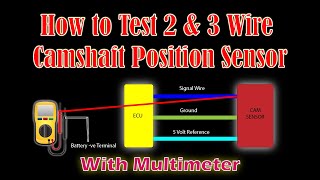
- Faulty Camshaft Position Sensor (CMP) (Very Common) — The sensor itself is the most frequent point of failure, succumbing to internal electronic failure, 🎬 See how to test 2 and 3 wire sensors with a multimeter heat damage, or oil contamination from a leaking seal.
- Wiring or Connector Issues (Common) — Broken, corroded, shorted, or loose wires and connectors disrupt the circuit. Wiring becomes brittle from engine heat, and rodent damage is a frequent culprit.
- Weak Battery or Faulty Alternator (Common) — Low system voltage from a weak battery or failing alternator creates electrical 'noise' or an unstable power supply, triggering P0340 even if the sensor and wiring are perfect.
- Worn Timing Belt or Timing Chain (Less Common) — If the timing chain or belt stretches, jumps a tooth, or a tensioner fails, the camshaft and crankshaft go out of sync. This mechanical misalignment causes the sensor to send a signal the PCM flags as a circuit fault.
- Dirty or Low Engine Oil (Less Common) — On engines with Variable Valve Timing (VVT), low or dirty oil prevents cam phasers from operating. Sludge buildup coats the sensor's magnetic tip, causing timing correlation issues that trigger P0340.
- Damaged Reluctor Wheel/Ring (Less Common) — The sensor reads a toothed ring (reluctor) on the camshaft. If this ring breaks teeth, collects metallic debris, or misaligns, the sensor cannot generate a proper signal.
- Faulty Crankshaft Position Sensor (CKP) (Rare) — The camshaft and crankshaft sensors work together. A failing crankshaft sensor signal confuses the PCM, causing it to incorrectly report a fault with the camshaft sensor circuit.
- Excessive Starter Motor Current Draw (Rare) — A failing starter motor draws excessive amperage during cranking, causing a massive voltage drop across the electrical system. This temporary drop disrupts the camshaft sensor's signal during start-up.
- Failing Powertrain Control Module (PCM) (Very Rare) — In rare instances, the PCM fails and cannot process the sensor signal. Consider this only after exhaustively testing every other possibility.
Symptoms

- Engine is Hard to Start or Won't Start — The engine cranks excessively before starting, or fails to start entirely. Without the cam signal, the PCM prevents spark and fuel injection.
- Engine Stalling, Rough Idling, and Power Loss — The engine shuts off suddenly while driving, idles erratically, or feels sluggish and hesitates during acceleration due to incorrect timing.
- Transmission Shifting Problems — The transmission shifts harshly or locks into a single gear ('limp mode') as a protective measure.
- Engine Knocking or Pinging — Incorrect ignition timing causes pre-detonation or knocking sounds from the engine compartment.
- Check Engine Light is On (also visible on scanner) — The light illuminates steadily or flashes. A flashing light signals a severe, catalyst-damaging misfire.
- Reduced Fuel Economy (also visible on scanner) — The vehicle consumes 5-10% more fuel than normal because fuel injection timing is no longer optimized.
Diagnostic Flowchart
Tap your situation to follow the diagnostic path that matches what you're seeing on this code.
Common Fixes & Costs
- Replace Camshaft Position Sensor — Parts: $40-$150, Labor: $100-$200, ~1.2 hr book time (DIY)
- Repair or Replace Wiring/Connector — Parts: $10-$50, Labor: $100-$300, ~2 hr book time (Intermediate)
- Perform PCM Software Update — Parts: $0, Labor: $100-$250, ~1 hr book time (Professional)
- Replace Crankshaft Position Sensor — Parts: $50-$200, Labor: $125-$300, ~1.8 hr book time (Intermediate)
- Replace Timing Chain or Belt — Parts: $400-$1200, Labor: $1200-$3000, ~8.5 hr book time (Professional)
Used vs. New Parts: Buying Guide
When a used part is worth it: Buying a used camshaft position sensor is NOT recommended. It is a low-cost electronic component that wears internally. The labor to replace it exceeds the part cost, making it a poor gamble.
Donor-vehicle mileage cap: roughly under 20000 miles for the part to have meaningful remaining life.
Donor quality checklist:
- Only consider from a very low-mileage vehicle that was wrecked.
- Verify the exact OEM part number matches; aftermarket sensors cause compatibility issues.
- Avoid parts with any signs of corrosion, oil contamination, or plastic brittleness.
Decision logic:
- If The new OEM sensor costs less than $150. → Always buy new OEM. The risk and potential for repeat labor with a used or cheap aftermarket part is not worth the minimal savings.
- If The vehicle is over 15 years old and has very high mileage. → A reputable aftermarket brand (e.g., Denso, Bosch, NTK) is an acceptable alternative to OEM, but a used sensor is still not advised.
- If The part is a known high-failure item on your specific vehicle (e.g., Nissan, Chrysler). → Buy new OEM only. Aftermarket sensors are notoriously problematic for these brands.
Warranty tradeoff: Used parts: Typically 30-day warranty, covers part only, not labor. Aftermarket new: 1-year to limited lifetime warranty. OEM new: 12-month/12,000-mile warranty is common.
Worst-case if a used part fails: $200-$400 if a used or cheap aftermarket sensor fails, requiring repeat diagnosis and labor costs.
What Happens If You Wait — Timeline
- 0-1 month: Code P0340 is set. The Check Engine Light is on. The driver notices occasional hard starting or a brief hesitation when accelerating. The car stalls once and then seems fine. (MPG impact: 0-5%% · Added cost: $0)
- 1-3 months: Symptoms become frequent. Hard starting is common, and the engine stalls at idle or low speeds. Misfires become noticeable, causing a rough idle. Fuel economy drops. (MPG impact: 5-10%% · Added cost: $50-$150 in wasted fuel and potential tow truck fees.)
- 3-6 months: Constant misfires from incorrect timing dump unburned fuel into the exhaust, causing the catalytic converter to overheat and its internal substrate to melt or break apart. (MPG impact: 10-15%% · Added cost: $1200-$2800 for catalytic converter replacement.)
- 6+ months: Worst-case scenario if the root cause is mechanical: a severely stretched timing chain jumps a tooth or breaks. On an interference engine, pistons collide with valves, resulting in catastrophic engine failure. (MPG impact: N/A (Engine destroyed)% · Added cost: $4000-$10000+ for a used or rebuilt engine replacement.)
Cost of Not Fixing It
- Immediate: Being stranded due to a no-start or stalling in traffic. Reduced fuel economy by 5-10%. (Added cost: $100-$300 (for a tow truck))
- 1-3 months: Persistent misfires overheat and destroy the catalytic converter by dumping raw fuel into it. (Added cost: $1200-$2800)
- 3+ months: If the root cause is a failing timing chain on an interference engine, the chain breaks, causing pistons to collide with valves, resulting in catastrophic engine failure. (Added cost: $4000-$10000+)
Diagnosis Steps

- Read Codes and Freeze Frame Data
Use an OBD-II scanner to confirm P0340 is active and check for related codes (e.g., P0335, P0016, P0341-P0344). Analyze freeze-frame data to identify the exact engine conditions when the code set.
Tools: OBD-II Scanner (Beginner) - Check Battery and Charging System
Test the battery with the engine off; it must read at least 12.4 volts. Start the engine and check voltage at the terminals; the alternator must charge between 13.7 and 14.7 volts. Low voltage triggers false P0340 codes.
Tools: Multimeter (Beginner) - Visually Inspect the Entire Circuit
Locate the Bank 1 camshaft position sensor. Inspect the sensor, connector, and wiring harness leading to the PCM. Look for oil contamination, loose pins, broken clips, and frayed or melted wires.
Tools: Flashlight, Inspection Mirror (Beginner) - Perform a 'Wiggle Test'
With the engine running or cranking, gently wiggle the wiring harness and connector for the camshaft sensor. If the engine stumbles, stalls, or the code appears, you have located an intermittent open or short in the harness.
Tools: Hands (Intermediate) - Test the Sensor's Circuit at the Connector
Disconnect the sensor and turn the ignition to 'ON' (engine off). Probe the connector terminals. A 3-wire Hall-effect sensor requires a power wire (typically 5V), a ground wire (< 0.1V), and a signal wire. Voltage below 4.5V indicates a supply issue.
Tools: Multimeter, Vehicle Service Manual (Intermediate) - Test Sensor Resistance and Check for Shorts
For 2-wire inductive sensors, measure resistance across the terminals; it must fall within manufacturer specs (typically 200-2,500 Ohms). Next, check for continuity between the signal wire and chassis ground. A low resistance reading indicates a short to ground in the harness.
Tools: Multimeter, Vehicle Service Manual (Advanced) - Test the Sensor's Signal with an Oscilloscope
Backprobe the signal wire with the engine running or cranking. A healthy Hall-effect sensor produces a clean digital square wave (0V to 5V). An inductive sensor produces an AC sine wave. A flat line or noisy waveform confirms a bad sensor or reluctor wheel issue.
Tools: Oscilloscope, Backprobe Pins (Advanced) - Check Starter Motor Current Draw
Disable fuel/ignition. Connect a clamp-on ammeter to the battery cable and crank the engine for 15 seconds. A 4-cylinder draws 125-160A, a 6-cylinder 160-210A, and an 8-cylinder 185-250A. Excessively high draw indicates a faulty starter causing voltage drops.
Tools: Clamp-on Ammeter, Socket Set (Advanced) - Inspect Mechanical Timing Components
If all electrical tests pass, the issue is mechanical. Inspect the timing belt or chain for proper tension and alignment, and check the camshaft's reluctor ring for damage or debris. This requires significant engine disassembly.
Tools: Socket Set, Wrenches, Engine-Specific Timing Tools (Advanced)
When This Code Triggers (Freeze-Frame Conditions)
- Engine Coolant Temp: 170-220°F (Fully warmed up, but also occurs during a cold start.)
- RPM: 0-800 (During engine cranking (no-start) or at idle just before a stall.)
- Engine Load: 15-40% (Low to moderate load, often during steady-state driving or light acceleration.)
- Vehicle Speed: 0-30 mph (Most common at low speeds or when stopped, consistent with stalling and starting issues.)
Related Codes
- P0335 — Crankshaft Position Sensor code. The PCM compares both signals. A P0335 fault causes an immediate engine stall and a no-start with no spark AND no fuel injector pulse. If the tachometer needle moves while cranking, the crank sensor works.
- P0341 - P0344 — More specific than P0340. P0340 means total signal loss. P0341 indicates an erratic signal, P0342 is a short to ground, P0343 is a short to power, and P0344 is an intermittent signal. These codes narrow down the electrical fault.
- P0016 — Crankshaft/Camshaft Correlation error. P0340 means the cam signal is GONE. P0016 means the PCM receives signals from BOTH sensors, but they don't line up. This points to a mechanical issue like a stretched timing chain or bad VVT phaser, not a bad sensor.
- P0300 — Random Misfire code. A missing cam signal (P0340) directly causes incorrect ignition and fuel timing, leading to misfires. Fixing the P0340 circuit fault resolves the P0300 misfire.
Climate & Environmental Factors
- Cold Weather: Cold exacerbates P0340 triggers. Thicker engine oil slows VVT phaser response, causing timing correlation issues. A weak battery's output drops significantly in the cold, making a voltage drop during cranking more likely to disrupt the sensor signal. Wiring insulation also becomes brittle and cracks in sub-zero temperatures.
- High Humidity / Salt: Humid and salt-prone regions accelerate corrosion on wiring connectors, pins, and ground points. A corroded ground or compromised connector seal introduces high resistance or intermittent connection failures in the sensor circuit, triggering P0340.
How to Talk to a Mechanic About This Code
Say this: "I have a P0340 code and I'd like to schedule a diagnostic. I want to avoid just replacing the sensor, so please test the full circuit. Specifically, check for proper voltage and ground at the connector and perform a 'wiggle test' on the wiring harness."
This signals to the shop that you understand P0340 is a circuit code. It directs them to perform a thorough diagnosis, reducing the chance of a misdiagnosis or the code returning after a simple part swap.
Avoid saying:
- 'My check engine light is on, can you just fix it?'
- 'I think it's the camshaft sensor, can you just replace it?'
- 'Just do whatever you think is best.'
Questions to ask before authorizing the repair:
- Did you test the sensor's power and ground at the connector? What were the voltage readings?
- Did you find any issues with the wiring harness or connector, like corrosion or damage?
- If you're recommending a sensor replacement, what test confirmed the old sensor failed? Did you use an oscilloscope?
- Is there a Technical Service Bulletin (TSB) for a software update related to P0340 on my vehicle?
- What is the warranty on both the parts and labor for this repair?
Where to Take It: Dealer vs Independent vs Chain
- Dealer:
Recommended for software updates and complex, engine-specific mechanical work. Otherwise, overpriced for a simple circuit fault.
Best for: Vehicles under warranty, Vehicles with known TSBs requiring a PCM software update (common on Chrysler/Jeep), Complex mechanical timing chain/belt jobs where special tools are required
Downsides: Highest labor rates, often 1.5-2x more than independent shops., Recommends expensive assemblies when a smaller component is the only issue. (Typical cost: +50% vs. baseline) - Independent Shop:
Best overall fit. A reputable independent shop with good diagnostic skills tackles a P0340 code efficiently and cost-effectively.
Best for: Out-of-warranty vehicles where cost is a major factor., Diagnosing electrical circuit faults, as they employ experienced diagnosticians., Most P0340 scenarios, from sensor replacement to wiring repair.
Downsides: Quality and expertise vary widely; vetting the shop's reputation and ASE certifications is crucial., Lacks access to the very latest manufacturer software for PCM flashing. (Typical cost: +0% vs. baseline) - Chain Shop:
AVOID for diagnosis. P0340 has too many potential causes. A chain shop replaces the sensor, which fails to fix the problem, leaving you to pay for the same repair twice.
Best for: Simple, pre-diagnosed part replacement (e.g., 'I have diagnosed it and just need you to swap the sensor').
Downsides: Technician skill varies dramatically; lacks advanced diagnostic tools like oscilloscopes., High pressure to meet sales targets leads to rushed diagnostics and unnecessary upselling., Fails to correctly diagnose complex wiring or mechanical timing issues. (Typical cost: -10% vs. baseline)
When to Walk Away From the Repair
If the estimated repair cost exceeds 40-50% of the car's private-party value (check Kelley Blue Book), sell or trade in the vehicle.
- Car worth $3000, fix is $2500: Walk away. The repair cost is over 80% of the car's value. This is a classic 'mechanic's special'.
- Car worth $12000, fix is $350: Fix it. A simple sensor replacement or wiring repair is a small investment to keep a valuable car running well.
- Car worth $5000, fix is $2500: Borderline. This is the 50% threshold. Before authorizing, get a second opinion and ask if any other major repairs (tires, brakes, etc.) are due soon.
What Scan Tool You Need for This Code

Minimum: A scanner that reads and clears codes, and crucially, displays live data streams (RPM, voltage, etc.).
A cheap $20 code reader only shows 'P0340'. It cannot show live sensor data needed to see if the signal is missing or erratic, making diagnosis impossible.
Budget: BlueDriver Pro (~$99) — Pairs with your smartphone to read codes, view freeze frame data, and graph live sensor data. This is the minimum required to see if the sensor outputs any signal while cranking.
Mid-range: Innova 5610 (~$330) — A powerful handheld unit that provides detailed OEM-specific live data and records data for later review. Useful for capturing intermittent dropouts in the sensor signal.
Professional: Autel MaxiCOM MK808 / Thinkcar Platinum S12 (~$500-1200) — These professional-grade tablets offer bidirectional controls and a built-in oscilloscope function. An oscilloscope is the only tool that definitively proves if the sensor's waveform is good or bad.
Rent vs buy: Rent for free from AutoZone or O'Reilly to confirm the P0340 code. However, to perform the actual diagnosis using live data, you must buy a scanner, as this takes more time than a rental program allows.
How to Clear the Code After You Fix It
- Fix the root cause of the fault.
- Use an OBD-II scan tool to clear the diagnostic trouble codes (DTCs).
- Perform a complete drive cycle to allow readiness monitors to run.
Drive cycle (~30 minutes): A generic drive cycle includes a cold start (after sitting 8+ hours), 2-3 minutes of idling, 10-15 minutes of steady highway driving (55-60 mph), followed by 15-20 minutes of stop-and-go city driving. Avoid aggressive acceleration and hard braking.
Readiness monitors affected: Misfire Monitor, Fuel System Monitor, Comprehensive Component Monitor, Catalyst (CAT) Monitor, Oxygen (O2) Sensor Monitor
Before emissions retest: drive at least 100 miles to fully set monitors.
Watch out for:
- Disconnecting the battery clears the code but resets all readiness monitors to 'Not Ready', guaranteeing an emissions test failure.
- The code returns immediately if the underlying mechanical or electrical fault hasn't been repaired.
- Some monitors, like the EVAP monitor, require the fuel level to be between 1/4 and 3/4 full to run.
Will This Fail Emissions / State Inspection?
Yes — this code typically fails an OBD-II emissions inspection.
- California: An active P0340 code is an automatic smog check failure. After repair, a full drive cycle must be completed. For 2001+ vehicles, only one monitor can be 'Not Ready' (usually EVAP) to pass.
- New York: The NYVIP3 inspection includes an OBD-II scan. An illuminated Check Engine Light and an active P0340 code result in an automatic failure.
- Texas: In counties requiring emissions testing, a P0340 code causes the vehicle to fail the OBD portion of the inspection. The number of allowable 'Not Ready' monitors depends on the vehicle's model year.
Most Commonly Affected Vehicles
- Ford F-150, Mustang, Explorer (2004-2010) — Extremely common on the 5.4L 3V V8 engine, where it indicates deeper issues with timing chains, tensioners, and cam phasers. A failing alternator or improper wiring harness shielding also triggers the code.
- Nissan Altima, Maxima, Murano, Sentra, Frontier (2002-2008) — Notorious for P0340 caused by a failed sensor. Broken connector clips are a frequent culprit. Using aftermarket sensors causes repeat failures or parasitic battery drain.
- Chrysler/Dodge/Jeep Various with 3.6L, 5.7L engines (Grand Cherokee, Pacifica, Wrangler, 300) (2011-2021) — Requires a PCM software update to fix a false P0340. Specific TSBs (#18-002-19, #18-049-20, #18-103-20) change the code to a 'two-trip' fault. Failing cam phasers are also a root cause.
- Chevrolet/GMC Silverado, Trailblazer, Sierra (2002-2009) — Appears due to sensor failure or wiring harness issues, particularly where the harness rubs against other engine components.
- Hyundai/Kia Elantra, Sonata, Optima, Sorento (2011-2016) — Caused by a failing camshaft position sensor. Some models require a 'relearn procedure' after replacement. OEM sensors are highly recommended to avoid compatibility issues.
- BMW 3-Series (E46, E90), 5-Series (E39, E60) (1998-2013) — Caused by a failed intake camshaft sensor. The wiring harness insulation becomes brittle and cracks from engine heat, leading to shorts. Harness chafing is also common.
- Honda Accord, Civic, CR-V (2003-2012) — While often a failing sensor, a stretched timing chain on higher mileage 2.4L K-series engines is a significant secondary cause. Poor electrical grounds also lead to this code.
- Volkswagen Jetta, Golf, Passat (2008-2014) — Sensor or wiring failure is common. This code is also triggered by incorrect valve timing set during a recent timing belt replacement, or by a failing timing chain tensioner on TSI engines.
Manufacturer-Specific Notes
- Chrysler/Jeep: Many models require a PCM software update via a Technical Service Bulletin (TSB) to fix overly sensitive fault logic for P0340. Using aftermarket (non-Mopar) camshaft sensors guarantees repeat failures.
- Ford: On 5.4L 3V engines, P0340 signals major underlying issues with cam phasers, timing chain guides, and tensioners. On some Mustangs, a failing alternator creating excessive electrical noise is the root cause.
- Nissan: On V6 engines, a loose or broken plastic connector clip causes an intermittent P0340 that leads to stalling. Aftermarket sensors fail quickly or cause parasitic battery drain.
- Hyundai/Kia: Some models require a 'camshaft position sensor relearn procedure' via a scan tool after a new sensor is installed. Genuine OEM sensors are required to avoid compatibility issues.
Real Owner Stories
2008 Infiniti M45x at 87K miles - The Misdiagnosis Loop
Intermittent stumble/stutter at various speeds, followed by SES, VDC Off, and SLIP lights. After shutting off, the engine was very hard to restart.
Outcome: An auto electrical specialist diagnosed the problem as a mechanical timing issue. The timing was slightly off at the camshaft sprocket, giving the sensor an incorrect reading and triggering the P0340 code.
Lesson: P0340 is a circuit code, but if replacing the sensor and checking wiring doesn't work, the root cause is mechanical. Investigate the underlying timing system.
2011 Ram 1500 5.7L at 196K miles - The Expensive Guess
Check engine light with P0340. No noticeable driving symptoms, but the transmission went into limp mode and would not shift past 4th gear.
Outcome: The owner returned to the dealer, who eventually fixed the issue. The experience highlights the high cost of a shop throwing expensive parts at a problem without a definitive diagnosis.
Lesson: Dealerships misdiagnose too. If a shop proposes an expensive repair (like a $1700 cam phaser), demand they prove the old part failed and explain why it's the root cause.
2006 Ford Mustang GT - The Unusual Electrical Cause
A P0340 code appeared after the owner had the engine bay shampooed. Replacing the camshaft position sensor did not fix the problem.
Outcome: The issue was a faulty alternator creating electrical noise that interfered with the camshaft sensor's signal. This is a known issue on some Ford models.
Lesson: Think beyond the sensor. A weak battery or failing alternator causes voltage drops or electrical interference that triggers P0340, even if the sensor and wiring are perfect.
2004 Nissan Sentra SE-R - The Aftermarket Parts Trap
Car immediately turned off after starting and threw a P0340 code.
Outcome: Forum users pointed out that Nissan models are notoriously sensitive to aftermarket sensors, which fail out of the box. The solution was using a genuine Nissan OEM part.
Lesson: For Nissan and Chrysler/Jeep, using an OEM sensor is critical. The small savings from an aftermarket part are not worth the high probability of repeat repairs.
How to Prevent This Code From Triggering
- Perform regular oil changes with high-quality synthetic oil (Every 5,000-7,500 miles or as per manufacturer's severe service interval) — Clean oil lubricates the timing chain and ensures proper hydraulic function of timing chain tensioners and VVT phasers. Dirty oil clogs small passages, leading to chain stretch and timing correlation faults.
- Avoid frequent short trips and allow the engine to warm up (Daily habit) — Short trips prevent engine oil from reaching optimal temperature, allowing moisture and fuel to build up and accelerate sludge formation. Warming up the engine ensures proper oil flow to timing components.
- Maintain the battery and electrical ground connections (Every 1-2 years) — A weak battery or corroded ground causes low voltage or electrical noise, disrupting the sensitive signal from the camshaft sensor. Cleaning ground points prevents these electrical gremlins.
- Address oil leaks promptly (As needed) — A leaking valve cover gasket or cam seal contaminates the camshaft position sensor's housing and electrical connector with oil. This degrades the wiring and causes a poor connection.
- Drive smoothly and avoid excessive engine strain (Daily habit) — Aggressive driving, frequent high-RPM operation, and overloading the vehicle put extra stress on the timing chain and tensioners, accelerating wear and stretch.
Frequently Asked Questions
Will replacing the camshaft sensor definitely fix P0340?
No. P0340 indicates a fault in the entire circuit, including wiring, connectors, and the PCM. Replacing the sensor without testing the power and ground supply is the most common mistake and guarantees the code returns.
What are the most common misdiagnosis mistakes for P0340?
The biggest mistake is parts-swapping the sensor without diagnosing the circuit. Technicians frequently find the true cause is a weak battery, failing alternator, or damaged wiring. Using cheap aftermarket sensors also causes immediate repeat failures.
Can a bad oil change or low oil cause P0340?
Yes. On engines with Variable Valve Timing (VVT), extremely low or dirty oil causes hydraulically-actuated cam phasers to malfunction. This creates a timing correlation issue the PCM interprets as a sensor circuit fault.
My car won't start, can P0340 cause this?
Yes. If the PCM receives no signal from the camshaft sensor, it prevents spark or fuel injection as a safety measure. This results in a crank-no-start condition.
Where is the camshaft position sensor 'A' on Bank 1 located?
Bank 1 is the side of the engine containing cylinder #1. The sensor mounts on the valve cover, the front/rear of the cylinder head, or near the timing cover. Consult your service manual for the exact location.
Can I just clear the P0340 code?
You can clear it with a scanner, but the code returns immediately or on the next drive cycle if the fault remains. Clearing the code does not fix the underlying electrical or mechanical problem.
What happens if I don't fix P0340?
Ignoring P0340 leaves you stranded when the car stalls or refuses to start. It also destroys the catalytic converter via misfires ($1,200+ repair) and causes complete engine destruction if a failing timing chain breaks.
Can a bad spark plug cause P0340?
No. A bad spark plug cannot trigger a P0340 code. However, a P0340 code causes engine misfires, which mimic the symptoms of a bad spark plug.
Key Takeaways
- P0340 is a circuit code, meaning 4 distinct components can fail: the sensor, the wiring harness, the connector, or the PCM itself.
- Test your battery and alternator first; a voltage drop below 12.4V during engine cranking triggers a false P0340 code.
- Never buy aftermarket camshaft sensors for Nissan or Chrysler vehicles; OEM sensors are required to prevent the code from returning immediately.
- If P0340 is paired with P0016, stop driving immediately; this indicates a mechanical timing failure that causes catastrophic engine damage.
Helpful Videos

The information in this article is provided for general reference and educational purposes only. Vehicle specifications, procedures, and part compatibility can vary by production date, trim level, and region. Always consult your vehicle's factory service manual and verify part numbers before purchasing or performing repairs. Safety-critical components such as airbags, seat belts, and braking systems should be installed by a qualified professional.
- 🎬 Helpful Videos
- What Does P0340 Mean?
- Can I Drive With P0340?
- Common Causes
- Symptoms
- Diagnostic Flowchart
- Common Fixes & Costs
- Used vs. New Parts: Buying Guide
- What Happens If You Wait — Timeline
- Cost of Not Fixing It
- Diagnosis Steps
- When This Code Triggers (Freeze-Frame Conditions)
- Related Codes
- Climate & Environmental Factors
- How to Talk to a Mechanic About This Code
- Where to Take It: Dealer vs Independent vs Chain
- When to Walk Away From the Repair
- What Scan Tool You Need for This Code
- How to Clear the Code After You Fix It
- Will This Fail Emissions / State Inspection?
- Most Commonly Affected Vehicles
- Manufacturer-Specific Notes
- Real Owner Stories
- 2008 Infiniti M45x at 87K miles - The Misdiagnosis Loop
- 2011 Ram 1500 5.7L at 196K miles - The Expensive Guess
- 2006 Ford Mustang GT - The Unusual Electrical Cause
- 2004 Nissan Sentra SE-R - The Aftermarket Parts Trap
- How to Prevent This Code From Triggering
- Frequently Asked Questions
- Will replacing the camshaft sensor definitely fix P0340?
- What are the most common misdiagnosis mistakes for P0340?
- Can a bad oil change or low oil cause P0340?
- My car won't start, can P0340 cause this?
- Where is the camshaft position sensor 'A' on Bank 1 located?
- Can I just clear the P0340 code?
- What happens if I don't fix P0340?
- Can a bad spark plug cause P0340?
- Key Takeaways
- 🎟️ Get 5% Off