

OBD-II Code P0018: Crankshaft-Camshaft Position Correlation (Bank 2, Sensor A)
The Ultimate Expert Guide to Diagnosing and Fixing P0018
- P0018 indicates the crankshaft and Bank 2 intake camshaft are out of sync by more than 5-8 degrees, risking severe engine damage.
- Check your engine oil and filter immediately; low oil pressure or a cheap aftermarket filter causes 20-30% of false VVT correlation codes.
- Swap the Bank 2 and Bank 1 VVT solenoids to instantly determine if a $50 solenoid is the culprit before authorizing a $2,500+ timing chain repair.
- Check for manufacturer TSBs before replacing parts; 2020-2022 Subarus often just need a free ECM software update, while GM 3.6L engines have extended warranties for stretched timing chains.
- Limit driving to absolute necessities; a stretched timing chain jumping just one tooth on an interference engine causes catastrophic piston-to-valve collisions costing upwards of $7,000.
What Does P0018 Mean?

Code P0018 indicates your Engine Control Module (ECM) detects the crankshaft and the Bank 2 intake camshaft are out of sync. Perfect synchronization is required to control valve timing for combustion. Bank 2 is the engine side without cylinder #1 (often the passenger side on V-engines, or the firewall side on transverse engines). 'Sensor A' designates the intake camshaft.
Technical definition: P0018 is a generic OBD-II code indicating the Bank 2 camshaft position sensor 'A' signal does not correlate with the crankshaft position sensor signal. The ECM triggers this code when the timing difference exceeds a programmed threshold, typically 8-9 degrees.
Can I Drive With P0018?

No — Do Not Drive. Do not drive the vehicle. Although the engine runs, you risk catastrophic damage. If a stretched timing chain breaks or jumps time, pistons will strike the valves in an interference engine, turning a $2,500 repair into a $7,000+ engine replacement. Continued driving with misfires also destroys the catalytic converter, adding $1,500 to the bill.
Common Causes

- Stretched timing chain or worn timing belt (Very Common) — Timing chains stretch and belts skip teeth over time, destroying the mechanical sync between the crankshaft and camshaft. This is the primary cause on engines like the GM 3.6L V6. 🎬 Watch: Step-by-step timing chain replacement on a GM 3.6L.
- Low, dirty, or incorrect engine oil / filter (Common) — The VVT system relies on precise hydraulic pressure. Low oil, sludge, or a cheap aftermarket cartridge filter drops oil pressure, preventing cam phasers from moving.
- Faulty VVT Solenoid / Oil Control Valve (OCV) (Common) — The VVT solenoid controls oil flow to the cam phaser. A stuck, clogged, or electronically failed solenoid cannot adjust camshaft position. 🎬 See how a failed VCT solenoid causes timing issues.
- Incorrect Parts or Procedures After a Recent Repair (Common) — This code frequently triggers immediately after engine work due to swapped VVT solenoid connectors, installing the wrong phaser, or misaligning the timing chain by a single tooth.
- Failed VVT Actuator (Cam Phaser) (Less Common) — The cam phaser mechanically rotates the camshaft. Internal failure or sludge binding prevents timing adjustments, often producing a distinct startup rattle.
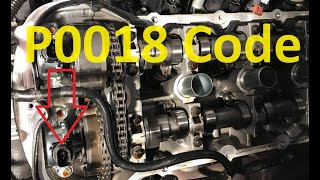
- Faulty Camshaft Position Sensor (Bank 2, Sensor A) (Less Common) — A failed sensor sends inaccurate position data to the ECM, creating a false correlation error. 🎬 Watch: A complete overview of P0018 causes and fixes.
- Outdated Engine Control Module (ECM) Software (Less Common) — Certain vehicles, notably 2020-2022 Subarus, possess overly sensitive ECM software that falsely triggers P0018. A dealer software update resolves this.
- Faulty Crankshaft Position Sensor (Rare) — A failing crank sensor provides an incorrect baseline reference signal, causing a correlation fault.
- Damaged or Shifted Crankshaft Reluctor Wheel (Rare) — The crankshaft tone ring can shear its alignment key and shift, sending a permanently skewed reference signal to the ECM.
- Wiring Harness or ECM Issues (Rare) — Corroded connectors, melted wiring, or a burnt ECM driver circuit severs communication with sensors or solenoids.
Symptoms
- Rattling noise from the engine — A loose timing chain creates a distinct metallic rattle near the front of the engine. Failing VVT phasers cause a sharp clicking or rattling on cold starts.
- Rough idle or stalling — Incorrect valve timing disrupts the air-fuel mixture, causing the engine to shake, run unevenly, or stall at stops.
- Engine enters 'limp mode' and loses power — The ECM limits engine power and disables traction control to prevent internal damage, making acceleration sluggish.
- Hard starting or extended cranking — Severe timing deviations force the engine to crank significantly longer before starting, or prevent starting entirely.
- Poor fuel economy — Inefficient combustion forces the engine to burn excess fuel to maintain speed.
- Check Engine Light is on (also visible on scanner) — The ECM illuminates the MIL immediately upon detecting the timing discrepancy.
Diagnostic Flowchart
Tap your situation to follow the diagnostic path that matches what you're seeing on this code.
Common Fixes & Costs
- Engine Oil and Filter Change — Parts: $50-$120, Labor: $50-$80, ~0.5 hr book time (DIY)
- Replace Variable Valve Timing (VVT) Solenoid — Parts: $40-$150, Labor: $100-$250, ~1.2 hr book time (DIY)
- Replace Camshaft Position Sensor — Parts: $50-$130, Labor: $50-$200, ~1 hr book time (DIY)
- Replace Crankshaft Position Sensor — Parts: $50-$150, Labor: $150-$700, ~2.5 hr book time (Intermediate)
- Replace Timing Chain, Phasers, Tensioners, and Guides — Parts: $400-$1,000, Labor: $1,800-$4,000+, ~14 hr book time (Professional)
DIY vs Professional
- Engine Oil and Filter Change — Beginner:
- Replace VVT Solenoid / Camshaft Sensor — Beginner:
- Replace Crankshaft Position Sensor — Beginner:
- Replace Timing Chain / Cam Phasers — Beginner:
Used vs. New Parts: Buying Guide
When a used part is worth it: For electronic components like sensors or VVT solenoids, a used OEM part from a low-mileage vehicle is a cost-effective alternative. NEVER use used timing chains, tensioners, guides, or phasers.
Donor-vehicle mileage cap: roughly under 60000 miles for the part to have meaningful remaining life.
Donor quality checklist:
- Verify the donor vehicle was not scrapped due to engine failure.
- Match the part number exactly.
- Avoid parts from engines known for oil sludge issues.
Decision logic:
- If The part is a timing chain, tensioner, guide, or phaser. → Always buy new OEM or high-quality aftermarket. The risk of catastrophic engine damage is too high.
- If The part is a sensor or solenoid and the vehicle has high mileage (>150k miles). → A used, low-mileage OEM part is often more reliable than a cheap aftermarket alternative.
- If The cost of a new OEM part is less than $150. → Buy new to get a full warranty.
Warranty tradeoff: Used parts typically come with a 30-90 day warranty covering the part only. New aftermarket parts offer 1-year to limited lifetime warranties. New OEM parts carry a 1-2 year warranty.
Worst-case if a used part fails: $1,500-$4,000 if a used timing component fails, requiring a repeat of the labor-intensive job plus potential engine damage.
What Happens If You Wait — Timeline
- 0-1 month: Check Engine Light illuminates with code P0018. Symptoms are subtle, like a slightly rough idle on a cold start. (MPG impact: 0-5%% · Added cost: $0-$50 in wasted fuel)
- 1-3 months: Performance degradation becomes noticeable. The vehicle feels sluggish, hesitates on acceleration, and stalls at idle. A startup rattle becomes frequent. (MPG impact: 5-15%% · Added cost: $50-$200 in wasted fuel)
- 3-6 months: Engine runs consistently rough. Misfires become common. Unburnt fuel from misfires overheats and damages the catalytic converter substrate. (MPG impact: 15-25%% · Added cost: $1,200-$2,800 for catalytic converter replacement)
- 6+ months: Catastrophic failure is imminent. A stretched timing chain jumps teeth or breaks. In an interference engine, pistons collide with valves, destroying the engine. (MPG impact: 25%+% · Added cost: $7,000-$10,000+ for engine replacement)
Cost of Not Fixing It
- Short-Term (0-1 Month): Noticeable decrease in fuel economy (5-15%), rough idle, stalling, and poor acceleration. The vehicle enters limp mode. (Added cost: $50-$150 in wasted fuel.)
- Medium-Term (1-6 Months): Continued misfires from incorrect timing cause unburnt fuel to enter the exhaust, overheating and destroying the catalytic converter. (Added cost: $1,200-$2,800 for catalytic converter replacement.)
- Long-Term (6+ Months): Catastrophic engine failure. A stretched timing chain breaks or jumps teeth, causing pistons to collide with valves in an interference engine. (Added cost: $7,000-$10,000+ for engine replacement.)
Diagnosis Steps

- Check Engine Oil and Filter
Verify the oil is full, clean, and the correct viscosity. If an oil change was just performed, ensure an OEM-quality filter was used to prevent pressure drops.
Tools: Dipstick (Beginner) - Scan Codes and Review Live Data
Use a scanner to monitor 'Desired' vs. 'Actual' cam angles for Bank 2. A deviation greater than ±5 degrees indicates a mechanical or hydraulic failure.
Tools: OBD-II Scanner (Beginner) - Pro Tip: Swap Solenoids for Diagnosis
Swap the Bank 2 intake VVT solenoid with the Bank 1 intake solenoid. Clear codes and drive. If the code changes to P0016, the solenoid is faulty. If P0018 returns, the solenoid is good.
Tools: Basic Hand Tools (Socket/Wrench Set) (Intermediate) - Pro Tip: Test VVT Solenoid with Scan Tool
Command the Bank 2 intake VVT solenoid on and off at idle using a bidirectional scanner. A working solenoid and phaser will cause the engine to stumble or stall. No change means a failed circuit or phaser.
Tools: Bidirectional OBD-II Scanner (Intermediate) - Inspect Wiring
Visually check the Bank 2 camshaft sensor, crankshaft sensor, and VVT solenoid connectors for oil intrusion, melted wires, or swapped plugs.
Tools: Flashlight (Beginner) - Test Sensor Resistance
Measure the VVT solenoid resistance (typically 6.9-7.9 Ω at 68°F) and cam/crank sensors (200-1,200 Ω) with a multimeter. Replace out-of-spec components.
Tools: Multimeter (Intermediate) - Advanced: Check VVT Solenoid Voltage
Disconnect the VVT solenoid and measure the harness power pin with the ignition on. It must show 12V. Zero voltage indicates a blown fuse or broken wire.
Tools: Multimeter (Advanced) - Advanced: Test Engine Oil Pressure
Connect a mechanical gauge. Minimum hot idle pressure is typically 10-15 PSI. Consistently low pressure indicates a worn oil pump or internal engine wear, starving the VVT system.
Tools: Mechanical Oil Pressure Gauge, Socket/Wrench Set (Advanced) - Advanced: Analyze Waveforms
Connect an oscilloscope to the crank and Bank 2 cam sensors. A horizontal shift in the cam signal relative to the crank signal proves a stretched chain or jumped tooth.
Tools: Oscilloscope (Advanced) - Inspect Mechanical Timing
Remove the timing cover. Check for chain slack, broken guides, and verify the crankshaft and camshaft sprocket timing marks align perfectly.
Tools: Socket/Wrench Set, Engine-specific timing tools (Advanced)
When This Code Triggers (Freeze-Frame Conditions)
- Engine Coolant Temp: 180-210°F (82-99°C) (The engine must be at full operating temperature for the VVT monitor to run.)
- Engine RPM: 1200-3000 RPM (The fault is typically detected during steady-state cruising or light acceleration, not at idle or during heavy acceleration.)
- Engine Load: 20-60% (The code sets under moderate engine load, where the VVT system actively adjusts cam timing for efficiency.)
- Vehicle Speed: 30-60 mph (48-97 kph) (The fault is commonly logged during city or highway cruise conditions, not during stop-and-go driving.)
Related Codes
- P0016 — This is the identical fault for Bank 1 Intake. Seeing both P0016 and P0018 together strongly suggests a 'global' engine issue, such as a stretched primary timing chain, a faulty crankshaft sensor, or widespread low oil pressure.
- P0019 — This indicates a correlation error for the exhaust camshaft on the same engine bank (Bank 2). Seeing P0018 and P0019 together suggests a mechanical timing or oil supply issue affecting all of Bank 2.
- P0017 — This code is for Bank 1 Exhaust. Seeing these two together is uncommon and indicates multiple, separate faults or a major timing issue.
- P0008 / P0009 — These are general engine position performance codes for GM vehicles. If you have P0018 and P0009, it confirms the timing system performance issue is on Bank 2.
Climate & Environmental Factors
- Cold Weather: Cold temperatures increase oil viscosity, slowing the movement of VVT phasers on startup. This causes a temporary timing correlation error, especially if the oil is old or the incorrect 'W' grade.
- High Heat / Heavy Load: Sustained high temperatures accelerate oil degradation. This leads to sludge formation, which clogs VVT solenoid screens and narrow oil passages, starving the VVT system.
- High Altitude: Reduced air density at altitude makes existing performance issues like rough idle or lack of power more noticeable to the driver.
How to Talk to a Mechanic About This Code
Say this: "I have a P0018 code and I'd like to schedule a diagnostic. Please start by checking oil pressure and quality, and then test the VVT solenoid for Bank 2 before quoting a timing chain replacement. Do not replace the cam or crank sensors without testing them first."
This directs the mechanic to follow a logical, cost-effective diagnostic path. It prevents unnecessary sensor replacement and forces them to prove a hydraulic or mechanical fault before recommending the most expensive repair.
Avoid saying:
- 'Just fix whatever's wrong'
- 'My car is making a funny noise, I think it's the timing chain.'
Questions to ask before authorizing the repair:
- What were the 'Desired' vs 'Actual' camshaft angle readings on the scan tool?
- Did you test the VVT solenoid, and if so, how? Did you try swapping it with the other bank?
- If you are recommending a timing chain replacement, what evidence of stretch or wear did you find?
- Does your estimate include replacing the timing chain, guides, tensioners, and cam phasers as a set?
- What is your warranty on parts and labor for this repair?
Where to Take It: Dealer vs Independent vs Chain
- Dealer:
Best for: Vehicles under warranty or a manufacturer's special coverage program (e.g., GM timing chains, Ford phasers)., Repairs requiring a specific TSB software update (e.g., Subaru)., Complex diagnostics on German vehicles (BMW VANOS, Mercedes).
Downsides: Highest labor rates, often 1.5-2x more than independent shops., May recommend a complete assembly replacement when only one component has failed. (Typical cost: +50% vs. baseline) - Independent Shop:
Best choice for most out-of-warranty P0018 repairs, especially if a timing chain replacement is needed. Vet the shop thoroughly by asking about their experience with this specific job on your engine.
Best for: Out-of-warranty vehicles where the cause is likely a major mechanical repair like a timing chain., Owners looking for a better value on labor and parts.
Downsides: Quality and expertise vary greatly. Must find a shop with proven experience in engine timing work., May not have access to the latest manufacturer-specific software updates. (Typical cost: +0% vs. baseline) - Chain Shop:
AVOID for P0018 diagnosis and repair. They lack the specialized tools and expertise for the root causes of this code. The risk of misdiagnosis is very high.
Best for: An oil and filter change as a first diagnostic step.
Downsides: Technician skill is highly variable and not suited for complex internal engine diagnostics., High pressure to upsell; misdiagnoses the issue and sells unnecessary parts like sensors., Not equipped for a timing chain replacement. (Typical cost: -10% vs. baseline)
When to Walk Away From the Repair
If the estimated repair cost exceeds 50% of the car's private-party market value, sell or trade it in instead of repairing it.
- Car worth $5000, fix is $3000: Walk away. The repair cost is 60% of the car's value. It is not financially sensible to proceed.
- Car worth $15000, fix is $3500: Fix it. The repair cost is 23% of the vehicle's value. If the car is otherwise in good condition, the repair is a worthwhile investment.
- Car worth $8000, fix is $400: Fix it. A low-cost repair like a new VVT solenoid is well below the threshold and restores the vehicle's function and value.
What Scan Tool You Need for This Code

Minimum: An OBD-II scanner that reads and graphs live data, specifically 'Desired' vs. 'Actual' camshaft position.
A basic $20 code reader only shows 'P0018'. It cannot display the live data needed to determine if the problem is a slow-to-respond solenoid, a stuck phaser, or a mechanical timing jump.
Budget: BlueDriver Pro Scan Tool (~$120) — Connects to your smartphone via Bluetooth and graphs live data for camshaft position PIDs, allowing you to see if the phaser responds to commands.
Mid-range: XTOOL D7 or A30M (~$150-350) — Offers bidirectional control. You use the scanner to command the VVT solenoid on and off at idle to see if it works. This confirms a faulty solenoid without turning a wrench.
Professional: Autel MaxiCOM MK900-BT / Launch X431 Series (~$500-1200) — Provides full bidirectional control, ECU coding capabilities, and access to manufacturer-specific PIDs and diagnostic procedures.
Rent vs buy: For a one-time code read, a free rental from a parts store is fine. However, to properly diagnose P0018, you need live data and bidirectional control, which rental tools lack. Buying a mid-range scanner is a worthwhile investment.
How to Clear the Code After You Fix It
- Use a quality OBD-II scan tool to erase the diagnostic trouble codes.
- Perform a crankshaft position variation relearn procedure if required by the manufacturer.
- Perform the specific drive cycle to allow readiness monitors to complete.
Drive cycle (~20 minutes): A general drive cycle includes: 1) Cold start. 2) Idle for 2-3 minutes. 3) Drive at a steady speed between 40-60 mph for 10-15 minutes. 4) Perform several moderate accelerations and decelerations. 5) Allow the vehicle to idle for another 2-3 minutes before shutdown.
Readiness monitors affected: Comprehensive Component Monitor, Misfire Monitor, Catalyst Monitor, Evaporative System Monitor
Before emissions retest: drive at least 50 miles to fully set monitors.
Watch out for:
- Disconnecting the battery clears the code but erases all readiness monitors, guaranteeing an emissions test failure.
- The code returns immediately if the underlying mechanical or hydraulic fault is not repaired.
- Failure to perform a required relearn procedure causes persistent running issues even after part replacement.
Will This Fail Emissions / State Inspection?
Yes — this code typically fails an OBD-II emissions inspection.
- California: An active P0018 code results in an automatic smog check failure. All OBD-II readiness monitors must be in a 'Ready' state to pass.
- New York: The NYS DMV emissions inspection includes an OBD-II scan. The presence of a Check Engine Light and code P0018 is an automatic failure.
- Texas: In the 17 counties requiring emissions testing, a vehicle with an illuminated Check Engine Light for P0018 fails the OBD-II inspection.
Most Commonly Affected Vehicles
- Chevrolet Traverse, Equinox, Camaro, Blazer (2009-2022) — The GM 3.6L V6 (LLT, LFX, LFY) is notorious for premature timing chain stretching. GM issued Special Coverage Adjustment #11340C extending the warranty for this repair to 10 years or 120,000 miles on some vehicles.
- GMC Acadia (2009-2022) — The Acadia with the 3.6L V6 engine frequently suffers from stretched timing chains that trigger this code.
- Ford F-150, Edge, Explorer (2011-2021) — On 3.5L EcoBoost engines, P0018 is preceded by a 'cold start rattle' caused by a failing cam phaser. Ford issued Customer Satisfaction Programs 21B10 and 21N03 to address this.
- Buick Enclave, LaCrosse (2009-2017) — Sharing the 3.6L V6 engine with the Traverse, these models are highly susceptible to timing chain stretch.
- Subaru Outback, Legacy, Crosstrek, Forester (2013-2022) — For 2020-2022 2.5L models, check for TSB #09-120-24R before replacing parts, as an overly sensitive ECM is a known cause.
- Hyundai / Kia Genesis, Sonata, Borrego (2009-2018) — On models with cartridge oil filters, use of an incorrect aftermarket filter causes oil pressure drops and triggers this code.
- BMW 3 Series, 5 Series, X3, X5 (2005-2015) — The code points to issues with the VANOS system. A ticking noise indicates a failing camshaft adjuster, which shifts the pulse wheel and causes a persistent P0018.
- Honda Accord, Odyssey (V6) (2008-2017) — Points to a failing camshaft position sensor or a faulty VVT oil control solenoid, often related to oil sludge buildup.
Manufacturer-Specific Notes
- General Motors (GM): On 3.6L V6 engines, P0018 is almost always caused by a stretched timing chain. TSB #23-NA-091 warns that VVT solenoid connectors are identical and easily swapped after a repair, causing this code instantly.
- Ford: In EcoBoost engines, this code is accompanied by a rattling noise on startup, pointing to failing cam phasers. Ford issued multiple programs (e.g., CSP 21N03) to cover phaser replacement.
- Subaru: For 2020-2022 models with the 2.5L engine, P0018 is triggered by overly sensitive ECM software. TSB #09-120-24R provides a software update that fixes this issue.
- Mercedes-Benz: The hammering of a bad camshaft adjuster causes the camshaft's pressed-on pulse wheel to shift. This creates a persistent P0018 requiring camshaft replacement.
Real Owner Stories
2009 Kia Borrego V6 with recurring P0018 after oil changes
Owner reported the check engine light with code P0018 came on. An oil change temporarily cleared the light, but it returned. The vehicle was driving fine.
What they tried:
- An oil change at a quick lube shop made the code go away for a few days before it returned.
Outcome: The owner found a forum post describing how aftermarket cartridge oil filters cause this exact issue. After installing a genuine Kia oil filter, the code cleared permanently.
Lesson: If P0018 appears immediately after an oil change on an engine with a cartridge filter, the filter itself is the prime suspect. An incorrect aftermarket filter causes oil pressure issues for the VVT system.
2006 Lexus GX470 with P0018 after major service
About 150 miles after a timing belt service, the check engine light and VSC lights came on with code P0018.
What they tried:
- The owner took the vehicle to a Toyota dealership for diagnosis, suspecting a mechanical timing error from the recent service.
Outcome: The dealership confirmed the mechanical timing was off by one tooth. They corrected the timing, and the check engine light cleared.
Lesson: If P0018 appears immediately following a timing belt/chain replacement, the most likely cause is a mistake during the repair. Return to the shop that performed the work.
2019 Ford F-150 3.5L EcoBoost with persistent P0018 & P0021
A new owner of a 2019 F-150 experienced codes P0018 and P0021 just a week after purchase.
What they tried:
- The dealer replaced all four cam phasers under Ford's Customer Satisfaction Program (21N03).
Outcome: The P0018 and P0021 codes returned on the drive home. The owner opened a case with Ford corporate to work with the dealer on a deeper diagnosis, suspecting an underlying oil pressure or sensor issue.
Lesson: Even when a common fix is performed, the code can persist. This points to a less common root cause, such as low oil pressure, a faulty sensor, or a wiring problem that was misdiagnosed.
2018 Subaru WRX with P0018 at 37k miles and no obvious symptoms
The owner got a P0018 code but the car ran and sounded fine.
What they tried:
- Inspected, cleaned, and swapped all four Oil Control Valves (OCVs) and Cam Position Sensors from one bank to the other. The code did not move to the other bank (P0016).
Outcome: With the easy swaps ruled out, the owner suspected a failed cam gear or a rare ECU issue.
Lesson: Systematically swapping components from one engine bank to the other is a powerful diagnostic technique. If the code doesn't follow the swapped part, you rule that part out and focus on mechanical issues specific to the original bank.
How to Prevent This Code From Triggering
- Perform regular oil changes with high-quality, manufacturer-specified oil (Every 5,000-7,500 miles) — Clean oil is critical for lubricating the timing chain and providing hydraulic pressure for the VVT system. Old oil causes accelerated wear on chain pins and clogs VVT solenoid screens.
- Use OEM or premium-quality oil filters (With every oil change) — High-quality filters ensure proper oil pressure is maintained. Cheap aftermarket filters collapse or lack internal check valves, starving the VVT system.
- Use synthetic motor oil in Turbocharged Direct Injection (T-GDI) engines (Every oil change) — T-GDI engines produce soot that contaminates oil and accelerates timing chain wear. Modern synthetic oils (API SP rated) resist soot-induced wear.
- Avoid aggressive driving habits and excessive high-RPM operation (Daily habit) — Hard acceleration puts immense strain on the timing chain and tensioners, accelerating wear and stretch.
- Adhere to the manufacturer's recommended timing chain/belt service interval (Typically every 80,000-120,000 miles) — Timing chains and belts are wear items. Replacing them proactively prevents the P0018 code and avoids catastrophic engine failure.
Frequently Asked Questions
How much does it cost to fix code P0018?
Diagnostic fees average $150. Simple fixes like an oil change or VVT solenoid replacement cost $100-$400. Replacing a stretched timing chain costs $1,800 to $4,000+ depending on the vehicle.
What is the most common misdiagnosis for P0018?
The biggest mistake is immediately replacing the camshaft and crankshaft sensors. P0018 indicates a correlation issue, which is almost always mechanical (timing chain) or hydraulic (oil pressure/VVT solenoid). Always diagnose the cheaper hydraulic causes first.
My P0018 code appeared right after an oil change or repair. What should I check?
If it appeared after an engine repair, the mechanic likely swapped the identical VVT solenoid connectors or misaligned the timing chain. If it appeared after an oil change, an incorrect or cheap aftermarket cartridge filter is likely dropping oil pressure. Replace it with an OEM filter immediately.
Can I fix P0018 myself?
Basic diagnostics like checking oil and swapping VVT solenoids are easy DIY tasks. Replacing sensors is also straightforward for beginners. However, replacing a timing chain requires special tools and engine removal on many vehicles, making it a professional-only job.
What happens if I don't fix P0018?
Ignoring P0018 guarantees poor performance and eventual catastrophic engine failure. If a stretched timing chain breaks, pistons will collide with valves in an interference engine. This turns a repairable issue into a complete engine replacement.
Will an oil change fix a P0018 code?
Yes, if the code is caused by low, dirty, or incorrect viscosity oil starving the VVT system. An oil and filter change restores proper hydraulic pressure to the cam phasers. This is always the cheapest and best first diagnostic step.
What is the difference between P0018 and P0016?
They represent the exact same mechanical failure on different sides of the engine. P0018 is a timing correlation problem on Bank 2. P0016 is the identical problem on Bank 1.
What does it mean if I have P0018 and P0019 at the same time?
Getting both P0018 (Intake) and P0019 (Exhaust) simultaneously points to a catastrophic failure affecting the entire Bank 2 cylinder head. This is usually a jumped secondary timing chain or a severe oil blockage to that specific head. Stop driving immediately.
Key Takeaways
- P0018 indicates the crankshaft and Bank 2 intake camshaft are out of sync by more than 5-8 degrees, risking severe engine damage.
- Check your engine oil and filter immediately; low oil pressure or a cheap aftermarket filter causes 20-30% of false VVT correlation codes.
- Swap the Bank 2 and Bank 1 VVT solenoids to instantly determine if a $50 solenoid is the culprit before authorizing a $2,500+ timing chain repair.
- Check for manufacturer TSBs before replacing parts; 2020-2022 Subarus often just need a free ECM software update, while GM 3.6L engines have extended warranties for stretched timing chains.
- Limit driving to absolute necessities; a stretched timing chain jumping just one tooth on an interference engine causes catastrophic piston-to-valve collisions costing upwards of $7,000.
Helpful Videos

The information in this article is provided for general reference and educational purposes only. Vehicle specifications, procedures, and part compatibility can vary by production date, trim level, and region. Always consult your vehicle's factory service manual and verify part numbers before purchasing or performing repairs. Safety-critical components such as airbags, seat belts, and braking systems should be installed by a qualified professional.
- 🎬 Helpful Videos
- What Does P0018 Mean?
- Can I Drive With P0018?
- Common Causes
- Symptoms
- Diagnostic Flowchart
- Common Fixes & Costs
- DIY vs Professional
- Used vs. New Parts: Buying Guide
- What Happens If You Wait — Timeline
- Cost of Not Fixing It
- Diagnosis Steps
- When This Code Triggers (Freeze-Frame Conditions)
- Related Codes
- Climate & Environmental Factors
- How to Talk to a Mechanic About This Code
- Where to Take It: Dealer vs Independent vs Chain
- When to Walk Away From the Repair
- What Scan Tool You Need for This Code
- How to Clear the Code After You Fix It
- Will This Fail Emissions / State Inspection?
- Most Commonly Affected Vehicles
- Manufacturer-Specific Notes
- Real Owner Stories
- 2009 Kia Borrego V6 with recurring P0018 after oil changes
- 2006 Lexus GX470 with P0018 after major service
- 2019 Ford F-150 3.5L EcoBoost with persistent P0018 & P0021
- 2018 Subaru WRX with P0018 at 37k miles and no obvious symptoms
- How to Prevent This Code From Triggering
- Frequently Asked Questions
- How much does it cost to fix code P0018?
- What is the most common misdiagnosis for P0018?
- My P0018 code appeared right after an oil change or repair. What should I check?
- Can I fix P0018 myself?
- What happens if I don't fix P0018?
- Will an oil change fix a P0018 code?
- What is the difference between P0018 and P0016?
- What does it mean if I have P0018 and P0019 at the same time?
- Key Takeaways
- 🎟️ Get 5% Off