

P0341 on 2007-2018 Jeep Wrangler: Cam Sensor Causes and Fixes
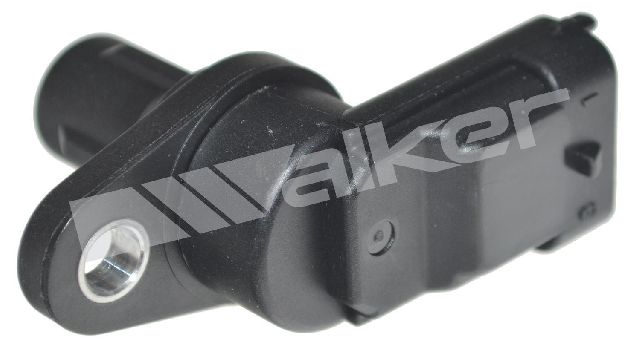
P0341 on a Jeep Wrangler JK typically points to a faulty camshaft position sensor or its wiring. The sensor itself is the most common failure point. On 3.6L models (2012-2018), this code can also be an early warning for a more serious rocker arm or cam phaser failure. Expect to pay between $40-$115 for the part and plan for a relatively simple DIY replacement for the sensor itself.
- P0341 on a Jeep Wrangler JK most often means the camshaft position sensor for Bank 1 has failed.
- Before replacing the sensor, always inspect the wiring and connector for obvious damage, as this is a common secondary cause.
- The 2007-2011 3.8L engine has one sensor, while the 2012-2018 3.6L engine has four. Ensure you are diagnosing the correct one.
- Replacement is a DIY-friendly job with basic tools, typically taking less than an hour.
- If a new sensor doesn't fix the code on a 3.6L engine, seek professional diagnosis as it could be a sign of a more significant timing or valvetrain issue.
What's Unique About the 2007-2018 Jeep Wrangler
The 2007-2018 Jeep Wrangler (JK) used two different V6 engines: the 3.8L from 2007-2011 and the 3.6L Pentastar from 2012-2018. While both can experience this code, the 3.6L Pentastar has four camshaft position sensors (two intake, two exhaust), whereas the older 3.8L has a single sensor. On the 3.6L, issues with rocker arms, lifters, and cam phasers are known, and a camshaft sensor code can sometimes be an early warning of this more serious mechanical issue. If the code returns after sensor replacement on a 3.6L, especially if accompanied by a ticking noise, further mechanical diagnosis is crucial. For some diesel models outside this primary engine range, a TSB noted that wiring harness routing near the alternator could cause electrical interference, triggering this code.
Generation note: This range covers the entire Jeep Wrangler JK generation (2007-2018). However, it spans two distinct engines. The 2007-2011 models use the 3.8L V6 with a single camshaft position sensor. The 2012-2018 models use the 3.6L Pentastar V6, which has four camshaft position sensors (one for each of the four camshafts). For both V6 engines, Bank 1 is the passenger side of the engine bay. While the code's meaning is the same, the location and number of sensors to diagnose differ significantly between the two engine types.
Symptoms You May Notice
- Check Engine Light is on
- Difficulty starting the engine, or extended cranking time
- Engine stalls, sometimes intermittently
- Rough idle
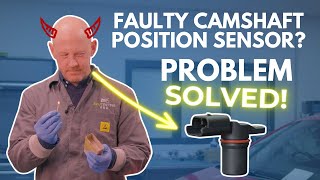
- Engine hesitation or lack of power during acceleration 🎬 See this guide on testing and fixing bad camshaft sensor symptoms.
- Reduced fuel economy
- Goes into limp mode
- Replacing the crankshaft position sensor when the code clearly indicates a camshaft sensor issue.
- On 3.6L engines, replacing the wrong camshaft position sensor. There are four, and P0341 specifically points to Bank 1 (passenger side), typically the intake cam.
- Repeatedly replacing the sensor on a 3.6L engine without investigating the possibility of a failing cam phaser or rocker arms, especially if a ticking noise is present.
Most Likely Causes
- Faulty Camshaft Position Sensor 🔴 High Probability Sensors are electronic components that can fail over time due to heat cycles and vibration, which are normal operating conditions in an engine bay. Oil leaks from valve cover gaskets can also contaminate the sensor's connector, causing failure.
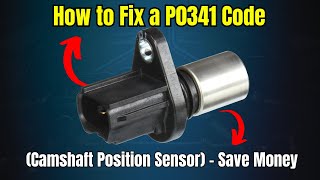
How to confirm: After checking wiring, test the sensor's output with a multimeter or oscilloscope. Often, the simplest diagnostic step for a DIYer is to replace the sensor, as it's a relatively inexpensive and common failure point. 🎬 Watch: A helpful walkthrough on fixing the P0341 code yourself. Always use a quality OEM (Mopar) or reputable aftermarket brand, as these engines can be sensitive to cheaper sensors.
Typical fix: Replace the faulty camshaft position sensor. On the 3.6L engine, be sure to identify the correct sensor for Bank 1 (passenger side).
Est. part cost: $40-$115 - Wiring Harness or Connector Issue 🟡 Medium Probability The wiring harness can be susceptible to damage from heat, oil contamination, or vibrations, leading to loose connections, corrosion, or broken wires. The harness can rub against engine components, causing chafing and short circuits. Manufacturer service bulletin TSB #08-099-25 notes that P0341 can be caused by the need to repair the cam sensor harness and re-route the generator (alternator) wiring.
How to confirm: Visually inspect the wiring harness leading to the camshaft position sensor for any signs of damage, melting, or corrosion. Check that the connector is securely plugged in and the pins are clean and free of oil. Wiggle the harness with the engine running to see if it affects idle.
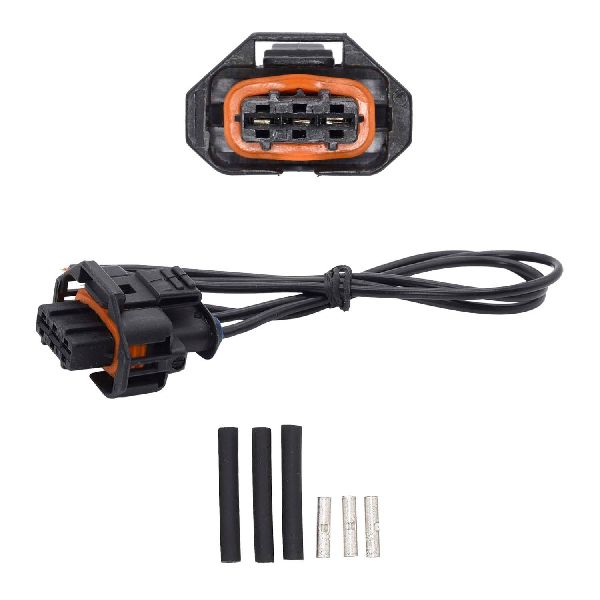
Typical fix: Repair the damaged section of the wiring harness or clean/replace the pigtail connector.
Est. part cost: $10-$50
Rare But Worth Checking
- Stretched Timing Chain or Timing Issue: While less common than a sensor failure, a stretched timing chain can cause the camshaft and crankshaft signals to fall out of sync, triggering a P0341 code. This is a more serious mechanical issue, often accompanied by rattling noises from the front of the engine, especially on startup.
- Failing Cam Phaser (3.6L Pentastar): On the 3.6L engine, the cam phasers can fail, particularly the locking pin mechanism. This can cause the camshaft to be out of position relative to the timing chain, leading to a P0341 or related code even with a good sensor. This is a known issue and often follows rocker arm failure or occurs on high-mileage engines. A technician can check for excessive play in the phaser with the valve cover removed.
- Failing PCM (Powertrain Control Module): In very rare cases, the engine computer itself can be the source of the problem, failing to correctly interpret the sensor's signal. This should only be considered after all other possibilities have been thoroughly ruled out.
- Damaged Camshaft Reluctor Wheel: The sensor reads notches on a reluctor wheel (or tone ring) on the camshaft. If this wheel is damaged, has debris on it, or is misaligned, it can cause an erratic signal. This usually requires significant engine disassembly to inspect.
Diagnosis Steps
- Verify the code with an OBD-II scanner. Note any other codes present and check for freeze frame data.
- Visually inspect the camshaft position sensor and its electrical connector on Bank 1 (passenger side for both V6 engines). Look for loose connections, oil contamination in the connector, or damaged wires.
- Ensure the connector is clean and securely fastened. Clear the codes and drive the vehicle to see if the code returns.
- If the code returns, the next logical step for many DIYers is to replace the camshaft position sensor, as it's the most common cause. Use an OEM Mopar part for best results.
- For advanced diagnosis, use a multimeter to check for the correct voltage (usually a 5V reference) and ground at the sensor connector with the ignition on.
- If wiring and the sensor are confirmed to be good, the issue may be mechanical. On 3.6L engines, listen carefully for any ticking or rattling that could indicate a rocker arm or timing chain problem.
- (3.6L Specific) If possible, remove the valve cover to inspect the cam phasers for excessive rotational play, which indicates a failed locking pin—a known cause for this code.
- If all else fails, the problem could be with the PCM, which would require professional diagnosis.
Parts You'll Likely Need
- Camshaft Position Sensor (3.6L V6)
(OEM #05149141AF)— This is the most frequent cause for the P0341 code on 2012-2018 models. The sensor is an electronic component that wears out over time from heat and vibration.
Trusted brands: Mopar, Hitachi, Delphi, Bosch
OEM price range: $55-$115
Aftermarket price range: $40-$80 - Camshaft Position Sensor (3.8L V6)
(OEM #56028815AA)— This is the most frequent cause for the P0341 code on 2007-2011 models. It is a single sensor for the entire engine.
Trusted brands: Mopar, NTK, Standard Motor Products
OEM price range: $45-$70
Aftermarket price range: $30-$55
Related Codes That Often Appear With This One
- P0340 — P0340 indicates a general circuit malfunction, while P0341 points to a performance/range issue. They often appear together as they both relate to the same sensor circuit.
- P0335 — This is a Crankshaft Position Sensor code. Seeing it with a camshaft code can indicate a timing issue, as the PCM is seeing a disagreement between the two sensors.
- P0345, P0365, P0390 — These are camshaft position sensor codes for the other sensors on the 3.6L Pentastar engine. Seeing multiple cam codes can point to a systemic issue like low oil pressure, a timing chain problem, or a failing PCM.
Technical Service Bulletins (TSBs) & Recalls
- TSB 08-099-25 - Mentions P0341 on some diesel models (outside this guide's primary scope) caused by electromagnetic interference from mis-routed wiring, requiring harness repair and re-routing.
- TSB S2308000152 (or similar updated number) - While not directly citing P0341, TSBs exist for the 3.6L Pentastar that address MIL illumination for various DTCs. A TSB released Nov 1, 2023 (NHTSA ID #10248856) specifically addresses MIL illumination with DTC P0341 set. This suggests a known issue that may have a specific diagnostic path or software update available at the dealership.
- TSB 18-103-20 - A PCM software update was issued for the 2018 Wrangler JK 3.6L to correct false or intermittent camshaft and crankshaft position sensor codes, including P0340 and related faults. This TSB addresses the PCM being overly sensitive to minor signal fluctuations.
- TSB Bulletin #S2318000011 - Notes that a Malfunction Indicator Lamp (MIL) illumination may occur with DTC P0341 (Camshaft Position Sensor Performance Bank 1 Sensor 1) set.
Platform-Specific Known Issues
- For 2012-2018 models with the 3.6L Pentastar engine, a camshaft sensor code can be an early indicator of the known issue with failing rocker arms and camshaft lobes. The needle bearings in the rocker arms can fail, scoring the camshaft. This can lead to a ticking noise. Subsequently, the cam phasers can fail, often due to oil starvation or debris from the initial failure. A failed phaser locking pin will cause timing deviation and trigger P0341 or related codes. If the code returns after replacing the sensor, further mechanical inspection is warranted.
Mechanic-Grade Diagnostic Values
- 3.6L V6 Camshaft Position Sensor 5-Volt Supply — expected: Approximately 5.0 volts with ignition on, engine off (KOEO).. Failure: Voltage significantly lower than 5.0V or 0V indicates an open/short in the supply circuit or a PCM fault.
- 3.6L V6 Camshaft Position Sensor Ground Circuit Resistance — expected: Less than 5.0 Ohms between the ground pin at the connector and a known good ground (e.g., battery negative terminal).. Failure: High resistance indicates a corroded or open ground wire.
- 3.6L V6 Camshaft Position Sensor Signal (Hall-Effect Test) — expected: With the sensor connected and ignition on, the signal wire voltage should switch between ~0V and ~5V when a magnet is passed over the sensor tip.. Failure: Voltage does not switch, indicating a faulty sensor.
- 3.8L V6 Camshaft Position Sensor Connector Pins (KOEO) — expected: Pin 1 (BK/GY): Ground. Pin 2 (DB/GY): Signal. Pin 3 (DB/YL): 5 Volt Supply.. Failure: Absence of 5V on Pin 3 or high resistance on Pin 1 indicates a wiring or PCM issue.
- 3.8L V6 CMP Signal Circuit Resistance (PCM to Sensor) — expected: Less than 5.0 ohms.. Failure: Resistance above 5.0 ohms indicates excessive resistance in the signal wire (K44 circuit).
Scan Tool Commands That Help
- iCarsoft CR Eagle (or similar advanced scanner): Special Functions > ECM Reset > Camshaft Sensor Relearn — After replacing a camshaft position sensor, this function clears old error data and forces the ECM to recognize the new sensor's operating parameters.
- iCarsoft CR Eagle (or similar advanced scanner): Special Functions > Timing Tests > Cam-Crank Sync Check — To rule out mechanical timing issues. If the code persists after sensor and wiring checks, this test can show if the cam and crank are out of sync due to a stretched chain or jumped tooth. An offset over ±3° indicates a mechanical problem.
Wiring & Ground Locations
- 3.8L V6 Cam Sensor Connector — Follow the upper radiator hose to the engine. The sensor is located on the engine block directly under that connection, slightly to the passenger side, held in by one bolt.. This is the primary connection point for testing and replacement. It is a 3-pin connector.
- 3.6L V6 Bank 1 Cam Sensor Connector — On the top of the passenger side (Bank 1) valve cover. P0341 refers to the intake sensor, which is typically the rearward of the two sensors on that cover.. This is the main testing point for P0341 on the Pentastar engine. The connector pins can back out or become contaminated with oil.
- G102 / G103 (3.6L V6) — G102 is located near the passenger (right) side headlight assembly. G103 is on the right side of the engine block itself.. These are main grounding points for the engine wiring harness. A poor or corroded connection at these grounds can cause erratic voltage and trigger false sensor codes, including P0341.
- 3.6L V6 PCM Connector C2 (Inboard) — The Powertrain Control Module (PCM) is located on the driver's side of the firewall. The inboard connector (C2) contains the wiring for the camshaft position sensors.. If sensor-side tests are inconclusive, this is the next place to test for continuity and shorts. For example, on a 2014 model, the Bank 1 cam sensor signals were on pins 62 and 85.
Real Owner Repair Stories
- JK-Forum.com user (2018 Jeep JKU 3.6L Pentastar) — Crank-no-start condition with four camshaft position sensor codes active (P0345, P0390, P0340, P0365).
❌ Tried (didn't work) Verified 5V supply and ground at sensors were in spec (4.9V, <3 ohms)., Wiggled harness with no change., Disconnected and reconnected all related wiring harnesses., Replaced both camshaft position sensors with new parts.
✅ What actually fixed it The user had rebuilt the engine due to sludge and reused the original timing components and oil pump. The ultimate resolution, though not explicitly stated in the final post, was implied to be related to the underlying mechanical timing or oil pressure from the original components, as all electrical tests passed and new sensors did not resolve the issue. The problem started after a major engine rebuild, pointing away from a simple sensor failure.
OEM Part Supersession History
56028815AA→56028815AB— Part revision or manufacturer change.
Heads up: Note: This part is often listed as a CRANKshaft position sensor for other vehicles (e.g., 5.7L Hemi) but is the correct part number for the CAMshaft position sensor on the 3.8L V6. This cross-listing causes significant confusion.5184296AE, 5184296AF→5184296AH— Design improvement to address premature failure of the needle bearings.
Heads up: This is for the rocker arms on the 3.6L Pentastar, not the sensor itself. However, failing rocker arms are a root cause of camshaft-related codes. Upgrading to the 'AH' revision is the permanent fix for the common 'Pentastar tick' that can lead to cam/phaser damage and trigger P0341.
Model Year Variations Within This Range
- 2012-2014: The 3.6L Pentastar engines in these earlier JK models are more prone to the rocker arm bearing failure. While the issue can occur on later models, the original rocker arm design was more susceptible, making a ticking noise and this P0341 code a stronger indicator of potential mechanical failure in these specific years.
- 2018: A specific PCM software update, TSB 18-103-20, was released for the 2018 JK 3.6L to address false or intermittent camshaft position sensor codes. This suggests the factory calibration was overly sensitive.
Diagnostic Flowchart
Real Owner Stories
Aggregated from forums and TSBs cited above. Mileages and costs reflect what owners reported in those sources.
2014 Jeep Wrangler Unlimited — 75000 miles
Symptoms: Check engine light with P0341 code, going in and out of limp mode.
What fixed it: Unresolved at the time of posting; replacing both camshaft position sensors did not fix the issue.
Source hint: P0341 trouble code - JK-Forum.com
2012 Jeep Wrangler JK
Symptoms: Stalling and not starting.
What fixed it: Replaced the cam position sensor.
Source hint: 2007 JK - no start, wait 6 hours, starts right up : r/Wrangler
2009 & 2012 Jeep Wrangler — 80000 miles
Symptoms: Stalling and no-start issues.
What fixed it: Replaced the camshaft position sensor (about 10 minutes of wrench work from underneath the passenger side).
Cost: $30
Source hint: 2007 JK - no start, wait 6 hours, starts right up : r/Wrangler
2007 Jeep Wrangler JK
Symptoms: Randomly won't start despite a charged battery, but starts up like nothing is wrong after waiting 5 or 6 hours.
What fixed it: Unresolved at the time of posting (owner was preparing to scan for P0341).
Source hint: 2007 JK - no start, wait 6 hours, starts right up : r/Wrangler
Related OBD-II Codes
Frequently Asked Questions
Does TSB 18-103-20 apply to my Jeep Wrangler for code P0341?
I replaced the camshaft position sensor on my 2014 Wrangler 3.6L but P0341 came back. What should I check next?
Is there a specific brand of camshaft position sensor recommended for the 3.8L or 3.6L Wrangler engine?
Where is the camshaft position sensor located that triggers P0341 on my Wrangler?
My 2012 Wrangler has a ticking noise along with the P0341 code. What does this mean?
Are there any recent TSBs for the 3.6L Pentastar regarding P0341?
Helpful Videos
Used OEM Parts in Stock
New Aftermarket Parts Available

The information in this article is provided for general reference and educational purposes only. Vehicle specifications, procedures, and part compatibility can vary by production date, trim level, and region. Always consult your vehicle's factory service manual and verify part numbers before purchasing or performing repairs. Safety-critical components such as airbags, seat belts, and braking systems should be installed by a qualified professional.
- Jeep Wrangler:
- 🎬 Helpful Videos
- 🛍️ Shop This Part
- What's Unique About the 2007-2018 Jeep Wrangler
- Symptoms You May Notice
- Most Likely Causes
- Rare But Worth Checking
- Diagnosis Steps
- Parts You'll Likely Need
- Related Codes That Often Appear With This One
- Technical Service Bulletins (TSBs) & Recalls
- Platform-Specific Known Issues
- Mechanic-Grade Diagnostic Values
- Scan Tool Commands That Help
- Wiring & Ground Locations
- Real Owner Repair Stories
- OEM Part Supersession History
- Model Year Variations Within This Range
- Diagnostic Flowchart
- Real Owner Stories
- 2014 Jeep Wrangler Unlimited — 75000 miles
- 2012 Jeep Wrangler JK
- 2009 & 2012 Jeep Wrangler — 80000 miles
- 2007 Jeep Wrangler JK
- Related OBD-II Codes
- Frequently Asked Questions
- 🎟️ Get 5% Off