

P0335 on 2006-2013 Audi A3 2.0T: Crankshaft Sensor Failure Causes and Fixes
For a 2006-2013 Audi A3 with code P0335, the most likely cause is a failed crankshaft position sensor, which Audi calls the Engine Speed Sensor (G28). This typically causes the engine to crank but not start, or stall when hot. Expect to pay $80-$150 for an OEM sensor; replacement is notoriously difficult due to its tight location behind the oil filter housing.
- P0335 on your A3 almost always means the crankshaft position sensor (G28) has failed, especially if you experience a 'crank but no start' condition when the engine is hot.
- Confirm the failure by checking for '0' RPM in live data with a scan tool while cranking the engine.
- Do not continue to drive the vehicle, as it can stall at any time, creating a serious safety hazard.
- Replacement of the sensor is considered a difficult DIY job due to its very tight location. Use long extensions, a swivel socket, and a magnetic tool.
- Always use a high-quality OEM (Bosch) or genuine sensor (Part No. 06H906433D). Aftermarket sensors for this part have a high failure rate.
What's Unique About the 2006-2013 Audi A3

The 2006-2013 Audi A3 (8P generation) with the 2.0T EA888 engine is well-known for this issue. The primary cause is almost always the failure of the Crankshaft Position Sensor (G28) itself, which is prone to failing from heat exposure over many years. The sensor's location on the EA888 engine, tucked low on the driver's side of the engine block between the oil filter housing and the transmission bell housing, makes it notoriously difficult to access. This can turn what would be a simple part replacement into a challenging, labor-intensive job that often requires working 'blind' from above with long extensions (~24 inches) and a swivel socket, or from below after removing the splash shield. The single 5mm Allen or T30 Torx bolt holding the sensor is infamous for being dropped into the subframe.
Generation note: The 2006-2013 year range covers the entire second generation (8P) of the Audi A3. The 2.0T engine could be the earlier EA113 (timing belt) or the later EA888 (timing chain), introduced around 2008.5. While the P0335 code has the same meaning for both, the exact sensor part number and access procedure may differ slightly. 🎬 See this replacement walkthrough for the earlier EA113 engine variant. This guide focuses on the EA888 as specified, which uses a Hall Effect sensor.
Symptoms You May Notice
- Engine cranks but will not start.
- Tachometer shows 0 RPM during cranking.
- Engine stalls suddenly while driving, especially when hot.
- May not restart until the engine has cooled down for 30-60 minutes.
- Intermittent loss of power or hesitation during acceleration.
- Rough idling or engine misfires.
- Illuminated Check Engine Light (CEL).
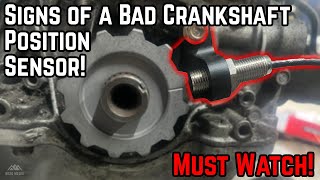
- EPC (Electronic Power Control) light may also illuminate. 🎬 Watch: A breakdown of common signs and symptoms of sensor failure.
- Replacing the battery or starter motor when a no-start condition is present. If the engine cranks over normally but doesn't start, the issue is likely not the battery or starter.
- Replacing fuel system components like the fuel pump. While a no-start can be fuel-related, the presence of code P0335 and a '0 RPM' signal on the scan tool points specifically to the crankshaft sensor circuit.
- Replacing the camshaft position sensor. A bad cam sensor will typically still allow the engine to start (though it will run poorly), whereas a bad crank sensor often results in a complete no-start condition.
Most Likely Causes

- Failed Crankshaft Position Sensor (G28) 🔴 High Probability The sensor is located in a high-heat area of the engine bay and is known to fail over time due to repeated heat cycles causing internal electronics to short or open.
How to confirm: Use a VAG-specific scan tool (VCDS, OBDeleven) to monitor live data for 'Engine Speed' while cranking. If the reading is zero or erratic, the sensor has failed. You can also test for 5V reference and ground at the connector with the key on.
Typical fix: Replace the crankshaft position sensor. This is a difficult DIY job due to the sensor's location. Many owners report the old sensor becomes brittle and breaks during removal, requiring careful extraction of the remaining piece.
Est. part cost: $80-$150 - Damaged Wiring or Connector 🟡 Medium Probability The wiring harness is routed near hot components and can become brittle. More commonly, oil leaks from components above (like the valve cover gasket or vacuum pump) can saturate the harness, degrading the insulation and causing shorts.
How to confirm: Visually inspect the wiring harness leading to the sensor for any signs of melting, chafing, or oil saturation. Check that the connector is securely plugged in and free of corrosion or oil contamination.
Typical fix: Repair the damaged section of wiring or replace the connector pigtail. Clean any oil residue and address the source of the oil leak to prevent recurrence.
Est. part cost: $15-$50
Rare But Worth Checking
- Damaged Reluctor Ring: The reluctor ring (a toothed wheel on the crankshaft that the sensor reads) can be damaged, or teeth can break off, though this is very uncommon. This would typically only happen during major engine work like a clutch or transmission replacement. Inspection requires significant disassembly.
- Faulty Engine Control Module (ECM): While extremely rare, the ECM itself can fail, specifically the 5V driver circuit for the sensor. This should only be considered after a new OEM sensor and verified wiring fail to resolve the issue. Testing involves checking for 5V output at the ECM pin for the sensor.
Diagnosis Steps

- Confirm the presence of code P0335 using a VAG-compatible scanner (VCDS, OBDeleven). Note any other codes, especially P0322, P0016, or misfire codes.
- Using the scanner's live data function (e.g., VCDS Engine -> Measuring Blocks -> Group 001), monitor Engine RPM while cranking the engine. A solid reading of '0' RPM strongly indicates a failed sensor or circuit.
- Perform a thorough visual inspection of the crankshaft position sensor's wiring and connector. The sensor is located on the engine block, near the transmission bell housing, behind and below the oil filter.
- Check for any signs of melted plastic, chafed wires, oil contamination from leaks above, or loose connections.
- If wiring appears intact, test the connector terminals. With the key on, you should have approximately 5V reference and a good ground.
- If wiring and power/ground are good, the next step is to replace the crankshaft position sensor (G28).
- After replacing the sensor, clear the codes with the scanner and perform a test drive. A specific 'relearn' procedure is generally not required for this platform.
Parts You'll Likely Need

- Engine Crankshaft Position Sensor (G28)
(OEM #06H906433D (supersedes 06H906433C and 06H906433))— This is the component that fails in the vast majority of P0335 cases on this vehicle due to heat and age. It is highly recommended to use an OEM or OEM-supplier part to avoid premature failure of aftermarket units.
Trusted brands: Bosch (OEM supplier), Continental/VDO, HELLA
OEM price range: $100-$150
Aftermarket price range: $30-$90
Related Codes That Often Appear With This One
- P0322 — This is an Audi/VW-specific code for 'Ignition/Distributor Engine Speed Input Circuit No Signal.' It is functionally identical to P0335 and points directly to a problem with the G28 sensor or its circuit.
- P0016 — Stands for 'Crankshaft Position - Camshaft Position Correlation.' If the ECM receives a signal from the camshaft sensor but not the crankshaft sensor, it may set this code. However, if P0335 is present, the crankshaft sensor is the primary fault. P0016 by itself more often points to a timing chain issue.
- P0321 — Ignition/Distributor Engine Speed Input Circuit Range/Performance. This code can be triggered by a damaged reluctor wheel and shares a diagnostic path with P0335.
- P0336 — Crankshaft Position Sensor 'A' Circuit Range/Performance. Indicates an erratic or implausible signal, rather than a complete loss of signal. This can be caused by a failing sensor, wiring issues, or a damaged reluctor ring.
Technical Service Bulletins (TSBs) & Recalls
- While no specific TSB directly for P0335 on this exact model is widely cited, Audi TSB 2072326/1 for related code P0321 points to a damaged sensor wheel, indicating a shared diagnostic path.
Platform-Specific Known Issues
- Owner Experience 1: A user on VWVortex with a 2.0T GTI reported a classic 'crank no-start when hot' symptom with codes P0335 and P0322. After letting the car cool for an hour, it would start again. The issue was resolved by replacing the G28 sensor.
- Owner Experience 2: On Audi-Sport.net, a user attempting to replace the sensor on a similar VAG engine noted the retaining bolt was completely seized and began to strip. This highlights a common frustration with this repair, where the bolt can be difficult to remove in the tight space.
- Repair Tip: Accessing the sensor bolt often requires a long (24"+) extension, a universal/swivel joint, and a 5mm hex bit socket. Many DIYers recommend having a magnetic retrieval tool ready as dropping the bolt is extremely common. Some find access from below easier after removing the undertray.
- Failure Story: An owner of a 2013 A4 with P0335 replaced the sensor with a new OEM part, but the problem persisted. The actual cause was found to be an oil leak from the valve cover that had saturated the sensor's wiring harness, causing it to short out. The fix required repairing the harness and replacing the valve cover gasket.
Mechanic-Grade Diagnostic Values
- Engine Speed Sensor (G28) Internal Resistance — expected: 480-1000 Ω (Ohms) between terminals 2 and 3 of the sensor connector.. Failure: A reading of infinite resistance (open circuit) or a value significantly outside the specified range indicates a faulty sensor.
- Engine Speed Sensor (G28) Short to Ground/Power Test — expected: Infinite resistance (no continuity) between pin 1 and pin 2, and between pin 1 and pin 3.. Failure: Any continuity (low resistance) indicates an internal short within the sensor, requiring replacement.
- VCDS Live Data - Engine Speed — expected: Engine -> Measuring Blocks -> Group 001, Field 1 should show cranking RPM (typically >200 RPM).. Failure: A value of '0' RPM while the engine is audibly cranking is a definitive sign of no signal from the G28 sensor circuit.
Scan Tool Commands That Help
- VCDS (VAG-COM): Engine -> Measuring Blocks — This is the primary function used to monitor live data from the G28 sensor (Engine Speed) to confirm a '0 RPM' reading during a crank-no-start condition, which is the most crucial diagnostic step for P0335.
Wiring & Ground Locations

- G28 Sensor Connector — On the driver's side of the engine block, tucked behind the oil filter housing and near the transmission bell housing.. This 3-pin connector is the primary point for testing. Pin 1 is 5V reference, Pin 2 is the signal wire to the ECM, and Pin 3 is ground. Oil leaks from above often contaminate this connector, causing the fault.
- Ground Point 12 — On the left side of the engine compartment, on the chassis frame rail.. This is a primary ground connection point in the engine bay. A loose or corroded connection here can cause intermittent electrical issues for various sensors, including the G28, leading to erratic signals.
- Ground Connection 369 — Located within the main engine wiring harness itself.. This ground connection is internal to the harness. While not serviceable without harness repair, damage to the harness from heat or oil saturation can compromise this ground, causing sensor faults like P0335.
Real Owner Repair Stories
- Forum User Report on Go-Parts blog (2013 Audi A4 2.0T) — Car would crank but not start, EPC light on, P0335 stored, tachometer showed 0 RPM during cranking.
❌ Tried (didn't work) Replaced the crankshaft position sensor (G28) with a new OEM Bosch part.
✅ What actually fixed it The wiring harness leading to the crankshaft sensor was damaged. An oil leak from the valve cover had saturated the harness, causing the insulation to degrade and wires to short. Repairing the harness and fixing the oil leak resolved the issue. - Reddit user in r/GolfGTI (2015 VW GTI (EA888 Gen 3, similar architecture)) — Engine stalls while driving on short trips, especially after warming up. Progressively harder to restart, eventually becoming a crank-no-start. EPC light comes on during stall. P0335 code present.
❌ Tried (didn't work) Replacing the battery., Replacing spark plugs., Replacing the MAP sensor.
✅ What actually fixed it The issue was resolved by replacing the crankshaft position sensor with a new OEM part. The user was advised that aftermarket crank sensors are notorious for failing quickly on this platform.
OEM Part Supersession History
06H906433 / 06H906433C→06H906433D— Revisions to improve durability and signal stability under high heat conditions.
Heads up: While older revisions may physically fit, using the latest 'D' revision is strongly recommended for longevity, as it is designed to better withstand the heat that causes the original part to fail.
Model Year Variations Within This Range
- 2006-2008.5: Models in this range may be equipped with the earlier EA113 2.0T engine, which uses a timing belt. While the P0335 code has the same meaning, the sensor's exact location and part number may differ from the timing-chain driven EA888 engine that became standard around 2008.5.
Diagnostic Flowchart
Other Known Issues on This Vehicle
Issues unrelated to this code that are worth knowing about as an owner of this generation:
- Timing Chain Tensioner Failure 🔴 High — Common on earlier EA888 Gen 1/2 engines (approx. up to 2013). Failure can occur without warning, often between 60k-100k miles, leading to catastrophic engine damage. (Ref: Multiple TSBs exist, and a class-action lawsuit addressed this issue. Checking tensioner version via inspection port is recommended.)
- Excessive Oil Consumption 🟠 Medium — Widespread on EA888 Gen 1/2 engines. Caused by piston ring design. Many owners report consuming 1 quart of oil every 1000-1500 miles. (Ref: A class-action lawsuit also covered this. The fix involves new pistons and rings, which is extremely expensive outside of warranty.)
- Water Pump / Thermostat Housing Failure 🟠 Medium — Very common. The plastic housing becomes brittle and cracks, leading to coolant leaks. Failure often occurs between 50k-90k miles.
- PCV Valve Failure 🟡 Low — The diaphragm in the PCV (oil separator) unit tears, causing a large vacuum leak. Symptoms include a rough idle, high-pitched whistling noise, and lean-related fault codes. Relatively common and an easy DIY fix.
- Intake Manifold Runner Flap Issues 🟠 Medium — The plastic intake manifold can fail, either due to the runner position sensor failing or the flap mechanism breaking, causing fault code P2015. This can lead to reduced performance and a CEL. (Ref: An extended warranty was offered for this component on some vehicles.)
- Carbon Buildup on Intake Valves 🟠 Medium — An inherent issue with all direct-injection engines. Performance degradation (misfires, hesitation) is usually noticed after 50k-80k miles. Requires manual cleaning (walnut blasting).
Used vs. New Parts: Buying Guide for This Vehicle
When a used part is the smart pick: Never. A used crankshaft position sensor is not a smart choice for this repair.
What to inspect on the donor part:
- Not applicable. The failure mode is due to accumulated heat cycles, not just mileage. A sensor from a low-mileage car that has seen many short trips could be just as close to failure as a high-mileage one. The labor involved in replacement is too high to risk using a part with an unknown lifespan.
OEM-only on this vehicle (don't cheap out):
- Engine Crankshaft Position Sensor (G28)
Aftermarket brands forum-validated for this vehicle:
- Bosch (the OEM supplier)
- Continental/VDO
- HELLA
Brands owners have reported issues with on this vehicle:
- Unnamed or 'white-box' generic brands. Forum users and mechanics consistently report that cheap aftermarket crankshaft sensors have a very high rate of premature failure or are dead-on-arrival for this specific application.
Real Owner Stories
Aggregated from forums and TSBs cited above. Mileages and costs reflect what owners reported in those sources.
2009 Volkswagen GTI 2.0T EA888
Symptoms: Classic 'crank no-start when hot' symptom with codes P0335 and P0322. After letting the car cool for an hour, it would start again.
What fixed it: Replacing the G28 sensor.
Source hint: VWVortex.com thread mentioned in vehicle_specific_issues
2013 Audi A4 2.0T EA888
Symptoms: P0335 code persisted even after replacing the sensor with a new OEM part.
What fixed it: Repairing the wiring harness and replacing the valve cover gasket to stop an oil leak that was saturating the connector.
Source hint: Failure Story in vehicle_specific_issues
2010 Audi A3 2.0T EA888
Symptoms: Attempted sensor replacement but the retaining bolt was completely seized and began to strip in the tight space.
What fixed it: Careful extraction of the bolt; owners suggest using a 5mm hex bit with a swivel joint and long extensions.
Source hint: Audi-Sport.net discussion in vehicle_specific_issues
Related OBD-II Codes
Frequently Asked Questions
My 2010 Audi A3 2.0T stalls when it gets hot but starts after cooling down. Is this P0335?
Is there an Audi TSB for P0335 or related crankshaft sensor issues on the EA888 engine?
Can I use a generic scanner to diagnose the G28 sensor on my A3?
I replaced the sensor but still have P0335 on my 2013 A3. What else should I check?
What tools do I need to replace the G28 sensor on an EA888 engine?
Does the A3 require a 'relearn' procedure after installing a new crankshaft sensor?
Helpful Videos

We Have This Part in Stock

The information in this article is provided for general reference and educational purposes only. Vehicle specifications, procedures, and part compatibility can vary by production date, trim level, and region. Always consult your vehicle's factory service manual and verify part numbers before purchasing or performing repairs. Safety-critical components such as airbags, seat belts, and braking systems should be installed by a qualified professional.
- Audi A3:
- 🎬 Helpful Videos
- 🛍️ Shop This Part
- What's Unique About the 2006-2013 Audi A3
- Symptoms You May Notice
- Most Likely Causes
- Rare But Worth Checking
- Diagnosis Steps
- Parts You'll Likely Need
- Related Codes That Often Appear With This One
- Technical Service Bulletins (TSBs) & Recalls
- Platform-Specific Known Issues
- Mechanic-Grade Diagnostic Values
- Scan Tool Commands That Help
- Wiring & Ground Locations
- Real Owner Repair Stories
- OEM Part Supersession History
- Model Year Variations Within This Range
- Diagnostic Flowchart
- Other Known Issues on This Vehicle
- Used vs. New Parts: Buying Guide for This Vehicle
- Real Owner Stories
- 2009 Volkswagen GTI 2.0T EA888
- 2013 Audi A4 2.0T EA888
- 2010 Audi A3 2.0T EA888
- Related OBD-II Codes
- Frequently Asked Questions
- 🎟️ Get 5% Off