

OBD-II Code P0322: Ignition/Distributor Engine Speed Input Circuit - No Signal
The Ultimate Guide to Understanding, Diagnosing, and Fixing P0322
- Code P0322 indicates a complete signal loss from the Crankshaft Position Sensor (CKP), preventing the engine computer from timing spark and fuel.
- Expect severe drivability issues, including a 100% crank-no-start condition or sudden engine stalling at operating temperature.
- Never drive with an active P0322 code, as the vehicle will stall unpredictably in traffic and lose power steering and brakes.
- Replacing the CKP sensor resolves 80% of P0322 cases, typically costing between $190 and $630 for parts and labor.
What Does P0322 Mean?
The Powertrain Control Module (PCM) lost the signal from the Crankshaft Position Sensor (CKP). This sensor dictates engine speed and crankshaft position. Without it, the PCM cannot time ignition or fuel injection, completely disabling the engine.
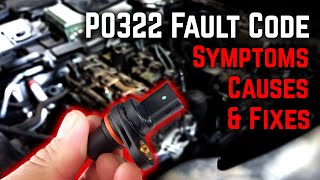
🎬 Watch: A complete breakdown of P0322 causes, symptoms, and fixes.Technical definition: SAE/OBD-II defines P0322 as "Ignition/Distributor Engine Speed Input Circuit No Signal." The PCM detects a complete loss of the pulse signal from the CKP sensor. The PCM requires this signal to calculate engine RPM and crankshaft position for spark and fuel delivery. Some manufacturers define it as "Crankshaft Position Sensor A Circuit Low".
Can I Drive With P0322?
No — Do Not Drive. Driving is strictly prohibited. The engine stalls without warning, creating an extreme hazard at highway speeds or in intersections. This sudden power loss disables power steering and brakes, causing accidents and leaving you stranded.
Common Causes
- Failed Crankshaft Position Sensor (CKP) (Very Common) — Accounts for 80% of P0322 cases. Internal electronics or the magnetic pickup fail from prolonged heat and vibration, stopping the signal entirely. This often happens intermittently when the engine reaches operating temperature.
- Wiring or Connector Issues (Common) — The wiring harness melts from exhaust heat, frays, or disconnects. Connectors corrode or fill with moisture, breaking the electrical circuit between the sensor and the PCM.
- Weak Battery or Charging System (Less Common) — System voltage dropping below 12.6V prevents the sensor from generating a recognizable signal during the high electrical load of engine cranking.
- Contaminated Sensor Tip or Damaged Reluctor (Less Common) — Engine oil leaks degrade the sensor housing. Alternatively, metallic sludge on the magnetic tip or broken teeth on the crankshaft reluctor ring physically block the sensor from reading the rotational signal.
- Blown Fuse or Faulty Relay (Rare) — A blown ignition fuse or faulty relay cuts power to the sensor circuit, resulting in an immediate 'no signal' condition.
- Faulty Aftermarket Sensor (Less Common) — Low-quality aftermarket sensors frequently fail prematurely or arrive dead out of the box, causing the P0322 code to return days after a repair.
- Failed Camshaft Position Sensor (CMP) (Rare) — The PCM compares CMP and CKP signals. A missing or erratic CMP signal sometimes confuses the PCM into triggering a false P0322 on specific vehicle platforms.
- Failed Powertrain Control Module (PCM) (Very Rare) — The PCM's internal signal processing circuit burns out. The computer cannot read the signal even if the sensor and wiring are perfect.
Symptoms
- Engine cranks but will not start — The starter turns the engine, but the lack of spark and fuel timing prevents ignition. This is the most prominent symptom. 🎬 See how a mechanic diagnoses a P0322 no-start condition.
- Engine stalls unexpectedly — The engine dies suddenly while driving. This frequently happens when a failing sensor gets hot ('heat soak') and drops the signal.
- Check Engine Light illuminates — The PCM triggers the Malfunction Indicator Lamp (MIL) immediately after losing the signal for a specified duration.
- Rough running and poor fuel economy — Intermittent signal loss causes hesitation, misfires, and forces the PCM into a rich fuel mixture to protect the engine.
- Tachometer shows zero RPM while cranking (also visible on scanner) — The RPM gauge stays at zero during startup, visually confirming the PCM sees no engine speed data.
Diagnostic Flowchart
Tap your situation to follow the diagnostic path that matches what you're seeing on this code.
Common Fixes & Costs
- Replace Crankshaft Position Sensor — Parts: $40-$180, Labor: $150-$450, ~1.5 hr book time (Intermediate)
- Repair or Replace Wiring/Connector — Parts: $10-$50, Labor: $100-$300, ~1.5 hr book time (Intermediate)
- Replace Battery — Parts: $150-$350, Labor: $25-$50, ~0.3 hr book time (DIY)
- Perform Crankshaft Variation Relearn — Parts: $0, Labor: $50-$150, ~0.5 hr book time (Professional)
- Replace Powertrain Control Module (PCM) — Parts: $800-$1200, Labor: $150-$250, ~1.2 hr book time (Professional)
Used vs. New Parts: Buying Guide
When a used part is worth it: Never buy a used crankshaft position sensor. The risk of receiving a degraded part is too high, and the labor cost to replace it twice negates any savings.
Donor-vehicle mileage cap: roughly under 20000 miles for the part to have meaningful remaining life.
Donor quality checklist:
- If forced to buy used, source from a wrecked vehicle with under 20,000 miles.
- Match the part number exactly.
Decision logic:
- If The part is a crankshaft position sensor. → Buy a new OEM or high-quality OEM-equivalent (Bosch, Denso) part.
- If The vehicle is older and budget is the absolute top priority. → Purchase a new aftermarket part with a lifetime warranty rather than a used OEM part.
Warranty tradeoff: Used parts offer 30-day warranties. New OEM parts offer 1-year warranties and maximum reliability. Cheap aftermarket parts offer lifetime warranties but fail frequently.
Worst-case if a used part fails: $200-$600 for repeat labor, towing, and a replacement part if a used sensor fails.
What Happens If You Wait — Timeline
- First occurrence to 1 month (Intermittent Failure): Longer crank times to start. Occasional stalling at idle when hot. The Check Engine Light illuminates but turns off intermittently. (MPG impact: 0-5%% · Added cost: $0-50 in wasted fuel.)
- 1-3 months (Consistent Intermittent Failure): Stalling becomes frequent and unpredictable. The engine runs rough, hesitates, and misfires. The Check Engine Light stays on permanently. (MPG impact: 5-15%% · Added cost: $50-150 in wasted fuel. Towing costs ($100-$300) become likely.)
- 3+ months (Pre-Total Failure): Vehicle is highly unreliable. Persistent misfiring sends unburnt fuel into the exhaust, overheating and damaging the catalytic converter. (MPG impact: 15-25%% · Added cost: $500-$1500 for catalytic converter damage.)
- Total Failure: Sensor signal is completely lost. The engine cranks but will not start under any circumstances. Vehicle is disabled. (MPG impact: 100% (vehicle is inoperable)% · Added cost: $1200-$2800 if the catalytic converter was destroyed prior to total failure.)
Cost of Not Fixing It
- Immediate: Vehicle stalls without warning or fails to start, creating a major safety hazard and leaving you stranded. (Added cost: Towing costs ($100-$300+).)
- 1-3 months (if intermittent): Engine runs rough, misfires, and suffers poor fuel economy. Unburnt fuel enters the exhaust system. (Added cost: $50-$150 in wasted fuel.)
- 3+ months (if intermittent): Persistent misfiring and rich conditions overheat and destroy the catalytic converter. (Added cost: $1200-$2800 for catalytic converter replacement.)
Diagnosis Steps
- Check Live Data
Connect an OBD-II scanner and view the 'Engine RPM' live data stream. While cranking the engine, this value must rise above zero (typically 200-300 RPM). If it stays at 0, the PCM is receiving no signal.
Tools: OBD-II Scanner with Live Data (Beginner) - Visual Inspection
Locate the Crankshaft Position Sensor. Inspect the wiring harness for melted insulation, cuts, or oil contamination. Ensure the electrical connector is plugged in securely and free of corrosion.
Tools: Flashlight, Mirror (Beginner) - Check for Other Codes
Scan for misfire codes (P0300-P0308) or camshaft sensor codes (P0341). These indicate broader electrical faults or timing issues related to the primary P0322 code.
Tools: OBD-II Scanner (Beginner) - Test the Sensor Circuit
Disconnect the sensor and turn the ignition ON. Use a multimeter to probe the connector. Verify the reference voltage (5V or 12V) and ground (<0.1V). Missing voltage indicates an upstream wiring fault or blown fuse, not a bad sensor.
Tools: Multimeter, Vehicle-specific wiring diagram (Intermediate) - Perform a 'Wiggle Test'
If the problem is intermittent, wiggle the wiring harness at the sensor connector and along its path while a helper cranks the engine. A sudden start or RPM spike on the scanner confirms a broken wire.
Tools: Multimeter or OBD-II Scanner (Intermediate) - Inspect Sensor Tip and Air Gap
Remove the sensor. Clean any metallic sludge off the magnetic tip. Verify the mounting surface is clean to ensure the correct air gap distance from the reluctor ring.
Tools: Basic hand tools, Shop towel (Intermediate) - Test Sensor Signal (Advanced)
Back-probe the signal wire with an oscilloscope while the sensor is plugged in. Crank the engine and verify a clean square wave (Hall-effect) or AC sine wave (magnetic pickup). No waveform confirms a dead sensor.
Tools: Oscilloscope, Vehicle-specific service manual (Advanced) - Test Sensor Resistance
For 2-wire magnetic sensors, measure resistance (Ohms) across the pins. Infinite resistance (OL) means the internal coil is broken. Note: A hot sensor may fail this test even if it passes when cold.
Tools: Multimeter, Service Manual for Specs (Advanced) - Check for PCM Communication
If the sensor and wiring test perfectly but the code persists, the PCM input circuit is likely damaged. Stop DIY diagnosis and tow the vehicle to a specialist with a breakout box to test the PCM directly.
Tools: Advanced scan tool, Breakout box (Expert)
When This Code Triggers (Freeze-Frame Conditions)
- Engine Coolant Temp: 50-90°C (122-194°F) (Failures frequently occur at operating temperature due to heat soak.)
- Engine RPM: 0 or drops suddenly from cruise RPM (Sets when the PCM expects an RPM signal but receives none.)
- Vehicle Speed: Any (Failure happens at any speed, leading to sudden stalls or no-start conditions.)
- Engine Load: Varies (Fault is not load-dependent; it manifests from idle to heavy acceleration.)
Related Codes
- P0321 — Indicates the sensor signal is erratic or out of range, but still present. Often appears as a precursor to the complete signal loss of P0322.
- P0335 — A generic code for 'Crankshaft Position Sensor A Circuit Malfunction.' P0322 is more specific to total signal loss. Diagnosis is identical.
- P0341 — Indicates a Camshaft Position Sensor (CMP) fault. A severe CMP fault sometimes confuses the PCM into setting P0322, but always diagnose the primary code first.
- P0300 - P0308 — Misfire codes. An intermittent crank signal destroys spark timing, directly causing misfires. Diagnose P0322 first to resolve the misfires.
Climate & Environmental Factors
- High Temperature / Heat Soak: The most significant factor. Internal sensor electronics fail at high operating temperatures, causing the engine to stall and refuse to restart until cooled. Extremely common on VW, Audi, and Mercedes.
- Cold Weather: Extreme cold makes wiring insulation brittle and reduces battery performance, causing low voltage during cranking that triggers P0322.
- Humidity and Moisture: Water ingress accelerates corrosion on connector pins, creating high resistance that interrupts the sensor signal.
- Altitude: Altitude does not directly cause P0322, but changes in engine load make pre-existing intermittent sensor issues more noticeable.
How to Talk to a Mechanic About This Code
Say this: "I have a P0322 code, and my engine is cranking without starting. I need a diagnostic. Please ensure the technician tests the crankshaft sensor circuit for power, ground, and signal before recommending a sensor replacement."
Directs the technician to perform a proper electrical diagnosis instead of blindly replacing the sensor, preventing a failed repair if wiring is the true cause.
Avoid saying:
- 'Just fix whatever's wrong'
- 'My check engine light is on, can you look at it?'
- 'Whatever you recommend'
Questions to ask before authorizing the repair:
- What were the results of the circuit test? Was the 5-volt reference present at the connector?
- Did you confirm a 'no signal' condition with a scanner or oscilloscope while cranking?
- Are you using an OEM or a quality aftermarket part like Bosch or Denso?
- Does my car require a 'crankshaft variation relearn' procedure, and is it included in the quote?
Where to Take It: Dealer vs Independent vs Chain
- Dealer:
Best for: Vehicles under warranty, Complex models (Audi, BMW) where the sensor is extremely difficult to access, Rare PCM failures requiring programming
Downsides: Highest labor rates, often 1.5-2x an independent shop., Defaults to expensive OEM-only parts. (Typical cost: +75% vs. baseline) - Independent Shop:
Best choice for most situations. Offers a good balance of expertise and cost.
Best for: Most out-of-warranty vehicles. Any competent mechanic can diagnose and repair this common code.
Downsides: Quality varies. Ensure they are comfortable with electrical diagnostics, not just swapping parts. (Typical cost: +0% vs. baseline) - Chain Shop:
High risk. Avoid for initial diagnosis. Only use if you are certain it's a simple sensor replacement.
Best for: Not recommended for P0322 diagnosis due to its electrical nature.
Downsides: Lacks diagnostic depth to trace wiring faults., Defaults to replacing the sensor without testing., High pressure to upsell. (Typical cost: -10% vs. baseline)
When to Walk Away From the Repair
If estimated repair cost exceeds 40-50% of the car's KBB private-party value, consider trading it in or selling it as-is.
- Car worth $3000, fix is $1100: Walk away. The repair cost is over a third of the car's value.
- Car worth $10000, fix is $450: Fix it. This is a routine and necessary repair well below the threshold.
- Car worth $5000, fix is $800: Borderline. Get a second opinion on the labor estimate before proceeding.
What Scan Tool You Need for This Code
Minimum: A scanner that reads and displays Live Data, specifically the 'Engine RPM' parameter.
A basic $20 code reader cannot show live Engine RPM data while cranking. Without this, you cannot confirm if the PCM is receiving the sensor signal.
Budget: BlueDriver Pro Scan Tool (~$120) — Connects to a smartphone, displays live RPM data, and saves Freeze Frame data to see exactly when the code set.
Mid-range: FOXWELL NT510 Elite (~$180) — Offers manufacturer-specific functions. Performs the mandatory 'Crankshaft Variation Relearn' procedure for GM, Honda, and Chrysler.
Professional: Autel MaxiCOM MK808S (~$550) — Offers full bidirectional control, extensive live data graphing, and performs relearn procedures for almost all manufacturers.
Rent vs buy: Rent a live-data capable scanner from an auto parts store for a one-time fix. Buy only if you anticipate doing regular diagnostics.
How to Clear the Code After You Fix It
- Perform the physical repair.
- Use an OBD-II scan tool to clear all diagnostic trouble codes (DTCs).
- Perform a complete drive cycle to allow readiness monitors to run.
Drive cycle (~30 minutes): Start the engine cold and idle for 3 minutes. Drive in stop-and-go traffic for 10 minutes, followed by steady highway driving at 55 mph for 10-15 minutes.
Readiness monitors affected: Misfire Monitor, Fuel System Monitor, Comprehensive Component Monitor, Catalyst Monitor
Before emissions retest: drive at least 50 miles to fully set monitors.
Watch out for:
- Disconnecting the battery clears the code but resets all readiness monitors, guaranteeing an emissions test failure.
- Failing to fix the root cause makes the P0322 code return immediately upon cranking.
Will This Fail Emissions / State Inspection?
Yes — this code typically fails an OBD-II emissions inspection.
- California: P0322 is an automatic smog check failure. The Check Engine Light must be off and monitors complete before re-testing.
- New York: An active P0322 code causes an immediate failure of the NYS DMV OBD-II emissions inspection.
- Texas: Vehicles in the 17 emissions-testing counties fail inspection with an illuminated Check Engine Light and active P0322.
Most Commonly Affected Vehicles
- Volkswagen Golf, Jetta, Passat, Tiguan, Taos (2000-2023) — Extremely common. The engine speed sensor (G28) frequently fails under heat soak, causing stalling and no-restart conditions.
- Audi A3, A4, A6, Q5, Q7 (2001-2011) — Shares engines with VW and suffers identical heat-related crankshaft position sensor failures.
- BMW 3-Series (E46, E90), 5-Series (E60), X3 (E83), X5 (E53) (2000-2010) — P0322 frequently points to a failed CKP sensor, starting with long crank times before total failure.
- Chevrolet Silverado, Cruze, Equinox (2007-2024) — Requires a mandatory 'crankshaft variation relearn' procedure using a scan tool after sensor replacement to avoid P1336 codes.
- Hyundai Sonata, Elantra, Santa Fe (2006-2016) — Widespread CKP sensor failures lead to stalling. Several recalls address improperly manufactured sensors on these models.
- Nissan Altima, Sentra, Maxima (2002-2012) — Failing crankshaft or camshaft sensors cause intermittent no-start conditions. Often, one sensor fails followed quickly by the other.
- Honda Accord, Civic, CR-V (2003-2024) — Sensors degrade from heat and vibration. Some models require a crank relearn procedure after replacement.
- Ford F-150, Focus, Escape, Mondeo (2004-2024) — Oil leaks from valve covers contaminate the sensor and wiring, leading to premature failure.
- Mercedes-Benz C-Class, E-Class, ML-Class (1999-2011) — Sensors are notorious for failing when hot, mirroring the VW/Audi heat soak symptoms.
Manufacturer-Specific Notes
- Volkswagen/Audi: Notorious for heat-sensitive CKP sensors (G28). The car runs fine cold but stalls at operating temperature and refuses to start until cooled.
- General Motors (Chevrolet/GMC): Requires a mandatory 'crankshaft variation relearn' (CASE learn) using a professional scan tool after sensor replacement. Failure to perform this sets code P1336.
- Hyundai/Kia: History of recalls for improperly manufactured sensors that crack internally and cause stalling (e.g., NHTSA Recall 17V-578).
- Ford: Sensors are located in areas prone to oil contamination from leaking valve covers. Oil saturation degrades the wiring and causes P0322.
Real Owner Stories
2005 VW Jetta 2.0L - Classic Heat Soak Failure
The car drove perfectly for an hour, then stalled suddenly while turning. It cranked but would not start. After cooling down for 45 minutes, it started normally. A pending P0322 code was stored.
What they tried:
- Cleared the code and continued driving, resulting in another stall the next day.
Outcome: The crankshaft position sensor's internal electronics failed at operating temperature. Replacing the sensor permanently resolved the stalling.
Lesson: On VW/Audi models, stalling exclusively when the engine is hot is a textbook symptom of a failing CKP sensor. Do not trust the sensor just because the car restarts when cold.
Ford Focus ST - Misdiagnosis and Repeat Failures
The car ran rough and threw a P0322 code. The owner replaced the crankshaft sensor, but the code and symptoms returned a week later.
What they tried:
- Replaced the crankshaft position sensor.
- Checked the camshaft sensor.
Outcome: The root cause was a corroded High Voltage Junction Box (HVJB) caused by a failing battery. The corrosion created widespread voltage drops mimicking a sensor failure. Replacing the battery and cleaning the junction box fixed the issue.
Lesson: If P0322 returns after replacing the sensor, the problem is in the circuit. Inspect the wiring harness, battery terminals, and main fuse boxes for corrosion before buying another sensor.
High-Mileage VW TDI - The Mechanical Culprit
A 281,000-mile VW TDI repeatedly threw P0322. Two different shops replaced the crankshaft sensor without success.
What they tried:
- Replaced the crankshaft sensor twice.
- Replaced the sensor wiring harness.
Outcome: A failing Dual Mass Flywheel (DMF) created erratic mechanical movement that the sensor could not read accurately. Replacing the DMF eliminated the code.
Lesson: On high-mileage manual transmission vehicles, a persistent P0322 that survives electrical repairs points to mechanical damage on the reluctor ring or flywheel.
How to Prevent This Code From Triggering
- Fix oil leaks promptly (As soon as detected) — Engine oil leaking from valve covers saturates the CKP connector and degrades wire insulation, causing electrical shorts.
- Protect wiring from heat (During any under-hood repairs) — Ensure CKP wiring is secured in factory clips away from exhaust manifolds. Replace damaged heat shielding with high-temperature wire loom to prevent melted insulation.
- Maintain battery health (Annually) — A weak battery drops system voltage below 12.6V during cranking, preventing the sensor from generating a signal the PCM can read.
- Clean engine grounds (Every 60,000 miles) — Corroded engine-to-chassis grounds cause voltage drops. The CKP sensor requires a clean ground reference to produce an accurate signal.
Frequently Asked Questions
What is the most common fix for P0322?
Replacing the crankshaft position sensor (CKP) resolves the issue in 80% of cases.
Can I drive my car with a P0322 code?
No. The engine stalls unpredictably, creating a severe safety hazard in traffic and disabling power steering and brakes.
How much does it cost to fix P0322?
Diagnostics cost $100-$200. Replacing the sensor typically costs $190-$630 total, depending heavily on labor rates and sensor accessibility.
Why did the P0322 code come back after replacing the sensor?
The true fault is likely a damaged wiring harness, a failed cheap aftermarket sensor, or a missing 'crankshaft variation relearn' procedure.
Can a weak battery cause a P0322 code?
Yes. Low voltage during cranking prevents the sensor from producing a strong enough signal for the PCM to read.
Will the P0322 code clear itself after repair?
No. You must manually clear the code from the PCM using an OBD-II scanner after completing the repair.
What are the most common mistakes when diagnosing P0322?
Replacing the sensor without testing the wiring circuit for power and ground is the biggest mistake. Using cheap aftermarket sensors is a close second.
Key Takeaways
- Code P0322 indicates a complete signal loss from the Crankshaft Position Sensor (CKP), preventing the engine computer from timing spark and fuel.
- Expect severe drivability issues, including a 100% crank-no-start condition or sudden engine stalling at operating temperature.
- Never drive with an active P0322 code, as the vehicle will stall unpredictably in traffic and lose power steering and brakes.
- Replacing the CKP sensor resolves 80% of P0322 cases, typically costing between $190 and $630 for parts and labor.
Helpful Videos



The information in this article is provided for general reference and educational purposes only. Vehicle specifications, procedures, and part compatibility can vary by production date, trim level, and region. Always consult your vehicle's factory service manual and verify part numbers before purchasing or performing repairs. Safety-critical components such as airbags, seat belts, and braking systems should be installed by a qualified professional.
- 🎬 Helpful Videos
- What Does P0322 Mean?
- Can I Drive With P0322?
- Common Causes
- Symptoms
- Diagnostic Flowchart
- Common Fixes & Costs
- Used vs. New Parts: Buying Guide
- What Happens If You Wait — Timeline
- Cost of Not Fixing It
- Diagnosis Steps
- When This Code Triggers (Freeze-Frame Conditions)
- Related Codes
- Climate & Environmental Factors
- How to Talk to a Mechanic About This Code
- Where to Take It: Dealer vs Independent vs Chain
- When to Walk Away From the Repair
- What Scan Tool You Need for This Code
- How to Clear the Code After You Fix It
- Will This Fail Emissions / State Inspection?
- Most Commonly Affected Vehicles
- Manufacturer-Specific Notes
- Real Owner Stories
- 2005 VW Jetta 2.0L - Classic Heat Soak Failure
- Ford Focus ST - Misdiagnosis and Repeat Failures
- High-Mileage VW TDI - The Mechanical Culprit
- How to Prevent This Code From Triggering
- Frequently Asked Questions
- What is the most common fix for P0322?
- Can I drive my car with a P0322 code?
- How much does it cost to fix P0322?
- Why did the P0322 code come back after replacing the sensor?
- Can a weak battery cause a P0322 code?
- Will the P0322 code clear itself after repair?
- What are the most common mistakes when diagnosing P0322?
- Key Takeaways
- 🎟️ Get 5% Off