

P0234 on 2015-2019 Ford F-150 2.7L EcoBoost: Turbo Overboost Causes and Fixes
For the 2.7L EcoBoost F-150, code P0234 is almost always caused by a faulty turbocharger wastegate control solenoid. Before replacing any parts, check the 10-amp fuse in the under-hood fuse box. If the fuse is good, the solenoid is the next likely culprit. It's an affordable part (around $50-$100) and a relatively easy DIY fix for most owners.
- P0234 on a 2.7L EcoBoost F-150 means the turbo is creating too much pressure.
- Before assuming a costly turbo failure, check the fuse for the wastegate solenoid.
- The most probable cause is a bad wastegate control solenoid, which is an affordable and accessible part to replace for most DIYers.
- Verify vacuum lines are intact and that the wastegate arms on the turbos are not physically seized.
- Do not drive extensively with this code, as it can lead to more severe engine damage.
What's Unique About the 2015-2019 Ford F-150

On the 2015-2019 F-150, the cause of P0234 is highly engine-dependent. While the 3.0L Power Stroke diesel variant can trigger this code due to a software issue fixed by TSB 19-2018, the 2.7L EcoBoost uses a vacuum-actuated wastegate system for its twin turbochargers. Experience from owners and mechanics shows that the control solenoid for this vacuum system is the most common failure point, far more so than the turbocharger itself. This makes diagnosis on the 2.7L relatively straightforward compared to the electronically-actuated wastegates on the 2017+ 3.5L EcoBoost.
Symptoms You May Notice
- Check Engine Light is on
- Vehicle enters 'limp mode' with significantly reduced power
- Hesitation or stumbling during acceleration
- Engine surging
- Audible whooshing or hissing sounds from the engine bay
- Wrench light may appear on the dashboard 🎬 See what happens when an F-150 enters limp mode.
- Replacing the entire turbocharger assembly without first testing the inexpensive control solenoid and its fuse. A forum user reported a professional diagnosed a bad solenoid for a total repair cost under $150, while dealers sometimes quote thousands for turbo replacement.
- Confusing the P0234 diagnosis for the 2.7L EcoBoost with the fix for the 3.0L Power Stroke diesel, which often involves a PCM reflash per TSB 19-2018 and is not a mechanical repair.
Most Likely Causes

- Faulty Wastegate Control Solenoid 🔴 High Probability The 2.7L EcoBoost uses a vacuum-operated system where this solenoid is a critical, and common, failure point. It controls the vacuum signal sent to the wastegate actuators. Over time, it can fail electrically or become clogged internally, preventing it from properly regulating boost. Forum users report the original supplier was Pierburg, with newer replacements often made by Padmini.
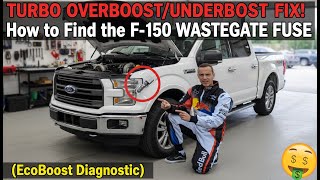
How to confirm: First, check the 10-amp fuse for the solenoid in the under-hood fuse box (often the third 10A fuse from the bottom in the right-most row). 🎬 Watch: How to find and check the wastegate solenoid fuse. If the fuse is good, you can test the solenoid with a vacuum pump and a multimeter. A scan tool like FORScan can command the solenoid's duty cycle to verify its response. However, given the high failure rate and low cost, replacement is often the most practical diagnostic step.
Typical fix: Replace the wastegate control solenoid. It is located on the engine and is accessible for a DIY replacement, often in under 30 minutes. Ford's parts catalog can be confusing, sometimes listing it as a 'Control assembly EGR solenoid valve'.
Est. part cost: $50-$100 - Sticking or Binding Wastegate Actuator 🟡 Medium Probability The wastegate actuator arm or the internal valve on the turbocharger can seize or bind due to heat, corrosion, and carbon buildup. This prevents the wastegate from opening to bleed off excess boost.
How to confirm: With the engine off and cool, manually try to move the wastegate actuator arm. It should move freely without binding. You can also apply vacuum with a hand pump to see if the actuator holds vacuum and moves the arm smoothly.
Typical fix: If the actuator is binding, sometimes it can be freed up with penetrating oil and manual movement. However, if the actuator diaphragm has failed or it is seized internally, the entire turbocharger assembly often needs to be replaced, as Ford does not typically sell the wastegate actuator separately for this application.
Est. part cost: $800-$1500 for a turbocharger assembly - Damaged or Leaking Vacuum Lines ⚪ Low Probability The plastic and rubber vacuum lines that control the wastegate can become brittle and crack over time due to engine heat, leading to vacuum leaks that prevent the wastegates from opening properly.
How to confirm: Visually inspect all vacuum lines running from the control solenoid to the wastegate actuators for cracks, breaks, or loose connections. A smoke test can also be performed to find hard-to-see leaks.
Typical fix: Replace the damaged section of vacuum line or the entire vacuum harness assembly.
Est. part cost: $20-$50
Rare But Worth Checking
- Faulty MAP (Manifold Absolute Pressure) Sensor: A MAP sensor that is reading incorrectly (reporting lower pressure than actual) can cause the PCM to command more boost than necessary, leading to an overboost condition. This is less common than control system failures. This may also be seen with codes like P0236 or P2227.
- Restricted Exhaust: A clogged catalytic converter can cause excessive backpressure, preventing the wastegate from effectively controlling turbo speed. This will usually be accompanied by other codes like P0420 or P0430 and more severe power loss.
Diagnosis Steps

- Read the code with an OBD-II scanner and confirm P0234 is present. Note any other codes, such as P1015, P1016, or P0236.
- Check the 10-amp fuse for the wastegate control solenoid in the under-hood fuse box. It is often the third 10A fuse from the bottom in the right-most row. If blown, replace it and re-test.
- Visually inspect all vacuum lines between the control solenoid and the turbo wastegate actuators for any cracks, breaks, or disconnections. Pay close attention to the connections at the solenoid and actuators.
- With the engine off, reach down to the turbochargers (once cool) and manually check if the wastegate actuator arms move freely without binding.
- Use a hand-held vacuum pump to test the wastegate actuators. They should hold vacuum and move the actuator arm smoothly through its full range of motion.
- If the fuse, lines, and actuators are good, the most likely culprit is the wastegate control solenoid itself. Given its high failure rate and low cost, many owners and mechanics opt to replace it as the next step.
- If a new solenoid does not resolve the issue, perform advanced diagnostics on the MAP sensor circuit and check for exhaust restrictions (e.g., clogged catalytic converters).
Parts You'll Likely Need
- Turbocharger Wastegate Control Solenoid
(OEM #FL3Z-9E882-A (supersedes FL3Z-9E882-B))— This is the most common failure point for the P0234 code on the 2.7L EcoBoost. It controls the vacuum that actuates the wastegates. Note that Ford's catalog may call this an 'EGR Solenoid Valve'.
Trusted brands: Motorcraft, Pierburg (often original supplier), Padmini (often newer supplier)
OEM price range: $70-$110
Aftermarket price range: $40-$80
Related Codes That Often Appear With This One
- P1015 — This Ford-specific code for 'Wastegate control pressure lower than expected' can appear alongside P0234 if the control system is malfunctioning erratically.
- P1016 — This Ford-specific code for 'Wastegate control pressure higher than expected' points directly to the same system and is often caused by the same faulty solenoid or binding wastegate.
- P0236 — This code for 'Turbocharger/Supercharger Boost Sensor 'A' Circuit Range/Performance' can accompany P0234, indicating a potential issue with the MAP sensor's readings in addition to the overboost condition.
Technical Service Bulletins (TSBs) & Recalls
- TSB 15-0182: Addresses DTCs P0234 and/or P0299 on some 2015 F-150s with GTDI engines, which can include the 2.7L EcoBoost.
Platform-Specific Known Issues
- A TSB (15-0182) was issued for some 2011-2015 F-150s with GTDI engines (including early 2015 2.7L models) for P0234, indicating this has been a known issue since the platform's early days.
- Owners report that Ford parts systems can be confusing, sometimes calling the wastegate solenoid an 'EGR control solenoid' or even 'vacuum hose', which can complicate finding the right part. One forum user confirmed they had to send a picture of the part to a dealer to get the correct replacement after being told it wasn't sold separately.
- A user on f150forum.com documented their P0234 repair, noting that after finding the original part number was superseded twice, parts websites incorrectly stated the newest part number was incompatible with their 2015 2.7L F-150. The new part worked perfectly, highlighting issues with parts catalog accuracy.
Mechanic-Grade Diagnostic Values
- Wastegate Control Solenoid Internal Resistance — expected: 10 - 40 Ohms across the two pins.. Failure: A reading of 'OL' (Over Limit/infinite resistance) or near zero Ohms indicates a failed solenoid.
- Wastegate Control Solenoid Connector Voltage (KOEO) — expected: Approximately 12V (Battery Voltage) on the power supply pin.. Failure: A reading significantly below battery voltage (e.g., a forum user measured 0.71V) points to a wiring or fuse issue upstream of the solenoid.
- Wastegate Actuator Vacuum Test — expected: Actuator arm begins to move at ~17 inHg and should be fully extended by ~22 inHg.. Failure: The actuator does not move, does not hold vacuum, or requires significantly more vacuum to actuate, indicating a failed diaphragm or seized arm.
Scan Tool Commands That Help
- FORScan / Ford IDS: Monitor Wastegate Control (WGC) or Turbocharger Wastegate Control Solenoid (TCWGS) Duty Cycle PID. — On 2015-2017 models, this allows you to see the PCM's command to the vacuum solenoid in real-time. A commanded duty cycle with no change in boost or vacuum at the actuator points to a failed solenoid or blockage.
- FORScan / Ford IDS: Turbocharger (TC) Vane Position Actuator Reset / Self-Test. — On 2018-2019 models with electronic wastegates, this command forces the actuator through its full range of motion. A failure of this test or an accompanying code like P003A definitively points to a problem with the electronic actuator.
Wiring & Ground Locations
- Body-to-Frame Ground (Passenger Side) — Under the passenger side of the truck, a cable runs from the body down to the frame rail, often near the front door area or where an external transmission control module might be located on other models.. This ground is a notorious failure point on F-150s due to corrosion. While not directly in the wastegate circuit, a poor primary ground can cause a cascade of unpredictable electrical issues and unstable sensor readings, potentially contributing to control module faults or incorrect sensor data that could trigger a P0234.
- G103 / G104 — Primary engine and chassis grounds, typically found on the inner fender in the engine bay near the battery, or on the lower front/side of the engine block.. These are the main ground points for the engine's electrical systems. A loose or corroded connection here can cause unstable voltage for the PCM and its sensors, leading to erratic behavior and false codes.
Real Owner Repair Stories
- Ford F150 Forum thread 'P0234 troubleshooting' (2015 Ford F-150 2.7L EcoBoost) — P0234 (overboost) code, wrench light on dash during acceleration.
❌ Tried (didn't work) Initial clearing of the code; it returned quickly.
✅ What actually fixed it Replacement of the wastegate control solenoid. The owner confirmed the wastegates held vacuum and moved freely before ordering the part. Critically, they documented that the original part number was superseded twice, and online parts catalogs incorrectly listed the newest, correct part number as 'incompatible' with their truck. This highlights a major pitfall for DIY repair.
OEM Part Supersession History
FL3Z-9E882-B→FL3Z-9E882-A— Standard part revision and update by Ford.
Heads up: Forum users have confirmed that many online parts catalogs incorrectly state that the newest part number (FL3Z-9E882-A) is incompatible with 2015-2017 2.7L models, even though it is the correct replacement part. Ford's official name for this part is often 'Control Assembly EGR Solenoid Valve', which adds to the confusion.
Model Year Variations Within This Range
- 2015-2017 (Gen 1 2.7L): These models use twin turbochargers with vacuum-actuated wastegates. The diagnosis for P0234 correctly focuses on the vacuum lines, the wastegate actuators holding vacuum, and the electronic solenoid (FL3Z-9E882-A) that controls the vacuum signal. The solenoid is the most common failure point.
- 2018-2019 (Gen 2 2.7L): These models feature revised twin turbochargers with electronic wastegate actuators (stepper motors). The vacuum control solenoid from the earlier years does not exist on this system. For these model years, a P0234 code is most likely caused by a faulty or binding electronic actuator itself, which is often integrated into the turbocharger assembly and is a much more complex and expensive repair. Diagnosis would involve using a scan tool to run an actuator self-test.
Diagnostic Flowchart

Other Known Issues on This Vehicle
Issues unrelated to this code that are worth knowing about as an owner of this generation:
- Leaking RTV Oil Pan Seal 🟠 Medium — Very common on 2015-2019 models. The original RTV sealant fails, causing oil seepage or drips. The issue was so widespread Ford issued multiple TSBs. (Ref: TSB 23-2083 (for 2015-2017 models) and TSB 19-2189 (for 2018-2019 models built before 05/21/2019). The fix involves replacing the original pan with an updated design that uses a press-in-place gasket.)
- Intake Valve Carbon Buildup 🟠 Medium — Primarily affects 2015-2017 models, which use direct injection only. Oil vapor from the PCV system bakes onto the intake valves, causing rough idle, hesitation, and power loss over time (typically noticeable after 60,000+ miles). The 2018+ models added port injection, which helps keep the valves clean.
- White/Blue Smoke from Exhaust on Startup 🟠 Medium — Common on 2015-2017 models. Caused by oil pooling in the left-hand turbocharger housing after a cold soak, which is then burned off at the next startup. (Ref: TSB 19-2188 details the issue and provides a fix, which typically involves installing an updated oil supply tube for the turbocharger.)
- Warped Dashboard at Defrost Vents 🟡 Low — A cosmetic issue common across 2015-2019 F-150s (XL/XLT trims) where the dashboard material lifts and separates near the windshield defrost vents due to sun/heat exposure. (Ref: TSB 19-2071 acknowledges the issue and the fix is to replace the upper section of the instrument panel.)
Used vs. New Parts: Buying Guide for This Vehicle
When a used part is the smart pick: For this repair, used parts are generally not recommended for the primary failure components. However, obtaining a used vacuum line harness from a low-mileage donor vehicle could be a cost-effective option if a specific plastic fitting is broken and not sold separately.
Donor-vehicle mileage cap: roughly under 60000 miles for the part to have meaningful remaining life.
What to inspect on the donor part:
- For vacuum lines, ensure the plastic is not brittle and rubber connectors are still pliable.
- For a 2018+ electronic turbocharger assembly, look for a donor with no signs of oil leaks, shaft play, or physical damage to the electronic actuator and its wiring.
OEM-only on this vehicle (don't cheap out):
- Wastegate Control Solenoid (2015-2017): Given the low cost of the OEM Motorcraft part and its criticality, using a known-good OEM part is strongly advised over unproven aftermarket alternatives or used parts.
- Turbocharger Assembly (2018-2019): If the entire turbo must be replaced due to a failed electronic actuator, a new or professionally remanufactured OEM unit is the most reliable option to ensure proper calibration and longevity.
Aftermarket brands forum-validated for this vehicle:
- Pierburg: Often the original equipment manufacturer for the vacuum solenoid; a Pierburg-branded part is equivalent to OEM.
Brands owners have reported issues with on this vehicle:
- Unbranded, low-cost solenoids from online marketplaces are a gamble. Many forum users report premature failure or out-of-box failure with no-name electronic parts.
Real Owner Stories
Aggregated from forums and TSBs cited above. Mileages and costs reflect what owners reported in those sources.
2015 Ford F-150 2.7L EcoBoost
Symptoms: The owner found that the original part number for the solenoid had been superseded twice, and parts websites incorrectly claimed the newest part number was incompatible with their vehicle.
What fixed it: Replaced the wastegate control solenoid with the newest superseded part number, which worked perfectly despite catalog errors.
Source hint: f150forum.com thread 'P0234 troubleshooting' by user 'RaptorYFM'
Ford F-150 2.7L EcoBoost
Symptoms: Overboost condition error code P0234.
What fixed it: Professional repair of a bad vacuum solenoid.
Cost: $0-$150
Source hint: f150forum.com thread 'Overboost Condition Error Code P0234' where user 'EcoBoostJake' shared their experience
2015 Ford F-150 2.7L EcoBoost
Symptoms: P0234 code present; owner was initially told the required part wasn't sold separately.
What fixed it: The owner had to send a physical picture of the part to a dealer to correctly identify and obtain the replacement solenoid.
Source hint: vehicle_specific_issues citing forum user documentation
Related OBD-II Codes
Frequently Asked Questions
Does TSB 15-0182 apply to my 2015 Ford F-150 2.7L EcoBoost?
Where is the fuse for the wastegate control solenoid located on the 2.7L EcoBoost?
I'm looking for the wastegate solenoid but the parts catalog shows an 'EGR solenoid.' Is this the same part?
Can I replace the wastegate actuator alone if it is sticking on my 2.7L turbo?
Is the P0234 code common on other Ford vehicles with the 2.7L engine?
Who is the original manufacturer of the wastegate control solenoid for the F-150 2.7L?
Helpful Videos
Used OEM Parts in Stock


New Aftermarket Parts Available


The information in this article is provided for general reference and educational purposes only. Vehicle specifications, procedures, and part compatibility can vary by production date, trim level, and region. Always consult your vehicle's factory service manual and verify part numbers before purchasing or performing repairs. Safety-critical components such as airbags, seat belts, and braking systems should be installed by a qualified professional.
- Ford F-150:
- 🎬 Helpful Videos
- 🛍️ Shop This Part
- What's Unique About the 2015-2019 Ford F-150
- Symptoms You May Notice
- Most Likely Causes
- Rare But Worth Checking
- Diagnosis Steps
- Parts You'll Likely Need
- Related Codes That Often Appear With This One
- Technical Service Bulletins (TSBs) & Recalls
- Platform-Specific Known Issues
- Mechanic-Grade Diagnostic Values
- Scan Tool Commands That Help
- Wiring & Ground Locations
- Real Owner Repair Stories
- OEM Part Supersession History
- Model Year Variations Within This Range
- Diagnostic Flowchart
- Other Known Issues on This Vehicle
- Used vs. New Parts: Buying Guide for This Vehicle
- Real Owner Stories
- 2015 Ford F-150 2.7L EcoBoost
- Ford F-150 2.7L EcoBoost
- 2015 Ford F-150 2.7L EcoBoost
- Related OBD-II Codes
- Frequently Asked Questions
- 🎟️ Get 5% Off