

P0223 on 2016-2020 Kia Sorento 2.4L: Throttle Position Sensor 'B' Circuit High Fixes
On a 2016-2020 Sorento with the 2.4L GDI engine, code P0223 almost always points to a failing electronic throttle body assembly. The throttle position sensor (TPS) is integrated and not sold separately. Expect to pay $150-$250 for an aftermarket part or $350-$450 for OEM. Replacement is a common DIY fix that requires a simple key-cycle relearn procedure.
- P0223 on a 2016-2020 Sorento 2.4L points directly to a problem with the electronic throttle body.
- The most probable fix is replacing the entire throttle body assembly, as the sensor is built-in.
- Do not drive the vehicle extensively with this code, as it will likely be in a low-power limp mode.
- After replacing the part, a simple throttle relearn procedure is necessary and can often be done without special tools by cycling the ignition key.
What's Unique About the 2016-2020 Kia Sorento
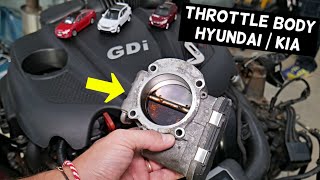
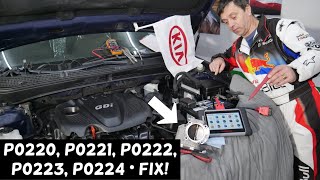
The Theta II 2.4L GDI engine is a direct-injection design, which means fuel doesn't wash over the intake and throttle body. This makes it prone to significant carbon buildup which can sometimes interfere with throttle plate movement. However, for a specific 'circuit high' code like P0223, the issue is more often an electronic failure within the throttle body assembly itself, 🎬 Watch: Diagnosing Kia throttle body codes a known weak point on this engine family and its platform mates. The TPS sensors are integrated and cannot be replaced separately, making replacement of the entire unit the standard repair.
Symptoms You May Notice
- Check Engine Light is on
- Vehicle enters 'limp mode' with drastically reduced engine power
- Hesitation or stumbling during acceleration
- Unstable or rough idle
- Difficulty starting the engine
- Poor or no throttle response
- Electronic Stability Control (ESC) light may also illuminate
- Replacing the Accelerator Pedal Position (APP) sensor. While the APP sensor is part of the throttle control system, P0223 specifically points to the sensor located on the throttle body at the engine, not the one connected to the pedal. A fault with the pedal sensor would typically set a different code, such as P2138.
Most Likely Causes
- Faulty Electronic Throttle Body Assembly 🔴 High Probability The Throttle Position Sensor (TPS) is integrated into the throttle body and is not serviceable separately. The internal electronic components are a common failure point on the Theta II engine platform, shared with vehicles like the Hyundai Santa Fe and Sonata.
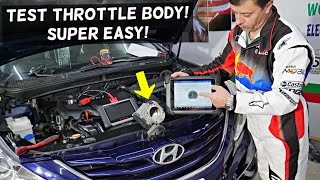
How to confirm: Use a scan tool with live data to monitor the TPS1 and TPS2 voltage readings. With the key on and engine off, slowly press the accelerator pedal. The voltage for TPS1 should sweep smoothly from low (approx. 0.5V) to high (approx. 4.5V), while TPS2 should do the opposite. A reading for TPS2 that is stuck high (e.g., above 4.7V) and does not change confirms a failed sensor within the assembly. 🎬 See how to test the throttle body
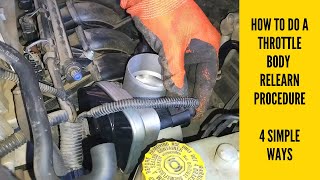
Typical fix: Replace the entire electronic throttle body assembly. After replacement, a throttle relearn procedure is required. A common method is to cycle the ignition 'ON' (engine off) for 15 seconds, then 'OFF' for 5-15 seconds, repeating 3-5 times before starting the engine.
Est. part cost: $150-$450 - Wiring Harness or Connector Issue ⚪ Low Probability
How to confirm: Visually inspect the 6-pin wiring harness and connector going to the throttle body for any signs of damage, corrosion, or loose pins. With a multimeter, check for a stable 5V reference and good ground at the connector with the key on. Wiggle the harness while monitoring live data to see if the voltage reading for TPS2 fluctuates, indicating an intermittent connection.
Typical fix: Repair the damaged section of the wiring harness or clean/replace the connector.
Est. part cost: $10-$50
Rare But Worth Checking
- Faulty Powertrain Control Module (PCM): This is extremely unlikely and should only be considered after the throttle body and all related wiring have been definitively ruled out. A faulty PCM will typically present with multiple other unrelated codes.
Diagnosis Steps
- Retrieve all stored fault codes with an OBD-II scanner. Note any accompanying codes like P0123, P2135, or P2106.
- Using the scanner's live data function, monitor the voltage readings for both TPS1 and TPS2.
- Observe the voltage as you slowly press and release the accelerator pedal with the key on, engine off. Look for any glitches, spikes, or flat spots in the voltage sweep. For P0223, you will likely see the TPS2 voltage stuck at a high value (e.g., >4.7V).
- If the live data confirms a sensor fault, turn the vehicle off and inspect the throttle body connector. Ensure it is clean, dry, and securely connected.
- Check the wiring harness for any visible damage, such as chafing, melting, or corrosion, particularly near the connector.
- If the wiring and connector are in good condition, the electronic throttle body assembly is the confirmed culprit and should be replaced.
- After replacement, perform a throttle relearn procedure. A common method is to cycle the key ON for 15 seconds, OFF for 15 seconds, and repeat 3-5 times before starting the engine.
- Clear all codes and perform a test drive to ensure the issue is resolved.
Parts You'll Likely Need
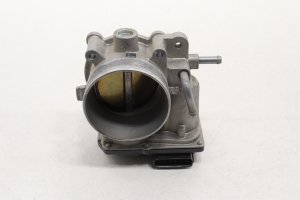
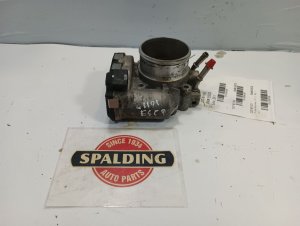
- Electronic Throttle Body Assembly
(OEM #35100-2G700)— The throttle position sensor (TPS) that causes P0223 is integrated into this assembly and cannot be replaced separately. This is the most common failure point for this code on the Sorento and its platform mates.
Trusted brands: Kia (OEM), Bosch, Hitachi, Standard Motor Products
OEM price range: $350-$450
Aftermarket price range: $150-$250
Related Codes That Often Appear With This One
- P0123 — This code is for 'Throttle Position Sensor 'A' Circuit High'. Since both sensors are in the same housing, it's common for a significant internal failure to trigger codes for both circuits simultaneously.
- P2135 — This code indicates 'Throttle/Pedal Position Sensor/Switch 'A'/'B' Voltage Correlation'. The PCM constantly compares the signals from the two sensors. If one fails and gets stuck high (P0223), the signals no longer mirror each other, triggering the P2135 correlation fault.
- P2106 — This code, 'Throttle Actuator Control System - Forced Limited Power,' is a result, not a cause. It confirms that the PCM has intentionally placed the vehicle into 'limp mode' as a direct safety response to the critical fault detected by P0223.
Platform-Specific Known Issues
- The Theta II 2.4L GDI engine is subject to recalls (like SC147 / NHTSA 17V224000) and a class-action lawsuit for serious internal issues like rod bearing failure and excessive oil consumption. While P0223 is an electronic issue unrelated to the engine's mechanical failures, owners should be aware of the engine's history and check their VIN for any open recalls or warranty extensions, particularly the lifetime warranty on the engine short block for certain failures.
Mechanic-Grade Diagnostic Values
- TPS 'B' (TPS2) Signal Voltage — expected: Approx. 4.5V at closed throttle, sweeping smoothly down to approx. 0.5V at wide-open throttle (Key On, Engine Off).. Failure: Voltage is stuck high, typically above 4.75V, and does not change when the accelerator pedal is pressed.
- Sensor 5V Reference Voltage at Connector — expected: A steady 5.0V with the key on, engine off.. Failure: Voltage significantly below 5.0V or 0V indicates a wiring or PCM fault, not a failed throttle body.
- Sensor Ground Voltage at Connector — expected: Less than 100mV (0.1V), ideally close to 0.01V.. Failure: A higher voltage reading indicates a poor ground connection, which can cause incorrect sensor readings.
Scan Tool Commands That Help
- Kia GDS (Global Diagnostic System) or equivalent professional scanner: Active Test / Actuation Test > ETC Motor — This bidirectional command allows the technician to directly order the throttle plate to open and close. It is used to definitively confirm if the throttle body's internal motor and sensors are responding correctly, isolating the fault to the assembly itself and ruling out issues with the accelerator pedal or wiring.
Wiring & Ground Locations
- Throttle Body Connector (Typical 6-Pin) — The electrical connector plugged directly into the electronic throttle body assembly, at the front of the intake manifold.. This is the single point for all power, ground, and signal wires for both throttle position sensors. Testing for voltage and ground at these specific pins is the primary way to rule out a wiring issue before condemning the throttle body. A typical pinout is: Pin 5 = 5V Reference, Pin 3 = Sensor Ground, Pin 4 = TPS1 Signal, Pin 6 = TPS2 Signal.
Real Owner Repair Stories
- Aggregated from Go-Parts repair database (Hyundai Tucson (platform mate) with 2.4L engine) — Limp mode, unstable idle, and throttle-related fault codes (P0121, P0221 - functionally similar to P0223).
❌ Tried (didn't work) Initial diagnosis pointed towards a sensor failure.
✅ What actually fixed it Replacing the entire electronic throttle body assembly (OEM P/N 35100-2G700) and performing a throttle adaptation resolved all symptoms and codes. The old unit had visible carbon and resistance to movement.
OEM Part Supersession History
35100-2G700→35100-2G700 (current)— Part number has remained stable for the specified vehicle range.
Heads up: While the part number is consistent, the OEM part may be supplied in either a red Kia box or a blue Hyundai box. They are the same component manufactured by Mobis.
Diagnostic Flowchart
Other Known Issues on This Vehicle
Issues unrelated to this code that are worth knowing about as an owner of this generation:
- Catastrophic Engine Failure (Rod Bearing Wear) 🔴 High — Widespread across the Theta II engine family, can occur at various mileages, often starting around 60,000 miles. Subject of a major class-action lawsuit. (Ref: Recall SC147 / NHTSA 17V224000; Lifetime Warranty Extension for short block)
- Excessive Engine Oil Consumption 🔴 High — Extremely common, often starting between 60,000 and 100,000 miles. Can lead to engine damage if not monitored closely. Kia considers >1 quart per 1,000 miles excessive. (Ref: TSB ENG223 (for oil consumption test procedure))
- Starter Motor Failure 🟠 Medium — Frequently reported by owners, often leading to a no-start or intermittent starting condition with a 'click' sound.
- Intake Valve Carbon Buildup 🟠 Medium — Common to all GDI engines. Symptoms like rough idle and hesitation typically appear between 60,000 and 100,000 miles and may require walnut blast cleaning.
Used vs. New Parts: Buying Guide for This Vehicle
When a used part is the smart pick: A used throttle body can be a cost-effective option if the budget is tight, but it carries risk due to being a common failure item. It makes the most sense if you can inspect the part thoroughly before purchase and get it from a reputable seller with a short-term warranty.
Donor-vehicle mileage cap: roughly under 75000 miles for the part to have meaningful remaining life.
What to inspect on the donor part:
- Verify the OEM part number (35100-2G700) matches exactly.
- Inspect the electrical connector pins. They must be straight, clean, and free of any green or white corrosion.
- Look inside the throttle bore. A light, dry layer of carbon is normal, but avoid any parts with heavy, caked-on buildup or a wet, oily film.
- Gently move the throttle plate by hand. It should move smoothly through its range of motion without any sticking, binding, or gritty feeling.
OEM-only on this vehicle (don't cheap out):
- Electronic Throttle Body Assembly: While not strictly 'OEM-only', a new OEM part is highly recommended for this repair to ensure longevity and avoid repeat failures, as the internal electronics are the primary failure point.
Aftermarket brands forum-validated for this vehicle:
- Standard Motor Products
- Dorman
- Bosch
- Hitachi
Brands owners have reported issues with on this vehicle:
- Unbranded, low-cost units from online marketplaces are generally not recommended for critical electronic components due to inconsistent quality control.
Real Owner Stories
Aggregated from forums and TSBs cited above. Mileages and costs reflect what owners reported in those sources.
2017 Kia Sorento 2.4L GDI — ~85000 miles
Symptoms: Widespread oil consumption issues where the engine consumes more than 1 quart per 1000 miles.
What fixed it: Followed TSB ENG223 for an oil consumption test to determine if the engine met the threshold for repair under Kia's guidelines.
Source hint: Kia Forums - "2017 Sorento 2.4L oil consumption"
2016-2020 Kia Sorento 2.4L GDI — ~60000 miles
Symptoms: Excessive oil consumption leading to potential engine damage; user noted Kia's threshold for 'excessive' is 1 quart per 1000 miles.
What fixed it: Service bulletin for excess oil consumption test.
Source hint: Reddit r/kia - "Service bulletin for excess oil consumption"
Related OBD-II Codes
Frequently Asked Questions
Is the P0223 code on my 2016-2020 Kia Sorento covered under the Theta II engine recall SC147?
Can I just replace the sensor for P0223 instead of the whole throttle body?
My Sorento is in 'limp mode' and the ESC light is on. Is this related to P0223?
How do I perform the throttle relearn on my Sorento after replacing the assembly?
What voltage should I see for TPS2 on my scan tool to confirm a failure?
Is there a TSB for the high oil consumption I'm noticing along with this code?
Helpful Videos
Used OEM Parts in Stock


New Aftermarket Parts Available



The information in this article is provided for general reference and educational purposes only. Vehicle specifications, procedures, and part compatibility can vary by production date, trim level, and region. Always consult your vehicle's factory service manual and verify part numbers before purchasing or performing repairs. Safety-critical components such as airbags, seat belts, and braking systems should be installed by a qualified professional.
- Kia Sorento:
- 🎬 Helpful Videos
- 🛍️ Shop This Part
- What's Unique About the 2016-2020 Kia Sorento
- Symptoms You May Notice
- Most Likely Causes
- Rare But Worth Checking
- Diagnosis Steps
- Parts You'll Likely Need
- Related Codes That Often Appear With This One
- Platform-Specific Known Issues
- Mechanic-Grade Diagnostic Values
- Scan Tool Commands That Help
- Wiring & Ground Locations
- Real Owner Repair Stories
- OEM Part Supersession History
- Diagnostic Flowchart
- Other Known Issues on This Vehicle
- Used vs. New Parts: Buying Guide for This Vehicle
- Real Owner Stories
- 2017 Kia Sorento 2.4L GDI — ~85000 miles
- 2016-2020 Kia Sorento 2.4L GDI — ~60000 miles
- Related OBD-II Codes
- Frequently Asked Questions
- 🎟️ Get 5% Off