

OBD-II Code P2106: Throttle Actuator Control System - Forced Limited Power
The Ultimate Guide to What P2106 Means, Why It Triggers, and How to Fix It for Good
- P2106 forces your vehicle into a 30-45 mph 'limp mode' due to a critical failure in the electronic throttle control system.
- P2106 is an informational code; you must diagnose accompanying codes like P2135 (Throttle Position Sensor) to find the actual root cause.
- A faulty Throttle Position Sensor (TPS) causes up to 38% of P2106 codes, making the throttle body assembly the primary suspect.
- Driving in limp mode for more than a few miles risks destroying your catalytic converter, adding up to $2,500 in repair costs.
- Check for Technical Service Bulletins (TSBs) before replacing parts, as manufacturers like Ford and Hyundai frequently issue PCM software updates to resolve this code.
What Does P2106 Mean?

P2106 indicates the Powertrain Control Module (PCM) detected a critical fault in the electronic throttle control system and forced the engine into a low-power 'limp mode'. This is an informational code alerting you that power is limited. You must diagnose accompanying codes (like P2135) to identify the failing component.
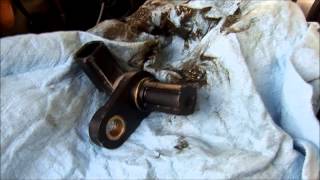
🎬 Watch: Ford electronic throttle body failure diagnosis and common codes.Technical definition: Throttle Actuator Control System - Forced Limited Power. The Powertrain Control Module (PCM) has entered a failure management mode, limiting throttle actuator operation due to a detected fault that compromises safe vehicle operation.
Can I Drive With P2106?
Yes, But With Caution. You can drive short distances to a repair shop. The PCM intentionally reduces engine power ('limp mode'), capping speeds at 30-45 mph. Continuing to drive long distances forces the engine to run rich, destroying the catalytic converter and adding $800-$2,500 to your repair bill.
Common Causes

- Faulty Throttle Position Sensor (TPS) (Very Common) — The TPS monitors throttle plate position using two redundant sensors. If they send conflicting data, the PCM triggers limp mode. This accounts for roughly 38% of P2106 cases.
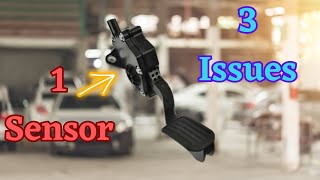
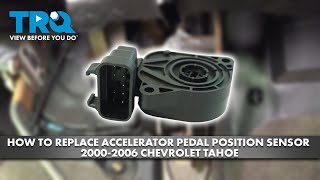
- Faulty Accelerator Pedal Position (APP) Sensor (Common) — The APP sensor measures gas pedal pressure. When it fails, the PCM cannot determine driver intent and defaults to a safe, low-power mode. This causes over 22% of P2106 incidents. 🎬 See how to replace a faulty accelerator pedal position sensor.
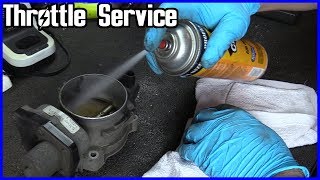
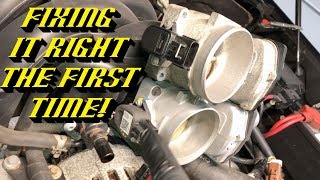
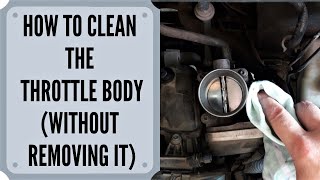
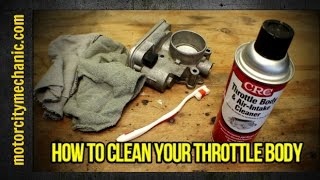
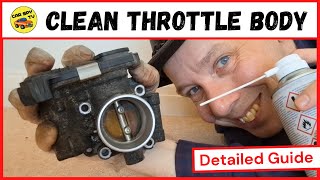
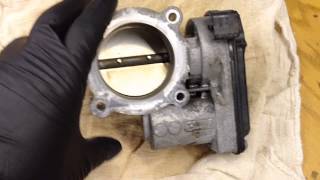
- Dirty or Sticking Throttle Body (Common) — Carbon buildup inside the throttle body prevents the throttle plate from moving smoothly. The PCM detects this mechanical resistance and limits power to prevent unintended acceleration. 🎬 Watch: How to clean an electronic throttle body safely.
- Wiring or Connector Issues (Common) — Frayed wires, corroded pins, or loose connectors between the gas pedal, throttle body, and PCM interrupt critical signals. These intermittent issues often surface when the engine is hot or driving on bumpy roads.
- Failing Throttle Actuator Control (TAC) Motor (Less Common) — The TAC motor physically opens and closes the throttle plate. Internal shorts or mechanical wear prevent it from executing PCM commands, accounting for 15% of cases.
- Low or Unstable System Voltage (Uncommon) — A weak battery (below 12.4V) or failing alternator starves the electronic throttle system of required voltage. A voltage drop below 11V during operation triggers this fault as a precaution.
- Faults in Other Major Systems (Uncommon) — Severe faults in unrelated systems, such as a failing ABS wheel speed sensor or clogged catalytic converter, force the PCM into a global limp mode that includes setting P2106.
- Unmetered Air Leak (Vacuum Leak) (Uncommon) — A cracked PCV hose or failed intake manifold gasket allows unmetered air into the engine. The resulting mismatch between expected airflow and actual throttle position triggers limp mode.
- Powertrain Control Module (PCM) Fault (Rare) — Internal PCM glitches or corrupted software incorrectly trigger limp mode. This requires a dealer software update (reflash) or module replacement.
Symptoms

- Forced Reduced Power / Limp Mode — Vehicle speed is capped at 30-45 mph, and engine RPMs are restricted to 2,000-3,000.
- Check Engine Light and/or Wrench Light On — The Check Engine Light illuminates immediately. Ford models often display a wrench-shaped powertrain warning light.
- Poor or No Throttle Response — Pressing the gas pedal yields little to no acceleration, making the pedal feel disconnected.
- Rough Idle or Stalling — The engine runs unevenly, shakes, or shuts off completely when stopped at idle.
- Disabled Cruise Control — The PCM disables cruise control as a mandatory safety precaution.
Diagnostic Flowchart
Tap your situation to follow the diagnostic path that matches what you're seeing on this code.
Common Fixes & Costs
- Cleaning the Throttle Body — Parts: $10-$20, Labor: $100-$150, ~1 hr book time (DIY)
- Replacing the Throttle Body Assembly
— Parts: $200-$600, Labor: $100-$250, ~1.5 hr book time
(Intermediate)
: OEM 8L3Z-9E926-C (Alt: Dorman 977-313, Standard Motor Products S20050)
: OEM 19420713 (Alt: ACDelco 217-3153, Dorman 977-313) - Replacing the Accelerator Pedal Position (APP) Sensor Assembly
— Parts: $100-$250, Labor: $75-$150, ~0.8 hr book time
(Intermediate)
: OEM 32700-C2300 (Alt: Standard Motor Products APS355, Walker 200-1176) - Repairing a Damaged Wiring Harness or Connector — Parts: $10-$50, Labor: $150-$400, ~2.5 hr book time (Professional)
- Replacing the Powertrain Control Module (PCM) — Parts: $500-$1200, Labor: $150-$300, ~1.5 hr book time (Professional)
DIY vs Professional
- Cleaning the Throttle Body — Beginner:
Tools: Socket set/screwdriver, throttle body cleaner, rags, flashlight. - Replacing the Accelerator Pedal Position (APP) Sensor — Beginner:
Tools: Basic socket set or wrenches. - Replacing the Throttle Body Assembly — Beginner:
Tools: Socket set, torque wrench, pliers for coolant lines, gasket scraper. - Repairing a Damaged Wiring Harness — Beginner:
Tools: Multimeter, soldering iron, heat shrink, wire strippers, depinning tools.
Used vs. New Parts: Buying Guide
When a used part is worth it: For a throttle body assembly, a used OEM part from a low-mileage vehicle (under 80K miles) that was wrecked is a cost-effective alternative to a new aftermarket part. Avoid parts from vehicles scrapped for engine or electrical issues.
Donor-vehicle mileage cap: roughly under 80000 miles for the part to have meaningful remaining life.
Donor quality checklist:
- Verify the donor vehicle's VIN to check its history and confirm it wasn't scrapped for a related failure.
- Inspect connectors for corrosion or damage.
- Match the OEM part number exactly, as superseded parts may have different software compatibility.
Decision logic:
- If The cost of a new OEM part is extremely high (>$700) and the vehicle is over 10 years old. → A used OEM part offers a good balance of cost and expected reliability.
- If Budget is the primary concern and the vehicle has high mileage (>150K miles). → A quality aftermarket part with a good warranty is often a better bet than a high-mileage used part.
- If The part is for a Ford, GM, or other make with known high failure rates for this component. → Favor a new OEM part, as it may have been updated to fix the original design flaw.
Warranty tradeoff: Used parts from a salvage yard typically come with a 30-90 day warranty. New aftermarket parts often carry a 1-year to limited lifetime warranty. New OEM parts usually have a 1-2 year warranty.
Worst-case if a used part fails: $300-$600 if a used or cheap aftermarket part fails prematurely, requiring repeat labor costs plus the cost of another replacement part.
What Happens If You Wait — Timeline
- 0-1 month: Intermittent limp mode, often reset by restarting the car. Check engine light is on. The underlying issue (e.g., dirty sensor, early wiring chafe) is just beginning. (MPG impact: 0-5%% · Added cost: $0-$50 in wasted fuel)
- 1-3 months: Limp mode becomes more frequent and persistent. The engine runs noticeably rich, leading to a drop in fuel economy and possible carbon fouling of spark plugs. (MPG impact: 5-15%% · Added cost: $100-$400 (wasted fuel, potential spark plug replacement))
- 3-6 months: Sustained rich running conditions from limp mode overheat the catalytic converter. The internal substrate starts to melt or become coated in soot, reducing efficiency. (MPG impact: 15-25%% · Added cost: $500-$1000 (damage to O2 sensors, early catalyst damage))
- 6+ months: Complete catalytic converter failure. The substrate melts into a blockage, causing severe backpressure that leads to engine damage. The car fails emissions testing. (MPG impact: 25-40%% · Added cost: $1500-$3000+ (catalytic converter and O2 sensor replacement))
Cost of Not Fixing It
- Immediate: Significant safety risk due to lack of acceleration, making it dangerous to merge, cross intersections, or maintain traffic speed. (Added cost: Negligible)
- 0-1 month: Continued driving in limp mode causes the engine to run rich, leading to premature carbon buildup on spark plugs and oxygen sensors. (Added cost: $200-$500)
- 1-6 months: Prolonged rich running conditions overheat and destroy the catalytic converter, a critical and expensive emissions component. (Added cost: $1200-$2800)
- 6+ months: Potential for additional stress on the transmission and cascading electrical issues if the root cause is a voltage or PCM problem. (Added cost: $1500-$4000+)
Diagnosis Steps

- Read All Trouble Codes & Freeze Frame Data
Scan all vehicle modules (PCM, ABS, TCM) for stored codes. P2106 is a secondary code. Primary codes like P2135, P0121, or P0221 pinpoint the exact failure. Diagnose and resolve these primary codes first.
Tools: OBD-II Scanner (Beginner) - Perform a Thorough Visual Inspection
Inspect the wiring harnesses connecting the throttle body and accelerator pedal. Look for chafed insulation, corroded connector pins, or loose grounds. Verify the air intake tube is securely clamped with no cracks.
Tools: Flashlight (Beginner) - Check Battery and Charging System Voltage
Test the battery with a multimeter to confirm at least 12.4 volts (engine off). Start the engine and verify the alternator outputs 13.8-14.4 volts. Voltage drops below 11V under load trigger false throttle codes.
Tools: Multimeter (Beginner) - Inspect and Clean the Throttle Body
Remove the air intake tube from the throttle body. Inspect the bore and throttle plate for heavy black carbon buildup. Clean the assembly using dedicated throttle body cleaner and a soft microfiber cloth.
Tools: Screwdriver or socket set, Throttle Body Cleaner, Soft cloth (Intermediate) - Test Sensor Voltages with Live Data
Monitor APP and TPS voltage readings using a live data scanner. Slowly press the gas pedal (key on, engine off). APP and TPS voltages must sweep smoothly without spikes or dropouts. Any erratic voltage jumps confirm a failed sensor.
Tools: Advanced OBD-II Scanner with Live Data (Advanced) - Perform a Wiring Harness Wiggle Test
Watch live sensor data on a scanner while gently wiggling the wiring harnesses at the throttle body and pedal. If voltage readings jump or the engine stumbles, locate and repair the wiring short.
Tools: Advanced OBD-II Scanner with Live Data (Intermediate) - Check for Ground Integrity
Measure resistance between the throttle body connector's ground pin and the negative battery terminal. Readings above 0.5 ohms indicate a poor ground connection causing erratic sensor behavior.
Tools: Multimeter (Advanced) - Test the Throttle Actuator Motor
Use a bi-directional scanner to command the throttle actuator motor open and closed. Lack of movement or sound confirms a dead TAC motor, distinguishing electrical failure from a mechanical jam.
Tools: Bi-directional OBD-II Scanner (Advanced) - Test Throttle Actuator Motor Resistance
Measure resistance across the TAC motor pins on the throttle body using a multimeter. Normal resistance is 2-15 ohms. Infinity (OL) indicates an open circuit; below 1 ohm indicates a short.
Tools: Multimeter, Vehicle-specific wiring diagram (Advanced) - Test Throttle Position Sensor Resistance
Identify the TPS signal and ground pins. Measure resistance while manually opening the throttle plate. Resistance must sweep smoothly (e.g., 2.2 kΩ to 0.8 kΩ). Drops to zero or OL indicate a dead spot.
Tools: Multimeter, Vehicle-specific wiring diagram (Advanced)
When This Code Triggers (Freeze-Frame Conditions)
- Engine Coolant Temp: 180-210°F (Fully warmed up, during normal operation.)
- RPM: 1500-2800 (During steady cruise or light to moderate acceleration.)
- Engine Load: 30-70% (The fault often occurs when the driver requests more power, such as climbing a hill or accelerating to merge.)
- Vehicle Speed: 30-55 mph (Often triggered during city or highway driving, not typically at idle.)
Related Codes
- P2135 — Throttle/Pedal Position Sensor Voltage Correlation. This is the most common companion code. P2135 is the root cause (disagreement between TPS sensors), and P2106 is the resulting limp mode.
- P2104 — Throttle Actuator Control System - Forced Idle. A more severe limp mode than P2106, restricting the engine to idle speed only with zero throttle response.
- P2110 — Throttle Actuator Control System - Forced Limited RPM. Similar to P2106, but specifically indicates the PCM is capping the engine's maximum revolutions per minute.
- P061B — Internal Control Module Torque Calculation Performance. Often appears with P2106 on Ford models, indicating a discrepancy between expected torque and sensor reality, usually caused by a dirty throttle body.
Climate & Environmental Factors
- High Humidity / Road Salt: Moisture and salt accelerate corrosion on wiring harness connectors and ground points, increasing electrical resistance and causing intermittent signal dropouts from the TPS or APP sensor.
- High Engine Bay Temperatures: Extreme heat degrades internal electronics in the TPS and TAC motor over time, often manifesting as intermittent limp mode issues that only occur after the engine is fully heat-soaked.
How to Talk to a Mechanic About This Code
Say this: "I have a P2106 'Forced Limited Power' code and I'd like to schedule a diagnostic. I know this code is often a symptom of another issue, so please check for any other codes in the engine, ABS, and transmission modules. I'd like the tech to specifically test the accelerator pedal sensor, the throttle position sensor, and check the wiring harness for damage before recommending a throttle body replacement."
This signals to the shop that you're an informed customer. It directs them to perform a comprehensive diagnosis instead of just replacing the most expensive part. It shows you understand P2106 is a 'result' code and the 'cause' code needs to be found, preventing unnecessary parts replacement.
Avoid saying:
- 'My car is in limp mode, just fix it.'
- 'My check engine light is on, can you look at it?' (too vague, invites upsells)
- 'I think I need a new throttle body.' (Don't diagnose for them)
Questions to ask before authorizing the repair:
- What was the specific code that caused the P2106? Was it P2135, an APP sensor code, or something else?
- Did you test the sensor voltages and did they show any glitches or dropouts? Can I see the live data graph?
- Did you perform a 'wiggle test' on the wiring harness to rule out an intermittent short?
- If you're recommending a part replacement, is a 'relearn' procedure required and is that included in the labor estimate?
- What is the warranty on the recommended parts and labor?
Where to Take It: Dealer vs Independent vs Chain
- Dealer:
Recommended if a PCM reflash or a specific TSB is the likely solution. Overkill for a simple sensor or wiring repair on an out-of-warranty vehicle.
Best for: Vehicles under warranty, Known TSBs or software updates for P2106 on your model, Complex electrical issues on newer or European vehicles
Downsides: Highest labor rates (1.5-2x independent shops), Defaults to replacing entire assemblies (e.g., throttle body) instead of smaller components or wiring repairs (Typical cost: +50% vs. baseline) - Independent Shop:
Best overall fit. A good independent diagnostician is the ideal choice for finding the true root cause of a P2106 code without the high cost of a dealer.
Best for: Most out-of-warranty vehicles, Diagnosing common failures like APP sensors, dirty throttle bodies, or wiring chafe
Downsides: Diagnostic skill and equipment quality vary greatly; vet shops by reviews and ASE certifications, May lack access to the latest manufacturer software updates (Typical cost: +0% vs. baseline) - Chain Shop:
AVOID for initial diagnosis. P2106 requires careful diagnostic work, not just code reading. A chain shop is likely to misdiagnose or recommend unnecessary, expensive repairs.
Best for: Simple, clear-cut part replacements after a proper diagnosis has already been made elsewhere
Downsides: Technician skill is highly variable, High pressure to sell parts leads to misdiagnosis (e.g., selling a throttle body when the issue is wiring), Often lack the advanced diagnostic tools or training for complex electrical issues (Typical cost: -10% vs. baseline)
When to Walk Away From the Repair
Sell or trade the vehicle if the estimated repair cost exceeds 50% of its private-party value.
- Car worth $4000, fix is $850: Fix it. The repair cost is ~21% of the car's value, which is well within a reasonable limit.
- Car worth $3000, fix is $1600: Walk away. The repair is over 50% of the car's value. The money is better put toward a replacement vehicle.
- Car worth $10000, fix is $1200: Fix it. This is a routine repair cost for a vehicle of this value.
What Scan Tool You Need for This Code
Minimum: OBD-II reader that can display live sensor data.
A basic $20 code reader only shows the P2106 code, not the underlying cause. To diagnose this issue, you MUST watch live voltage data from the accelerator pedal (APP) and throttle position (TPS) sensors to spot glitches or dropouts. Without live data, you are guessing.
Budget: BlueDriver Pro or Topdon TopScan Lite (~$60-120) — Connects to your smartphone via Bluetooth. Reads all codes, views freeze-frame data, and graphs live sensor data for the TPS and APP sensors to spot failures.
Mid-range: XTOOL D7 or Innova 5610 (~$250-400) — Tablet-style or dedicated handheld scanners offering bidirectional controls. Allows you to actively command the throttle actuator motor to open and close, and performs throttle body relearn procedures.
Professional: Autel MaxiCOM MK808S or Launch X431 Series (~$450-1200) — Provides full, OEM-level bidirectional control over all vehicle modules. Performs advanced functions like PCM software updates and detailed topology mapping to identify communication issues.
Rent vs buy: For a one-time diagnosis, auto parts stores like O'Reilly Auto Parts and AutoZone have a loaner tool program. You pay a deposit for a scanner, which is fully refunded upon return. Buy a scanner only if you plan on doing your own diagnostics regularly.
How to Clear the Code After You Fix It
- Reconnect battery if it was disconnected for the repair.
- Use an OBD-II scan tool to clear all diagnostic trouble codes.
- Perform a complete drive cycle to allow readiness monitors to run.
Drive cycle (~30 minutes): A generic drive cycle includes a cold start (engine off for 8+ hours), 2-3 minutes of idling with electrical loads on (A/C, defroster), followed by mixed city driving (accelerating to ~35-45 mph and coasting down), and concluding with 5-10 minutes of steady highway speed driving (55-60 mph).
Readiness monitors affected: Catalyst Monitor, Evaporative System (EVAP) Monitor, O2 Sensor Monitor
Before emissions retest: drive at least 100 miles to fully set monitors.
Watch out for:
- Simply disconnecting the battery does not guarantee readiness monitors will reset quickly; a full drive cycle is required.
- The code will return immediately if the underlying mechanical or electrical fault has not been properly repaired.
- Failing to perform a throttle body relearn procedure after replacement/cleaning prevents the system from passing its self-tests.
Will This Fail Emissions / State Inspection?
Yes — this code typically fails an OBD-II emissions inspection.
- California: An active P2106 code is an automatic failure. After repair, most readiness monitors must be set to 'Ready'. For 2000+ model year gas vehicles, only the EVAP monitor can be 'Not Ready'. Expect to drive 50-100 miles to complete the drive cycle before a retest.
- New York: A vehicle with an illuminated Check Engine Light will automatically fail the NYS inspection. For 2001 and newer vehicles, only one readiness monitor is allowed to be 'Not Ready'.
- Texas: In counties requiring emissions testing, an illuminated Check Engine Light from a code like P2106 is an automatic failure. After clearing codes, you must drive 50-100 miles for readiness monitors to reset before passing the inspection.
Most Commonly Affected Vehicles

- Ford F-150, Explorer, Mustang, Freestyle (2004-2010) — Extremely common for throttle body failures. Early generation TPS sensors were failure-prone. A corroded wiring harness connector at the throttle body is also a frequent cause.
- Hyundai / Kia Sonata, Optima, Santa Fe, Elantra (2006-2015) — Frequently experience failures of the Accelerator Pedal Position (APP) sensor. Multiple TSBs exist for PCM updates to address over-sensitive fault detection.
- Chevrolet / GMC Silverado, Sierra, Malibu, Trailblazer (2007-2013) — Prone to wiring harness chafing against the intake manifold or brackets, causing shorts. Faulty accelerator pedal sensors are also common.
- Nissan Versa, Sentra, Altima, Tiida (2007-2015) — Prone to failures in the electronic throttle control relay and the throttle body motor itself.
- Toyota Camry, RAV4, Corolla (2006-2012) — P2106 is often related to the throttle actuator or associated sensors. A strict throttle body relearn procedure is critical after service.
- Honda Accord, CR-V, Civic (2007-2012) — Typically points to issues within the electronic throttle body assembly or a faulty APP sensor.
- Subaru Outback, Forester, Impreza (2005-2014) — Often linked to a faulty throttle body or sensor correlation issues. A relearn procedure is mandatory after disconnecting the battery.
- Dodge / Chrysler / Jeep Ram 1500, Charger, Grand Cherokee (2008-2014) — Check for related TSBs regarding PCM software updates that resolve erroneous P2106 codes before replacing hard parts.
Manufacturer-Specific Notes
- Ford: Early-2000s original throttle position sensors were highly prone to failure. The wiring harness connector at the throttle body is a known weak point for corrosion. Ford issued customer satisfaction program 16B32 for electronic throttle body failures on 2015-2016 models.
- Hyundai / Kia: P2106 is frequently caused by a failing Accelerator Pedal Position (APP) sensor rather than the throttle body. Multiple TSBs require updating the PCM software to be less sensitive to minor signal fluctuations.
- General Motors (Chevy/GMC): The wiring harness to the throttle body is routed poorly on many trucks, rubbing against the intake manifold and causing wires to fray and short out.
- Subaru: A 'Throttle Body Relearn' procedure is mandatory after replacing the throttle body or disconnecting the battery. Skipping this causes high idle, stalling, and immediate return of the P2106 code.
Real Owner Stories
2005 Ford F-150 with 5.4L V8
Truck would intermittently enter limp mode (wrench light) and throw codes P2106 and P2135. It would sometimes die and not restart for 15 minutes.
What they tried:
- Replaced the entire throttle body assembly based on online advice.
Outcome: The problem returned 10 minutes after replacing the throttle body. After borrowing a more advanced scanner that could read ABS codes, the true fault was found to be a bad rear wheel ABS sensor ($61 part). Replacing the ABS sensor fixed the limp mode issue.
Lesson: P2106 is often a 'result' code. A fault in a seemingly unrelated system, like ABS, can trigger limp mode. Always scan all vehicle modules (Engine, ABS, etc.) for codes, not just the engine computer.
2006 Ford Freestyle with P2106 & P061B
Vehicle would stall when put in reverse and had almost no power, creeping along even with the pedal to the floor. The dealer quoted $600 to replace the throttle body.
What they tried:
- Added a bottle of Lucas Fuel additive cleaner to the gas tank.
- Drove the car on the freeway for 50 miles while in limp mode.
Outcome: After letting the car sit for 10 minutes and restarting, the check engine light was off and the car ran perfectly. The issue was attributed to carbon buildup from using low-quality gasoline.
Lesson: For a gradual onset of symptoms, a dirty throttle body is a likely cause. A simple and inexpensive first step is to try a quality fuel system cleaner or perform a manual throttle body cleaning before replacing expensive parts.
2004 Ford F-150 with P2106
Owner replaced the throttle body to fix a P2106 code, but the problem persisted. The truck was over-fueling and running poorly.
What they tried:
- Replaced throttle body assembly.
- Cleaned the Mass Air Flow (MAF) sensor.
- Inspected for wiring damage.
Outcome: The actual root cause was a completely corroded Fuel Pump Driver Module (FPDM) located above the spare tire, a very common issue on these trucks. Replacing the FPDM resolved the fuel delivery issue that was indirectly causing the PCM to trigger limp mode.
Lesson: Always inspect for known common failure points on your specific vehicle model. A 5-minute visual inspection of a part like the FPDM on a Ford truck can save hundreds in misdiagnosis.
How to Prevent This Code From Triggering
- Clean the throttle body periodically. (Every 30,000-75,000 miles.) — Prevents the buildup of carbon and gunk from the PCV system that causes the throttle plate to stick, leading to slow response and triggering faults.
- Inspect and protect wiring harnesses. (During any under-hood maintenance.) — Look for areas where harnesses rub against brackets or the engine. Secure loose harnesses with zip ties or install protective conduit to prevent chafing.
- Maintain the battery and charging system. (Annually.) — Ensure battery terminals are clean and tight. Test the battery and alternator to confirm stable voltage (12.4V+ engine off, 13.8V+ running). Low voltage causes false codes in the sensitive throttle control system.
- Use high-quality fuel with detergents. (Every fill-up.) — Top-tier fuels contain additives that reduce carbon deposits throughout the intake system, lessening the rate at which the throttle body gets dirty.
- Apply dielectric grease to key connectors. (When servicing related parts or if living in a wet/salty climate.) — Applying dielectric grease to the seals of the throttle body and APP sensor connectors keeps moisture and road salt out, preventing corrosion.
Frequently Asked Questions
What is a common misdiagnosis for P2106?
The most common mistake is replacing the throttle body without diagnosing accompanying codes. P2106 is an informational code; the actual problem is usually indicated by codes like P2135 or an APP sensor code. Technicians often overlook wiring damage or missing PCM software updates.
Do I need to perform a 'relearn' procedure after cleaning or replacing the throttle body?
Yes, a throttle body relearn is required on most modern vehicles after cleaning, replacement, or battery disconnection. Skipping this step leaves the PCM unaware of the throttle plate's new closed position, causing erratic idle and re-triggering the P2106 code. The procedure often involves letting the car idle for 10-15 minutes with the A/C on.
Can I just clear the code P2106 to fix it?
No. Clearing the code temporarily removes the light, but the PCM will immediately re-trigger limp mode as soon as it detects the unresolved hardware or wiring fault.
Is it safe to drive with code P2106?
It is highly unsafe to drive in heavy traffic. Your ability to accelerate is severely restricted, making merging or crossing intersections dangerous.
Why did P2106 appear with other codes like P2135 or an ABS light?
P2106 is an informational code stating power is limited. Accompanying codes like P2135 reveal the actual reason why. Always diagnose and fix the specific component codes first, as P2106 will clear automatically once the root cause is resolved.
Can a bad battery cause a P2106 code?
Yes. The electronic throttle control system requires a highly stable voltage supply. A weak battery (below 12.4V) or failing alternator causes voltage drops that the PCM interprets as a system fault, triggering limp mode.
What's the difference between P2106, P2104, and P2110?
P2106 limits overall engine power and speed. P2104 is more severe, forcing the engine to idle only with zero throttle response. P2110 specifically caps the engine's maximum RPM, though all three share identical root causes.
Key Takeaways
- P2106 forces your vehicle into a 30-45 mph 'limp mode' due to a critical failure in the electronic throttle control system.
- P2106 is an informational code; you must diagnose accompanying codes like P2135 (Throttle Position Sensor) to find the actual root cause.
- A faulty Throttle Position Sensor (TPS) causes up to 38% of P2106 codes, making the throttle body assembly the primary suspect.
- Driving in limp mode for more than a few miles risks destroying your catalytic converter, adding up to $2,500 in repair costs.
- Check for Technical Service Bulletins (TSBs) before replacing parts, as manufacturers like Ford and Hyundai frequently issue PCM software updates to resolve this code.
Helpful Videos

The information in this article is provided for general reference and educational purposes only. Vehicle specifications, procedures, and part compatibility can vary by production date, trim level, and region. Always consult your vehicle's factory service manual and verify part numbers before purchasing or performing repairs. Safety-critical components such as airbags, seat belts, and braking systems should be installed by a qualified professional.
- 🎬 Helpful Videos
- What Does P2106 Mean?
- Can I Drive With P2106?
- Common Causes
- Symptoms
- Diagnostic Flowchart
- Common Fixes & Costs
- DIY vs Professional
- Used vs. New Parts: Buying Guide
- What Happens If You Wait — Timeline
- Cost of Not Fixing It
- Diagnosis Steps
- When This Code Triggers (Freeze-Frame Conditions)
- Related Codes
- Climate & Environmental Factors
- How to Talk to a Mechanic About This Code
- Where to Take It: Dealer vs Independent vs Chain
- When to Walk Away From the Repair
- What Scan Tool You Need for This Code
- How to Clear the Code After You Fix It
- Will This Fail Emissions / State Inspection?
- Most Commonly Affected Vehicles
- Manufacturer-Specific Notes
- Real Owner Stories
- 2005 Ford F-150 with 5.4L V8
- 2006 Ford Freestyle with P2106 & P061B
- 2004 Ford F-150 with P2106
- How to Prevent This Code From Triggering
- Frequently Asked Questions
- What is a common misdiagnosis for P2106?
- Do I need to perform a 'relearn' procedure after cleaning or replacing the throttle body?
- Can I just clear the code P2106 to fix it?
- Is it safe to drive with code P2106?
- Why did P2106 appear with other codes like P2135 or an ABS light?
- Can a bad battery cause a P2106 code?
- What's the difference between P2106, P2104, and P2110?
- Key Takeaways
- 🎟️ Get 5% Off