

OBD-II Code P0123: Throttle Position Sensor 'A' Circuit High
The Ultimate Guide to What P0123 Means, Why It Triggers, and How to Fix It
- Code P0123 triggers when the Engine Control Module detects a Throttle Position Sensor 'A' signal exceeding 4.5 volts for more than two seconds.
- A failed Throttle Position Sensor causes 70% of P0123 codes, with wiring shorts to a 12V power source being the second most common culprit.
- Vehicles with this code frequently enter a 40-mph 'limp mode' to prevent engine damage from incorrect air-fuel mixtures.
- Always verify the sensor's 5-volt reference and ground circuits with a multimeter before spending $150+ on replacement parts.
What Does P0123 Mean?

Code P0123 means the Engine Control Module (ECM) detects a voltage signal from the Throttle Position Sensor (TPS) that exceeds the normal limit. The TPS reports throttle position; a high voltage signal confuses the ECM, causing immediate engine performance issues.
Technical definition: The SAE/OBD-II definition is "Throttle/Pedal Position Sensor/Switch 'A' Circuit High Input." The ECM detects voltage from the 'A' sensor circuit exceeding 4.5 volts for over two seconds. This indicates a short to power or a failed sensor, preventing accurate air-fuel mixture and ignition timing control.
Can I Drive With P0123?
Yes, But With Caution. Yes, for short distances to a repair shop. The car frequently experiences poor acceleration, rough running, or enters a low-power 'limp mode,' making it unsafe in traffic. Driving with incorrect fuel mixtures damages the catalytic converter over time, a repair costing $800 to $2,500.
Common Causes

- Faulty Throttle Position Sensor (TPS) (Very Common) — The sensor itself is the most frequent cause of failure. Internal electronic components and resistive strips wear out or suffer contamination, forcing the sensor to broadcast a permanently high voltage signal.
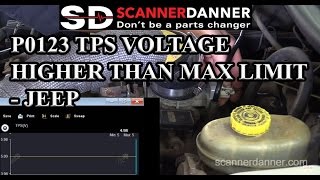
- Wiring Shorts or Connector Damage (Common) — Damaged, corroded, or frayed wires create short circuits. If the signal wire touches a 12V power source, or if a bent pin at the ECM connector bridges two circuits, the computer 🎬 See how a bent computer pin can trigger this code. receives a continuously high voltage signal. Intermittent ground loss also causes the signal voltage to float high.
- Dirty or Sticking Throttle Body (Common) — Carbon buildup inside the throttle body causes the throttle plate to stick partially open. This physically prevents the TPS from returning to its baseline reading, resulting in an elevated voltage signal at idle.
- Loose Sensor Mounting (Less Common) — If the sensor is not securely bolted to the throttle body, its rotational reading becomes inaccurate. Engine vibrations cause it to shift and send erratic, high signals.
- Floor Mat Obstruction (Drive-by-Wire) (Rare) — In vehicles with electronic throttles, a bunched-up floor mat prevents the accelerator pedal from returning to the idle position. The Accelerator Pedal Position (APP) sensor sends a constant high signal, triggering a P0123 fault.
- High System Voltage (Failing Alternator) (Rare) — A failing alternator producing excessive voltage (over 15 volts) spikes the entire electrical system. This forces the TPS to send a signal higher than the ECM's expected 5V range, triggering P0123 alongside other electrical codes.
- Faulty Engine Control Module (ECM) (Very Rare) — The ECM misinterprets a normal signal due to a failed internal input circuit. Consider this only after exhaustively eliminating all sensor and wiring possibilities.
Symptoms

- Check Engine Light is On — The Malfunction Indicator Lamp (MIL) illuminates immediately upon the ECM detecting the high voltage.
- Engine Enters 'Limp Mode' — The ECM severely limits engine power and speed to prevent damage, capping vehicle speed at 40-50 mph.
- Poor Acceleration or Hesitation — The car feels sluggish, hesitates, or jerks during acceleration because the ECM cannot properly calculate the air-fuel mixture.
- Rough or High Idle — The engine idles higher than normal or surges erratically while stopped.
- Engine Stalling — The engine stalls unexpectedly, particularly when decelerating or stopping in traffic.
- Harsh Transmission Shifting — Automatic transmissions rely on TPS data for shift points. An incorrect high signal causes delayed, harsh, or erratic gear changes.
Common Fixes & Costs
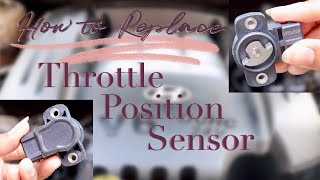
- Replace the Throttle Position Sensor (TPS) 🎬 Watch this step-by-step guide on replacing your TPS. — ~1.0 hr book time (DIY)
- Repair or Replace Damaged Wiring/Connector — ~1.5 hr book time (Intermediate)
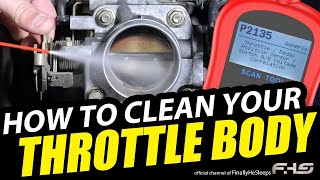
- Clean the Throttle Body 🎬 Watch: How to clean your throttle body without removing it. — ~0.8 hr book time (DIY)
- Replace the Throttle Body Assembly — ~1.5 hr book time (Professional)
- Replace the Engine Control Module (ECM) — ~2.5 hr book time (Professional)
DIY vs Professional
- Replace Throttle Position Sensor — Beginner:
Tools: Socket set, multimeter. - Repair Wiring/Connector — Beginner:
Tools: Multimeter, wiring diagrams, wire strippers, crimpers, heat shrink tubing. - Clean Throttle Body — Beginner:
Tools: Socket set, throttle body cleaner spray, rags. - Replace Throttle Body Assembly — Beginner:
Tools: Socket set, torque wrench, new gasket, advanced scan tool. - Replace Engine Control Module (ECM) — Beginner:
Tools: Professional diagnostic/programming tool.
Used vs. New Parts: Buying Guide
When a used part is worth it: For older vehicles (>150k miles) where the part is a simple, standalone sensor, a used OEM part from a low-mileage donor is cost-effective. Avoid used integrated throttle bodies due to internal motor wear.
Donor-vehicle mileage cap: roughly under 80000 miles for the part to have meaningful remaining life.
Donor quality checklist:
- Verify the donor vehicle's mileage and reason for salvage (accident damage is better than engine failure).
- Match the part number exactly; visual similarities do not guarantee compatibility.
- Avoid parts with signs of corrosion or from regions with heavy road salt use.
Decision logic:
- If Part is an integrated electronic throttle body → Buy new (OEM or high-quality aftermarket) due to the complexity and multiple failure points.
- If Vehicle is > 150K miles and part is a simple, bolt-on sensor → A used OEM part is acceptable, but an aftermarket new part offers a better warranty.
- If Part has a known high failure rate for your model → Buy new from a reputable brand (Denso, Bosch, NTK) to avoid repeating the repair.
Warranty tradeoff: Used parts typically have a 30-90 day warranty. Aftermarket new parts offer 1-year to limited lifetime warranties. OEM parts have 1-2 year warranties.
Worst-case if a used part fails: $200-$500 if a used part fails after installation, accounting for repeat labor and a new replacement part.
What Happens If You Wait — Timeline
- 0-1 month: Check Engine Light illuminates. Occasional hesitation or high idle occurs. The vehicle remains drivable but suffers a 5-10% drop in fuel economy. (MPG impact: 5-10%% · Added cost: $20-$50 in wasted fuel)
- 1-3 months: The vehicle frequently enters 'limp mode' with severely reduced power. Stalling at intersections becomes common, posing a significant safety risk. (MPG impact: 10-20%% · Added cost: $50-$150 in wasted fuel)
- 3-6 months: Consistently incorrect air-fuel mixtures dump unburnt fuel into the exhaust, overheating and degrading the catalytic converter. Harsh shifting strains the transmission. (MPG impact: 15-25%% · Added cost: $800-$2500 (catalytic converter replacement))
- 6+ months: Catastrophic catalytic converter failure occurs. The engine runs so poorly it becomes undrivable. Spark plugs and O2 sensors foul completely. (MPG impact: >25%% · Added cost: $1500-$3500+ (catalytic converter, O2 sensors, spark plugs))
Cost of Not Fixing It
- 0-1 month: Poor drivability (hesitation, stalling), reduced fuel economy by 5-15%, and unsafe throttle response. (Added cost: Negligible)
- 1-6 months: Incorrect air-fuel mixtures overheat the catalytic converter with unburnt fuel, causing internal failure. (Added cost: $800-$2500)
- 6+ months: Prolonged rich/lean conditions foul spark plugs and oxygen sensors. Erratic shifting causes premature transmission wear. (Added cost: $300-$1000)
Diagnosis Steps

- Read Codes and Freeze Frame Data
Use an OBD-II scanner to confirm P0123 is active and check for related codes (e.g., P0121, P0122, P2135). Document the freeze frame data to see the exact voltage reading and engine conditions when the code triggered.
Tools: OBD-II Scanner (Beginner) - Analyze Live Sensor Data
View the live data stream for 'TPS A' voltage. With Key On, Engine Off (KOEO), the reading should be 0.45V to 1.0V. Slowly press the gas pedal; the value must increase smoothly to 4.5V-4.8V at wide-open throttle. A reading stuck at 5.0V or jumping erratically confirms a hard fault.
Tools: Advanced OBD-II Scanner (Intermediate) - Visually Inspect & Wiggle Test Wiring
Inspect the TPS and its connector for frayed wires, melted insulation, or corrosion. With the scanner displaying live data, gently wiggle the connector and harness. If the voltage spikes to 5V, you have located a loose connection or intermittent short.
Tools: Flashlight, Advanced OBD-II Scanner (Intermediate) - Inspect the Throttle Body
Remove the air intake hose and inspect the throttle body bore. Heavy carbon buildup causes the throttle plate to stick open. Manually open and close the plate to ensure smooth, bind-free movement.
Tools: Screwdriver or socket set (Beginner) - Verify Reference Voltage and Ground
Disconnect the TPS. With KOEO, use a multimeter to test the harness terminals. One terminal must show a steady 5-volt reference from the ECM. Test the ground terminal by measuring resistance to the battery negative; it must be under 5 ohms.
Tools: Multimeter, Vehicle-specific wiring diagram (Advanced) - Test the Signal Circuit
Set the multimeter to DC volts. Back-probe the signal wire with the TPS connected and KOEO. It should read ~0.5V closed and sweep to ~4.5V open. A constant 5V or 12V reading indicates a short to power in the harness or a dead sensor.
Tools: Multimeter, Back-probe pins (Advanced) - Check for Technical Service Bulletins (TSBs)
Search for manufacturer TSBs related to P0123. Known issues often require specific harness repairs or ECM software updates rather than part replacements.
Tools: Online access to TSBs (Intermediate) - Oscilloscope Testing (Advanced)
For intermittent faults invisible to a multimeter, connect an oscilloscope to the signal wire. Sweep the throttle and watch the waveform. Spikes, dropouts, or excessive noise definitively prove a failing sensor or wiring issue.
Tools: Oscilloscope (Advanced)
When This Code Triggers (Freeze-Frame Conditions)
- Engine Coolant Temp: 175-210°F (Fully warmed up)
- RPM: Any (Code sets at idle or during cruise)
- Engine Load: Any (The fault is electrical and not load-dependent)
- Vehicle Speed: 0-60 mph (Occurs at any speed, including stopped)
Related Codes
- P0120 — P0120 is a generic 'TPS Circuit Malfunction.' P0123 specifies the circuit voltage is HIGH.
- P0121 — P0121 indicates the sensor's signal is illogical for the current engine state. A short causing P0123 also triggers P0121.
- P0122 — The direct opposite of P0123, indicating voltage is too LOW. Caused by a short to ground or an open circuit rather than a short to power.
- P2135 — Indicates signals from TPS 'A' and 'B' do not match. P0123 identifies sensor 'A' as the high-reading culprit causing the correlation fault.
Climate & Environmental Factors
- High Humidity / Moisture: Water intrusion from heavy rain or engine washing seeps into the TPS connector, causing corrosion and short circuits that spike the voltage reading.
- Extreme Temperature Cycles: Repeated expansion and contraction from engine heat cracks the internal electronics and resistive tracks of the TPS over time.
How to Talk to a Mechanic About This Code
Say this: "I have a P0123 code and need a diagnostic. Please check the live TPS voltage, the 5V reference, and the ground at the connector to confirm if the cause is the sensor, the wiring, or a dirty throttle body before replacing parts."
Signals you want a proper diagnosis, not a part swap. It directs the technician to test the entire circuit, preventing them from immediately selling you an expensive throttle body.
Avoid saying:
- 'My car is hesitating, can you fix it?'
- 'My check engine light is on, just fix it.'
- 'I think I need a new throttle sensor.'
Questions to ask before authorizing the repair:
- What was the TPS signal voltage reading at closed throttle and wide-open throttle?
- Did you confirm a stable 5-volt reference and a good ground at the sensor's connector?
- If recommending a throttle body replacement, is it because the sensor is integrated?
- Does this repair require a throttle relearn procedure, and is it included in the quote?
- What is the warranty on the parts and labor?
Where to Take It: Dealer vs Independent vs Chain
- Dealer:
Best for: Vehicles under warranty., Newer vehicles with integrated throttle bodies., Cases requiring ECM software updates (common with Chrysler/Dodge/Jeep).
Downsides: Highest labor rates., Defaults to replacing the entire throttle body assembly ($500+) instead of cheaper wiring repairs. (Typical cost: +50% vs. baseline) - Independent Shop:
Best choice. An experienced independent mechanic accurately diagnoses the circuit and offers the most cost-effective repair without dealer markup.
Best for: Out-of-warranty vehicles., Diagnosing standalone TPS replacements, wiring issues, or throttle body cleaning.
Downsides: Quality varies; check reviews and ASE certifications., May lack manufacturer-specific software for ECM reflashing. (Typical cost: +0% vs. baseline) - Chain Shop:
Use with caution. Acceptable for a straightforward sensor swap, but avoid for initial diagnosis of intermittent P0123 faults.
Best for: Getting the code read for free., Simple, standalone sensor replacement if pre-diagnosed.
Downsides: Technician skill varies greatly., High pressure to upsell services., Incapable of complex electrical tracing or software issues. (Typical cost: -10% vs. baseline)
When to Walk Away From the Repair
If the estimated repair cost exceeds 50% of your car's private-party value, seriously consider selling or trading it in.
- Car worth $4000, fix is $800: Fix it. This repair is well below the 50% threshold and restores critical drivability.
- Car worth $3000, fix is $1800: Walk away. The repair cost is over 50% of the car's value.
- Car worth $10000, fix is $2000: Fix it. The cost is a reasonable percentage of the vehicle's value.
What Scan Tool You Need for This Code

Minimum: A scanner that reads and graphs live data, specifically the Throttle Position Sensor voltage.
A basic $20 code reader only shows the P0123 code. It cannot display the live voltage signal required to identify dead spots, stuck voltages, or wiring faults.
Budget: BlueDriver Pro (~$99) — Connects to your smartphone to graph live TPS voltage as you press the pedal, visually confirming if the signal is smooth or erratic.
Mid-range: Foxwell NT510 Elite (~$199) — Offers bi-directional controls crucial for performing the electronic throttle relearn procedure required after replacing a sensor or throttle body.
Professional: Autel MaxiCOM MK808Z (~$389) — Provides full OE-level diagnostics and advanced bi-directional control to command throttle relearns and diagnose complex module-related causes.
Rent vs buy: Auto parts stores read codes for free, but their tools lack live data. If a throttle relearn is required, buy a mid-range scanner, as renting advanced tools is rarely an option.
How to Clear the Code After You Fix It
- Reconnect battery if disconnected
- Use an OBD-II scan tool to clear the P0123 code
- Perform a throttle body relearn procedure if the sensor or throttle body was replaced
- Complete a full OBD-II drive cycle to run all readiness monitors
Drive cycle (~30 minutes): Cold start (sit for 8+ hours). Idle for 2-3 minutes with A/C and rear defroster on. Drive for 15 minutes with mixed city/highway speeds (up to 55 mph). Perform several steady cruises and coast-downs.
Readiness monitors affected: Catalyst Monitor, Evaporative System Monitor, Oxygen Sensor Monitor
Before emissions retest: drive at least 100 miles to fully set monitors.
Watch out for:
- Clearing the code resets all readiness monitors to 'Not Ready', causing an immediate emissions test failure.
- The code returns immediately if an intermittent wiring short is not fully repaired.
- Highway driving alone does not set all required monitors.
Will This Fail Emissions / State Inspection?
Yes — this code typically fails an OBD-II emissions inspection.
- California: An active P0123 code is an automatic failure. After repair, all readiness monitors must be 'Ready' before passing a smog check.
- New York: An illuminated Check Engine Light for code P0123 results in an automatic inspection failure.
- Texas: In counties requiring emissions testing, an active P0123 code fails the OBD-II portion of the inspection.
Most Commonly Affected Vehicles
- Jeep Wrangler, Grand Cherokee, Patriot (1998-2018) — Extremely common. On 2005-2006 4.0L models, a faulty steering column clockspring shorts 12V into the 5V TPS circuit, triggering P0123.
- Dodge/Ram/Chrysler Ram 1500/2500, 300 (2003-2016) — On diesel Ram trucks, this points to the Accelerator Pedal Position Sensor (APPS). Chrysler issued software updates to fix erroneous P0123 codes on the 300.
- Ford F-150, Focus, Mustang (2004-2016) — The TPS is integrated into the electronic throttle body. TSB 13-6-15 addresses internal contamination causing faults on multiple models.
- Chevrolet/GMC Silverado, Sierra (2000-2007) — Moisture intrusion into the main engine harness connector (C100) after heavy rain causes shorts triggering this code.
- Toyota Corolla, Camry, Tacoma (2005-2013) — On 2009-2013 Corollas, wiring harness chafing between the sensor and the ECM requires harness repair rather than sensor replacement.
- Hyundai/Kia Sonata, Elantra, Optima (2006-2015) — Usually a straightforward TPS failure. Confirm a stable 5V reference and good ground before condemning the sensor.
- Volkswagen/Audi Jetta, GTI, A4 (2006-2010) — TSB 01-09-04 addresses a wiring repair at the throttle body connector for 2.0T FSI engines, which causes P0123 and an EPC light.
- Nissan Altima, Sentra, Frontier (2002-2012) — Often accompanied by P2135. The fix almost always requires replacing the entire electronic throttle body assembly and performing an Idle Air Volume Relearn.
Manufacturer-Specific Notes
- Ford, Mazda, VW, Audi, Nissan: The TPS is integrated into the electronic throttle body assembly and cannot be replaced separately. The entire unit requires replacement.
- Ford: Customer Satisfaction Program 13N03 extended the warranty on the electronic throttle body to 10 years/150,000 miles for certain 2009-2013 models.
- Chrysler/Jeep/Dodge: A PCM software reflash fixes erroneous P0123 codes on some models. On Jeeps, a shorted steering column clockspring feeds 12V into the TPS circuit.
- GM (Chevrolet/GMC): Water intrusion into the main engine wiring harness connectors (C100) after heavy rain causes shorts leading to P0123.
- Subaru: A poor ground connection for the main engine harness causes floating voltages. Technicians add a redundant ground strap from the intake manifold to the chassis.
Real Owner Stories
2008 Jeep Wrangler JK with intermittent P0123
The Check Engine Light and Electronic Throttle Control light illuminated intermittently, causing sluggish performance.
What they tried:
- Replaced the entire throttle body assembly.
- Replaced the accelerator pedal sensor.
Outcome: The problem persisted. The owner discovered the electrical connector to the pedal sensor was loose. Securing the connector properly provided a final fix.
Lesson: Always check simple solutions first. Before replacing expensive components, thoroughly inspect all related wiring and connectors. A 'wiggle test' saves hundreds of dollars.
Jeep Cherokee XJ with P0123 and electrical gremlins
Vehicle had a persistent P0123 code, broken cruise control, intermittent turn signals, and engine sputtering.
What they tried:
- Replaced the TPS.
- Tested wiring and found the signal wire stuck at 5.7V.
Outcome: The root cause was a faulty clockspring in the steering column. The 12V horn circuit shorted internally to the cruise control circuit, which shares a 5V reference with the TPS. Replacing the clockspring resolved all symptoms.
Lesson: If a direct sensor replacement fails, look for seemingly unrelated electrical symptoms. Shared 5V reference circuits mean a short in one system (like a clockspring) spikes voltage in another (the TPS).
2002 Dodge Dakota with P0123 after a car wash
Immediately after an automatic car wash with underbody spray, the engine revved high, shifted poorly, and threw P0123.
What they tried:
- Blew out the TPS connectors with compressed air.
- Waited several days for components to dry.
Outcome: The symptoms persisted until the owner disconnected the main engine harness, cleaned the corroded pins caused by the water intrusion, and sealed it with dielectric grease.
Lesson: If a fault appears immediately after exposure to water, suspect water intrusion into an electrical connector. Disconnect, inspect, dry, and apply dielectric grease.
How to Prevent This Code From Triggering
- Clean the throttle body periodically (Every 30,000-60,000 miles) — Removes carbon buildup that causes the throttle plate to stick, preventing incorrect high readings from the TPS.
- Apply dielectric grease to the TPS connector (Whenever disconnected for service) — Seals electrical connectors from moisture and dirt, preventing corrosion and short circuits.
- Inspect and secure wiring harnesses (During routine oil changes) — Prevents the wiring harness from rubbing against sharp metal edges, stopping vibrations from wearing through insulation and causing shorts.
- Avoid high-pressure water in the engine bay (During vehicle cleaning) — Directly spraying the engine forces water into sensitive electrical connectors, causing immediate short circuits.
Frequently Asked Questions
Can I just clean the throttle position sensor?
No, the throttle position sensor is a sealed electronic component and cannot be cleaned internally. You must clean the throttle body itself, as carbon buildup causes the throttle plate to stick and the sensor to give incorrect readings.
Is a P0123 code serious?
Yes, it is moderately serious. It causes unsafe driving conditions like stalling in traffic, sudden loss of power, and entering limp mode. Repair it immediately to avoid $1,000+ in catalytic converter damage.
What are the most common mistakes when diagnosing a P0123 code?
The most common mistake is replacing the TPS without testing the circuit. The actual problem is often a wiring short, a poor connection, or a dirty throttle body. Always test the 5V reference, ground, and signal wire before replacing parts.
Could my floor mat cause a P0123 code?
Yes, in cars with electronic 'drive-by-wire' throttles, a bunched-up floor mat holds the gas pedal down slightly. This prevents the Accelerator Pedal Position (APP) sensor from returning to zero. The computer interprets this as a high circuit input, triggering P0123.
What is the difference between a TPS and an APP sensor?
The Accelerator Pedal Position (APP) sensor sits on the gas pedal and reports how far you push it. The Throttle Position Sensor (TPS) mounts on the engine's throttle body and reports the actual throttle blade angle. A fault in either sensor triggers P0123 depending on the vehicle's specific drive-by-wire design.
Do I need to do a 'relearn' procedure after replacing the TPS?
Yes, most modern vehicles require a throttle relearn procedure after replacing the sensor or cleaning the throttle body. This calibrates the computer to the new sensor's idle and wide-open throttle positions. You often need a professional bi-directional scan tool to complete this correctly.
Can a bad battery cause a P0123 code?
A bad battery rarely causes P0123. However, a failing alternator producing excessive voltage (over 15 volts) spikes the sensor circuit. This triggers P0123 alongside multiple other electrical fault codes.
How do I clear a P0123 code?
Clear the code from the ECM using an OBD-II scanner after completing the repair. If you do not fix the root cause, the code returns immediately upon starting the engine.
Key Takeaways
- Code P0123 triggers when the Engine Control Module detects a Throttle Position Sensor 'A' signal exceeding 4.5 volts for more than two seconds.
- A failed Throttle Position Sensor causes 70% of P0123 codes, with wiring shorts to a 12V power source being the second most common culprit.
- Vehicles with this code frequently enter a 40-mph 'limp mode' to prevent engine damage from incorrect air-fuel mixtures.
- Always verify the sensor's 5-volt reference and ground circuits with a multimeter before spending $150+ on replacement parts.
Helpful Videos

The information in this article is provided for general reference and educational purposes only. Vehicle specifications, procedures, and part compatibility can vary by production date, trim level, and region. Always consult your vehicle's factory service manual and verify part numbers before purchasing or performing repairs. Safety-critical components such as airbags, seat belts, and braking systems should be installed by a qualified professional.
- 🎬 Helpful Videos
- What Does P0123 Mean?
- Can I Drive With P0123?
- Common Causes
- Symptoms
- Common Fixes & Costs
- DIY vs Professional
- Used vs. New Parts: Buying Guide
- What Happens If You Wait — Timeline
- Cost of Not Fixing It
- Diagnosis Steps
- When This Code Triggers (Freeze-Frame Conditions)
- Related Codes
- Climate & Environmental Factors
- How to Talk to a Mechanic About This Code
- Where to Take It: Dealer vs Independent vs Chain
- When to Walk Away From the Repair
- What Scan Tool You Need for This Code
- How to Clear the Code After You Fix It
- Will This Fail Emissions / State Inspection?
- Most Commonly Affected Vehicles
- Manufacturer-Specific Notes
- Real Owner Stories
- 2008 Jeep Wrangler JK with intermittent P0123
- Jeep Cherokee XJ with P0123 and electrical gremlins
- 2002 Dodge Dakota with P0123 after a car wash
- How to Prevent This Code From Triggering
- Frequently Asked Questions
- Can I just clean the throttle position sensor?
- Is a P0123 code serious?
- What are the most common mistakes when diagnosing a P0123 code?
- Could my floor mat cause a P0123 code?
- What is the difference between a TPS and an APP sensor?
- Do I need to do a 'relearn' procedure after replacing the TPS?
- Can a bad battery cause a P0123 code?
- How do I clear a P0123 code?
- Key Takeaways
- 🎟️ Get 5% Off