

P0172 on 2008-2016 Audi A4 2.0T: Causes and Fixes for Rich Fuel Mixture
Code P0172 on a 2008-2016 Audi A4 2.0T means the engine is running too rich. The most common causes are a failed PCV valve or a faulty high-pressure fuel pump (HPFP) leaking fuel into the crankcase. Expect to pay $150-$250 for a PCV valve replacement and $250-$400 for an HPFP.
- P0172 on your Audi A4 2.0T means the engine is getting too much fuel.
- Start your diagnosis by checking the PCV valve; a simple 'oil cap test' can often confirm its failure.
- If the PCV is good, the next most likely culprits are the high-pressure fuel pump (HPFP) or a leaking fuel injector.
- Do not immediately replace the oxygen sensor; it is usually just reporting the rich condition caused by another part.
- Ignoring this code can lead to costly damage to your catalytic converter over time.
What's Unique About the 2008-2016 Audi A4

The 2.0T TFSI (EA888) engine used in the B8 generation A4 is known for specific issues that directly cause a P0172 code. Unlike generic causes, a failed PCV valve (crankcase ventilation) is a very frequent culprit, creating a significant vacuum issue that skews fuel trims. Additionally, the high-pressure fuel pump (HPFP) has a known failure mode where its internal seals degrade, allowing raw fuel to leak directly into the engine crankcase. This fuel contaminates the oil and the resulting fuel vapors are pulled into the intake via the PCV system, creating a severe, uncommanded rich condition. These platform-specific problems should be among the first items to check.
Generation note: This guide covers the B8 generation Audi A4 (2008-2012) and its facelift, the B8.5 (2013-2016). Both use versions of the 2.0T EA888 engine (e.g., CAEB, CPMB). While the core causes for P0172 are similar, some parts like the PCV valve were updated in later years, but can still fail. The HPFP failure is particularly noted on flex-fuel capable engines like the CPMA and CPMB.
Symptoms You May Notice

- Check Engine Light is on
- Rough or unstable idle
- Poor fuel economy
- Strong smell of gasoline from the exhaust
- Black smoke from the exhaust, especially on acceleration
- Hesitation or reduced engine power
- Engine stalling in some cases, particularly when coming to a stop
- Strong smell of fuel from the engine oil (on the dipstick or oil cap)
- Difficulty starting when the engine is warm, sometimes requiring throttle input to start
- Replacing the oxygen sensor first without testing. The O2 sensor is often just the messenger, accurately reporting a rich condition caused by another component like the PCV, HPFP, or a leaking injector.
- Replacing the MAF sensor without cleaning it first. Often, cleaning the sensor element with a dedicated cleaner is enough to restore proper function.
Most Likely Causes

- Failed PCV Valve / Oil Separator 🔴 High Probability The diaphragm inside the PCV valve on the EA888 engine is made of rubber and is known to tear or rupture. This creates a massive unmetered air leak (internal vacuum leak) within the crankcase system. The ECU misinterprets this as a lean condition and adds excessive fuel to compensate, leading to a rich code.
How to confirm: With the engine running, try to remove the oil filler cap. If there is extreme suction holding it down, making it very difficult to remove, the PCV valve has failed. You may also hear a loud whistling or 'honking' noise from the engine bay.
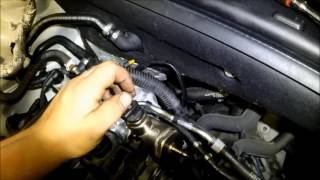
Typical fix: Replace the entire PCV valve assembly. It is located on top of the valve cover and is a relatively simple DIY job. 🎬 Watch: How to diagnose and fix a P0172 rich condition.
Est. part cost: $150-$250 - Faulty High-Pressure Fuel Pump (HPFP) 🔴 High Probability The HPFP is a very common failure point. A seal inside the pump fails, causing fuel to leak past the pump's plunger directly into the crankcase, mixing with the engine oil. This fuel-laden oil then releases vapors that are sucked into the intake manifold by the PCV system, causing a severe rich condition that the ECU cannot compensate for.
How to confirm: The most definitive symptom is a strong smell of gasoline on the oil dipstick or from the oil filler neck. The oil level may also appear to be rising over time. A scan tool can monitor fuel rail pressure, but the pressure may appear normal while the leak into the crankcase is happening. This is often diagnosed after other causes (like the PCV valve) are ruled out.
Typical fix: Replace the high-pressure fuel pump and change the engine oil and filter to remove the contaminated oil. 🎬 See this step-by-step guide to replacing the high-pressure fuel pump.
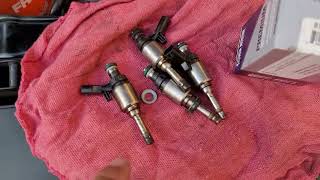
Est. part cost: $250-$400 - Leaking Fuel Injector(s) 🟡 Medium Probability Direct injection systems operate under very high pressure, and injectors can wear out, get stuck partially open due to carbon buildup, or fail electronically, leaking fuel into a cylinder.
How to confirm: Check spark plugs for signs of richness (black, sooty, or wet with fuel) on a specific cylinder. If a specific cylinder has a wet plug, it points to an injector issue. A fuel pressure leak-down test can also indicate a leaking injector, though this is more complex to perform.
Typical fix: Replace the faulty fuel injector(s). It is often recommended to replace them as a set, along with their seals.
Est. part cost: $50-$150 per injector - Faulty Front Oxygen (O2) Sensor ⚪ Low Probability
How to confirm: A faulty O2 sensor (also called an air-fuel ratio sensor) can send incorrect signals, telling the ECU the engine is lean when it's not, causing it to add too much fuel. Use a scan tool to observe the O2 sensor voltage. A healthy sensor fluctuates rapidly. A lazy or stuck sensor will have slow or no voltage changes and should be replaced. However, it's more likely the sensor is accurately reporting a rich condition caused by another part.
Typical fix: Replace the front (pre-catalyst) oxygen sensor (Bank 1, Sensor 1).
Est. part cost: $100-$200 - Dirty or Faulty Mass Airflow (MAF) Sensor ⚪ Low Probability
How to confirm: A contaminated MAF sensor can under-report the amount of air entering the engine, causing the ECU to calculate an overly rich fuel mixture. The sensor can be carefully cleaned with a dedicated MAF sensor cleaner. If cleaning doesn't resolve the issue, replacement is necessary. Unplugging the sensor at idle and seeing if the engine runs better is a quick but not always conclusive test.
Typical fix: Clean the MAF sensor. If the problem persists, replace the sensor.
Est. part cost: $150-$250
Rare But Worth Checking
- Faulty EVAP Purge Valve (N80): If the purge valve sticks open, it can allow un-metered fuel vapors from the charcoal canister to enter the intake manifold, creating a rich condition. This can sometimes trigger EVAP-related codes as well.
- Engine Coolant Thermostat Stuck Open: If the thermostat is stuck open, the engine may not reach its proper operating temperature (around 95-105°C). The ECU will intentionally run a richer mixture on a cold engine, and if it never fully warms up, the rich condition will persist and can trigger P0172.
Diagnosis Steps
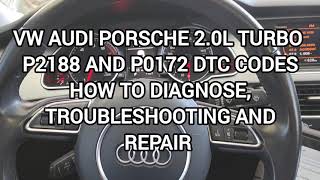
- Read Fault Codes: Use an OBD-II scanner to confirm P0172 and check for any other codes (e.g., P2188, P030x) that could provide clues. 🎬 Watch: A complete diagnostic walkthrough for P0172 and P2188 codes.
- Check Fuel Trims: Observe Short-Term (STFT) and Long-Term Fuel Trim (LTFT) values. For P0172, you will see significantly negative numbers (e.g., -10% to -25% or more) as the ECU tries to subtract fuel.
- Smell the Oil: This is a critical, platform-specific step. Open the oil filler cap or pull the dipstick and smell for a strong gasoline odor. If fuel is present, the High-Pressure Fuel Pump (HPFP) is the most likely culprit.
- Perform PCV Valve Check: With the engine idling, attempt to remove the oil filler cap. If a strong vacuum makes it very difficult to remove, the PCV valve has failed and must be replaced.
- Inspect Spark Plugs: If misfire codes are present or you suspect an injector, remove the spark plugs. A plug that is black, sooty, or wet with fuel points to a leaking injector or severe rich condition in that cylinder.
- Analyze Fuel Pressure: Using a capable scan tool, monitor the high fuel pressure at the rail. While a leaking HPFP might not show abnormal pressure, this can help rule out other fuel pressure regulator issues.
- Test the MAF Sensor: Inspect the air filter and MAF sensor. Clean the sensor with dedicated MAF cleaner. If the issue persists, you can try unplugging it to see if the idle stabilizes.
- Test the Oxygen Sensor: Graph the voltage of the front O2 sensor. It should fluctuate rapidly between approximately 0.1V and 0.9V. If it's slow, stuck, or flat-lined, it may need replacement, but only after ruling out other causes.
Parts You'll Likely Need

- PCV Valve / Oil Separator
(OEM #06H103495AH, 06H103495AC, 06H103495E)— This is the most frequent cause of P0172 on the 2.0T engine due to a common diaphragm failure. Part numbers have been revised over the years; using the latest version is recommended.
Trusted brands: Audi (Genuine), Vaico, Febi Bilstein
OEM price range: $150-$200
Aftermarket price range: $80-$140 - High-Pressure Fuel Pump (HPFP)
(OEM #06H127025Q (and other revisions))— A common failure item on this direct-injection engine that leaks fuel into the crankcase, leading to over-fueling.
Trusted brands: Bosch, Hitachi
OEM price range: $350-$450
Aftermarket price range: $200-$300 - Fuel Injector
(OEM #06H906036N)— Can get stuck open or leak, causing a rich condition in a single cylinder.
Trusted brands: Bosch
OEM price range: $115-$155
Aftermarket price range: $60-$100
Related Codes That Often Appear With This One
- P2188 — This code also means 'System Too Rich at Idle' and is often triggered along with P0172, pointing strongly towards the same set of root causes like a bad HPFP or PCV valve.
- P030x (e.g., P0301, P0302) — A misfire code for a specific cylinder can appear if a fuel injector is leaking badly, fouling the spark plug and causing incomplete combustion in that cylinder.
- P0101 — This code indicates a fault with the Mass Airflow (MAF) sensor circuit. If the MAF sensor is providing incorrect readings, it can directly cause the P0172 rich condition.
Technical Service Bulletins (TSBs) & Recalls
- TSB 2024549/7 - While not directly for P0172, this TSB addresses issues with the HPFP on certain VINs and may be relevant if HPFP failure is suspected. It concerns fuel pressure issues and starting problems.
- TSB 2027732 - This TSB relates to crankcase pressure regulation and oil consumption, which can be related to PCV issues that might lead to a P0172 code, though it doesn't call out the code specifically.
Platform-Specific Known Issues
- HPFP Failure on Flex Fuel Engines (CPMA/CPMB): The issue of the high-pressure fuel pump leaking fuel into the crankcase appears to be particularly common on the flex-fuel versions of the EA888 engine, engine codes CPMA and CPMB, found in later B8.5 models. Owners on forums specifically call out this failure mode for these engines.
- PCV Valve Revisions: Audi/VW has released multiple updated versions of the PCV valve assembly (e.g., revisions ending in A, E, AC, AH). When replacing, it is crucial to use the latest available OEM part number to benefit from design improvements intended to increase longevity.
Mechanic-Grade Diagnostic Values
- Long-Term Fuel Trim (Adaptation Partial) - VCDS Block 032 — expected: Within +/- 10%. For P0172, this value will be highly negative, often exceeding -15% to -25%.. Failure: A strongly negative value (e.g., -17.2% as seen in one log) shows the ECU is consistently removing fuel to counteract a rich condition.
- Mass Air Flow (MAF) Sensor at warm idle — expected: Approximately 2.0-5.0 g/s. A common rule of thumb is engine displacement in liters multiplied by 1.7-1.9 g/s. For a 2.0T, this is ~3.4-3.8 g/s.. Failure: A reading significantly lower than expected can indicate a vacuum leak after the sensor, while a higher reading could indicate a contaminated sensor element.
- High-Pressure Fuel Rail Pressure at warm idle — expected: Requested and Actual values should match closely, around 40 bar (580 PSI).. Failure: While a leaking HPFP may not show a pressure drop, a reading significantly below 40 bar (e.g., 6-10 bar) indicates a failed pump. During a leak-down test (engine off), the pressure should hold steady; a rapid drop can indicate a leaking injector or check valve.
- Low-Pressure Fuel Pump Pressure — expected: Typically 4.0-6.0 bar (58-87 PSI).. Failure: Pressure below this range, especially during acceleration, points to a failing in-tank pump or clogged filter, which must be ruled out before condemning the HPFP.
- EVAP Purge Valve (N80) Coil Resistance — expected: Between 22 and 30 Ohms.. Failure: A reading outside this range, or an open circuit, indicates a failed electrical coil. However, the valve can still be mechanically stuck open even with correct resistance.
Scan Tool Commands That Help
- VCDS (VAG-COM): Engine -> Measuring Blocks -> Group 032 — To view long-term (partial, idle) and short-term fuel trims. This is the primary data to confirm the existence and severity of the rich condition.
- VCDS (VAG-COM): Engine -> Measuring Blocks -> Group 140 — To monitor 'Fuel Rail Pressure (High) Requested' vs. 'Actual'. This helps diagnose the health of the high-pressure fuel pump and system.
- VCDS (VAG-COM): Engine -> Output Tests -> EVAP Canister Purge Regulator Valve (N80) — To manually cycle the N80 purge valve. You should hear an audible click, confirming the solenoid is being commanded and is mechanically actuating. This helps test for a stuck valve.
- VCDS (VAG-COM): Engine -> Basic Settings -> Group 070 (EVAP System Test) — To run an automated test of the entire EVAP system. A 'Syst. NOT OK' result confirms a fault within the system, which could be a stuck-open N80 valve contributing to the rich condition.
Wiring & Ground Locations
- G12 (or G26) — Located on the firewall in the engine compartment, often near the center or on the left side (driver's side).. This is a primary ground point for multiple engine components. A corroded or loose connection here can cause erratic sensor readings, including from the MAF or O2 sensors, potentially leading to incorrect fuel calculations.
- Engine Block to Chassis Ground Strap — Typically a braided strap connecting the engine block (often near the alternator or starter) to the vehicle's chassis frame rail.. This is the main ground path for the entire engine. Degradation of this strap can cause a host of electrical issues, including intermittent sensor faults that could trigger a P0172 code.
- G44 — Located behind the driver's side kick panel, inside the cabin.. This ground point serves the Body Control Module (BCM) and other interior modules. While less likely to directly cause P0172, a fault here can create bizarre, hard-to-diagnose electrical issues throughout the vehicle.
Real Owner Repair Stories
- YouTube user fsteddie98 (2013 Audi A4 2.0L) — Running rough, misfiring, check engine light, exhaust smelling like rotten eggs, codes P2178 (System Too Rich Off Idle) and P0172.
❌ Tried (didn't work) The car had already received new spark plugs, all 4 ignition coils, and a new PCV/oil separator assembly before the diagnosis.
✅ What actually fixed it The high-pressure fuel pump (HPFP) was found to be leaking fuel into the crankcase. The technician confirmed this by smelling fuel in the oil and observing extremely negative long-term fuel trims (-36%). After replacing the HPFP, the issue was resolved. - Ross-Tech Forums user (Audi 3.0L (similar principle)) — Check engine light with rich codes P1127 and P0172. Long-term fuel trims were very negative (-17.2% and -14.1%).
❌ Tried (didn't work) Cleaning the MAF sensor., Checking MAF sensor wiring., Performing a smoke test, which found and fixed a minor leak on a hose clamp, but the codes returned.
✅ What actually fixed it The final advice from an expert on the forum was that the issue was likely sticking or dirty fuel injectors due to the car having very low mileage for its age. The recommended fix was to use a strong in-tank fuel system cleaner (like Techron) and a fuel lubricant (Marvel Mystery Oil), which resolved the rich condition. - NHTSA ODI #11402605 — An owner of a similar Audi model reported that after maintenance service, the vehicle displayed code P0172 Bank 1 System Too Rich, and noted that a recall for the Engine Control Unit (ECU) software might be relevant to the condition.
OEM Part Supersession History
06H-103-495-A / E / AC→06H-103-495-AH / AJ / AK— The original PCV valve diaphragms were prone to tearing, causing significant vacuum leaks. VW/Audi released multiple revisions to improve durability and change crankcase pressure settings, partly to address oil consumption concerns.
Heads up: It is critical to use the latest revision. Some software updates for oil consumption require a specific PCV version (e.g., the 'white cap' version with 100 mbar pressure vs the original 'black cap' with 20 mbar). Using the wrong pressure spec PCV for your car's software can cause other issues.
Model Year Variations Within This Range
- 2008-2012 (B8) vs 2013-2016 (B8.5): The PCV valve design and internal pressure settings were changed. Early B8 models (approx. pre-2012) used a PCV (e.g., 06H103495AC/AH) with different pressure regulation than later B8.5 models (e.g., 06H103495AE/AK). This was part of an effort to combat oil consumption. It's crucial to match the part to the engine code and model year.
- Flex-Fuel Engines (CPMA, CPMB): While the HPFP can fail on any 2.0T, anecdotal evidence from forums suggests that the flex-fuel capable engines may be more prone to the specific failure mode where the HPFP leaks fuel into the crankcase, directly causing P0172 and P2188.
Diagnostic Flowchart
Real Owner Stories
Aggregated from forums and TSBs cited above. Mileages and costs reflect what owners reported in those sources.
2015 Audi Q5 2.0T
Symptoms: Diagnosed with codes P2188 and P0172.
What fixed it: Traced the issue back to the High-Pressure Fuel Pump (HPFP) leaking fuel into the crankcase.
Source hint: AudiWorld Forums: HPFP replacement for P2188 and P0172
2014 Audi A4 2.0T (Flex-Fuel)
Symptoms: Experienced classic P0172 symptoms accompanied by a no-start condition.
What fixed it: Identified the high-pressure fuel pump (HPFP) leaking fuel into the oil as the culprit.
Source hint: Reddit r/AudiA4: System too rich 2014 a4 2.0t
2014 Audi A4 2.0T — 122000 miles
Symptoms: Triggered code P0172 and the engine oil smelled strongly of gas.
What fixed it: Replaced all four leaking fuel injectors and changed the contaminated oil.
Source hint: YouTube video of a 2014 A4 with 122k miles and code P0172
Related OBD-II Codes
Frequently Asked Questions
I need to replace the PCV valve on my A4 2.0T to fix P0172. Are there specific part numbers I should look for?
My B8.5 A4 has the flex-fuel CPMA engine. Is it more prone to this rich condition?
Does TSB 2024549/7 apply to my P0172 code?
Why does my engine oil smell strongly of gasoline with this code?
How can I easily test if the PCV valve is causing my P0172 code?
Is there a TSB for the PCV valve on the 2.0T engine?
Helpful Videos
Used OEM Parts in Stock


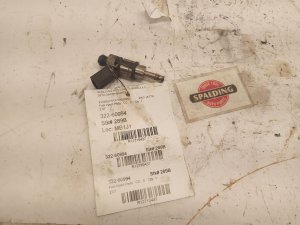

New Aftermarket Parts Available


The information in this article is provided for general reference and educational purposes only. Vehicle specifications, procedures, and part compatibility can vary by production date, trim level, and region. Always consult your vehicle's factory service manual and verify part numbers before purchasing or performing repairs. Safety-critical components such as airbags, seat belts, and braking systems should be installed by a qualified professional.
- Audi A4:
- 🎬 Helpful Videos
- 🛍️ Shop This Part
- What's Unique About the 2008-2016 Audi A4
- Symptoms You May Notice
- Most Likely Causes
- Rare But Worth Checking
- Diagnosis Steps
- Parts You'll Likely Need
- Related Codes That Often Appear With This One
- Technical Service Bulletins (TSBs) & Recalls
- Platform-Specific Known Issues
- Mechanic-Grade Diagnostic Values
- Scan Tool Commands That Help
- Wiring & Ground Locations
- Real Owner Repair Stories
- OEM Part Supersession History
- Model Year Variations Within This Range
- Diagnostic Flowchart
- Real Owner Stories
- 2015 Audi Q5 2.0T
- 2014 Audi A4 2.0T (Flex-Fuel)
- 2014 Audi A4 2.0T — 122000 miles
- Related OBD-II Codes
- Frequently Asked Questions
- 🎟️ Get 5% Off