

P0123 on 2015-2020 Kia Sorento 2.4L: Throttle Position Sensor High Input Causes and Fixes
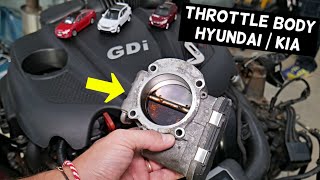
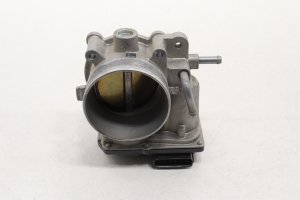
On a 2015-2020 Sorento with the 2.4L engine, code P0123 almost always means the entire electronic throttle body assembly has failed. The sensor is integrated and not sold separately. Expect to pay $200-$400 for a new throttle body (OEM Part #35100-2G700 for 2015, #35100-2G600 for 2016-2020), which is the required fix. This is a common failure on the Theta II engine platform.
- P0123 on a 2015-2020 Sorento 2.4L almost always points to a failed electronic throttle body.
- The Throttle Position Sensor (TPS) cannot be replaced separately; you must replace the entire throttle body assembly (Part # 35100-2G700).
- Symptoms are serious and include sudden power loss ('limp mode'), making the vehicle potentially unsafe to drive.
- After replacing the part, a 'relearn' procedure is necessary to ensure the car idles and drives correctly.
- This is a known issue on the Theta II engine platform, also affecting the Hyundai Santa Fe and Kia Optima.
What's Unique About the 2015-2020 Kia Sorento
The 2015-2020 Sorento with the 2.4L GDI 'Theta II' engine has a well-documented history of electronic throttle body failures. Unlike many older vehicles where the Throttle Position Sensor (TPS) is a separate, inexpensive part, on this platform it is integrated directly into the electronic throttle body assembly. Because of this design, a P0123 code almost always requires the replacement of the entire throttle body unit to resolve the issue. This issue is shared with platform mates like the Hyundai Santa Fe Sport and Kia Optima using the same engine.
Symptoms You May Notice
- Check Engine Light is on
- Vehicle enters 'limp mode' (drastically reduced engine power, RPM limited)
- Poor, hesitant, or jerky acceleration
- Unstable or high idle speed
- Engine may stall, especially when coming to a stop
- In automatic transmissions, gears may not shift properly or may shift harshly
- Sudden or unintended acceleration
- Attempting to purchase or replace only the Throttle Position Sensor, which is not sold separately for this vehicle.
- Replacing the Accelerator Pedal Position (APP) sensor, which has its own set of diagnostic codes (e.g., P2120-P2128) and is a less common failure point for this specific code.
Most Likely Causes
- Failed Electronic Throttle Body Assembly 🔴 High Probability The Throttle Position Sensor (TPS) is integrated into the assembly and is a common failure point on this engine platform. The sensor itself is not available as a separate part. The internal electronics fail, causing the high voltage reading.
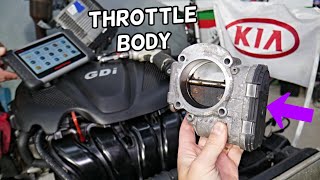
How to confirm: Using a scan tool, observe the live data for 'Throttle Position Sensor A'. If the voltage is stuck high (e.g., near 5V) and does not change when pressing the accelerator pedal, the assembly has likely failed. This is the definitive diagnostic step. 🎬 See: How to troubleshoot a P0123 high input code
Typical fix: Replace the entire electronic throttle body assembly. A throttle relearn procedure is required after installation.
Est. part cost: $200-$400 - Wiring Harness or Connector Issue ⚪ Low Probability Rodents can sometimes chew wires in the engine bay, and connectors can become corroded or loose over time, though it is far less common than outright throttle body failure.
How to confirm: Visually inspect the wiring harness and connector leading to the throttle body for any signs of damage, corrosion, or loose pins. Perform a continuity and voltage check on the signal, reference, and ground wires. A short to voltage on the signal wire can cause a P0123 code.
Typical fix: Repair the damaged section of the wiring harness or clean/replace the connector.
Est. part cost: $10-$50
Rare But Worth Checking
- Faulty Powertrain Control Module (PCM): This is very rare. The PCM should only be considered after the throttle body and wiring have been definitively ruled out as the cause. Sometimes a PCM software update may be available to address related logic issues.
Diagnosis Steps
- Connect an OBD-II scanner to confirm the P0123 code and check for any other related codes like P0223, P2110, or P2135.
- View live data on the scanner. Observe the voltage for Throttle Position Sensor 'A'. With the key on and engine off, it should be stuck at a high value (e.g., >4.5V).
- Confirm the voltage does not change when the accelerator pedal is slowly pressed and released.
- If the voltage is stuck high, turn off the vehicle and disconnect the throttle body electrical connector.
- Thoroughly inspect the connector and the wiring harness for any visible damage, corrosion, chafing, or bent pins.
- If the wiring appears okay, the failure is almost certainly internal to the electronic throttle body assembly.
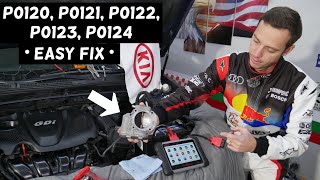
- After replacing the throttle body, perform a throttle relearn procedure. A common method is to turn the key to 'ON' (without starting the engine) for 30 seconds, then turn it 'OFF' for 30 seconds. Repeat this cycle twice, then start the engine and let it idle for several minutes. Consulting a service manual or using a professional scan tool for the specific procedure is recommended. 🎬 Watch: Quick tips to reset your throttle position sensor
Parts You'll Likely Need
- Electronic Throttle Body Assembly
(OEM #35100-2G700 (2015 MY), 35100-2G600 (2016-2020 MY))— This is the most common failure for a P0123 code on this vehicle, as the non-serviceable Throttle Position Sensor is integrated within this assembly. Part numbers differ between early and late models in this generation.
Trusted brands: Kia (OEM), Hyundai (OEM), Bosch, Hitachi, Cardone, Standard Motor Products (SMP)
OEM price range: $250-$400
Aftermarket price range: $200-$300
Related Codes That Often Appear With This One
- P0121 — Indicates a performance or range problem with the same throttle position sensor, often preceding a complete failure that results in P0123.
- P0221, P0222, P0223 — These codes relate to the 'B' circuit of the throttle position sensor. Since electronic throttle bodies use two sensors for redundancy, a failure can sometimes trigger codes for both circuits.
- P2110 — This code, 'Throttle Actuator Control System - Forced Limited RPM,' is often triggered alongside P0123. It confirms the PCM has intentionally put the vehicle into 'limp mode' as a direct result of the sensor fault.
- P2135 — This code for 'Voltage Correlation' means the signals from the 'A' and 'B' sensors don't agree, strongly pointing to an internal failure of the throttle body assembly.
Technical Service Bulletins (TSBs) & Recalls
- TSB SA316C (NHTSA ID: 10143270): Titled '2.4L ENGINE START LOGIC IMPROVEMENT', this service action for 2018 Sorentos addresses issues like extended crank and surging with cruise control via an ECU update. While not directly for P0123, it shows that ECU logic updates for this engine are common.
- TSB SC340 (NHTSA ID: 10250000): An emissions service campaign to update the ECM logic on 2016-2022 models with the 2.4L Theta II engine to ensure compliance with emissions standards.
- TSB ENG222_R5 (NHTSA ID: 10206642): Titled 'EXCESSIVE OIL CONSUMPTION NU/GAMMA/THETA/KAPPA ENGINES', this bulletin provides the dealer procedure for diagnosing and addressing the common oil consumption problem on the 2.4L GDI engine.
- TSB ENG 078: Provides the official dealer procedure for resetting and relearning the electronic throttle control (ETC) adaptive values using the GDS scan tool after replacing the throttle body or ECM.
Platform-Specific Known Issues
- The electronic throttle body on the 2.4L GDI engine is a known failure point that can cause this code and related drivability symptoms.
- Owner Experience: A 2014 Sorento owner on Reddit described symptoms of the radio flashing, power steering cutting out, and all dash lights illuminating, followed by a no-start 'click' condition. After a jump start, codes P2106 and P2110 were present, pointing to the throttle actuator control system failure that underlies P0123.
Mechanic-Grade Diagnostic Values
- ECM 5V reference voltage (Vref) at TPS connector — expected: 4.75V – 5.25V (Key ON, Engine OFF). Failure: Voltage significantly outside this range points to an ECM or wiring issue, not the sensor itself.
- TPS signal voltage at closed throttle (idle position) — expected: ~0.2V – 1.0V. Failure: A reading stuck near 5.0V with the throttle closed confirms a 'Circuit High' fault.
- TPS signal voltage at wide-open throttle (WOT) — expected: ~4.0V – 4.8V. Failure: The voltage should sweep smoothly from idle to WOT. If it's stuck high, the sensor has failed.
Scan Tool Commands That Help
- Kia GDS (Global Diagnostic System): Actuation Test: ETC Motor — To command the throttle body motor to open and close, verifying the mechanical and electrical function of the throttle plate actuator, separate from the sensor readings.
- Kia GDS (Global Diagnostic System): Reset / Relearn ETC Adaptive Value — This is a required service function after replacing the throttle body. It erases the old learned values and forces the ECM to learn the new sensor's closed, open, and idle positions. Failure to perform this can result in persistent codes or poor idle.
Wiring & Ground Locations
- GC101 / GC102 — These are the main engine control harness ground points. Common locations for Theta II engines include the engine block itself, the frame rail near the ECU, and on top of the transmission housing under the battery tray.. A poor or corroded ground at these locations can introduce electrical noise or voltage offsets into all sensor circuits, including the TPS, potentially causing incorrect readings and fault codes.
- Throttle Body Connector (2018 Model Example) — The 6-pin connector on the electronic throttle body assembly.. A 2018 Sorento 2.4L wiring diagram shows Pin 80 (Light Green wire) at the PCM connector (C100-A) is the TPS 2 Signal wire. This is the specific wire that carries the high voltage signal to the PCM.
OEM Part Supersession History
35100-2G700→N/A— This part number applies to the 2015 model year Sorento 2.4L.
Heads up: This part is for the early 3rd generation models and should not be used on 2016 or newer Sorento 2.4L vehicles.35100-2G600→N/A— This part number applies to the 2016-2020 model year Sorento 2.4L.
Heads up: This part is for the updated 3rd generation models and will not work on the 2015 model year.
Model Year Variations Within This Range
- 2015 vs. 2016-2020: The OEM part number for the electronic throttle body assembly changes. The 2015 model year uses part number 35100-2G700. The 2016-2020 model years use part number 35100-2G600. Using the wrong part will result in fitment or electrical incompatibility.
Diagnostic Flowchart
Other Known Issues on This Vehicle
Issues unrelated to this code that are worth knowing about as an owner of this generation:
- Connecting Rod Bearing Failure / Engine Seizure 🔴 High — Widespread enough to trigger multiple class-action lawsuits and recalls. Primarily affects earlier models but the risk exists across the generation. Often preceded by knocking noises. (Ref: Multiple recalls (e.g., NHTSA 17V224000) and a lifetime warranty extension for the engine short block if the Knock Sensor Detection System (KSDS) software update (e.g., Campaign PI1805) is performed.)
- Excessive Oil Consumption 🟠 Medium — A very common complaint, with many owners reporting the need to add a quart of oil every 1,000 miles. The cause is often attributed to carbon buildup on piston rings. (Ref: TSB ENG222 / TSB 23-EM-007H outlines an oil consumption test and a combustion chamber cleaning procedure to free stuck piston rings.)
- Stretched Timing Chain 🔴 High — Often presents as a rattling noise on startup, typically after 60,000 miles. If not addressed, it can lead to catastrophic engine failure.
- Carbon Buildup on Intake Valves 🟡 Low — A common characteristic of GDI (Gasoline Direct Injection) engines, as fuel is not sprayed over the back of the valves to clean them. Can lead to misfires and rough running over time.
Used vs. New Parts: Buying Guide for This Vehicle
When a used part is the smart pick: For this specific repair, a used part is NOT recommended. The electronic throttle body is a known high-failure-rate component with internal electronic sensors and plastic gears that wear over time. The risk of a used part failing shortly after installation is very high.
What to inspect on the donor part:
- Not applicable, as used parts are not advised.
OEM-only on this vehicle (don't cheap out):
- Electronic Throttle Body Assembly
Aftermarket brands forum-validated for this vehicle:
- Bosch
- Hitachi
- Standard Motor Products (SMP)
- Cardone (Remanufactured)
Brands owners have reported issues with on this vehicle:
- Unbranded, 'white-box' parts from online marketplaces should be avoided as they are known to have incorrect electronic calibrations and high premature failure rates for this specific application.
Real Owner Stories
Aggregated from forums and TSBs cited above. Mileages and costs reflect what owners reported in those sources.
2016 Kia Sorento 2.4L — 160000 miles
Symptoms: Struggle gaining speed/power in general, vehicle shuddered and misfired, then died. Multiple codes appeared including P0123 and P0222.
What fixed it: The owner reset the computer and identified multiple sensor circuit issues including Throttle/pedal position sensor/switch A circuit high.
Source hint: Reddit r/AutoMechanics
2014 Kia Sorento
Symptoms: Radio flashing, power steering cutting out, all dash lights illuminating, followed by a no-start 'click' condition. After a jump start, the vehicle entered limp mode.
What fixed it: Diagnosis pointed to a throttle actuator control system failure (codes P2106 and P2110) which underlies the P0123 condition.
Source hint: vehicle_specific_issues - Reddit owner report
2013-2018 Hyundai Santa Fe Sport 2.4L GDI
Symptoms: Limp mode and drivability symptoms identical to the Sorento due to the shared Theta II engine platform.
What fixed it: Replacement of the entire electronic throttle body assembly (part #35100-2G700).
Source hint: Go-Parts.com - Article: 'P0123 on 2013-2018 Hyundai Santa Fe Sport 2.4L'
Related OBD-II Codes
Frequently Asked Questions
Can I just replace the Throttle Position Sensor (TPS) on my 2.4L Sorento to fix P0123?
Is there a specific TSB for resetting the throttle after I replace the part?
Does my 2016 Sorento with the 2.4L engine have any known logic updates related to this?
My 2018 Sorento is surging while using cruise control; is this related to P0123?
How do I perform a throttle relearn at home without a professional scan tool?
Are there other major engine issues I should watch for on my 2.4L GDI Sorento?
Helpful Videos

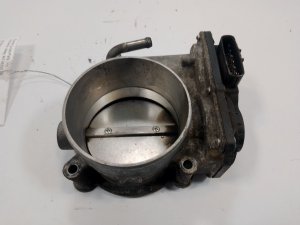
Used OEM Parts in Stock
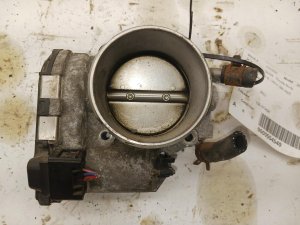

New Aftermarket Parts Available


The information in this article is provided for general reference and educational purposes only. Vehicle specifications, procedures, and part compatibility can vary by production date, trim level, and region. Always consult your vehicle's factory service manual and verify part numbers before purchasing or performing repairs. Safety-critical components such as airbags, seat belts, and braking systems should be installed by a qualified professional.
- Kia Sorento:
- 🎬 Helpful Videos
- 🛍️ Shop This Part
- What's Unique About the 2015-2020 Kia Sorento
- Symptoms You May Notice
- Most Likely Causes
- Rare But Worth Checking
- Diagnosis Steps
- Parts You'll Likely Need
- Related Codes That Often Appear With This One
- Technical Service Bulletins (TSBs) & Recalls
- Platform-Specific Known Issues
- Mechanic-Grade Diagnostic Values
- Scan Tool Commands That Help
- Wiring & Ground Locations
- OEM Part Supersession History
- Model Year Variations Within This Range
- Diagnostic Flowchart
- Other Known Issues on This Vehicle
- Used vs. New Parts: Buying Guide for This Vehicle
- Real Owner Stories
- 2016 Kia Sorento 2.4L — 160000 miles
- 2014 Kia Sorento
- 2013-2018 Hyundai Santa Fe Sport 2.4L GDI
- Related OBD-II Codes
- Frequently Asked Questions
- 🎟️ Get 5% Off