

P0119 on 2015-2020 Ford Edge: Engine Coolant Temperature Sensor Circuit Causes and Fixes
On a 2015-2020 Ford Edge, code P0119 is most often caused by a faulty Engine Coolant Temperature (ECT) sensor connector or wiring harness, as noted in multiple Ford Technical Service Bulletins. Before replacing the sensor, inspect the connector for a secure fit and the wiring for damage. This is especially prevalent on models with the 2.7L EcoBoost engine.
- For the 2015-2020 Ford Edge, P0119 is very frequently caused by a bad connection at the ECT sensor, not a bad sensor.
- Always inspect the ECT sensor connector and nearby wiring for damage or a loose fit before buying any parts.
- The official Ford Motorcraft replacement ECT sensor is part number DY1145.
- Driving with this code can cause poor performance and potentially lead to overheating if the cooling fans fail to operate correctly.
- Other codes like P0116, P0117, P0118, and P0217 are commonly seen with P0119 and point to the same root cause in the ECT circuit.
What's Unique About the 2015-2020 Ford EDGE

For the second-generation Ford Edge, particularly those with the 2.7L EcoBoost engine, Ford has issued multiple Technical Service Bulletins (TSBs) related to code P0119. These bulletins specifically point to problems with the ECT sensor's electrical connector not being fully seated or having damaged wiring, rather than an immediate failure of the sensor itself. This makes a thorough inspection of the wiring and connector the most critical first step. On later model year 2.7L engines (around 2018+), the ECT sensor was moved to a difficult-to-access location in the engine valley, leading Ford to issue a TSB for an ECT relocation kit for the F-150, a procedure which may be relevant to Edge owners facing a high labor quote for sensor replacement.
Diagnostic Flowchart
Tap your situation to follow the diagnostic path that matches what you're seeing on this vehicle.
Symptoms You May Notice
- Check Engine Light (Malfunction Indicator Lamp) is on
- Engine temperature gauge fluctuates erratically or reads cold when the engine is warm
- Engine Coolant Over Temperature warning message appears on the dash, even on a cold start
- Cooling fans run constantly at high speed, even when the engine is cold
- Rough or unstable idle
- Reduced fuel economy
- Hesitation during acceleration
- A rumbling noise described by some owners as if driving on rumble strips, which may be the engine entering a limp mode
- Replacing the ECT sensor without first checking the connector and wiring. The Ford TSBs strongly suggest the wiring/connector is the more likely culprit, especially on the 2.7L EcoBoost.
- Replacing the thermostat when the issue is purely electrical (sensor, wiring, or connector).
- On 2.0L and 3.5L engines, assuming the problem is identical to the 2.7L. 🎬 See this 2.0L cylinder head temperature sensor replacement guide. While possible, the specific TSBs are for the 2.7L engine.
Most Likely Causes

- ECT Sensor Connector Not Fully Seated or Damaged 🔴 High Probability Ford TSBs #SSM 47791 and #SSM 46906 specifically call out this issue on 2.7L engines, stating the connector may not be fully seated or the wiring may be damaged. The connector's location can make it susceptible to vibration or improper seating during prior service.
How to confirm: Visually inspect the ECT sensor connector. Wiggle it to see if it is loose. Unplug it and check for corrosion, bent pins, or damage to the locking tab. Inspect the wiring leading to the connector for any signs of chafing, breaks, or heat damage.
Typical fix: Ensure the connector is clean and fully seated until it clicks. If the connector or pigtail is damaged, it must be replaced. The Motorcraft WPT-1251 is a commonly used pigtail for various Ford sensors and may be the correct part.
Est. part cost: $15-$45 for a new pigtail connector - Damaged ECT or Knock Sensor Wiring Harness 🔴 High Probability Ford TSB #SSM 48991 indicates that the wiring harness for the ECT sensor (which may be shared with the knock sensor) can be the source of the problem. TSB #SSM 47791 further specifies to check for damaged wiring between connectors C1016 and C1168 on the Edge. The harness can be damaged by heat, vibration, or contact with sharp edges on the engine or brackets.
How to confirm: Perform a continuity and resistance test on the wires between the ECT sensor connector and the PCM. Check for shorts to ground or power. Visually trace the harness for damage, paying close attention to areas where it crosses over the engine or is secured by clips.
Typical fix: Repair the specific damaged section of the wiring harness using approved splice procedures or replace the harness if damage is extensive. TSB 48991 advises replacing both the 12A648 ECT sensor and the 12A699 knock sensor harness.
Est. part cost: $5-$50 for wiring repair supplies, up to $150+ for a new harness section - Faulty Engine Coolant Temperature (ECT) Sensor 🟡 Medium Probability While wiring is the more likely culprit per TSBs, the sensor itself can still fail. On 2018+ 2.7L models, the sensor is notoriously difficult to access, buried under the intake manifold in the engine valley, making it a labor-intensive job.
How to confirm: Use a scan tool to monitor the live ECT data stream for erratic jumps. You can also test the sensor's resistance with a multimeter while heating it in water and comparing the readings to the specifications in a service manual. A typical sensor should read 2000-3000 ohms at 68°F (20°C).
Typical fix: Replace the ECT sensor. This may require draining some coolant. For later 2.7L models, this is a significant job requiring intake manifold removal. A relocation kit may be available. 🎬 Watch: How to install the Ford ECT relocation kit.
Est. part cost: $25-$75 - Low Engine Coolant or Air in the System ⚪ Low Probability
How to confirm: Check the coolant level in the reservoir when the engine is cold. If low, there is a leak. If the level is correct, air pockets can still exist if the system was recently serviced. Air pockets can cause the sensor to give erratic readings as coolant and air pass over it.
Typical fix: Top off the coolant and properly bleed the cooling system to remove all air pockets. Find and repair any leaks.
Est. part cost: $15-$30 for coolant
Rare But Worth Checking
- Faulty Thermostat: A thermostat that is sticking open or closed can cause actual, albeit sometimes erratic, temperature fluctuations that the sensor correctly reports, potentially triggering a P0119 code.
- Powertrain Control Module (PCM) Fault: In very rare cases, the internal circuits of the PCM that process the ECT sensor signal can fail, causing it to misinterpret a good signal as erratic. This should be the last consideration after all other possibilities are exhausted.
Diagnosis Steps
- Check the engine coolant level and condition. Ensure it is full and not contaminated.
- Visually inspect the ECT sensor's electrical connector for a tight fit, corrosion, or damage. This is a very common failure point on this vehicle, especially the 2.7L engine.
- Inspect the wiring harness leading to the ECT sensor for any signs of chafing, melting, or breaks, as highlighted in Ford TSBs. Pay special attention to the harness sections between connectors C1016 and C1168.
- Use an OBD-II scanner to view the live data for the ECT sensor (ECT1). Watch for erratic jumps or spikes in the temperature reading that don't correspond to actual engine temperature changes.
- If the signal is erratic, disconnect the sensor and check for a stable 5-volt reference signal and a good ground at the connector with the key on, engine off.
- If the wiring provides a stable voltage and ground, test the sensor itself. You can measure its resistance with a multimeter when cold and hot to see if it changes smoothly. A common reading is 🎬 Watch: How to diagnose and fix an intermittent P0119 code. 2000-3000 ohms at room temperature (68°F/20°C).
- If the sensor and wiring test good, investigate other possibilities like air in the cooling system or a faulty thermostat.
- If all other components are confirmed to be working, the issue may lie with the PCM, though this is rare.
Parts You'll Likely Need

- Engine Coolant Temperature (ECT) Sensor Connector Pigtail
(OEM #WPT-1251 (unconfirmed, but likely))
Related Codes That Often Appear With This One
- P0116 — This code indicates an ECT Sensor Circuit Range/Performance problem, often set alongside P0119 due to the erratic signal.
- P0117 — This code for ECT Sensor Circuit Low Input (indicating high temp) can appear intermittently with P0119 if the signal shorts to ground.
- P0118 — This code for ECT Sensor Circuit High Input (indicating low temp) can appear with P0119 if the circuit has an intermittent open.
- P0128 — This code means 'Coolant Thermostat (Coolant Temperature Below Thermostat Regulating Temperature)' and can be triggered if the faulty ECT signal makes the PCM believe the engine isn't warming up correctly.
- P1299 — This code indicates 'Cylinder Head Overtemperature Protection Active'. The PCM may trigger this based on the faulty, high readings from the ECT sensor, even if the engine is not actually overheating. It is listed in the same TSBs as P0119.
- P0217 — This code indicates an 'Engine Overheat Condition', which can be triggered by a faulty ECT sensor reading even if the engine is not actually overheating. It is listed in the same TSBs as P0119.
Technical Service Bulletins (TSBs) & Recalls
- SSM 48991: Mentions P0119 related to the engine coolant temperature (ECT) sensor or knock sensor wiring harness.
- SSM 47791: Points to a not fully seated or damaged ECT sensor connector or wiring on 2.7L engines.
- SSM 46906: Also identifies a poorly seated or damaged ECT sensor connector/wiring on 2.7L engines as the cause.
Platform-Specific Known Issues
- TSB #SSM 48991: For some 2020 Edge models (and others from 2015-2020 with the 2.7L engine), this code can be caused by issues with the ECT or knock sensor wiring harness. The TSB advises replacing both the ECT sensor and the knock sensor harness.
- TSB #SSM 47791: On some 2017 Edge models (and others from 2015-2019) with the 2.7L engine, this code may be due to the ECT sensor connector not being fully seated or damaged wiring between specific connectors C1016 and C1168. It explicitly states NOT to replace the sensor if wiring damage is found.
- TSB #SSM 46906: An earlier TSB for 2015+ models with the 2.7L engine that mirrors the advice of SSM 47791, pointing to the connector or wiring as the primary fault.
- Owner Experience (2.7L): An owner of a 2017 Edge Sport on Reddit reported getting an overheating message (P1299) shortly after startup. A suggested fix was to check the Cylinder Head Temperature sensor (Ford Part # 9L8Z-6G004-F), located on the driver's side below the oil dipstick, which is a relatively easy 10-minute fix.
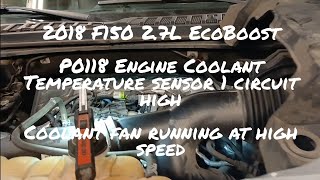
- Owner Experience (F-150 2.7L): An owner of a 2018 F-150 with the same engine confirmed the ECT sensor is buried under the intake manifold, resulting in a $1,500 repair bill from the dealer. The dealer fix involves installing a new part on an external coolant line, effectively relocating the sensor. This is part of TSB 21-2168 for the F-150.
Mechanic-Grade Diagnostic Values

- ECT Sensor Resistance — expected: Approximately 2,000 - 3,000 Ohms at 68°F (20°C).. Failure: A reading significantly outside this range, or an open/infinite reading, indicates a faulty sensor.
- ECT Sensor Connector Voltage (KOEO) — expected: Approximately 5.0 volts on the reference wire and a good ground (near 0 volts) on the ground wire.. Failure: Voltage that is missing, low, or unstable points to a wiring or PCM issue, not a sensor failure.
- Scan Tool Sensor Cross-Check (Cold Soak) — expected: After the vehicle has sat overnight (cold soak), the Engine Coolant Temperature (ECT), Intake Air Temperature (IAT), and Transmission Fluid Temperature (TFT) should all read within a few degrees of each other and the ambient air temperature.. Failure: If the ECT reading is significantly different from the IAT and TFT readings, the ECT sensor is likely faulty.
Hidden / Shadow Codes Worth Checking
- Mode $06 Data: Mode $06 is not a trouble code but a diagnostic function that accesses the results of the PCM's onboard diagnostic monitoring tests. Before a fault is bad enough to set a code and turn on the check engine light, it may fail the Mode $06 test. A technician can view this data to see if the ECT sensor test is failing or approaching its failure threshold. (see via Requires an advanced OBD-II scan tool that supports Mode $06 functionality, such as FORScan or professional-grade scanners.)
Scan Tool Commands That Help
- Instrument Cluster: Engineering Test Mode — This built-in mode can be accessed without a scan tool to view raw vehicle data, including battery voltage and other inputs. While it may not show ECT directly in degrees, it can help diagnose underlying electrical issues that might affect sensor readings. It is accessed by holding the 'OK' button on the steering wheel before turning the key to the 'ON' position.
Wiring & Ground Locations
- Connector C1016 — This is the electrical connector directly on the Engine Coolant Temperature (ECT) sensor itself.. TSB #SSM 47791 specifically identifies this connector as a potential failure point for not being fully seated. A poor connection here is a primary cause of intermittent signals.
- Connector C1168 — This is a harness-to-harness connector in the engine bay. TSB #SSM 47791 points to potential wiring damage between C1016 and C1168.. Damage to the wiring between the sensor and this downstream connector can cause the P0119 code. Technicians should inspect this section of the harness for chafing or breaks.
- C1016 Pinout (2.7L) — At the ECT sensor connector.. Pin 1 (YE-GY wire) is the Signal Return/Ground. Pin 2 (GY-VT wire) is the ECT Sensor Signal wire that goes to the PCM (Connector C1551E, Pin 78). Knowing the pinout is essential for testing continuity and voltage.
Real Owner Repair Stories
- Reddit user in r/f150 (2018 Ford F-150 with 2.7L EcoBoost engine) — Getting 'Engine Coolant Over Temperature' warning, cooling fan racing at start, engine temp gauge pegged to cold.
❌ Tried (didn't work) Initial research pointed to an easy-to-access sensor location, which was incorrect for the 2018 model year.
✅ What actually fixed it The owner confirmed the sensor was buried under the intake manifold. The dealer repair involved installing a Ford ECT sensor relocation kit. The total cost was approximately $1,500, which avoided the high labor cost of replacing the sensor in its original location. - YouTube video by 'F-150 2.7L EcoBoost' (2016 Ford F-150 with 2.7L EcoBoost engine) — Check engine light with codes P1289 and P1299 (Cylinder Head Overtemperature).
✅ What actually fixed it The video shows the Cylinder Head Temperature (CHT) sensor, which serves the same function as the ECT on this engine, located on the driver's side near the oil dipstick. Replacing this easily accessible sensor cleared the codes. This highlights the pre-2018 engine configuration.
OEM Part Supersession History
Varies by VIN (Base P/N 12A648)→Varies. Examples include 3L8Z-12A648-A, 3F1Z-12A648-A (Motorcraft DY-1144).— Standard part evolution and application changes across different Ford engine families.
Heads up: Multiple sensors share the base part number 12A648 but are not interchangeable. Using a sensor from a different engine (e.g., a 5.0L sensor in a 2.7L) may result in incorrect temperature readings even if it physically fits. Always verify the correct part number by VIN.N/A→ML3Z-14A411-H (Relocation Kit)— To address the high-labor cost of replacing the ECT sensor on 2018+ 2.7L EcoBoost engines where the sensor is located in the engine valley.
Heads up: This kit is specifically for 2018-2020 2.7L engines with the inaccessible sensor. It relocates the sensor to an external coolant line, making future replacement much easier. It is not needed for pre-2018 models.
Model Year Variations Within This Range
- 2015-2017 (approx.): On 2.7L EcoBoost engines, the Engine Coolant Temperature (ECT)/Cylinder Head Temperature (CHT) sensor is typically located on the driver's side of the cylinder head, near the oil dipstick. It is relatively easy to access and replace.
- 2018-2020 (approx.): On 2.7L EcoBoost engines, Ford moved the ECT sensor to the engine valley, underneath the intake manifold. This makes replacement a very labor-intensive job (8+ hours). A Ford TSB and a relocation kit (Part #ML3Z-14A411-H) exist to move the sensor to a more accessible location as a permanent fix.
Helpful Videos


We Have This Part in Stock



The information in this article is provided for general reference and educational purposes only. Vehicle specifications, procedures, and part compatibility can vary by production date, trim level, and region. Always consult your vehicle's factory service manual and verify part numbers before purchasing or performing repairs. Safety-critical components such as airbags, seat belts, and braking systems should be installed by a qualified professional.
- Ford EDGE:
- 🎬 Helpful Videos
- 🛍️ Shop This Part
- What's Unique About the 2015-2020 Ford EDGE
- Diagnostic Flowchart
- Symptoms You May Notice
- Most Likely Causes
- Rare But Worth Checking
- Diagnosis Steps
- Parts You'll Likely Need
- Related Codes That Often Appear With This One
- Technical Service Bulletins (TSBs) & Recalls
- Platform-Specific Known Issues
- Mechanic-Grade Diagnostic Values
- Hidden / Shadow Codes Worth Checking
- Scan Tool Commands That Help
- Wiring & Ground Locations
- Real Owner Repair Stories
- OEM Part Supersession History
- Model Year Variations Within This Range
- 🎟️ Get 5% Off