

P0107 on 2012-2018 Ford Focus 2.0L: MAP Sensor Circuit Low Causes and Fixes
P0107 on a 2012-2018 Ford Focus almost always points to a faulty Manifold Absolute Pressure (MAP) sensor. This can cause stalling, a rough idle, and multiple warning lights like "Service AdvanceTrac". Replacing the sensor is the most common fix. The sensor is located on the intake manifold, making it a simple DIY job. An OEM part costs around $60-$105.
- P0107 on your Focus means the MAP sensor circuit has low voltage.
- The most likely cause is a failed MAP sensor itself, which is a relatively inexpensive and easy part to replace.
- Symptoms can be severe, including stalling and loss of power, so it's best to address the issue promptly.
- Before buying a new sensor, check its electrical connector and nearby wiring for any visible damage, as this is the second most common cause.
- Don't be alarmed by other warnings like 'Service AdvanceTrac'; they are usually triggered by the engine fault and will clear once the P0107 code is resolved.
What's Unique About the 2012-2018 Ford Focus
While P0107 is a generic code, Ford vehicles of this era, including the Focus, seem particularly prone to the MAP sensor itself failing and triggering this code. Authoritative documents for other Ford models like the Taurus and Explorer from the same period point directly to faulty MAP sensors as the cause. A common and well-documented symptom on these Fords is the simultaneous illumination of the Check Engine Light along with "Service AdvanceTrac" and "Hill Start Assist Not Available" messages. This occurs because the stability control systems rely on accurate engine torque data, which is lost when the MAP sensor provides an invalid low-voltage signal to the PCM.
Symptoms You May Notice
- Check Engine Light is on
- Engine stalling or dying, sometimes when coming to a stop
- Rough or unstable idle
- Lack of power and poor acceleration
- Hesitation during acceleration
- Warning messages such as "Service AdvanceTrac" and "Hill Start Assist Not Available"
- Reduced fuel economy
- Hard starting, requiring long cranking times
- Black smoke from the exhaust
- Replacing the throttle body or other sensors without first diagnosing the MAP sensor circuit.
- Replacing the MAP sensor when the actual fault is in the wiring or connector.
Most Likely Causes
- Faulty Manifold Absolute Pressure (MAP) Sensor 🔴 High Probability The sensor's internal electronics can fail from heat and vibration over time. Ford issued TSBs for similar issues on other models, indicating a known weakness in sensors from this period. The sensor is the most common failure point for this code.
How to confirm: After checking wiring, test the sensor. With the key on and engine off, the signal wire should read a specific voltage based on altitude. With a vacuum pump applied to the sensor, the voltage should decrease smoothly. A static low voltage (under 0.5V) regardless of vacuum or engine state points to a bad sensor. The sensor is located on the top of the intake manifold.
Typical fix: Replace the MAP sensor. It is located on the intake manifold and secured with one or two bolts, making it easily accessible.
Est. part cost: $40-$105 - Wiring or Connector Issue 🟡 Medium Probability The wiring harness in the engine bay is exposed to heat and vibrations, which can cause wires to break or insulation to crack over time, leading to a short to ground or an open circuit.
How to confirm: Visually inspect the MAP sensor connector and its wiring for any signs of damage, corrosion, or loose pins. Use a multimeter to check for a 5V reference voltage and a good ground at the connector with the key on. Perform a "wiggle test" on the harness while the engine is running to see if it causes the idle to change.
Typical fix: Repair the damaged section of wire or replace the connector pigtail. Apply dielectric grease to the new connector to prevent future corrosion.
Est. part cost: $10-$30 - Major Vacuum Leak ⚪ Low Probability While less common for a 'circuit low' code, a massive vacuum leak from a cracked intake manifold or disconnected hose could theoretically cause erratic sensor readings, though it more commonly triggers other codes. The canister purge valve on the 2.0L GDI engine is a known failure point that can cause excessive vacuum and drivability issues.
How to confirm: With the engine running, listen for hissing sounds around the intake manifold. You can also carefully spray brake cleaner or a propane torch (unlit) around suspected areas; a change in engine idle indicates a leak. A smoke test is the most effective way to find a leak.
Typical fix: Replace the leaking gasket, hose, or faulty canister purge valve. In some cases, the plastic intake manifold itself may be cracked and require replacement.
Est. part cost: $5-$300
Rare But Worth Checking
- Faulty Powertrain Control Module (PCM): This is the least likely cause. The PCM should only be considered after the sensor, wiring, and all other possibilities have been definitively ruled out.
Diagnosis Steps
- Connect an OBD-II scanner to verify P0107 is the primary code. Note any other codes present, especially P0106 or P0108.
- With the scanner, check the live data for the MAP sensor reading (both pressure and voltage) with the Key On, Engine Off (KOEO). The pressure should be close to atmospheric pressure for your altitude. The voltage should be between 1.0V and 4.5V. A reading below 0.5V indicates a problem.
- Visually inspect the MAP sensor on the intake manifold, its electrical connector, and the surrounding wiring for obvious damage, corrosion, or loose connections.
- Disconnect the sensor and test the connector with a multimeter (KOEO). You should find a 5-volt reference wire, a ground wire (near 0 volts), and a signal wire.
- If the 5V reference or ground is missing, trace the wiring back to the PCM to find the break or short.
- If reference voltage and ground are good, reconnect the sensor. Back-probe the signal wire with the multimeter. If the voltage is stuck below 0.5V, the sensor is almost certainly bad.
- As a final confirmation, you can jump the 5V reference wire to the signal wire at the connector. The scanner's live data for MAP voltage should jump to 5V. If it does, the wiring to the PCM is good, confirming a failed sensor.
- If the sensor and wiring test good, check for a clogged catalytic converter or a major vacuum leak, although these are less likely for a 'circuit low' code.
- If all other possibilities are exhausted, the final possibility is a fault within the PCM, which is rare.
Parts You'll Likely Need
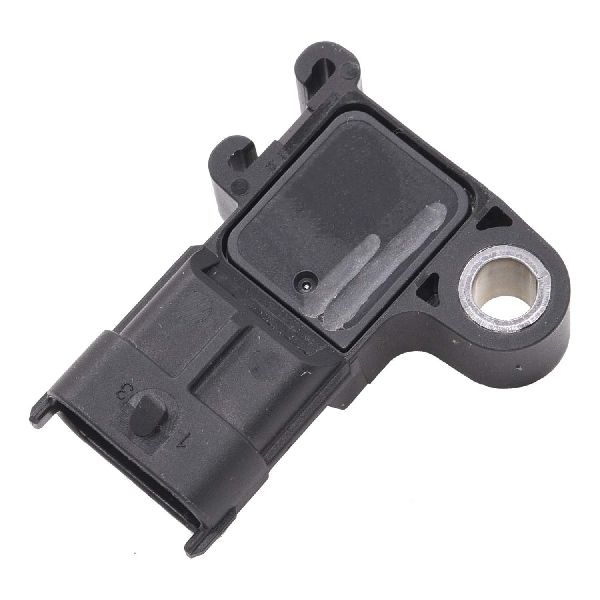
- Manifold Absolute Pressure (MAP) Sensor
(OEM #CV2Z-9F479-B)— This is the most frequent point of failure for code P0107 on this vehicle, as supported by owner experiences and Ford's own technical service bulletins for similar models.
Trusted brands: Motorcraft, Bosch, NGK, Standard Motor Products (SMP), Delphi
OEM price range: $60-$105
Aftermarket price range: $40-$75
Related Codes That Often Appear With This One
- P0106 — P0106 indicates a MAP sensor performance/range issue. It can appear alongside P0107 if the sensor's signal is erratic before failing completely low.
- P0108 — P0108 is for MAP sensor circuit high input. It's the opposite of P0107 but can be seen if there are intermittent wiring shorts or if it's part of a pattern identified by Ford TSBs for this sensor family.
Technical Service Bulletins (TSBs) & Recalls
- TSB 19-2212 / 19-2183: Although for different Ford models with EcoBoost engines, it directly links P0107, P0108, and/or P0109 to a faulty MAPT sensor causing a lack of power and multiple warning messages, establishing a known pattern for Ford vehicles of this era.
Platform-Specific Known Issues
- A Ford Technical Service Bulletin (TSB 19-2212, later superseded by 19-2183) for other models of the same era identifies a faulty MAP sensor as the cause for P0107, often accompanied by "Service AdvanceTrac" and "Hill Start Assist Not Available" messages, which is a pattern also reported by owners.
- An owner complaint to NHTSA (ODI #11351923) for a similar Ford model describes the vehicle stalling in the middle of an intersection due to a faulty MAP sensor triggering code P0107, highlighting the potential safety risk.
- Owners on forums like FocusFanatics and Reddit frequently report that replacing the MAP sensor (Part No. CV2Z-9F479-B) is the definitive fix for a P0107 code accompanied by stalling and AdvanceTrac warnings.
Mechanic-Grade Diagnostic Values
- MAP Sensor Voltage (KOEO - Key On, Engine Off) — expected: ~4.5V (at sea level, decreases with altitude). Failure: Voltage is below 0.5V, indicating a circuit low fault.
- MAP Sensor Voltage (Engine Idling) — expected: 0.9V - 1.3V (high vacuum). Failure: Voltage remains below 0.5V and does not change with engine RPM.
- MAP Sensor Pressure (Engine Idling, warm) — expected: 28-32 kPa. Failure: Reading is static or does not correlate with engine load changes.
- MAP Sensor Connector - Reference Voltage — expected: 5.0V on the reference wire from the PCM.. Failure: Voltage is significantly lower than 5.0V or absent, indicating a wiring or PCM issue.
- MAP Sensor Connector - Ground Circuit — expected: Near 0V.. Failure: Voltage is present on the ground wire, indicating a bad ground connection.
Scan Tool Commands That Help
- Ford IDS (Integrated Diagnostic System): KOER (Key On, Engine Running) Self-Test — To command the PCM to run a full system check while the engine is running, which can help identify intermittent faults or confirm if the P0107 code returns immediately after being cleared.
- Ford IDS (Integrated Diagnostic System): Datalogger - Monitor MAP_V (Voltage) and MAP (Pressure) PIDs — To view live data from the MAP sensor while performing wiggle tests on the harness or applying vacuum with a hand pump, which helps isolate a faulty sensor from a wiring issue.
- OBD-II Scanner (Advanced): Clear KAM (Keep Alive Memory) — After replacing the MAP sensor or repairing a wiring fault, clearing the KAM resets the PCM's adaptive learning tables. This forces the computer to relearn fuel trims and sensor values immediately with the new, correct data, which can resolve lingering performance issues.
Wiring & Ground Locations
- G100 / G102 / G104 — Various points on the left side of the engine compartment, near the battery junction box and front of the motor assembly.. These are primary engine bay ground points. Corrosion or a loose connection at these locations can create a floating ground, causing erratic voltage readings for multiple sensors, including the MAP sensor, potentially triggering a P0107 code.
- MAP Sensor Connector — On the MAP sensor itself, which is mounted to the front of the intake manifold on the 2.0L engine.. This 3-pin connector provides the 5V reference, ground, and signal return for the sensor. It is a common failure point due to vibration and heat, leading to intermittent or total loss of signal. The Ford part number for the connector pigtail is HC3Z-14S411-A.
- Ground Point under Air Box — Underneath the air filter box assembly in the engine bay.. This is a major chassis ground point that serves multiple engine components. Owners performing a 'ground mod' often clean and improve this connection to resolve various electrical issues, including those related to the transmission control module and engine sensors.
Real Owner Repair Stories
- Reddit user in r/FordFocus (2008 Ford Focus, 200,000 miles (Note: Mk2, but diagnosis is relevant)) — Persistent P0107 code, smooth idle, good gas mileage.
❌ Tried (didn't work) Replaced MAP sensor, Cleaned throttle body, Replaced injectors, plugs, wires, and coils for a separate misfire code
✅ What actually fixed it The issue was identified by another user as a likely wiring problem ('circuit code'), not a sensor failure. The final fix was not posted, but the diagnosis shifted from parts replacement to checking the circuit integrity between the sensor and the computer, which is the correct next step when a new sensor doesn't solve a circuit code.
OEM Part Supersession History
CV2Z-9F479-A→CV2Z-9F479-B— Standard part revision by the manufacturer for improved reliability or a change in supplier.
Heads up: The parts are interchangeable. CV2Z-9F479-B is the current service part for the specified vehicle range.CM5E-9F479-A→CV2Z-9F479-B (also listed as CX2423)— Part number consolidation and revision. The base number 9F479 is used across many Ford models, with the prefix changing based on the vehicle application and revision.
Heads up: While physically similar, always verify fitment using the vehicle's VIN. The CM5E prefix was associated with early Focus models and may have different calibration from the later CV2Z part.
Diagnostic Flowchart
Other Known Issues on This Vehicle
Issues unrelated to this code that are worth knowing about as an owner of this generation:
- DPS6 PowerShift Dual-Clutch Transmission Failure 🔴 High — Extremely common on automatic models from 2012-2016. Issues include shuddering, hesitation, and complete transmission failure. (Ref: Multiple lawsuits and customer satisfaction programs (e.g., 19N08) extended warranties on the Transmission Control Module (TCM) and clutch packs.)
- Faulty Canister Purge Valve (CPV) 🟠 Medium — Common across 2.0L GDI engines. Can cause stalling, difficult starting after refueling, and an illuminated check engine light. (Ref: NHTSA Recalls 18V735000 and 19V515000 (Ford recall 18S32).)
- Collapsed/Failed Passenger-Side Engine Mount 🟠 Medium — A very common issue causing excessive vibration and harshness felt in the cabin, especially at idle. (Ref: No specific recall, but it is a widely documented failure requiring replacement of the hydraulic mount.)
- Shudder/Vibration from Rear Engine Roll Restrictor 🟡 Low — Common on earlier models (2000-2011) but can still occur on the Mk3. Debris gets lodged in the mount, causing vibration in reverse. (Ref: TSB 11-3-24 (for earlier models, but the principle applies).)
Used vs. New Parts: Buying Guide for This Vehicle
When a used part is the smart pick: A used MAP sensor is generally not recommended. It is an inexpensive electronic component critical for engine management. The risk of getting a part that is already failing or has a short remaining lifespan outweighs the small cost savings over a new aftermarket part.
Donor-vehicle mileage cap: roughly under 60000 miles for the part to have meaningful remaining life.
What to inspect on the donor part:
- Check the donor vehicle's mileage; lower is always better.
- Inspect the sensor's plastic housing for cracks or heat damage.
- Ensure the electrical connector pins are straight and free of corrosion.
- Verify the O-ring is present and not flattened or cracked.
OEM-only on this vehicle (don't cheap out):
- While not strictly OEM-only, using a Motorcraft (Ford's OEM brand) sensor is highly recommended for this repair to ensure correct voltage scaling and longevity. Some cheap aftermarket sensors may not be calibrated correctly, leading to persistent performance issues even if the code is resolved.
Aftermarket brands forum-validated for this vehicle:
- Bosch
- Denso
- Standard Motor Products (SMP)
- NGK/NTK
Brands owners have reported issues with on this vehicle:
- Unnamed, no-brand sensors from online marketplaces should be avoided, as their quality and calibration are often questionable and can cause more diagnostic headaches.
Real Owner Stories
Aggregated from forums and TSBs cited above. Mileages and costs reflect what owners reported in those sources.
2012-2018 Ford Focus 2.0L Ti-VCT GDI I4
Symptoms: Vehicle stalling in the middle of an intersection due to a faulty MAP sensor triggering code P0107.
What fixed it: Replacement of the MAP sensor.
Source hint: NHTSA owner complaint (ODI #11351923)
2012-2018 Ford Focus 2.0L Ti-VCT GDI I4
Symptoms: P0107 code accompanied by stalling and 'Service AdvanceTrac' and 'Hill Start Assist Not Available' warnings.
What fixed it: Replacing the MAP sensor (Part No. CV2Z-9F479-B).
Source hint: FocusFanatics and Reddit forum reports
2012-2018 Ford Focus 2.0L Ti-VCT GDI I4
Symptoms: P0107 code stayed on even after the owner attempted a repair.
What fixed it: The source emphasizes that because it is a 'circuit code,' wiring integrity checks are necessary as the sensor itself is not always the culprit.
Source hint: Reddit r/FordFocus - "P0107 Code stays on" (2022)
Related OBD-II Codes
Frequently Asked Questions
Why is my Ford Focus showing 'Service AdvanceTrac' and 'Hill Start Assist Not Available' along with code P0107?
Is there a specific replacement part number recommended for the MAP sensor on the 2.0L GDI engine?
Could my Focus stalling at intersections be related to the P0107 code?
Does the canister purge valve issue on the 2.0L GDI engine cause P0107?
Where is the MAP sensor located on my 2012-2018 Focus 2.0L?
If I replace the MAP sensor and the P0107 code stays on, what should I check next?
Helpful Videos
We Have This Part in Stock


The information in this article is provided for general reference and educational purposes only. Vehicle specifications, procedures, and part compatibility can vary by production date, trim level, and region. Always consult your vehicle's factory service manual and verify part numbers before purchasing or performing repairs. Safety-critical components such as airbags, seat belts, and braking systems should be installed by a qualified professional.
- Ford Focus:
- 🎬 Helpful Videos
- 🛍️ Shop This Part
- What's Unique About the 2012-2018 Ford Focus
- Symptoms You May Notice
- Most Likely Causes
- Rare But Worth Checking
- Diagnosis Steps
- Parts You'll Likely Need
- Related Codes That Often Appear With This One
- Technical Service Bulletins (TSBs) & Recalls
- Platform-Specific Known Issues
- Mechanic-Grade Diagnostic Values
- Scan Tool Commands That Help
- Wiring & Ground Locations
- Real Owner Repair Stories
- OEM Part Supersession History
- Diagnostic Flowchart
- Other Known Issues on This Vehicle
- Used vs. New Parts: Buying Guide for This Vehicle
- Real Owner Stories
- 2012-2018 Ford Focus 2.0L Ti-VCT GDI I4
- 2012-2018 Ford Focus 2.0L Ti-VCT GDI I4
- 2012-2018 Ford Focus 2.0L Ti-VCT GDI I4
- Related OBD-II Codes
- Frequently Asked Questions
- 🎟️ Get 5% Off