

OBD-II Code P0108: Manifold Absolute Pressure (MAP) Sensor Circuit High Voltage
What P0108 means, why it triggers, and how to fix it
- A failed, internally shorted MAP sensor causes 80% of P0108 codes by sending a constant high-voltage signal (over 4.5V) to the engine computer.
- Expect a 15-20% drop in fuel economy, rough idling, and black exhaust smoke as the engine dumps excess fuel to compensate for the false high-pressure reading.
- Stop driving to prevent a $1,200 to $2,800 catalytic converter replacement; the unburned fuel from the rich condition melts the converter's internal honeycomb within weeks.
- Test the sensor's live data with a scan tool at Key On, Engine Off (KOEO); a reading stuck at 5 volts confirms a hard electrical short in the sensor or wiring harness.
What Does P0108 Mean?

Your car's Engine Control Module (ECM) detected the voltage signal from the Manifold Absolute Pressure (MAP) sensor is higher than the specified limit, typically over 4.5 volts. The MAP sensor measures the pressure inside the engine's intake manifold, providing critical data the ECM uses to calculate the correct fuel injection amount. This high voltage signal incorrectly tells the computer the engine is under heavy load, causing it to inject too much fuel (running rich).
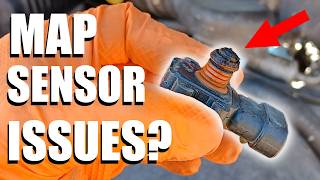
Technical definition: The SAE/OBD-II definition is "Manifold Absolute Pressure/Barometric Pressure Circuit High Input." The Powertrain Control Module (PCM) registered a voltage from the MAP sensor circuit above the normal range 🎬 Watch: How to test and replace a faulty MAP sensor (over 4.5 volts) for a sustained period. This reading is implausible because it conflicts with Throttle Position Sensor (TPS) and engine RPM data, which indicate the engine is not under high load.
Can I Drive With P0108?
Yes, But With Caution. Driving with P0108 is not recommended. While the vehicle is operable, you will experience poor performance, a 15-20% drop in fuel economy, and stalling in traffic, creating a safety hazard. Ignoring the code for an extended period causes expensive damage to the catalytic converter due to the excessively rich fuel mixture, a repair costing between $1,200 and $2,800.
Common Causes

- Faulty MAP Sensor (Very Common) — The sensor itself is the most frequent culprit. An internal short circuit or failure of the piezo-electric element causes it to send a continuous high voltage signal to the PCM. Repetitive heat cycling breaks down internal circuitry over time.
- Wiring or Connector Issues (Common) — The wiring harness connected to the MAP sensor is damaged, frayed, corroded, or shorted to a power source. Moisture intrusion in the connector or a poor electrical ground connection disrupts the signal, causing a high voltage reading.
- Significant Vacuum Leaks (Less Common) — A large leak in a vacuum hose, intake manifold gasket, or the hose leading directly to the MAP sensor alters the pressure the sensor reads, causing it to report a higher-than-expected voltage.
- Clogged Catalytic Converter (Less Common) — A severely restricted exhaust system creates backpressure that backs up into the intake manifold. This increased pressure causes the MAP sensor to generate a legitimate, but problematic, high voltage reading.
- Boost Pressure Issues (Turbocharged Engines) (Less Common) — On turbocharged vehicles, a malfunctioning turbocharger wastegate or boost control solenoid causes pressure in the intake manifold to exceed its designed limits, leading to an accurate but problematic high reading from the MAP sensor.
- Severe Intake Restriction (Rare) — A throttle body heavily caked with carbon, or a severely clogged engine air filter, restricts airflow and disrupts air-fuel mixture calculations, contributing to abnormal manifold pressure readings.
- Worn Engine Components (Rare) — In high-mileage vehicles, worn piston rings or valve seals lead to reduced engine vacuum, which is extreme enough to cause the MAP sensor reading to be higher than what the ECM expects at idle.
- Faulty Powertrain Control Module (PCM) (Very Rare) — The vehicle's main computer failed. An internal fault in the PCM's circuitry, such as a failed voltage regulator or a compromised input circuit, causes it to misinterpret the signal from the MAP sensor.
Symptoms

- Check Engine Light is On — This is the most common and first indication of a problem. The P0108 code is stored in the vehicle's computer.
- Poor Engine Performance — The vehicle experiences sluggish acceleration, hesitation, a general lack of power, or enters a reduced-power 'limp mode'.
- Rough Idle or Stalling — The engine idles erratically, shakes, or stalls, particularly when coming to a stop or at low speeds.
- Decreased Fuel Economy — Because the engine is running rich (too much fuel), you see a noticeable drop in your miles per gallon (MPG), often by 15-20%.
- Black Smoke from Exhaust — The excessively rich fuel mixture results in unburned fuel exiting the exhaust pipe, appearing as black smoke.
- Hard Starting — The incorrect air-fuel mixture makes it difficult for the engine to start, especially during a cold start.
- Negative Fuel Trims (scan-tool only — no driver-felt sign) — On a scan tool, short-term and long-term fuel trims are highly negative (e.g., -25%) as the PCM tries to remove fuel to compensate for the false rich signal.
Diagnostic Flowchart
Tap your situation to follow the diagnostic path that matches what you're seeing on this code.
Common Fixes & Costs
- Replace MAP Sensor
— Parts: $20-$190, Labor: $70-$130 (parts+labor), ~0.6 hr book time
(DIY)
Ford F-150 (3.5L EcoBoost): OEM {'brand': 'Motorcraft', 'part_number': 'AA5Z-9F479-E', 'estimated_price': '$60-$120'} (Alt: {"brand": "Bosch", "estimated_price": "$50-$90"}, {"brand": "Standard Motor Products (SMP)", "estimated_price": "$40-$80"})
Honda Civic: OEM {'brand': 'Honda', 'part_number': '37830-RNA-A01', 'estimated_price': '$60-$90'} (Alt: {"brand": "Denso (OEM Supplier)", "estimated_price": "$40-$60"}, {"brand": "Walker Products", "estimated_price": "$30-$50"})
Chevrolet Silverado: OEM {'brand': 'ACDelco', 'part_number': '12711681', 'estimated_price': '$45-$75'} (Alt: {"brand": "Delphi", "estimated_price": "$35-$60"}, {"brand": "Bosch", "estimated_price": "$40-$65"}) - Repair Wiring or Connector — Parts: $10-$50, Labor: $120-$280 (parts+labor), ~1.5 hr book time (Intermediate)
- Repair Vacuum Leak — Parts: $5-$100, Labor: $100-$200 (parts+labor), ~1.2 hr book time (Intermediate)
- Professional Diagnosis — Parts: $0, Labor: $80-$160 (parts+labor), ~1 hr book time (Professional)
- Replace Powertrain Control Module (PCM) — Parts: $500-$1500+, Labor: $100-$300 (parts+labor), ~1.5 hr book time (Professional)
DIY vs Professional
- Replace MAP Sensor — Beginner: Yes
Tools: Basic hand tools (socket set, screwdriver). Requires a Torx bit (e.g., T20) for some Fords. - Repair Wiring or Connector — Beginner: No
Tools: Digital multimeter, wiring diagrams, wire strippers, crimpers, heat shrink tubing, soldering iron (optional). - Repair Vacuum Leak — Beginner: Maybe
Tools: Smoke machine (professional method), or brake cleaner/propane torch (DIY method). Basic hand tools for replacing hoses/gaskets. - Replace Powertrain Control Module (PCM) — Beginner: No
Tools: Advanced scan tools for programming, socket set.
Used vs. New Parts: Buying Guide
When a used part is worth it: Buying a used MAP sensor is not recommended. As a sensitive electronic component, its history is unknown, and the $20-$40 cost savings are minimal compared to the risk of premature failure and repeat labor costs.
Donor-vehicle mileage cap: roughly under 50000 miles for the part to have meaningful remaining life.
Donor quality checklist:
- Source from a low-mileage vehicle not scrapped for engine or electrical issues.
- Match the OEM part number exactly; small differences in calibration cause immediate issues.
- Avoid parts with physical damage, pin corrosion, or oil contamination in the port.
Decision logic:
- If The vehicle is a European brand like BMW, Mini, or VW. → Buy a new OEM or OEM-supplier (Bosch) part. These vehicles are highly sensitive to sensor calibration, and aftermarket parts frequently cause the code to return.
- If The cost of a new OEM sensor is under $100. → Buy new. The warranty and reliability are worth the small additional cost over a used part.
- If Budget is the absolute priority and the vehicle is high-mileage. → A used OEM part from a reputable salvage yard with a short-term warranty is a viable, but risky, option.
Warranty tradeoff: Used parts offer a 30-90 day warranty. New aftermarket parts come with a 1-year to limited lifetime warranty. New OEM parts carry a 1-2 year warranty.
Worst-case if a used part fails: $150-$300 if a used or cheap aftermarket sensor fails, requiring a second diagnostic fee, repeat labor, and the cost of another part.
What Happens If You Wait — Timeline
- 0-4 weeks: Check Engine Light is on. You notice a slight drop in fuel economy and a rougher than normal idle, especially on cold starts. Performance issues are minimal. (MPG impact: 5-10%% · Added cost: $20-$60 in wasted fuel.)
- 1-3 months: Engine performance degrades noticeably. Hesitation during acceleration becomes common, and the engine stalls at stop lights. Black smoke is visible from the exhaust during acceleration due to the rich fuel mixture. (MPG impact: 10-20%% · Added cost: $100-$250 in wasted fuel.)
- 3-6 months: The persistent rich condition damages the catalytic converter. The unburned fuel overheats the catalyst substrate, causing it to start melting and cracking. You do not notice this damage yet, but it is occurring. (MPG impact: 15-25%% · Added cost: $800-$1500 (catalytic converter replacement is now likely needed).)
- 6+ months: The catalytic converter becomes fully clogged, creating significant exhaust backpressure. The engine has a severe lack of power, struggles to accelerate, and fails to start. The extreme backpressure damages oxygen sensors and internal engine components like piston rings or valve seals. (MPG impact: 25-40%% · Added cost: $2000-$3500+ (for catalytic converter, O2 sensors, and potential further engine diagnostics/repairs).)
Cost of Not Fixing It

- 0-1 month: Noticeable drop in fuel economy (15-20%), rough idle, and poor acceleration. Black smoke from exhaust is visible. (Added cost: $50-$150 in wasted fuel.)
- 1-6 months: The persistent rich fuel mixture overheats the catalytic converter, causing its internal structure to melt and clog. This creates a major exhaust restriction, severely reducing engine power. (Added cost: $1200-$2800 for catalytic converter replacement.)
- 6+ months: Continued operation with a clogged catalytic converter and rich condition fouls spark plugs, damages oxygen sensors, and causes internal engine damage from excessive backpressure. (Added cost: $3000+ for catalytic converter, O2 sensors, and engine repairs.)
Diagnosis Steps
- Check for Other Codes
Use an OBD-II scanner to read the trouble codes. Note if any other codes are present, as they pinpoint the root cause. Codes like P0105, P0106, P0107, or P0069 are directly related and narrow the diagnosis.
Tools: OBD-II Scanner (Beginner) - Check Live Data (KOEO & Idle)
With the Key On, Engine Off (KOEO), use a scan tool to view the MAP sensor's live data. The reading matches the Barometric Pressure (BARO) PID and reflects your current altitude (e.g., ~101 kPa or ~4.5V at sea level). A reading stuck at 5 volts points to a circuit fault. Start the engine; the voltage drops significantly to around 1.0-1.8 volts at idle. If it stays high, the fault is confirmed.
Tools: OBD-II Scanner with Live Data (Intermediate) - Visually Inspect the MAP Sensor and Wiring
Locate the MAP sensor on the intake manifold. Inspect the sensor, its electrical connector, and the surrounding wiring for damage, corrosion, moisture, or loose connections. Ensure the vacuum hose to the sensor (if applicable) is connected and not cracked.
Tools: Flashlight (Beginner) - Test the MAP Sensor Circuit at the Connector
Disconnect the MAP sensor. With the key on, use a multimeter to test the harness connector. You find: 1) A 5-volt reference wire from the PCM. 2) A ground wire (check for less than 0.5 volts). 3) A signal wire. If the 5V reference or ground is missing, the problem is in the wiring or PCM.
Tools: Digital Multimeter (Intermediate) - Check for Vacuum Leaks
With the engine running, listen for hissing sounds around the intake manifold. Carefully spray brake cleaner or unlit propane around gasket surfaces and vacuum hoses; a change in engine idle indicates a leak. A smoke machine is the most effective tool for finding intake leaks.
Tools: Brake Cleaner or Propane Torch (unlit), Smoke Machine (recommended) (Intermediate) - Pro Tip: Check Signal Wire for Shorts
With the sensor disconnected and key on, probe the signal wire in the harness connector. It reads near 0 volts (or 5V on some 'pull-up' circuit designs). If you read battery voltage, the signal wire is shorted to power in the harness. With the key off, check for continuity between the signal wire and the 5V reference wire; there is none (O.L. on the meter).
Tools: Digital Multimeter (Advanced) - Advanced: Scan Tool Analysis of Related PIDs
Observe live data for MAP, BARO, Throttle Position (TPS), and Short/Long Term Fuel Trims (STFT/LTFT). At KOEO, MAP and BARO pressure are nearly identical (~101 kPa at sea level). At idle, MAP pressure drops to ~30 kPa. If P0108 is active, LTFT values sit at -25% or lower as the ECM compensates for the rich condition.
Tools: OBD-II Scanner with Live Data (Advanced) - Advanced: MAP Sensor Resistance Test
With the sensor disconnected and the key off, test the internal resistance of the MAP sensor. Set your multimeter to Ohms (Ω). Probe the ground and signal terminals on the sensor itself. A reading of around 2.5 kΩ or less is a common benchmark for a good sensor. An open loop (O.L.) or very high resistance reading indicates a failed sensor.
Tools: Digital Multimeter (Advanced) - Inspect for Exhaust Restrictions
A clogged catalytic converter causes this code. A professional performs a backpressure test. A DIY check involves feeling the exhaust flow at the tailpipe; it is strong and steady. A weak or pulsing flow indicates a restriction.
Tools: Exhaust Backpressure Gauge (optional) (Advanced) - Pro Tip: Jump the Circuit to Test PCM Response
On some vehicles (like GM), use a 3A fused jumper wire to connect the signal circuit terminal to the 5-volt reference circuit terminal in the harness connector. The MAP sensor parameter on your scan tool reads the maximum value (>103 kPa). This confirms the PCM and signal wire are capable of reading the full voltage range.
Tools: Fused Jumper Wire, OBD-II Scanner with Live Data (Advanced)
When This Code Triggers (Freeze-Frame Conditions)
- Engine Coolant Temp: 180-200°F (82-93°C) (The engine is fully warmed up.)
- RPM: < 900 RPM (The code sets at idle or when engine speed is low.)
- Engine Load: Low (The fault registers when the throttle position is low (below 2%), but the MAP sensor reports a high-load (high pressure) condition.)
- Vehicle Speed: 0 mph (The conditions for this code are met when the vehicle is stationary with the engine running.)
Related Codes
- P0105 — Indicates a general MAP/BARO Circuit Malfunction. P0108 is specific to a HIGH voltage condition. P0105 is a generic fault set if the sensor signal is missing, irrational, or fails a PCM self-test, but isn't necessarily stuck high. A P0108 is often accompanied by a P0105.
- P0106 — Indicates a MAP sensor performance/range issue. P0108 means the signal is stuck electrically high (>4.5V). P0106 means the signal fluctuates, but its reading doesn't make sense compared to throttle position and RPM. P0106 points to a slow sensor or clogged port, whereas P0108 is a hard electrical fault.
- P0107 — The opposite of P0108, indicating the MAP sensor circuit voltage is too low (<0.5V). P0108 is a short to voltage, while P0107 is a short to ground or an open circuit. Seeing both codes stored together strongly suggests an intermittent wiring problem or a completely failed sensor fluctuating between open and shorted states.
- P0069 — Indicates a disagreement between the MAP sensor and the Barometric Pressure (BARO) sensor at Key-On, Engine-Off. P0069 is a correlation fault diagnosed before the engine starts. P0108 is a circuit fault where the voltage is out of its valid electrical range at any time. A faulty MAP sensor causes both codes, but P0069 specifically points to a KOEO comparison failure.
Climate & Environmental Factors
- Altitude: Altitude directly affects the baseline pressure reading. At KOEO, the MAP sensor reading matches the local barometric pressure, which decreases as altitude increases (e.g., ~101 kPa at sea level vs. ~88 kPa at 4,000 ft). A technician accounts for altitude when diagnosing KOEO values to avoid misdiagnosis.
- Temperature Extremes: Repeated exposure to high heat and extreme cold (heat cycling) degrades the MAP sensor's internal electronic components over time, leading to failure.
- Cold Weather: On some vehicles, the ECM delays running the self-test that triggers a P0108 code until the engine warms up. A test does not run until 8 minutes pass if the engine coolant was below 0°C (32°F) at startup. This causes the code to appear intermittently in cold climates.
How to Talk to a Mechanic About This Code
Say this: "I have a P0108 code and I'd like to schedule a diagnostic. Can you please test the MAP sensor circuit — specifically the 5-volt reference, ground, and signal wire integrity — before recommending a sensor replacement?"
This signals you understand that P0108 is an electrical circuit code, not just a bad part. It directs the technician to perform a proper diagnosis, preventing them from simply replacing the sensor (a common misdiagnosis) and having the code return.
Avoid saying:
- 'My check engine light is on, can you look at it?'
- 'My car is running rough, I think it's a sensor.'
- 'Just fix whatever's wrong.'
Questions to ask before authorizing the repair:
- What were the live data readings for the MAP sensor voltage with the Key On, Engine Off, and at idle?
- Did you confirm the 5-volt reference and ground were good at the sensor connector?
- Was the signal wire shorted to voltage or ground?
- Can you show me the old part?
- What is the warranty on the part and the labor for this repair?
Where to Take It: Dealer vs Independent vs Chain
- Dealer:
Best for: Vehicles still under powertrain or emissions warranty., Vehicles with known TSBs for this code (like 2018-2019 Ford 3.5L EcoBoost)., Complex electrical issues on sensitive European brands (BMW, Audi).
Downsides: Significantly higher labor rates and diagnostic fees., May follow rigid diagnostic trees that lead to replacing more parts than necessary. (Typical cost: +40% vs. baseline) - Independent Shop:
Best fit for most vehicles. A competent independent technician easily diagnoses a P0108 circuit fault or bad sensor, often with more flexibility and at a lower cost than a dealer.
Best for: Out-of-warranty vehicles where cost is a factor., Straightforward electrical diagnosis and sensor replacement., Building a long-term relationship with a trusted mechanic.
Downsides: Quality and expertise vary widely; vet shops by checking for ASE certifications and online reviews. (Typical cost: +0% vs. baseline) - Chain Shop:
Use with caution. Acceptable if you are certain the MAP sensor itself is the problem and just need it replaced. AVOID for initial diagnosis, as they misdiagnose a wiring problem as a bad sensor.
Best for: Simple parts replacement if you have already diagnosed the issue yourself.
Downsides: Technician skill varies dramatically; lacks the in-depth electrical diagnostic expertise for a circuit fault vs. a sensor fault., Often use basic code scans without a full diagnostic process, leading to incorrect repairs., High pressure to upsell services. (Typical cost: -10% vs. baseline)
When to Walk Away From the Repair
If the estimated repair cost exceeds 50% of the car's private-party value, sell or trade it in instead of repairing it.
- Car worth $4000, fix is $350: Fix it. This repair is a small fraction of the car's value.
- Car worth $3000, fix is $1800: Walk away. The repair cost is 60% of the car's value. This is a bad investment, especially if the fix involves a costly PCM replacement.
- Car worth $15000, fix is $1200: Fix it. The repair is well below the threshold and maintains the value of a more expensive vehicle.
What Scan Tool You Need for This Code

Minimum: A scanner that reads and graphs live data, specifically the MAP sensor voltage PID.
A basic $20 code reader only tells you the P0108 code exists. It cannot show live voltage data, which is essential to confirm if the sensor signal is stuck high (>4.5V), making a proper diagnosis impossible.
Budget: BlueDriver Pro Bluetooth (~$100) — Connects to your smartphone and provides detailed live data graphing, allowing you to watch the MAP sensor voltage in real-time to see if it's stuck high or responds correctly to engine load.
Mid-range: Innova 5610 or Foxwell NT604 Elite (~$150) — These handheld units offer robust live data streaming and graphing for engine PIDs. The Innova 5610 adds some bidirectional controls which, while not essential for P0108, are useful for other diagnostics.
Professional: Autel MaxiCOM MK808 / MK808BT (~$450-650) — A full-featured tablet scanner that provides dealership-level diagnostics, including advanced live data analysis and bidirectional controls to test circuits and components directly.
Rent vs buy: For a one-time check, auto parts stores like AutoZone and Advance Auto Parts offer a free tool loaner program where you borrow a basic scanner. You leave a deposit which is fully refunded upon return. Buy a scanner only if you plan to perform your own diagnostics regularly.
How to Clear the Code After You Fix It
- Use an OBD-II scan tool to clear the fault code.
- Start the engine and let it idle for at least 5 minutes.
- Perform a drive cycle that includes a mix of city and highway driving.
Drive cycle (~20 minutes): After clearing the code, start the engine from cold and let it idle for 2-3 minutes. Drive for 15-20 minutes, including both stop-and-go city conditions and a period of steady cruising at highway speed (55 mph). Allow the vehicle to cool down completely. The Check Engine Light remains off if the repair was successful.
Readiness monitors affected: Catalyst monitor, Evaporative System monitor, O2 sensor monitor
Before emissions retest: drive at least 50 miles to fully set monitors.
Watch out for:
- Disconnecting the battery does not clear the code from the PCM's permanent memory and resets all readiness monitors, guaranteeing an emissions test failure.
- The code returns immediately if the underlying electrical or mechanical fault is not properly repaired.
Will This Fail Emissions / State Inspection?
Yes — this code typically fails an OBD-II emissions inspection.
- California: An active P0108 code results in an automatic smog check failure. After repair, a full drive cycle must be completed to set all OBD-II readiness monitors before a re-test is possible.
- New York: The NYS DMV inspection includes an OBD-II scan. The presence of a Check Engine Light and an active P0108 code is an automatic failure.
- Texas: In counties requiring emissions testing, a vehicle with an illuminated Check Engine Light for a code like P0108 fails the inspection.
Most Commonly Affected Vehicles
- Ford Flex, Explorer, Taurus, F-150 (2018-2019) — A faulty MAPT sensor is a very common issue on the 3.5L EcoBoost engine, documented by Ford in TSBs 19-2183 and 19-2212. Older Fords use a frequency-based MAP sensor, with a normal KOEO reading around 158 Hz.
- Honda Civic, Accord (2006-2024) — These models are known for MAP sensor failures that trigger P0108. For 2006-2011 Civics, the code specifically triggers when voltage exceeds 4.49V. Replacement with an OEM-equivalent brand like Denso is required.
- Chevrolet Silverado (2007-2024) — P0108 is frequently caused by a failing MAP sensor on these trucks. Service manuals for these models provide detailed circuit testing procedures.
- Jeep Cherokee, Renegade, Compass (2014-2020) — On models with the 2.4L MultiAir engine, P0108 is accompanied by code P1185 (General Pressure Sensor Correlation), strongly indicating a failed MAP sensor or wiring issue.
- Subaru Impreza, Crosstrek, Forester (2012-2016) — These vehicles experience MAP sensor issues, accompanied by P0107 (low voltage), pointing to an intermittent wiring fault.
- BMW / Mini 3 Series, 5 Series, X3, X5, Mini Cooper, Countryman (2004-2016) — Commonly seen on models with the 1.5L (B38) engine. Using an OEM sensor (Bosch or Continental) is critical; aftermarket sensors cause the code to return immediately. The MINI part number is 12-14-0-872-648.
- Hyundai Accent, Elantra, i10, Matrix (2008-2020) — P0108 is a known code on several Hyundai models, pointing directly to a failed MAP sensor or a wiring issue in the harness.
- Volkswagen / Audi Jetta, Golf, A4, and others (2000-2015) — These makes are prone to P0108, caused by sensor failure, vacuum leaks, or wiring faults.
Manufacturer-Specific Notes
- Ford: On 2018-2019 models with the 3.5L EcoBoost engine (Flex, Explorer, Taurus, MKT), a P0108 code is almost certainly due to a faulty MAPT sensor. Ford issued Technical Service Bulletins 19-2183 and 19-2212 for this known issue, covered under new vehicle and emissions warranties. Older Fords use a frequency-based MAP sensor instead of voltage-based, with a normal KOEO reading around 158 Hz.
- GM (Chevrolet, GMC): On some GM vehicles, a dirty or contaminated MAP sensor causes this code. Cleaning the sensor port is a common first step before replacement. Advanced diagnostics involve jumping the signal and reference wires to test the PCM's response, as outlined in service manuals.
- Subaru: On Subarus, it is common to see both P0107 (low input) and P0108 (high input) codes stored together, which points to a wiring issue or a completely failed sensor.
- Honda: Honda MAP sensors fail over time, making sensor replacement a very common fix for P0108 on models like the Civic and Accord. Using an OEM-equivalent part from brands like Denso is highly recommended.
- BMW/Mini: Technicians strongly advise using only original equipment (OEM) MAP sensors (Bosch, Continental) on these vehicles. Cheaper aftermarket sensors have slight electrical resistance differences that cause the P0108 code to return immediately after installation.
Real Owner Stories
2018 Ford Explorer 3.5L EcoBoost
Check Engine Light, Service AdvanceTrac, and Hill Start Assist warnings all appeared. Vehicle had a severe lack of power and sluggishness from a stop.
What they tried:
- Initially thought it was a transmission issue due to the poor acceleration.
- Scanned codes and found P0107, P0108, and P0109.
Outcome: Identified Ford TSB 19-2212 which points directly to a faulty MAPT sensor. Replaced the sensor (Part # AA5Z-9F479-E) in under 15 minutes. All codes cleared and performance was restored.
Lesson: For specific models like the 2018-2019 Ford 3.5L EcoBoost, always check for Technical Service Bulletins (TSBs) first. A well-known issue saves hours of diagnostic time.
2003 Buick Park Avenue
Persistent P0108 code with rough idle and decreased fuel economy.
What they tried:
- Replaced the MAP sensor three separate times.
- Replaced both upper and lower intake gaskets to rule out vacuum leaks.
Outcome: Despite replacing common culprits, the code remained. The owner's scan tool showed the new MAP sensor was still stuck at 5 volts. This indicates the problem is not the sensor but the circuit itself (wiring short to power) or the PCM.
Lesson: If replacing a sensor doesn't fix the code, do not assume the new part is also bad. You must test the circuit. A sensor stuck on 5V points to a wiring harness short or a PCM fault, not the sensor itself.
2010 Toyota Prius with 205k miles
After replacing the water pump, a new P0107/P0108 code appeared. No noticeable driving symptoms.
What they tried:
- Checked MAP sensor voltage, cleaned the sensor, and cleared the code, but it returned immediately.
- Searched for vacuum leaks but couldn't find any.
Outcome: A mechanic found oil inside the intake manifold near the MAP sensor. This was caused by a stuck-open PCV valve creating an internal vacuum leak. Replacing the PCV valve and cleaning the sensor again permanently fixed the codes.
Lesson: An unusual root cause is a failed related component. Oil contamination on the MAP sensor is a clue pointing to a problem in the PCV system.
2001 Chevy S-10 2.2L
Engine ran very rough and would not accelerate when pressing the gas pedal. P0108 code was present.
What they tried:
- Replaced the MAP sensor and cleared the code, but the problem was unchanged.
- Tested the new sensor with a multimeter and got a reading of 0 ohms, suspecting a defective new part.
Outcome: The owner was advised that replacing the part without testing the circuit was a mistake. The next steps required testing the 3-wire connector for 5V reference, ground, and the signal wire to determine if the fault was in the wiring harness before condemning another sensor.
Lesson: Never assume a new part is good or that it fixes the problem. Always test the circuit's integrity (power, ground, signal) before and after part replacement to avoid wasting money and time.
How to Prevent This Code From Triggering
- Regularly inspect vacuum hoses and connections (Every oil change or 10,000 miles) — Over time, rubber hoses become brittle, crack, or collapse due to heat and age, creating vacuum leaks that trigger MAP sensor codes. Early detection prevents this.
- Keep engine bay clean and deter rodents (As needed; seasonally in high-risk areas) — Rodents are attracted to the soy-based wiring insulation used in modern cars and chew through the MAP sensor harness. Using rodent-repellent tape or sprays protects wiring.
- Use high-quality OEM or OEM-supplier sensors for replacement (When replacement is needed) — Cheaper aftermarket sensors lack the precise calibration or durability of OEM parts, leading to premature failure or the code returning, especially on sensitive European vehicles.
- Clean the MAP sensor port during throttle body service (Every 30,000-50,000 miles) — Carbon and oil vapor from the PCV system clog the small port leading to the MAP sensor, causing inaccurate readings. Cleaning this passage ensures the sensor measures the correct manifold pressure.
- Apply dielectric grease to the sensor connector (During sensor replacement or inspection) — In humid climates or areas with road salt, applying a small amount of dielectric grease to the connector pins prevents moisture intrusion and corrosion, which causes high resistance or shorts in the circuit.
Frequently Asked Questions
What is the difference between a MAP sensor and a BARO sensor?
A MAP (Manifold Absolute Pressure) sensor measures the pressure inside the intake manifold. A BARO (Barometric) sensor measures the outside atmospheric pressure. On many modern vehicles, these two functions are integrated into a single sensor. The PCM uses the BARO reading at key-on to establish a baseline for altitude before using the MAP reading to measure engine load.
Can I just clean the MAP sensor to fix P0108?
Cleaning a dirty throttle body or MAP sensor port sometimes helps if it is physically clogged. However, P0108 is an electrical fault (high voltage). Cleaning the sensor's electrical components rarely fixes an internal short circuit.
What are the most common misdiagnoses for a P0108 code?
A common mistake is replacing the MAP sensor when the actual problem is a wiring issue (a short to power or a bad ground) or a significant vacuum leak. It is crucial to test the circuit and check for leaks before replacing parts.
Can I use a cheap aftermarket MAP sensor to fix the P0108 code?
Using cheap aftermarket sensors is a bad idea, especially on European vehicles like BMW and Mini. Aftermarket sensors have slight electrical differences that the sensitive engine computer detects, causing the P0108 code to reappear almost immediately. Always use an OEM or OEM-quality part.
Will a P0108 code clear itself?
No, the Check Engine Light stays on and the code remains stored as an 'active' fault until the underlying electrical problem is fixed. After the repair, the code must be cleared with a scan tool, or it clears on its own after a specific number of successful drive cycles.
How much does it cost to fix a P0108 code?
A professional diagnosis costs between $80 and $160. If you do it yourself, replacing the MAP sensor costs between $20 and $190 for the part. A professional repair, including diagnosis and labor, ranges from $150 to $350.
Is it dangerous to drive with a P0108 code?
While not immediately dangerous, it is not recommended. Poor engine performance and stalling are safety issues in traffic. Continuing to drive with a rich fuel condition causes expensive damage to your catalytic converter over time, a repair costing over $1,200.
Key Takeaways
- A failed, internally shorted MAP sensor causes 80% of P0108 codes by sending a constant high-voltage signal (over 4.5V) to the engine computer.
- Expect a 15-20% drop in fuel economy, rough idling, and black exhaust smoke as the engine dumps excess fuel to compensate for the false high-pressure reading.
- Stop driving to prevent a $1,200 to $2,800 catalytic converter replacement; the unburned fuel from the rich condition melts the converter's internal honeycomb within weeks.
- Test the sensor's live data with a scan tool at Key On, Engine Off (KOEO); a reading stuck at 5 volts confirms a hard electrical short in the sensor or wiring harness.
Helpful Videos




The information in this article is provided for general reference and educational purposes only. Vehicle specifications, procedures, and part compatibility can vary by production date, trim level, and region. Always consult your vehicle's factory service manual and verify part numbers before purchasing or performing repairs. Safety-critical components such as airbags, seat belts, and braking systems should be installed by a qualified professional.
- 🎬 Helpful Videos
- What Does P0108 Mean?
- Can I Drive With P0108?
- Common Causes
- Symptoms
- Diagnostic Flowchart
- Common Fixes & Costs
- DIY vs Professional
- Used vs. New Parts: Buying Guide
- What Happens If You Wait — Timeline
- Cost of Not Fixing It
- Diagnosis Steps
- When This Code Triggers (Freeze-Frame Conditions)
- Related Codes
- Climate & Environmental Factors
- How to Talk to a Mechanic About This Code
- Where to Take It: Dealer vs Independent vs Chain
- When to Walk Away From the Repair
- What Scan Tool You Need for This Code
- How to Clear the Code After You Fix It
- Will This Fail Emissions / State Inspection?
- Most Commonly Affected Vehicles
- Manufacturer-Specific Notes
- Real Owner Stories
- 2018 Ford Explorer 3.5L EcoBoost
- 2003 Buick Park Avenue
- 2010 Toyota Prius with 205k miles
- 2001 Chevy S-10 2.2L
- How to Prevent This Code From Triggering
- Frequently Asked Questions
- What is the difference between a MAP sensor and a BARO sensor?
- Can I just clean the MAP sensor to fix P0108?
- What are the most common misdiagnoses for a P0108 code?
- Can I use a cheap aftermarket MAP sensor to fix the P0108 code?
- Will a P0108 code clear itself?
- How much does it cost to fix a P0108 code?
- Is it dangerous to drive with a P0108 code?
- Key Takeaways
- 🎟️ Get 5% Off