

P0107 on 2008-2011 Ford Focus: MAP Sensor Circuit Low Causes and Fixes
On a 2008-2011 Ford Focus, P0107 almost always points to a failed Manifold Absolute Pressure (MAP) sensor. It's a simple, beginner-friendly DIY fix, with a replacement sensor costing between $40 and $80. Before replacing, a quick visual inspection of the wiring and connector is wise, as harness damage is the second most likely cause, often accelerated by vibration from a failed passenger-side motor mount.
- P0107 on a 2008-2011 Focus almost certainly points to a bad MAP sensor or its wiring.
- This is a beginner-friendly DIY repair that usually takes less than 30 minutes and requires only basic tools.
- Always check the wiring and connector for damage before buying a new sensor.
- Do not confuse the MAP sensor with a MAF sensor; this vehicle uses a MAP sensor for its primary load calculations.
What's Unique About the 2008-2011 Ford Focus
For the second-generation North American Ford Focus with the 2.0L Duratec engine, the P0107 code is very straightforward. Unlike some vehicles where this code could be triggered by a major vacuum leak, on this Focus it almost exclusively points to an electrical fault in the MAP sensor circuit itself or the sensor. The sensor is mounted directly on the plastic intake manifold, making it very easy to access and replace, but also exposing it to engine heat and vibrations that can lead to its failure over time. A critical factor for this platform is the extremely common failure of the passenger-side hydraulic motor mount, which leads to excessive engine vibration that can fatigue the MAP sensor's wiring or internal electronics, accelerating failure.
Symptoms You May Notice
- Check Engine Light is on
- Rough idle or stalling, especially at stop lights
- Lack of engine power and sluggish acceleration
- Engine hesitation upon acceleration
- Poor fuel economy
- Black smoke from the exhaust in some cases
- In some cases, warning messages like "Service AdvanceTrac" or "Hill Start Assist Not Available" may appear, as noted in NHTSA complaints for other Ford models with the same code. [TSB 19-2212, ODI #11351923]
- Replacing the Mass Air Flow (MAF) sensor. The 2.0L Duratec in this Focus uses a MAP sensor for its primary engine load calculations, not a MAF sensor. P0107 is specific to the MAP sensor circuit.
- Assuming a vacuum leak is the primary cause. While a vacuum leak can cause performance issues, P0107 on this car is an electrical circuit code that more commonly points to the sensor or its wiring.
Most Likely Causes
- Faulty Manifold Absolute Pressure (MAP) Sensor 🔴 High Probability The sensor is exposed to constant heat cycles and engine vibration, leading to internal electronic failure over time. This is the most common cause for P0107 on this vehicle. The high failure rate of the passenger-side engine mount on this platform can cause excessive vibration, further stressing the sensor and leading to premature failure.
How to confirm: Use a scan tool to monitor MAP sensor voltage with the Key On, Engine Off (KOEO). The reading should correspond to atmospheric pressure (approx. 4.5-5.0 volts at sea level). At idle, it should drop to 1.0-1.8 volts. If the voltage is stuck below 0.5V in all states, the sensor has failed internally.
Typical fix: Replace the MAP sensor. It is located on the intake manifold, held in by a single T20 Torx bolt.
Est. part cost: $40-$125 - Wiring Harness or Connector Damage 🟡 Medium Probability The wiring harness leading to the MAP sensor can become brittle and chafe due to engine vibration and heat, causing a short to ground or an open circuit. The connector pins can also corrode or lose tension. This issue can be exacerbated by a failed motor mount causing excessive engine movement.
How to confirm: Visually inspect the wiring and connector for damage, chafing, or corrosion. With the key on, unplug the sensor and use a multimeter to verify a 5-volt reference and a good ground at the connector. If either is missing, the problem is upstream toward the PCM.
Typical fix: Repair the damaged section of wiring or replace the connector with a new pigtail if it is corroded or broken. Use zip ties to secure the harness away from sharp edges or sources of vibration.
Est. part cost: $15-$30 - Large Vacuum Leak ⚪ Low Probability While possible, a vacuum leak large enough to cause a P0107 is less common on this platform than a direct sensor or wiring failure. It would typically be accompanied by other codes like P0171 (System Too Lean) and cause a very high, unstable idle.
How to confirm: Perform a smoke test on the intake system to find the source of the leak. Listen for hissing sounds around the intake manifold, vacuum hoses, and throttle body at idle.
Typical fix: Replace the cracked vacuum hose or faulty intake manifold gasket.
Est. part cost: $10-$100
Rare But Worth Checking
- Faulty Powertrain Control Module (PCM): This is very rare. The PCM should only be considered after all other possibilities, including the sensor, wiring, and vacuum system, have been thoroughly tested and ruled out.
Diagnosis Steps
- Read the Code: Use an OBD-II scanner to confirm P0107 is the active code. Check for any other pending or stored codes.
- Check Live Data: With the scanner, observe the MAP sensor voltage or pressure reading. With the Key On, Engine Off (KOEO), it should read close to your local atmospheric pressure (around 4.5-5.0V). When the engine is started, the voltage should drop to around 1.0-1.8V at idle. If the reading is stuck near zero or below 0.5V, the problem is likely electrical.
- Visual Inspection: Inspect the MAP sensor, its electrical connector, and the surrounding wiring for any obvious signs of damage, corrosion, or loose connections. Pay close attention to where the harness might rub against other components.
- Test the Circuit: Unplug the sensor. Use a multimeter to test the connector. You should find a 5-volt reference wire, a ground wire (<1.0 ohm to chassis ground), and a signal wire. If the 5V reference or ground is missing, the problem is in the wiring leading back to the PCM.
- Check for Vacuum Leaks: While less likely to be the root cause of P0107, it's good practice to listen for hissing sounds around the intake manifold. A smoke test is the most effective way to find hard-to-see leaks in hoses or gaskets.
- Test/Replace the Sensor: If the wiring provides proper voltage and ground, the MAP sensor itself is the most likely culprit. Given the high failure rate and moderate cost, replacing it is often the most efficient final diagnostic step.
Parts You'll Likely Need
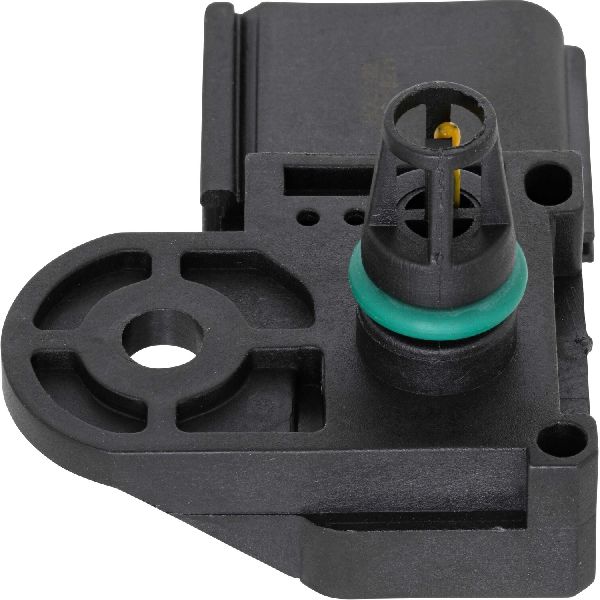
- Manifold Absolute Pressure (MAP) Sensor
(OEM #4S4Z-9F479-AA (Superseded by 1S7Z-9F479-AD))— This is the most common failure point for a P0107 code on this vehicle due to electronic failure from heat and vibration.
Trusted brands: Motorcraft (OEM), Bosch (0261230044), NTK, Spectra Premium
OEM price range: $75-$125
Aftermarket price range: $40-$80
Related Codes That Often Appear With This One
- P0106 — Indicates a MAP sensor performance/range issue, which can be a precursor to the complete circuit failure indicated by P0107.
- P0108 — Indicates the opposite of P0107 (MAP Circuit High Input). Seeing them together could point to an intermittent wiring short or a failing sensor.
Technical Service Bulletins (TSBs) & Recalls
- TSB 19-2212: Mentions DTC P0107 being caused by a faulty MAPT sensor on other Ford models, providing relevant context for potential failure patterns.
Platform-Specific Known Issues
- The extremely common failure of the passenger-side hydraulic motor mount (OEM part 5S4Z-6038-CB) is a major contributing factor to this code. The resulting excessive engine vibration can fatigue the MAP sensor's internal components or its wiring harness over time, leading to the 'Circuit Low' fault. When diagnosing P0107, it is wise to also inspect this mount for collapse or fluid leaks.
- While not specific to the Focus, a Ford Technical Service Bulletin (TSB 19-2212) for other models indicates that a faulty MAP sensor can cause a P0107 code along with a lack of power and various warning messages like 'Service AdvanceTrac' and 'Hill Start Assist Not Available'. This suggests a known pattern of MAP sensor issues in Ford vehicles of this era. [TSB 19-2212]
Mechanic-Grade Diagnostic Values
- MAP Sensor Signal Voltage (Key On, Engine Off) — expected: ~4.5 - 5.0 Volts DC (at sea level, reflects barometric pressure). Failure: A reading below 0.5V indicates a circuit low fault and will trigger P0107.
- MAP Sensor Signal Voltage (Engine at Idle) — expected: 1.0 - 1.8 Volts DC (reflects engine vacuum). Failure: Voltage remains below 0.5V or does not change from the KOEO reading.
- MAP Sensor Connector 5V Reference (Key On, Sensor Unplugged) — expected: 4.8 - 5.2 Volts DC. Failure: Voltage is near 0V, indicating an open or short in the reference circuit from the PCM.
- MAP Sensor Connector Ground Pin Resistance — expected: Less than 1.0 Ohm to chassis ground. Failure: High or infinite resistance indicates a poor or open ground circuit.
Wiring & Ground Locations
- MAP Sensor Connector — On the MAP sensor, which is mounted directly on the top of the plastic intake manifold, near the throttle body.. This is the primary point for testing. It has three pins: a 5V reference from the PCM, a ground, and the signal wire back to the PCM. Corrosion, damage, or loose pins here are a common cause of P0107.
- G104 / G105 — Main engine grounds typically located on the driver's side chassis frame rail, often underneath the air filter box assembly.. A corroded or loose main engine ground can cause a host of intermittent and difficult-to-diagnose electrical issues, including erratic sensor readings. While not a primary cause for P0107 alone, checking that this ground is clean and tight is a crucial step if multiple electrical faults are present or if voltage readings are unstable.
When the Usual Fixes Don't Work
- While a faulty MAP sensor is the most frequent cause, it is not the only one. A real-world report from a 2008 Focus owner showed that the P0107 code persisted even after replacing the MAP sensor and cleaning the throttle body. This scenario strongly indicates that the next diagnostic step must be a thorough inspection and testing of the wiring harness and connector between the sensor and the PCM, as a short to ground or an open circuit will produce the same code as a failed sensor.
OEM Part Supersession History
4S4Z-9F479-AA→1S7Z-9F479-AD— Part revision and consolidation by the manufacturer. The new part number also replaces 1S7Z-9F479-AA and 1S7Z-9F479-AC.
Heads up: No incompatibility issues are noted; 1S7Z-9F479-AD is the correct service replacement for all previous versions on this vehicle.
Diagnostic Flowchart
Other Known Issues on This Vehicle
Issues unrelated to this code that are worth knowing about as an owner of this generation:
- Passenger-Side Hydraulic Motor Mount Failure 🔴 High — Extremely common, often fails every 50,000-80,000 miles. Causes severe vibration at idle and in gear. (Ref: No specific recall, but widely documented as the #1 complaint for this generation.)
- 4F27E Automatic Transmission Problems 🔴 High — Common on higher-mileage vehicles, especially if fluid has not been maintained. Symptoms include harsh shifting, shift flares between 2nd and 3rd gear, and solenoid failures (e.g., P0751).
- Rear Quarter Panel & Rocker Panel Rust 🟠 Medium — Very common in regions that use road salt. Rust typically starts from the inside out near the wheel arches and rocker panels, leading to paint bubbling and eventual perforation.
- Frozen or Failing Door Latches 🟡 Low — A common annoyance where door latches can fail or freeze, making it difficult to open or close doors. (Ref: Referenced in general problem guides for the platform.)
Used vs. New Parts: Buying Guide for This Vehicle
When a used part is the smart pick: A used MAP sensor from a reputable auto recycler can be a cost-effective diagnostic tool. If installing a used sensor resolves the code, it confirms the original sensor was faulty. Given the low cost of aftermarket replacements, many owners may opt for a new part for long-term reliability.
Donor-vehicle mileage cap: roughly under 100000 miles for the part to have meaningful remaining life.
What to inspect on the donor part:
- Inspect the plastic housing for cracks or signs of heat damage.
- Check the electrical connector pins for corrosion, moisture, or being bent.
- Ensure the O-ring seal is present, intact, and still pliable.
OEM-only on this vehicle (don't cheap out):
- For this specific repair, no parts are considered 'OEM-only'. Quality aftermarket sensors are widely available and perform well.
Aftermarket brands forum-validated for this vehicle:
- Bosch
- NTK / NGK
- Delphi
- Standard Motor Products (SMP)
Brands owners have reported issues with on this vehicle:
- Ultra-low-cost, unbranded sensors from online marketplaces can have poor quality control and may fail prematurely or provide inaccurate readings out of the box.
Real Owner Stories
Aggregated from forums and TSBs cited above. Mileages and costs reflect what owners reported in those sources.
2008 Ford Focus 2.0L Duratec — 200000 miles
Symptoms: Check Engine Light with code P0107 remains on. Previously had a P0301 code which was fixed with new injectors, coils, plugs, and wires, but the P0107 persists even after replacing the MAP sensor.
What fixed it: The context indicates that in cases where a new sensor fails to clear the code, the cause is likely the wiring harness or connector damage due to vibration.
Source hint: Reddit r/FordFocus - P0107 Code stays on
Related OBD-II Codes
Frequently Asked Questions
Could the 'Service AdvanceTrac' or 'Hill Start Assist Not Available' messages on my Focus be related to code P0107?
Why does my 2008-2011 Focus vibrate so much at idle, and could this be causing my MAP sensor to fail?
I replaced the MAP sensor on my 2008 Focus but the P0107 code won't go away. What should I check next?
Where is the MAP sensor located on the 2.0L Duratec engine and what tools do I need?
What should the MAP sensor voltage readings be for a healthy 2010 Ford Focus?
Helpful Videos


We Have This Part in Stock


The information in this article is provided for general reference and educational purposes only. Vehicle specifications, procedures, and part compatibility can vary by production date, trim level, and region. Always consult your vehicle's factory service manual and verify part numbers before purchasing or performing repairs. Safety-critical components such as airbags, seat belts, and braking systems should be installed by a qualified professional.
- Ford Focus:
- 🎬 Helpful Videos
- 🛍️ Shop This Part
- What's Unique About the 2008-2011 Ford Focus
- Symptoms You May Notice
- Most Likely Causes
- Rare But Worth Checking
- Diagnosis Steps
- Parts You'll Likely Need
- Related Codes That Often Appear With This One
- Technical Service Bulletins (TSBs) & Recalls
- Platform-Specific Known Issues
- Mechanic-Grade Diagnostic Values
- Wiring & Ground Locations
- When the Usual Fixes Don't Work
- OEM Part Supersession History
- Diagnostic Flowchart
- Other Known Issues on This Vehicle
- Used vs. New Parts: Buying Guide for This Vehicle
- Real Owner Stories
- 2008 Ford Focus 2.0L Duratec — 200000 miles
- Related OBD-II Codes
- Frequently Asked Questions
- 🎟️ Get 5% Off