

P0032 on 2011-2017 Hyundai Accent 1.6L: Oxygen Sensor Heater Circuit High Causes & Fixes
This code almost always indicates a failed upstream oxygen sensor (Bank 1, Sensor 1). On this Accent, the sensor is very easy to access on the front of the engine. Before replacing the sensor, check the 15A 'SENSOR 1' fuse in the engine bay fuse box. A DIY replacement is straightforward and the part costs between $80 and $180.
- P0032 on a 2012-2017 Accent almost always points to a bad upstream (Bank 1, Sensor 1) oxygen sensor.
- Before buying parts, always check the 15A 'SENSOR 1' fuse in the engine bay fuse box.
- Thoroughly inspect the sensor's wiring for any heat damage or corrosion, as this can mimic a failed sensor.
- This is a very DIY-friendly repair due to the sensor's accessible location on the front of the exhaust manifold.
- Using a quality replacement sensor from a brand like Denso (P/N 234-5011) or NGK/NTK is recommended to avoid compatibility issues.
What's Unique About the 2011-2017 Hyundai Accent
On the 2012-2017 Hyundai Accent with the 1.6L GDI engine, this code is a very common and simple issue. The Bank 1, Sensor 1 oxygen sensor is conveniently located right at the front of the engine bay, screwed into the exhaust manifold, making it exceptionally easy to access and replace compared to many other vehicles. The failure is almost always the internal heater of the sensor itself due to age and heat cycles, rather than complex wiring or computer problems.
Generation note: The 2011-2017 year range covers two generations of the Accent in North America. This guide is specifically for the fourth generation (RB), sold from 2012-2017, which is equipped with the 1.6L Gamma GDI engine. The 2011 model was the third generation (MC) and used a different, non-GDI 1.6L engine (Alpha II). While the code is similar, part numbers and some specifics differ.
Symptoms You May Notice
- Check Engine Light is on
- Decreased fuel economy
- Vehicle may fail an emissions test
- Slightly rough idle or hesitation, particularly when the engine is cold
- Replacing the downstream (Bank 1, Sensor 2) oxygen sensor. This code specifically points to the upstream sensor before the catalytic converter.
- Assuming the catalytic converter is bad. This code is for the sensor's heater circuit, not the efficiency of the converter.
Most Likely Causes
- Failed Upstream Oxygen Sensor (Bank 1, Sensor 1) 🔴 High Probability The internal heater element is a common wear-and-tear item that fails after many thousands of heat cycles. This is the most frequent cause of P0032.
How to confirm: After confirming the fuse and wiring are good, test the resistance of the heater circuit pins on the sensor's connector with a multimeter. The two same-colored wires are for the heater. A healthy sensor should have a resistance between 8.1 and 11.1 Ohms at room temperature. An abnormally high or infinite resistance reading ('OL') confirms the heater element has failed.
Typical fix: Replace the upstream oxygen sensor.
Est. part cost: $80-$180 - Damaged Wiring or Corroded Connector 🟡 Medium Probability The wiring harness is exposed to high heat in the engine bay, which can lead to insulation becoming brittle, melting, or wires fraying over time. The connector itself can also be damaged by heat or road debris.
How to confirm: Visually inspect the entire wiring harness leading to the oxygen sensor for any signs of melting, burns, chafing against engine components, or corrosion inside the electrical connector.
Typical fix: Repair the damaged section of wiring or clean/replace the connector.
Est. part cost: $5-$50 - Blown Fuse for Heater Circuit ⚪ Low Probability
How to confirm: Check the fuse box in the engine compartment for a blown fuse. On the Accent, this is typically a 15A fuse labeled 'SENSOR 1' or 'SNSR'. A short in the circuit can cause this fuse to blow.
Typical fix: Replace the blown fuse. If it blows again immediately, a short circuit exists that must be found and repaired.
Est. part cost: $1-$5
Rare But Worth Checking
- Faulty Powertrain Control Module (PCM): This is very uncommon. The PCM's internal driver for the heater circuit can fail, causing a constant high voltage signal. This should only be considered after all other possibilities (sensor, wiring, fuses) have been definitively ruled out.
Diagnosis Steps
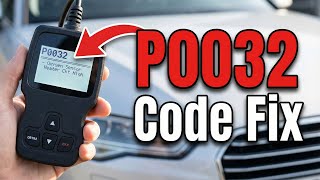
- Read the trouble codes with an OBD-II scanner to confirm P0032 is present.
- Open the hood and locate the engine bay fuse box. Inspect the 15A fuse labeled 'SENSOR 1' or 'SNSR' and replace it if blown.
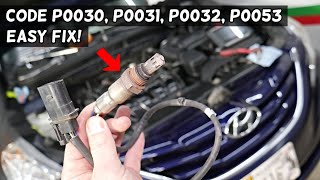
- Locate the upstream oxygen sensor (Bank 1, Sensor 1). It is screwed into the exhaust manifold at the front of the engine.
- Carefully inspect the sensor's wiring harness and electrical connector for any signs of melting, fraying, chafing, or corrosion.
- Disconnect the sensor. With the ignition key in the 'On' position (engine off), use a multimeter to verify that there is ~12V power on one pin of the harness-side connector and a good ground on another.
- Using the multimeter set to Ohms (Ω), measure the resistance between the two heater circuit pins on the sensor itself (usually the two wires of the same color). A reading between 8.1 and 11.1 Ohms is expected. A reading that is very high or 'OL' (open loop) indicates the internal heater has failed.
- If the fuse, wiring, and sensor resistance all check out, the issue may be a rare PCM fault.
Parts You'll Likely Need
- Upstream Oxygen Sensor / Air-Fuel Ratio Sensor
(OEM #39210-2B210)— This is the most common failure point for code P0032, as the internal heater element wears out over time.
Trusted brands: Denso (Aftermarket P/N: 234-5011), NGK/NTK, Bosch
OEM price range: $150-$220
Aftermarket price range: $80-$180
Technical Service Bulletins (TSBs) & Recalls
- TSB #17-ST-002: Details the procedure to replace the worn steering coupler, a common source of steering noise on this platform.
Platform-Specific Known Issues
- The Kia Rio from 2012-2017 uses the identical 1.6L GDI engine and is also prone to P0032 from a failed upstream O2 sensor.
Mechanic-Grade Diagnostic Values
- Upstream O2 Sensor Heater Circuit Voltage (at harness connector) — expected: ~12V (Battery Voltage) with key on, engine off.. Failure: A reading significantly above 12.5V suggests a short to power. A reading near 0V suggests an open circuit or blown fuse.
- Upstream O2 Sensor Heater Circuit Current Draw (Live Data) — expected: 0.5 - 1.5 Amps when active.. Failure: Very low or no current (<0.2A) indicates an open circuit (bad heater or wiring). High current (>2.0A) suggests a short circuit.
- Heater Control Signal (Live Data, Duty Cycle) — expected: The ECM uses Pulse Width Modulation (PWM) to control the heater. The duty cycle will vary based on engine temperature and load.. Failure: A duty cycle stuck at 0% or 100% when it should be modulating can indicate a PCM fault or a short/open in the control wire.
Scan Tool Commands That Help
- Hyundai GDS (Global Diagnostic System): Actuation Test > Heater (Bank 1 Sensor 1) — This command allows a technician to manually turn the O2 sensor heater on and off. By observing live data (voltage, current) while activating the heater, you can confirm if the PCM is capable of controlling the circuit and if the circuit responds as expected, helping to isolate the fault between the PCM, wiring, and the sensor itself.
Wiring & Ground Locations
- ECM Connector [EGG-K], Pin 7 — At the Engine Control Module (ECM), which is typically located in the engine bay near the battery.. This is the specific pin on the ECM that provides the heater control (ground) for the upstream oxygen sensor (Bank 1, Sensor 1). Technicians can back-probe this pin to verify if the ECM is sending the correct control signal, which is crucial for diagnosing a rare PCM failure.
- HO2S Connector, Pin 4 — On the vehicle's wiring harness connector that plugs into the upstream oxygen sensor.. This pin is the power supply for the heater circuit, fed from the main relay. Verifying battery voltage at this pin with the key on is a primary step to ensure the circuit has power and that the fuse is not blown.
- Ground Points GE301 / GE302 — Located on the left side of the engine compartment, likely on the chassis frame rail or inner fender.. These are main ground points for various engine components. While not directly for the O2 sensor heater (which is typically ground-controlled by the ECM), a poor engine-to-chassis ground can create voltage offsets and electrical noise, potentially causing incorrect readings and fault codes. Verifying clean, tight grounds is a best practice.
OEM Part Supersession History
39210-2B210→39210-2B410, 39210-2B220, 39210-2B320— Part revisions and consolidation for use across multiple models (Accent, Veloster, Rio, Soul).
Heads up: While later part numbers are generally backward-compatible, it is critical to use a part cross-reference system. Some aftermarket sensors may have slightly different heater resistance values, which can cause the P0032 code to return even with a new part. Sticking to OEM or a validated OEM equivalent like Denso or NTK is strongly recommended.
Model Year Variations Within This Range
- 2015-2017: A mid-cycle facelift was introduced for the 2015 model year, which included a new grille, updated headlights, and revised interior materials. However, there were no significant changes to the 1.6L GDI powertrain or the emissions control system, so the causes and fixes for P0032 remain identical for all 2012-2017 models.
Diagnostic Flowchart
Other Known Issues on This Vehicle
Issues unrelated to this code that are worth knowing about as an owner of this generation:
- Intake Valve Carbon Buildup 🟠 Medium — A common issue for all Gasoline Direct Injection (GDI) engines. Becomes noticeable after 60,000-100,000 miles, causing rough idle, hesitation, or misfires.
- Steering Coupler Wear 🟡 Low — A very common issue where the flexible rubber coupler in the steering column wears out, causing a clicking or ticking noise when turning the steering wheel. It is a nuisance but not a safety issue. (Ref: TSB #17-ST-002 (and others) / Warranty Extension TXX7)
- Timing Chain Stretch / Tensioner Wear 🔴 High — Less common than other issues but can occur on higher mileage (100,000+ miles) engines. Symptoms include a rattling noise on cold starts. If ignored, it can lead to catastrophic engine failure.
- Ignition Coil Failure 🟠 Medium — Can fail over time, leading to engine misfires, rough running, and a flashing Check Engine Light.
Used vs. New Parts: Buying Guide for This Vehicle
When a used part is the smart pick: For this specific repair, using a used part is almost never a smart choice. However, if the wiring pigtail/connector on the vehicle's harness is damaged, sourcing a used pigtail from a junkyard vehicle is a viable and cost-effective repair method compared to replacing a larger section of the engine harness.
Donor-vehicle mileage cap: roughly under 50000 miles for the part to have meaningful remaining life.
What to inspect on the donor part:
- For a wiring pigtail, inspect for at least 6-8 inches of clean, flexible wire.
- Ensure the connector's locking tab is intact and not brittle.
- Check for any signs of corrosion, melting, or previous repair on the connector pins or wires.
OEM-only on this vehicle (don't cheap out):
- Oxygen Sensor: While not strictly 'OEM-only', using a known high-quality OEM supplier (Denso, NTK/NGK) is critical. Cheap, unbranded aftermarket sensors are notorious for having incorrect heater resistance, causing the code to return immediately.
Aftermarket brands forum-validated for this vehicle:
- Denso (often the original equipment manufacturer)
- NGK / NTK
Brands owners have reported issues with on this vehicle:
- Unbranded, no-name sensors from online marketplaces are frequently cited in forums as being problematic and a common cause of repeat failures.
Real Owner Stories
Aggregated from forums and TSBs cited above. Mileages and costs reflect what owners reported in those sources.
2013 Hyundai Accent 1.6L GDI — 110000 miles
Symptoms: Intermittent check engine light with code P0032, occurs every summer and turns off within a few days.
What fixed it: The issue was not resolved; mechanics were unable to address the issue, but the light turns off on its own after a few days.
Source hint: r/whatcarshouldIbuy
2014 Kia Rio 1.6L GDI
Symptoms: Multiple O2 sensor heater circuit codes including P0030, P0031, P0036, and P0037.
What fixed it: Replacing both the upstream and downstream oxygen sensors.
Source hint: Kia-Forums.com - P0030, P0031, P0036, P0037 on 2014 Kia Rio
2012 Hyundai Accent 1.6L GDI — 165000 miles
Symptoms: Visible slack in the timing chain observed while performing a valve cover gasket replacement.
What fixed it: This report highlights timing chain wear as a high-mileage concern for this engine platform, though not a direct fix for P0032.
Source hint: Reddit r/MechanicAdvice - 2012 Hyundai Accent Timing Chain Slack
Related OBD-II Codes
Frequently Asked Questions
Does TSB #17-ST-002 relate to my P0032 engine code on my 2013 Hyundai Accent?
Which fuse should I check for a P0032 code on my 2011-2017 Accent?
Can I use any aftermarket oxygen sensor to fix this issue?
Is the P0032 code common on other vehicles similar to the Accent?
What resistance should I see when testing the upstream O2 sensor on my 1.6L Gamma engine?
Could my P0032 code be caused by the common GDI carbon buildup issue?
Helpful Videos
We Have This Part in Stock



The information in this article is provided for general reference and educational purposes only. Vehicle specifications, procedures, and part compatibility can vary by production date, trim level, and region. Always consult your vehicle's factory service manual and verify part numbers before purchasing or performing repairs. Safety-critical components such as airbags, seat belts, and braking systems should be installed by a qualified professional.
- Hyundai Accent:
- 🎬 Helpful Videos
- 🛍️ Shop This Part
- What's Unique About the 2011-2017 Hyundai Accent
- Symptoms You May Notice
- Most Likely Causes
- Rare But Worth Checking
- Diagnosis Steps
- Parts You'll Likely Need
- Technical Service Bulletins (TSBs) & Recalls
- Platform-Specific Known Issues
- Mechanic-Grade Diagnostic Values
- Scan Tool Commands That Help
- Wiring & Ground Locations
- OEM Part Supersession History
- Model Year Variations Within This Range
- Diagnostic Flowchart
- Other Known Issues on This Vehicle
- Used vs. New Parts: Buying Guide for This Vehicle
- Real Owner Stories
- 2013 Hyundai Accent 1.6L GDI — 110000 miles
- 2014 Kia Rio 1.6L GDI
- 2012 Hyundai Accent 1.6L GDI — 165000 miles
- Related OBD-II Codes
- Frequently Asked Questions
- 🎟️ Get 5% Off