

OBD-II Code P0030: HO2S Heater Control Circuit Malfunction
The Ultimate Guide to Diagnosing and Fixing P0030
- Code P0030 indicates an electrical failure in the heater circuit of the Bank 1, Sensor 1 upstream oxygen sensor.
- Replacing the Bank 1, Sensor 1 oxygen sensor resolves this code in over 80% of cases, costing between $150 and $400 at a shop.
- Inspect the dedicated O2 sensor heater fuse and the wiring harness for melted insulation before buying any replacement parts.
- An active P0030 code immediately fails state emissions tests and drops fuel economy by 5 to 10 percent.
- Driving with a failed O2 sensor heater for more than 6 months forces a rich fuel mixture that destroys the catalytic converter, turning a $200 repair into a $2,000 replacement.
What Does P0030 Mean?

Your car's Engine Control Module (ECM) detected an electrical fault within the heater circuit of the Bank 1, Sensor 1 oxygen sensor. This sensor must reach 600°F to accurately measure exhaust oxygen content. A built-in heater brings the sensor to operating temperature quickly after a cold start, allowing the engine to adjust the fuel mixture efficiently and enter 'closed-loop' mode.
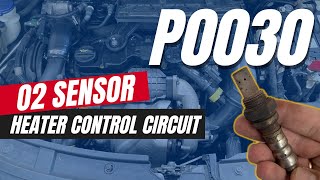
Technical definition: HO2S (Heated Oxygen Sensor) Heater Control Circuit Malfunction (Bank 1, Sensor 1). This generic OBD-II code signifies the ECM detected an open circuit, a short to ground, a short to power, or abnormally high resistance in the upstream oxygen sensor's heater circuit 🎬 Watch: How to test the O2 sensor heater circuit on the engine's first bank.
Can I Drive With P0030?

Yes, But With Caution. You can drive, but prolonged driving is not recommended. Your vehicle will experience increased emissions and reduced fuel economy. Driving for hundreds of miles with a faulty sensor heater forces an improper air-fuel mixture, which eventually destroys the catalytic converter—an $800 to $2500 repair. Address the issue immediately to prevent expensive secondary damage.
Common Causes

- Failed Oxygen Sensor Heater Element (Very Common) — The internal heating element is the most frequent failure point. 🎬 Watch: A quick 2-minute fix for Chevrolet P0030 codes This resistor burns out or breaks over time from constant heat cycling, similar to an old light bulb filament.
- Blown Fuse or Faulty Relay (Common) — The heater circuit relies on a dedicated fuse and relay. A short in the wiring or sensor blows the fuse, instantly cutting power to the heater.
- Damaged Wiring or Connectors (Common) — The wiring harness endures extreme exhaust heat, road debris, and moisture. Melted insulation, frayed wires, and corroded connector pins disrupt the circuit.
- Exhaust Leak Near the Sensor (Less Common) — A cracked exhaust manifold or bad gasket introduces outside air into the exhaust stream. This alters sensor readings and occasionally triggers a heater circuit code.
- Use of Incorrect/Low-Quality Aftermarket Sensor (Less Common) — Cheap 'universal' sensors requiring wire splicing have incorrect resistance values. This triggers the P0030 code immediately or causes premature failure.
- Poor Engine or Chassis Ground Connection (Rare) — A corroded main engine ground strap creates widespread electrical problems. Unstable voltage and ground references trigger a P0030 code alongside other electrical faults.
- Outdated ECM Software (Rare) — Automakers release software updates (TSBs) to adjust fault code sensitivity. An update is sometimes required to prevent a false P0030 trigger.
- Faulty Engine Control Module (ECM) (Very Rare) — The internal ECM driver circuit supplying power or ground to the sensor fails. Consider this last-resort diagnosis only after eliminating every other possibility.
Symptoms
- Check Engine Light On — The Malfunction Indicator Lamp (MIL) illuminates and remains on while the fault is active.
- Decreased Fuel Economy — Without the heater, the engine stays in 'open-loop' mode longer, running a rich fuel mixture. This drops MPG by 5 to 10 percent.
- Failed Emissions Test — An active P0030 code and illuminated Check Engine Light trigger an automatic failure for state-mandated emissions inspections.
- Rough Idle on Cold Starts — Before the exhaust naturally heats the sensor, the engine idles erratically or stumbles due to an incorrect air-fuel mixture.
- Delayed Engine Performance — The vehicle feels sluggish for the first 3 to 5 minutes of driving until the O2 sensor gets hot enough to provide accurate ECM readings.
Diagnostic Flowchart

Tap your situation to follow the diagnostic path that matches what you're seeing on this code.
Common Fixes & Costs
- Replace Bank 1, Sensor 1 Oxygen Sensor — Parts: $50-$250, Labor: $100-$200, ~0.8 hr book time (DIY)
- Replace Blown Heater Circuit Fuse — Parts: $1-$5, Labor: $0-$60, ~0.1 hr book time (Beginner)
- Repair Damaged Wiring or Replace Connector Pigtail — Parts: $15-$40, Labor: $150-$300, ~1.5 hr book time (Intermediate)
- Repair Exhaust Leak — Parts: $10-$150, Labor: $150-$400, ~2.5 hr book time (Intermediate)
- Replace Engine Control Module (ECM) — Parts: $600-$1200, Labor: $200-$300, ~1.5 hr book time (Professional)
Used vs. New Parts: Buying Guide
When a used part is worth it: Almost never. An oxygen sensor is a wear-and-tear component with a finite lifespan, similar to a spark plug. The labor to install the part is often more than the part itself, making it risky to install a used sensor with an unknown history.
Donor-vehicle mileage cap: roughly under 20000 miles for the part to have meaningful remaining life.
Donor quality checklist:
- Only consider a used sensor if it comes from a very low-mileage vehicle that was wrecked.
- Never buy a used 'universal' sensor that has had its wires cut and spliced.
- Visually inspect for physical damage, but be aware that internal heater failure is not visible.
Decision logic:
- If The cost of a new, quality aftermarket sensor (e.g., Denso, NTK, Bosch) is under $150. → Always buy new. The risk of premature failure and paying for labor twice is not worth the small savings of a used part.
- If The vehicle is very old and the budget is extremely tight. → A used sensor from a reputable salvage yard with a short-term warranty is a last resort, but understand it fails quickly.
- If The part is an integrated Air/Fuel Ratio sensor on a high-end vehicle and costs over $300 new. → A used OEM part from a low-mileage donor is an option, but a new aftermarket direct-fit remains the recommended path.
Warranty tradeoff: Used parts typically have a 30-day warranty at best. New aftermarket parts carry a 1-year or longer warranty. The peace of mind and protection against repeat labor costs heavily favor buying new.
Worst-case if a used part fails: $150-$300 if a used sensor fails after installation, requiring a second part purchase and repeat labor charges.
What Happens If You Wait — Timeline
- 0-2 weeks: Code P0030 is set and the Check Engine Light is on. The engine runs in open-loop for longer on cold starts, but there are no other noticeable symptoms. (MPG impact: 0-5%% · Added cost: $0-15 in wasted fuel)
- 2 weeks - 3 months: A noticeable drop in fuel economy (5-10%) occurs. The vehicle has a rough or stumbling idle for the first few minutes after a cold start. (MPG impact: 5-10%% · Added cost: $20-80 in wasted fuel)
- 3-8 months: The persistent rich fuel mixture begins to overheat the catalytic converter. The converter's internal ceramic substrate starts to melt, leading to reduced efficiency and the potential for a P0420 code to appear. (MPG impact: 10-15%% · Added cost: Damage to the catalytic converter is beginning. Replacement cost is imminent.)
- 8+ months: The catalytic converter is severely damaged or melted, causing a significant exhaust restriction. The vehicle experiences a major loss of power, a dramatic drop in fuel economy, and a solid P0420 code. The converter must be replaced. (MPG impact: 15-25%+% · Added cost: $1000-3000 to replace the catalytic converter, plus the cost of the original O2 sensor repair.)
Cost of Not Fixing It
- 0-1 month: Reduced fuel economy by 5-15% and noticeably sluggish performance during the first 5 minutes of driving. (Added cost: $20-$60 in wasted fuel per month, depending on mileage.)
- 1-6 months: The engine running a default rich fuel mixture begins to overheat the catalytic converter. You smell rotten eggs from the exhaust. (Added cost: Negligible, but permanent damage is accumulating.)
- 6+ months: Sustained overheating destroys the internal structure of the catalytic converter, causing a blockage. The vehicle experiences a severe loss of power and triggers a P0420 code. (Added cost: $1000-$3000 to replace the catalytic converter, in addition to the original P0030 repair.)
Diagnosis Steps
- Scan for Codes and Review Freeze Frame Data
Use an OBD-II scanner to confirm P0030 and check for related codes. Review freeze-frame data to identify engine conditions when the fault triggered. Clear the code and test drive to see if it returns.
Tools: OBD-II Scanner (Beginner) - Inspect the Heater Circuit Fuse and Relay
Consult your owner's manual to locate the oxygen sensor heater fuse (e.g., 'A/F HTR'). Visually inspect it. If blown, replace it, but investigate the wiring or sensor for the short circuit that caused the failure.
Tools: Owner's Manual, Fuse Puller (Beginner) - Visually Inspect the Sensor, Connector, and Wiring
Locate Bank 1, Sensor 1 upstream of the catalytic converter. Inspect the wiring harness for melting, chafing, or breakage. Check the electrical connector for corrosion, moisture, or bent pins.
Tools: Flashlight, Safety Glasses, Inspection Mirror (Beginner) - Test Heater Circuit Power Supply
Disconnect the O2 sensor and turn the ignition to 'ON' (engine off). Use a multimeter to test for battery voltage (12V+) at the power supply pin on the harness connector. Zero voltage indicates a blown fuse, bad relay, or broken wire.
Tools: Multimeter, Vehicle Wiring Diagram (Intermediate) - Test Heater Element Resistance
With the sensor disconnected, set a multimeter to measure resistance (Ω). Probe the two heater circuit pins on the sensor. A healthy sensor reads between 2 and 30 ohms. An 'OL' (infinite) reading confirms a broken heater element requiring sensor replacement.
Tools: Multimeter, Service Manual (Intermediate) - Test Heater Circuit Current Draw
Clamp an ammeter around the heater power wire and start the engine. A healthy circuit draws 0.5 to 1.5 amps. Zero amps indicates an open circuit, while readings over 5 amps indicate a short.
Tools: Clamp-on Ammeter (DC capable) (Advanced) - Analyze Live Data PIDs
Monitor the 'O2 Heater' PID with an advanced scan tool. The ECM uses a pulse-width modulated (PWM) duty cycle to control the heater. A cold start shows a high percentage that decreases as the sensor warms. A constant 0% or 100% confirms a control circuit fault.
Tools: Advanced OBD-II Scanner (Advanced) - Test the Heater Control Circuit (Ground Side)
The ECM controls the heater by switching the ground circuit. With the sensor disconnected and key on, check for voltage on the ground wire at the harness connector. Check for continuity to ground with the key off; a constant ground indicates a harness short.
Tools: Multimeter, Vehicle Wiring Diagram (Advanced) - Check for Voltage Drop on Power and Ground
Back-probe the power and ground wires at the connected sensor with the engine running. Measure between the ground wire and negative battery terminal (should be <0.2V). Measure between the power wire and positive battery terminal (should be <0.5V). Higher readings indicate excessive resistance.
Tools: Multimeter with Back-Probes (Advanced) - Check for Exhaust Leaks
Start the cold engine and listen for hissing or ticking near the exhaust manifold. Locate leaks using a mechanic's stethoscope, as outside air alters sensor readings.
Tools: Safety Glasses, Mechanic's Stethoscope (optional) (Intermediate)
When This Code Triggers (Freeze-Frame Conditions)
- Engine Coolant Temp: Below 122°F (50°C) (During a cold start, as this is when the heater is most critical.)
- Time After Start: 10-60 seconds (The ECM runs the heater circuit test shortly after the engine starts.)
- RPM: 600-800 (Often triggers at idle shortly after startup.)
- Battery Voltage: 11-14.5V (The ECM monitors system voltage to ensure it's sufficient to run the test.)
Related Codes
- P0031 — Indicates Heater Circuit Low. The ECM detected a short to ground in the circuit, causing excessive current draw.
- P0032 — Indicates Heater Circuit High. The ECM detected either a short to power or a complete open in the circuit (infinite resistance).
- P0135 — An alternative but identical code for O2 Sensor Heater Circuit Malfunction (Bank 1, Sensor 1). The meaning, diagnosis, and repair are exactly the same.
- P0050 — The identical fault code but for Bank 2, Sensor 1. This applies to V6, V8, or boxer engines and points to the upstream sensor on the opposite cylinder bank.
Climate & Environmental Factors
- Cold Climates: The heater element works harder and longer on cold starts to reach 600°F. Increased thermal cycling accelerates aging and causes premature heater failure.
- High Humidity / Road Salt: Moisture and road salt penetrate the sensor's connector and wiring harness. This causes corroded pins, high resistance, and short circuits.
- High Altitude: Lower air density affects overall O2 sensor readings. While it rarely triggers P0030 directly, it causes fuel trim codes if the system fails to compensate.
How to Talk to a Mechanic About This Code
Say this: "I have an OBD-II code P0030 for the Bank 1 Sensor 1 heater circuit. Before replacing the sensor, I'd like you to perform a diagnostic to confirm the cause. Please test the heater circuit fuse, check for 12V power and good ground at the connector, and measure the resistance of the sensor's heater element."
This signals you've done research and understand that the fault is often a cheap fuse or wiring issue, not just the sensor itself. It directs the technician to perform a proper electrical diagnosis instead of immediately replacing the most expensive part of the circuit.
Avoid saying:
- 'My check engine light is on, can you look at it?' (This is too vague and invites a broad, expensive diagnostic process)
- 'Just replace the O2 sensor.' (This assumes the sensor is the problem and skips crucial, cheaper diagnostic steps)
- 'My car is running weird, just fix whatever is wrong.' (This gives the shop a blank check to replace parts without your approval)
Questions to ask before authorizing the repair:
- Did you test the heater circuit fuse? Was it good?
- What was the resistance reading on the sensor's heater element? Was it within the specified range for my vehicle?
- Did you confirm there is 12-volt power and a good ground signal at the sensor's electrical connector?
- Is the wiring harness between the computer and the sensor free of damage?
- What is your warranty on this specific repair, including both parts and labor?
Where to Take It: Dealer vs Independent vs Chain
- Dealer:
Best for: Vehicles still under a powertrain or emissions warranty., Complex electrical issues on newer or German vehicles where manufacturer-specific software is required., When a Technical Service Bulletin (TSB) has been issued for the P0030 code on your specific model.
Downsides: Significantly higher labor rates (30-60% more) and parts costs compared to independent shops., More inclined to replace an entire assembly rather than performing a simpler wiring repair. (Typical cost: +50% vs. baseline) - Independent Shop:
Best fit. P0030 is a routine electrical fault that any competent independent shop diagnoses and repairs effectively, often at a much lower cost than a dealership.
Best for: Out-of-warranty vehicles where cost is a primary concern., Common, well-understood codes like P0030 that don't require proprietary dealer tools., Building a long-term relationship with a trusted mechanic.
Downsides: Quality and diagnostic skill vary widely; it's crucial to vet the shop through reviews and ASE certifications., Lacks the very latest diagnostic software for brand-new models. (Typical cost: +0% vs. baseline) - Chain Shop:
Acceptable, with caution. A budget-friendly option if you have already diagnosed a bad sensor and just need it replaced. AVOID for initial diagnosis, as they rarely test the full circuit.
Best for: Simple, routine maintenance like oil changes or tire rotations.
Downsides: Technician skill varies dramatically; lacks the experience for proper electrical diagnostics beyond reading the code., High pressure to upsell services and parts, pushing for a sensor replacement without proper diagnosis. (Typical cost: -10% vs. baseline)
When to Walk Away From the Repair
If the estimated repair cost exceeds 40-50% of the car's private-party value (e.g., from Kelley Blue Book), seriously consider selling or trading in the vehicle instead of repairing it.
- Car worth $2000, fix is $400: Fix it. The repair cost is only 20% of the car's value and is a manageable expense.
- Car worth $3500, fix is $1800: Walk away. The repair cost is over 50% of the car's value. This repair involves replacing the catalytic converter and the O2 sensor. It is not financially sensible.
- Car worth $15000, fix is $450: Fix it. The repair is a small fraction of the vehicle's value and is necessary for proper operation and emissions compliance.
What Scan Tool You Need for This Code

Minimum: A tool that reads/clears codes, and more importantly, displays live data PIDs (Parameter IDs) for the O2 sensor heater circuit and voltage.
A basic $20 code reader only tells you the P0030 code exists. It cannot show you the live data, such as the heater duty cycle or sensor voltage, which is crucial for confirming if the circuit is actually being commanded on by the ECM and if the sensor is responding.
Budget: BlueDriver Pro Scan Tool (~$100) — Connects to your smartphone via Bluetooth. It reads and clears the P0030 code, views freeze-frame data, and displays essential live data, including O2 sensor voltages and heater status, allowing you to see if the circuit works in real-time.
Mid-range: Foxwell NT510 Elite (~$180) — A handheld scanner that offers brand-specific software. In addition to live data graphing, it provides bi-directional control, allowing you to command the O2 heater circuit on/off to test its function directly, providing a much more confident diagnosis.
Professional: Autel MaxiCOM MK808 / MK906BT (~$500-1200) — Offers full-system diagnostics and advanced bi-directional controls similar to dealer-level tools. It provides fast, detailed live data graphing and performs system-wide tests to quickly rule out or confirm an ECM driver issue.
How to Clear the Code After You Fix It
- Use an OBD-II scan tool to clear the P0030 code. Disconnecting the battery resets all vehicle memory and readiness monitors.
- Perform a complete drive cycle to allow the O2 sensor and catalyst readiness monitors to run and complete.
Drive cycle (~20 minutes): Start the engine from cold (coolant temp below 122°F) and let it idle for 2-3 minutes with electrical loads on (A/C, defroster). Turn loads off and drive at a steady 55 mph for 3-5 minutes. Decelerate without using the brake to 20 mph, then accelerate back to 55 mph. Hold steady for another 5 minutes. This combination of idling, steady cruising, and acceleration/deceleration runs the necessary readiness monitors.
Readiness monitors affected: O2 Sensor Heater Monitor, O2 Sensor Monitor, Catalyst Monitor
Before emissions retest: drive at least 50 miles to fully set monitors.
Watch out for:
- Clearing the code with a scanner resets all readiness monitors to 'Not Ready'. You cannot pass an emissions test until they complete.
- The code returns immediately if the underlying issue (bad sensor, wiring short, blown fuse) was not properly fixed.
- Simply driving on the highway is not enough; a varied drive cycle with different speeds and loads is required to set all monitors.
Will This Fail Emissions / State Inspection?
Yes — this code typically fails an OBD-II emissions inspection.
- California: An active check engine light is an automatic failure. After repair, a specific drive cycle must be completed to set all readiness monitors to 'Ready' before a re-test is possible.
- New York: The NYS DMV vehicle inspection includes an OBD-II scan. An illuminated MIL (Check Engine Light) for P0030 results in an immediate inspection failure.
- Texas: In the 17 counties requiring emissions testing, an active P0030 code causes the vehicle to fail the OBD-II portion of the state inspection.
Most Commonly Affected Vehicles
- Subaru Forester, Impreza, Legacy, Outback (2005-2014) — Extremely common issue, almost always resolved by replacing the front oxygen (Air/Fuel Ratio) sensor. Using a direct-fit Denso or NTK sensor is highly recommended over generic brands.
- Ford F-150, Explorer, Mustang (2004-2010) — Often caused by sensor failure or wiring harness damage near the exhaust manifold. On Ford trucks, Bank 1 is the passenger side.
- Chevrolet / GMC Silverado, Sierra, Tahoe, Suburban (2003-2013) — Aged sensors are the primary cause, but wiring damage is also frequent. On these GM V8 engines, Bank 1 is the driver's side.
- Toyota Camry, Tacoma, 4Runner, RAV4 (2002-2011) — Heater elements fail at high mileage. The circuit is protected by a dedicated 'A/F Heater' fuse and relay in the engine bay fuse box that must be checked first.
- Hyundai Elantra, Sonata, Tucson (2007-2015) — This code typically points directly to a failed sensor heater. OEM or equivalent quality sensors are required for reliable performance.
- Kia Optima, Sorento, Forte, Soul, Rio (2010-2020) — Many owners report that cheap aftermarket sensors do not work correctly. Using an OEM sensor ensures the code does not return.
- Volkswagen Jetta, Golf, GTI, Passat (2006-2016) — Diagnosis must include a thorough check of the wiring and fuse before condemning the sensor, as electrical issues are highly common on these models.
- Honda Civic, Accord, CR-V (2005-2022) — Sensor failure is the most common cause. Newer models (2018-2022 Civic) have a known issue with water intrusion causing connector corrosion, covered under TSB 21-017.
Manufacturer-Specific Notes
- Ford: On Ford V6 and V8 engines, Bank 1 is the cylinder bank on the passenger's side of the vehicle.
- General Motors (Chevy/GMC/Cadillac): On GM V6 and V8 engines, Bank 1 is the cylinder bank on the driver's side of the vehicle.
- Dodge / Chrysler / Jeep: Similar to GM, Bank 1 is typically on the driver's side for V-style engines.
- Honda / Acura: For transverse (sideways) mounted V6 engines, Bank 1 is the bank closer to the firewall (rear of the vehicle). For 2018-2022 Civics, check TSB 21-017 regarding water intrusion into the front A/F sensor connector.
Real Owner Stories
2010 Subaru Forester with P0030 & P0134
Check engine light on, engine running rough, and a rich exhaust smell.
Outcome: Forum consensus pointed to a classic failure of the front Air/Fuel (A/F) sensor, which is extremely common on this model. Replacing the sensor resolved the issue.
Lesson: On many Subarus of this era, P0030 is almost synonymous with a failed front A/F sensor. Start by inspecting and replacing this specific part.
2003 Subaru Impreza with persistent P0030
Previous owner cut out the catalytic converters and O2 sensors. After replacing the sensors and cats, the P0030 code remained.
Outcome: The issue was not the new sensor but a problem in the wiring circuit leading to it. The diagnosis shifted to checking for power and ground at the connector.
Lesson: If a new sensor doesn't fix the code, the problem is in the circuit itself. Always test for 12V power and ground at the sensor connector before assuming the new part is bad.
2004 Subaru Legacy with intermittent rough running when warm
Car ran poorly only after reaching operating temperature, with an intermittent P0030 code.
Outcome: The heater element failure causes erratic sensor readings even when warm. The recommended fix was to replace the Bank 1, Sensor 1 O2 sensor.
Lesson: Don't be thrown off by symptoms that appear when the engine is warm. The P0030 code points to an electrical fault within the heater circuit, and replacing the sensor is the most direct solution.
How to Prevent This Code From Triggering
- Use Top-Tier certified gasoline (Every fill-up) — Top-Tier gas contains a higher concentration of detergent additives that prevent carbon deposit buildup on fuel injectors and valves. This ensures more complete combustion, reducing the contaminants that foul the O2 sensor and overload the catalytic converter.
- Replace upstream O2 sensors as a maintenance item (Every 100,000 miles) — O2 sensors are wear items. As they age, their response time slows, leading to a less efficient air-fuel mixture, which reduces fuel economy and strains the catalytic converter even before a code is set.
- Address engine oil leaks promptly (As needed) — Oil leaking onto the exhaust or being consumed by the engine contaminates the oxygen sensor, leading to premature failure. Fixing leaks prevents this contamination.
- Perform regular visual inspections of wiring (During oil changes) — Periodically checking the O2 sensor wiring harness for contact with hot exhaust pipes or road debris helps you catch potential damage before a wire melts or breaks, preventing an open or short circuit.
Frequently Asked Questions
What's the most common mistake when fixing P0030?
The biggest mistake is immediately replacing the oxygen sensor without first checking the fuse and inspecting the wiring. A 50-cent fuse is often the culprit. Always confirm you have correctly identified Bank 1 vs. Bank 2 and Sensor 1 (upstream) vs. Sensor 2 (downstream).
Should I use a cheap universal O2 sensor or a direct-fit OEM-style sensor?
Always choose a direct-fit, OEM-quality sensor from brands like Denso, Bosch, or NTK. Universal sensors require splicing wires, creating a common failure point. They also have slightly different resistance values, causing the P0030 code to return immediately.
What does 'Bank 1, Sensor 1' mean?
'Bank 1' refers to the side of the engine containing cylinder #1. 'Sensor 1' is the upstream oxygen sensor located in the exhaust system before the catalytic converter. Inline engines only have one bank.
Can I clean the oxygen sensor to fix P0030?
No. Code P0030 indicates an electrical failure within the sensor's internal heater circuit. Cleaning the sensor's exterior does not repair a broken internal resistor.
Can a bad battery cause a P0030 code?
A weak battery causes numerous electrical issues, but it rarely triggers a direct P0030 code. The code sets when the ECM detects an open or short in the heater circuit itself. However, system voltage below 10.5V during operation contributes to false readings.
What is the fastest way to fix P0030?
Use an OBD-II scanner to confirm the code, then immediately check the O2 sensor heater fuse. If the fuse is intact, test the resistance of the heater element in the sensor itself. If it falls outside the 2-30 ohm specification, replace the sensor.
Will my car pass an emissions test with this code active?
No. An active P0030 code causes an automatic failure of any emissions or smog test. The Check Engine Light remains illuminated, and the oxygen sensor heater readiness monitor cannot complete.
Key Takeaways
- Code P0030 indicates an electrical failure in the heater circuit of the Bank 1, Sensor 1 upstream oxygen sensor.
- Replacing the Bank 1, Sensor 1 oxygen sensor resolves this code in over 80% of cases, costing between $150 and $400 at a shop.
- Inspect the dedicated O2 sensor heater fuse and the wiring harness for melted insulation before buying any replacement parts.
- An active P0030 code immediately fails state emissions tests and drops fuel economy by 5 to 10 percent.
- Driving with a failed O2 sensor heater for more than 6 months forces a rich fuel mixture that destroys the catalytic converter, turning a $200 repair into a $2,000 replacement.
Helpful Videos

![How to Fix CHEVROLET P0030 Engine Code in 2 Minutes [1 DIY Method / Only $19.55]](https://img.youtube.com/vi/rFhuz9DoPfk/mqdefault.jpg)

The information in this article is provided for general reference and educational purposes only. Vehicle specifications, procedures, and part compatibility can vary by production date, trim level, and region. Always consult your vehicle's factory service manual and verify part numbers before purchasing or performing repairs. Safety-critical components such as airbags, seat belts, and braking systems should be installed by a qualified professional.
- 🎬 Helpful Videos
- What Does P0030 Mean?
- Can I Drive With P0030?
- Common Causes
- Symptoms
- Diagnostic Flowchart
- Common Fixes & Costs
- Used vs. New Parts: Buying Guide
- What Happens If You Wait — Timeline
- Cost of Not Fixing It
- Diagnosis Steps
- When This Code Triggers (Freeze-Frame Conditions)
- Related Codes
- Climate & Environmental Factors
- How to Talk to a Mechanic About This Code
- Where to Take It: Dealer vs Independent vs Chain
- When to Walk Away From the Repair
- What Scan Tool You Need for This Code
- How to Clear the Code After You Fix It
- Will This Fail Emissions / State Inspection?
- Most Commonly Affected Vehicles
- Manufacturer-Specific Notes
- Real Owner Stories
- 2010 Subaru Forester with P0030 & P0134
- 2003 Subaru Impreza with persistent P0030
- 2004 Subaru Legacy with intermittent rough running when warm
- How to Prevent This Code From Triggering
- Frequently Asked Questions
- What's the most common mistake when fixing P0030?
- Should I use a cheap universal O2 sensor or a direct-fit OEM-style sensor?
- What does 'Bank 1, Sensor 1' mean?
- Can I clean the oxygen sensor to fix P0030?
- Can a bad battery cause a P0030 code?
- What is the fastest way to fix P0030?
- Will my car pass an emissions test with this code active?
- Key Takeaways
- 🎟️ Get 5% Off