

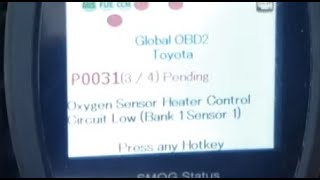
OBD-II Code P0031: Oxygen Sensor Heater Control Circuit Low
What P0031 means, why it triggers, and how to fix it for good
- Code P0031 indicates low voltage in the Bank 1 upstream oxygen sensor heater circuit, which drops fuel economy by up to 10%.
- Always check the 15A or 20A A/F heater fuse and inspect the wiring harness for melted spots before buying a $150 replacement sensor.
- Driving with P0031 for more than a few months forces the engine to run rich, risking a $1,500+ catalytic converter meltdown.
- If P0031 appears alongside P0051, do not replace the sensors; the fault is a shared blown fuse or faulty relay.
What Does P0031 Mean?

The Powertrain Control Module (PCM) detected a voltage or current drop in the heater circuit of the upstream oxygen sensor on engine Bank 1. This sensor must reach 600°F to accurately measure exhaust gases. When the heater fails, the engine stays in a fuel-wasting 'open-loop' mode longer during cold starts.
Technical definition: SAE/OBD-II defines P0031 as "HO2S Heater Control Circuit Low (Bank 1 Sensor 1)". The PCM uses a pulse-width modulated (PWM) signal to power the heater. The code triggers when the circuit current drops below a specific threshold (typically 0.8 amps), indicating an open circuit, a short to ground, or high resistance.
Can I Drive With P0031?
Yes, But With Caution. You can drive, but do not ignore it. Your car uses up to 10% more gas and runs rough when cold. Ignoring it for months destroys the catalytic converter, a repair costing $800 to $2,500. Fix the issue within 200 miles.
Common Causes

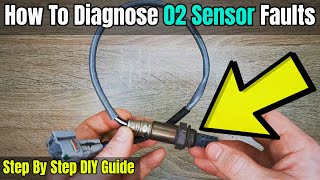
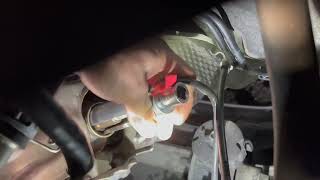
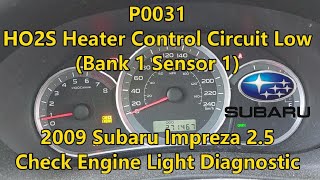
- Blown Fuse or Faulty Relay (Very Common) — A blown A/F HEATER or O2 HTR fuse cuts power to the circuit. Always check this first before buying parts. 🎬 Watch this breakdown of the three most common P0031 fixes.
- Faulty Bank 1, Sensor 1 Oxygen Sensor (Very Common) — The internal heater element inside the oxygen sensor burns out 🎬 See how to replace a faulty sensor in under five minutes. over time, creating an open circuit.
- Damaged Wiring or Connectors (Common) — Wiring near the hot exhaust manifold melts, frays, or corrodes, causing a short to ground or an open circuit.
- Poor Ground Connection (Less Common) — A corroded engine or chassis ground strap adds resistance, dropping circuit voltage below the PCM's required threshold.
- Contaminated Oxygen Sensor (Less Common) — Internal engine fluid leaks, such as oil or coolant burning in the exhaust, destroy the sensor's internal components.
- Faulty Powertrain Control Module (PCM) (Rare) — The PCM's internal heater driver fails. Rule out all electrical issues before replacing the computer.
Symptoms
- Check Engine Light is On — The light illuminates immediately and stays on as long as the electrical fault is present.
- Worse Gas Mileage — The engine stays in 'open-loop' mode longer, running a rich air-fuel mixture that drops fuel economy by 5-10%.
- Rough Idle on Cold Starts — The engine idles unevenly or hesitates when first started because the computer guesses the fuel mixture until the exhaust naturally heats the sensor.
- Failed Emissions Test — The oxygen sensor heater monitor will not set to 'Ready', resulting in an automatic emissions test failure.
Diagnostic Flowchart

Tap your situation to follow the diagnostic path that matches what you're seeing on this code.
Common Fixes & Costs

- Replace Blown Fuse — Parts: $1-$10, Labor: $20-$50, ~0.3 hr book time (DIY)
- Replace Bank 1, Sensor 1 Oxygen Sensor — Parts: $50-$200, Labor: $100-$200, ~1.0 hr book time (DIY)
- Repair Damaged Wiring — Parts: $20-$60, Labor: $100-$250, ~1.5 hr book time (Intermediate)
- Clean Ground Connection — Parts: $0-$10, Labor: $50-$100, ~0.8 hr book time (DIY)
Used vs. New Parts: Buying Guide
When a used part is worth it: Never buy a used oxygen sensor. The internal heater element is a wear item with a finite lifespan.
Donor-vehicle mileage cap: roughly under 20000 miles for the part to have meaningful remaining life.
Donor quality checklist:
- Must be from a low-mileage wrecked vehicle.
- Connector and wiring must have zero corrosion or heat damage.
Decision logic:
- If A new OEM or quality aftermarket sensor (Denso, NTK) is under $150. → Always buy new. The risk of a used part failing quickly is too high.
- If The part is a cheap, no-name brand from an online marketplace. → Avoid. These are notoriously unreliable and trigger repeat codes.
Warranty tradeoff: Used parts have a 30-day warranty. New aftermarket sensors offer 1-year to lifetime warranties.
Worst-case if a used part fails: $150-$350 if a used sensor fails, requiring repeat labor costs.
What Happens If You Wait — Timeline
- 0-2 weeks: Check Engine Light illuminates. The engine enters a failsafe mode on cold starts. (MPG impact: 0-3%% · Added cost: $0)
- 2 weeks - 3 months: Fuel economy drops. The engine idles roughly for the first 2 minutes after a cold start. (MPG impact: 5-10%% · Added cost: $20-$80 in wasted fuel)
- 3-8 months: The rich fuel mixture overheats the catalytic converter, coating the substrate in soot. (MPG impact: 7-15%% · Added cost: $300-$900 (Catalytic converter damage begins))
- 8+ months: The catalytic converter melts down completely, causing severe power loss and requiring mandatory replacement. (MPG impact: 15-25%% · Added cost: $1,200-$2,500+)
Cost of Not Fixing It
- 0-1 month: Reduced fuel economy by 5-10% and rough idling when the engine is cold. (Added cost: $10-$40 in wasted fuel.)
- 1-6 months: Prolonged open-loop operation runs a rich fuel mixture, overheating the catalytic converter substrate. (Added cost: $60-$240 in wasted fuel, plus potential for major future repair.)
- 6+ months: Complete meltdown of the catalytic converter due to extreme temperatures from burning raw fuel. (Added cost: $1000-$2500+ for catalytic converter replacement.)
Diagnosis Steps
- Check for Other Codes
Use an OBD-II scanner to confirm P0031 is the only code. If P0051 (Bank 2 heater) is also present, the fault is a shared blown fuse or relay, not two failed sensors.
Tools: OBD-II Scanner (Beginner) - Inspect the Heater Fuse
Locate the fuse box using your owner's manual and find the fuse for the O2 or A/F sensor heater. Visually inspect it and replace it if blown.
Tools: Owner's Manual, Fuse Puller (Beginner) - Visually Inspect Wiring
Locate the Bank 1, Sensor 1 oxygen sensor (upstream, cylinder #1 side). Inspect the wiring harness for melting, fraying, or loose connections near the hot exhaust.
Tools: Flashlight (Beginner) - Test Sensor Heater Resistance
Unplug the sensor. Use a multimeter set to Ohms to measure resistance across the two heater pins on the sensor itself. Normal is 2-30 ohms. 'OL' means an open circuit; 0 means a short. Both require sensor replacement.
Tools: Multimeter (Intermediate) - Test Harness Power and Ground
With Key On Engine Off (KOEO), check the harness-side power wire for 12V and the ground wire for continuity (under 1 ohm). No voltage means a blown fuse or broken wire; no ground means a broken ground strap.
Tools: Multimeter, Wiring Diagram (Intermediate) - Check for a Short to Ground
If the fuse blows instantly upon replacement, trace the power wire from the fuse box to the sensor to find where it touches bare metal and repair the wire.
Tools: Multimeter, Wiring Diagram (Advanced) - Analyze Live Data PIDs
Using an advanced scan tool, command the heater on. A healthy circuit draws 0.5-1.5 Amps. 0 Amps confirms an open circuit in the wiring or sensor.
Tools: Advanced OBD-II Scan Tool (Advanced)
When This Code Triggers (Freeze-Frame Conditions)
- Engine Coolant Temp: Below 122°F (50°C) (During a cold start. The PCM runs the heater monitor early to get the sensor online quickly.)
- RPM: Idle to 2500 RPM (The test runs shortly after startup and during initial acceleration.)
- Engine Load: 20-50% (The monitor runs under light to moderate engine load.)
- Time After Start: 20-120 seconds (The PCM commands the heater on immediately and expects a valid current draw within two minutes.)
Related Codes
- P0032 — The direct opposite: 'Heater Control Circuit High.' Caused by a short to power, whereas P0031 is a short to ground or open circuit.
- P0051 — The identical code for Bank 2. If P0031 and P0051 appear together, the fault is a shared blown fuse or relay, not two bad sensors.
- P0131 — 'O2 Sensor Circuit Low Voltage.' Refers to the sensor's signal, not the heater. A broken heater (P0031) causes a cold sensor, which triggers P0131.
- P0135 — A general 'O2 Sensor Heater Circuit Malfunction.' P0031 is more specific, pointing directly to an electrical low-voltage condition.
Climate & Environmental Factors
- Cold Weather: Exposes weak heaters because the PCM demands maximum current to reach 600°F quickly. Cold starts are the most common time for P0031 to trigger.
- Road Salt: Corrodes ground straps and wiring harness connectors, increasing circuit resistance and triggering voltage drop codes.
How to Talk to a Mechanic About This Code
Say this: "I have code P0031 for the Bank 1 Sensor 1 heater circuit. Please test the A/F heater fuse and check for 12V at the harness before replacing the sensor."
This directs the technician to perform a proper electrical diagnosis, preventing them from swapping a $150 part when a $2 fuse is the actual problem.
Avoid saying:
- 'My check engine light is on, can you just fix it?'
- 'I'm pretty sure it's just a bad O2 sensor, can you replace it?'
- 'Just do whatever you think is best.'
Questions to ask before authorizing the repair:
- Did you check the O2 sensor heater fuse? Is it good?
- What was the resistance reading across the sensor's heater pins?
- Did you confirm there is 12-volt power and a good ground at the sensor's wiring harness connector?
- What is the warranty on the parts and labor?
Where to Take It: Dealer vs Independent vs Chain
- Dealer:
Best for: Vehicles under the 8-year/80,000-mile federal emissions warranty., Repairs involving a known TSB that requires a PCM software update.
Downsides: Highest labor rates., More likely to suggest replacing an entire $800 wiring harness instead of repairing a single wire. (Typical cost: +50% vs. baseline) - Independent Shop:
Best fit. P0031 is a common code, and any competent independent shop can perform the necessary electrical tests.
Best for: Most out-of-warranty vehicles., Standard diagnosis and replacement of the sensor, wiring, or fuse.
Downsides: Quality varies; choose a shop with ASE-certified technicians. (Typical cost: +0% vs. baseline) - Chain Shop:
Avoid for initial diagnosis. They often default to replacing the sensor without testing the fuse or wiring.
Best for: If you have already diagnosed a bad fuse or sensor and just need it replaced.
Downsides: Technician skill varies dramatically., High pressure to upsell unrelated services like fuel system cleanings. (Typical cost: -10% vs. baseline)
When to Walk Away From the Repair
If the total estimated repair cost exceeds 50% of your car's private-party market value, seriously consider whether it's worth fixing.
- Car worth $4000, fix is $350: Fix it. This repair is well below the 50% threshold and is a routine maintenance issue.
- Car worth $3000, fix is $1600: Walk away. The repair requires replacing a faulty PCM, costing over half the car's value.
What Scan Tool You Need for This Code
Minimum: A code reader that displays live data for O2 sensor heater circuits.
A basic $20 scanner only shows the code. It cannot display live electrical data (voltage/current) necessary to determine if the problem is the sensor, wiring, or computer.
Budget: Ancel BD310 or BlueDriver Pro (~$60-100) — Connects to a smartphone to read codes and graph live data. Sufficient to monitor the heater status for a DIY diagnosis.
Mid-range: Foxwell NT510 Elite (~$150-200) — Adds bidirectional control. Allows you to command the PCM to actively turn the O2 sensor heater on and off, saving significant diagnostic time.
Professional: Autel MaxiCOM MK808S (~$400-600) — Professional-grade tablet offering full bidirectional control and access to all vehicle modules. Essential for diagnosing rare PCM failures.
Rent vs buy: For a one-time fix, borrow a basic scanner for free from an auto parts store. Buy a scanner only if you diagnose vehicles regularly.
How to Clear the Code After You Fix It
- Use an OBD-II scan tool to clear the diagnostic trouble codes.
- Perform a complete drive cycle to allow the readiness monitors to run.
Drive cycle (~20 minutes): Start a cold engine. Idle for 3 minutes with A/C on. Accelerate to 55 mph and hold steady for 10 minutes. Coast down to 20 mph without braking. Drive for 10 minutes in stop-and-go traffic.
Readiness monitors affected: Oxygen Sensor Heater Monitor, Oxygen Sensor Monitor, Catalyst Monitor
Before emissions retest: drive at least 50 miles to fully set monitors.
Watch out for:
- Disconnecting the battery clears the code but resets all readiness monitors, guaranteeing an emissions test failure.
- The code returns immediately if the underlying blown fuse or melted wire was not fixed.
Will This Fail Emissions / State Inspection?

Yes — this code typically fails an OBD-II emissions inspection.
- California: Automatic failure. The O2 Sensor and O2 Heater readiness monitors must be set to 'Ready'.
- New York: The NYVIP3 inspection fails any vehicle with an active P0031 code. The heater monitor must complete.
- Texas: Fails the OBD-II inspection. A full drive cycle must be completed after repairs to ensure monitors are ready.
Most Commonly Affected Vehicles
- Subaru Crosstrek, Impreza, Forester (2012-2018) — A blown 'A/F SENSOR' fuse in the under-hood fuse box is the most common cause. Always check this before replacing the sensor.
- Ford F-150, Explorer, Escape (2015-2023) — Wiring shorts near the exhaust manifold are frequently reported on truck and SUV forums.
- Toyota Camry, Tacoma, 4Runner (2004-2022) — Highly sensitive to aftermarket parts. Using non-Denso A/F sensors guarantees a returning check engine light.
- Chevrolet / GMC Silverado, Equinox, Sierra (2016-2023) — Sensor failures are common in harsh winter climates due to extreme thermal cycling.
- Jeep Wrangler, Grand Cherokee, Compass (2004-2022) — TSB 18-078-22 notes that a PCM software update fixes false P0031 triggers caused by low battery voltage.
- Honda Accord, CR-V (2015-2023) — Stick with Denso or NTK branded sensors; cheap alternatives fail within months.
- Hyundai / Kia Sonata, Santa Fe, Sorento (2009-2021) — Plastic wire routing clips fail, allowing the harness to melt against the hot exhaust manifold.
- BMW 3-Series, X3, X5 (2006-2016) — A single 30A fuse in the engine bay powers all O2 sensor heaters. A blown fuse triggers multiple codes simultaneously.
Manufacturer-Specific Notes
- Subaru: Always check the SBF-5 or 'A/F SENSOR' 15A fuse in the main fuse box before replacing the sensor. It blows frequently.
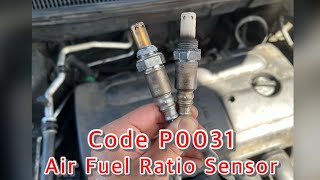
- Toyota: Uses Air/Fuel Ratio (A/F) sensors instead of traditional O2 sensors. They reject cheap aftermarket parts; use OEM Denso only.
- Jeep: Check for TSBs. Software updates are often required to prevent false P0031 codes triggered by minor voltage drops.
Real Owner Stories
2004 Jeep Grand Cherokee 4.0L
Check engine light came on with P0031. A shop replaced the O2 sensor, but the code returned immediately.
What they tried:
- Replaced the upstream O2 sensor.
- A second shop performed electrical diagnostics.
Outcome: The second shop found a shorted wire to ground in the harness. The wiring was repaired, and the code was resolved.
Lesson: A code that returns instantly after a sensor replacement strongly points to a wiring or fuse issue.
2014 Toyota Tacoma
Check engine light appeared with both P0031 (Bank 1) and P0051 (Bank 2) codes simultaneously.
What they tried:
- Swapped the 'A/F HEATER' relay with an identical relay from the horn circuit.
Outcome: Swapping the relay immediately cleared the codes. The original relay had failed, cutting power to both heaters.
Lesson: If you get two heater codes at once, the problem is a shared fuse or relay, not two bad sensors.
2013 Subaru Forester
After exhaust work, a P0031 code appeared. The mechanic replaced the sensor and checked fuses, but the code remained.
What they tried:
- Replaced O2 sensor.
- Checked fuses and relays.
Outcome: The wiring harness was melted against the new exhaust pipe during the repair, causing a permanent short.
Lesson: If P0031 appears immediately after exhaust or transmission work, suspect damaged wiring.
How to Prevent This Code From Triggering
- Replace upstream O2 sensors proactively (Every 100,000 miles) — Modern heated O2 sensors degrade over time. Proactive replacement prevents sudden heater failures and maintains optimal fuel economy.
- Address engine oil and coolant leaks promptly (As they occur) — Fluids burning in the exhaust coat the O2 sensor's protective shell, poisoning the element and causing premature failure.
- Periodically inspect sensor wiring (During oil changes) — Ensures the harness hasn't come loose from its clips and melted against the hot exhaust manifold.
Frequently Asked Questions
What does Bank 1, Sensor 1 mean?
Bank 1 is the side of the engine containing cylinder #1. Sensor 1 is the 'upstream' oxygen sensor located before the catalytic converter. It monitors exhaust gases directly from the engine.
Can I just replace the oxygen sensor to fix P0031?
Replacing the sensor fixes the issue 70% of the time. However, you must check the heater fuse and wiring first to avoid wasting money on a part you don't need.
What is the most common mistake when diagnosing P0031?
The biggest mistake is replacing the sensor without checking the fuse. A blown $2 fuse or a melted wire causes the exact same code as a $150 failed sensor.
How much does it cost to fix code P0031?
Costs range from $10 for a DIY fuse replacement to $400 for a shop to install a new sensor. Wiring repairs typically cost $150 to $250. Always diagnose before replacing parts to avoid unnecessary expenses.
What are 'open-loop' and 'closed-loop' operation?
In 'open-loop', the cold engine guesses the fuel mixture, wasting gas. Once the O2 sensor heats up, it enters 'closed-loop' and precisely adjusts fuel for maximum efficiency. P0031 keeps the car in open-loop longer.
Can I fix P0031 myself?
Yes. Checking fuses, cleaning grounds, and replacing the sensor are DIY-friendly. You will need a specialized oxygen sensor socket to remove the old part without stripping it.
Can a bad battery cause a P0031 code?
Yes. A weak battery causes low system voltage during cold starts. This prevents the heater circuit from receiving the required 12 volts, triggering a false code on sensitive vehicles.
Will cleaning an oxygen sensor fix this code?
No. P0031 indicates an electrical failure inside the sealed heater element. The element cannot be cleaned or repaired; the entire sensor must be replaced.
Key Takeaways
- Code P0031 indicates low voltage in the Bank 1 upstream oxygen sensor heater circuit, which drops fuel economy by up to 10%.
- Always check the 15A or 20A A/F heater fuse and inspect the wiring harness for melted spots before buying a $150 replacement sensor.
- Driving with P0031 for more than a few months forces the engine to run rich, risking a $1,500+ catalytic converter meltdown.
- If P0031 appears alongside P0051, do not replace the sensors; the fault is a shared blown fuse or faulty relay.
Helpful Videos

The information in this article is provided for general reference and educational purposes only. Vehicle specifications, procedures, and part compatibility can vary by production date, trim level, and region. Always consult your vehicle's factory service manual and verify part numbers before purchasing or performing repairs. Safety-critical components such as airbags, seat belts, and braking systems should be installed by a qualified professional.
- 🎬 Helpful Videos
- What Does P0031 Mean?
- Can I Drive With P0031?
- Common Causes
- Symptoms
- Diagnostic Flowchart
- Common Fixes & Costs
- Used vs. New Parts: Buying Guide
- What Happens If You Wait — Timeline
- Cost of Not Fixing It
- Diagnosis Steps
- When This Code Triggers (Freeze-Frame Conditions)
- Related Codes
- Climate & Environmental Factors
- How to Talk to a Mechanic About This Code
- Where to Take It: Dealer vs Independent vs Chain
- When to Walk Away From the Repair
- What Scan Tool You Need for This Code
- How to Clear the Code After You Fix It
- Will This Fail Emissions / State Inspection?
- Most Commonly Affected Vehicles
- Manufacturer-Specific Notes
- Real Owner Stories
- 2004 Jeep Grand Cherokee 4.0L
- 2014 Toyota Tacoma
- 2013 Subaru Forester
- How to Prevent This Code From Triggering
- Frequently Asked Questions
- What does Bank 1, Sensor 1 mean?
- Can I just replace the oxygen sensor to fix P0031?
- What is the most common mistake when diagnosing P0031?
- How much does it cost to fix code P0031?
- What are 'open-loop' and 'closed-loop' operation?
- Can I fix P0031 myself?
- Can a bad battery cause a P0031 code?
- Will cleaning an oxygen sensor fix this code?
- Key Takeaways
- 🎟️ Get 5% Off