

P0031 on 2013-2017 Honda Accord: Heater Circuit Causes and Fixes
On a 2013-2017 Honda Accord, code P0031 almost always means the Bank 1, Sensor 1 Air/Fuel Ratio sensor has failed. Replacing this sensor is the most common fix. Expect to pay $90-$150 for an OEM-quality aftermarket part (like Denso or NGK) and around $200-$280 for a genuine Honda part. Before replacing, check fuse A19 (10A) in the under-hood fuse box.
- P0031 points directly to a problem with the heater in the upstream Air/Fuel Ratio sensor (Bank 1, Sensor 1).
- The most likely solution is to replace the sensor itself. Using an OEM-quality brand like Denso or NGK is highly recommended.
- Before buying a new sensor, perform a quick visual inspection of the wiring for damage and check the A/F HEATER fuse (likely A19 10A in the under-hood box).
- On a V6 Accord, ensure you are working on Bank 1, which is the cylinder bank located near the firewall and may require removing the strut brace for access.
- This is a DIY-friendly repair for those with basic tools, including a 22mm (7/8") O2 sensor socket, and can save hundreds compared to a shop repair.
What's Unique About the 2013-2017 Honda Accord
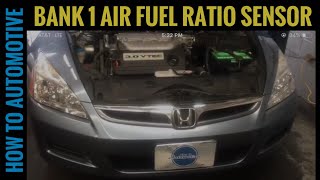
For the 9th generation Honda Accord, this is a straightforward and common fault. The key difference depends on your engine. On the 2.4L 4-cylinder (K24W1), 'Bank 1' is the only bank, and the sensor is easily accessible on the front exhaust manifold. On the 3.5L V6 (J35Y series), 'Bank 1' is the cylinder bank closer to the firewall, making that sensor more difficult to access than the Bank 2 sensor at the front of the car. Access may 🎬 Watch: Locate the Bank 1 sensor on your Accord require removing the engine cover and the front strut tower brace to reach it from above.
Symptoms You May Notice
- Check Engine Light is on
- Decreased fuel economy
- Rough or unstable idle, especially when the engine is cold
- Hesitation or sluggish acceleration
- Failing a vehicle emissions test
- Slightly stronger exhaust smell on startup
- Replacing the downstream (Bank 1, Sensor 2) oxygen sensor. This sensor monitors the catalytic converter and will set codes like P0037, not P0031.
- Replacing the Bank 2 sensor on a V6 model. P0031 specifically points to Bank 1 (firewall side).
- Replacing the catalytic converter. A bad converter typically sets a P0420 code and is often the result of a bad O2 sensor, not the cause of an O2 sensor heater code.
Most Likely Causes
- Failed Bank 1, Sensor 1 (Air/Fuel Ratio Sensor) 🔴 High Probability The internal heating element of the sensor has a finite lifespan and is a common failure point due to constant, rapid heat cycles.
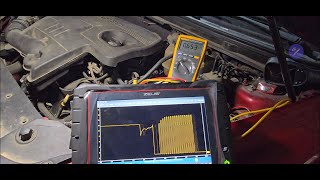
How to confirm: Disconnect the sensor and measure the resistance between the two heater pins (usually the two same-colored wires, often black) using a multimeter. A healthy 🎬 See this guide on testing oxygen sensor heater circuits sensor should read between 1.8 and 3.4 ohms when cold. An open circuit (infinite resistance) or a reading far outside this range confirms the heater has failed.
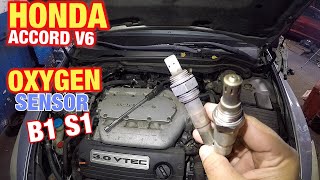
Typical fix: Replace the Bank 1, Sensor 1 Air/Fuel Ratio sensor. A 22mm or 7/8" offset oxygen sensor socket is recommended for removal. 🎬 Watch: Step-by-step walkthrough for replacing your oxygen sensors
Est. part cost: $90-$280 - Damaged Wiring or Connector 🟡 Medium Probability The wiring harness is close to hot exhaust components and can become brittle, melted, or corroded. Rodent damage is also a notable possibility, as the soy-based wire insulation used in this era can attract animals.
How to confirm: Visually inspect the entire wiring harness leading to the sensor for any signs of melting, chafing, breaks, or chewing. Check the connector for corrosion or pushed-out pins. Use a multimeter to check for 12V power and a good ground at the harness-side connector with the key on, engine off.
Typical fix: Repair the damaged section of the wiring harness or replace the connector pigtail. Honda sells anti-rodent tape (P/N 4019-2317) that can be wrapped around the new repair.
Est. part cost: $10-$50 - Blown Fuse ⚪ Low Probability
How to confirm: Check the under-hood fuse box for the fuse labeled 'A/F HEATER'. On most 2013-2017 Accords, this is fuse A19, a 10A fuse. Refer to the owner's manual or fuse box diagram to confirm the location.
Typical fix: Replace the blown fuse. If the fuse blows again immediately, it indicates a short circuit in the wiring or the sensor itself that must be found.
Est. part cost: $1-$5
Rare But Worth Checking
- Faulty Powertrain Control Module (PCM): This is very uncommon. The PCM should only be considered after all other possibilities, including the sensor, wiring, and fuses, have been thoroughly tested and ruled out.
Diagnosis Steps
- Read the code with an OBD-II scanner to confirm P0031 is the primary code present.
- Locate and check fuse A19 (10A) in the under-hood fuse box. Replace if blown. If it blows again, suspect a shorted sensor or wiring.
- Visually inspect the Bank 1, Sensor 1 wiring harness and connector. Look for any obvious signs of damage, such as melting, fraying, rodent chew marks, or corrosion.
- If the fuse and wiring look good, disconnect the sensor. Test for 12-volt power and ground on the vehicle's harness side of the connector (with the ignition on, engine off). Lack of power or ground points to a wiring issue upstream of the connector.
- If power and ground are present, test the sensor itself. Measure the resistance across the two heater pins (typically same-colored wires) on the sensor. A reading outside the 1.8-3.4 ohm range indicates a bad sensor.
- If the sensor and wiring test good, the fault may lie with the PCM, which is a rare occurrence.
Parts You'll Likely Need
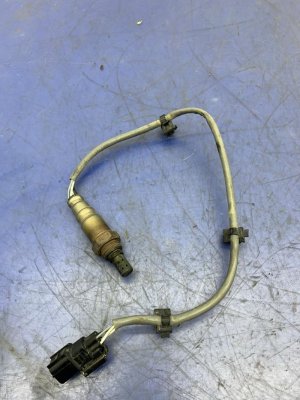
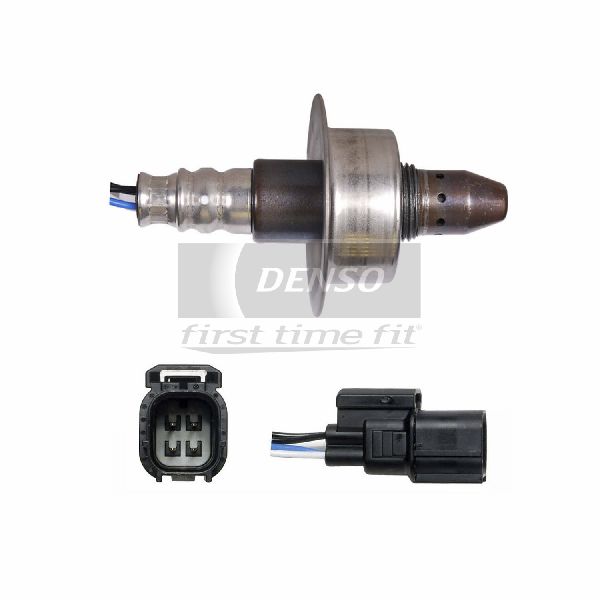
- Air/Fuel Ratio Sensor (Bank 1, Sensor 1)
(OEM #36531-5A2-A01 (for 2.4L engine) / 36531-RCA-A02 (for 3.5L V6 engine))— This is the most common cause of a P0031 code, as the internal heater element fails over time. Denso is the Original Equipment Manufacturer (OEM) for Honda, so their aftermarket part is identical to the genuine Honda part.
Trusted brands: Denso (OEM), NGK (NTK)
OEM price range: $200-$280
Aftermarket price range: $90-$150
Mechanic-Grade Diagnostic Values
- A/F Sensor Heater Circuit Current Draw — expected: Greater than 0.8 A when commanded on. Failure: Current is less than 0.8 A, triggering a P0031 fault.
- A/F Sensor Heater Power Supply Voltage — expected: 11V to 14V (Battery Voltage) with Key On, Engine Off. Failure: Voltage significantly below 11V indicates a wiring or fuse issue upstream of the sensor.
- Live Data - HO2S Heater Duty Cycle (Honda HDS) — expected: The PCM sends a pulse-width modulated (PWM) signal to control the heater. The duty cycle will vary based on conditions.. Failure: A 0% duty cycle when the heater should be on could indicate an ECM issue or a detected short/open that caused the ECM to shut down the circuit.
Scan Tool Commands That Help
- Honda HDS (or equivalent professional scanner): Live Data Monitoring: 'AF sensor (mA)', 'AF FB CMD', 'AF FB' — These parameters are used to assess the overall performance of the A/F sensor's sensing capability, not just the heater. While not a direct heater test, observing these values can help confirm if the sensor is completely unresponsive after a cold start, which would be consistent with a failed heater.
- OBD-II Scanner: Clear DTCs — After performing a repair (e.g., replacing the sensor or fixing wiring), clear the P0031 code. Then, perform a drive cycle to see if the code returns. A specific Honda drive cycle may be needed to get the oxygen sensor heater monitor to run and confirm the fix.
Wiring & Ground Locations
- G101 — Commonly found on the intake manifold plenum or thermostat housing area on the driver's side of the engine bay.. This is a primary ground termination point for the ECU and engine sensor harness. A corroded or loose G101 ground can cause a host of erratic sensor readings and codes, including P0031, due to improper voltage reference.
- A/F Sensor Connector (2.4L) — On the 2.4L K24W1 engine, the 4-pin connector for Bank 1 Sensor 1 is designated B7 in wiring diagrams.. This is the primary point for testing both the sensor-side resistance and the harness-side power/ground. Pin 1 (HA1A) is the heater control wire going to the ECM, and Pin 2 (+B) is the 12V power feed from the A/F Heater relay/fuse.
- ECM Connector (2.4L) — The heater control wire (HA1A) from the A/F sensor terminates at the B30 ECM connector, specifically at pin 109.. For advanced diagnostics where a wiring break is suspected between the sensor and the ECM, a continuity test can be performed between pin 1 of the B7 connector and pin 109 of the B30 ECM connector.
Real Owner Repair Stories
- driveaccord.net forum user (2013 Honda Accord Sport (2.4L)) — Check Engine Light with code P0031.
✅ What actually fixed it The user confirmed that replacing the Bank 1, Sensor 1 with a Denso 234-9131 aftermarket sensor resolved the code. They noted the dealer wanted over $500 for the repair, which they did themselves for the cost of the part. - YouTube video by 'Car Garage' (Honda Pilot V6 (similar J-series engine architecture)) — Check Engine Light with codes P0134 and P2237 (related to B1S1).
✅ What actually fixed it The video demonstrates the replacement of the Bank 1, Sensor 1 on the firewall side of the V6 engine, confirming this location for 'Bank 1' and showing that replacement of the sensor fixed the codes.
OEM Part Supersession History
36531-5A2-A01→
Heads up: This part number appears to be consistent for the 2.4L engine across the entire 2013-2017 model range and even fits some later models and the CR-V. No significant supersessions or incompatibilities have been noted for this generation.
Model Year Variations Within This Range
- 2013-2017: The 2016 model year received a mid-cycle refresh which included updated styling and technology like Apple CarPlay/Android Auto. However, the core powertrain (K24W1 and J35Y series engines) and emissions components, including the A/F sensors related to P0031, were not changed. Diagnosis and repair remain identical across this entire year range.
Diagnostic Flowchart
Used vs. New Parts: Buying Guide for This Vehicle
When a used part is the smart pick: For this specific repair, a used part is NOT recommended. The failure is due to the burnout of an internal heating element, which is a wear-and-tear item with a finite lifespan. A used sensor from a junkyard has unknown remaining life and is very likely to fail soon, if it works at all.
What to inspect on the donor part:
- Not applicable, as used parts are not advised.
OEM-only on this vehicle (don't cheap out):
- While not strictly 'OEM-only', it is critical to use a part from the Original Equipment Manufacturer. For Honda, this is typically Denso or NGK (sold as NTK). Avoid generic, no-name, or 'universal' sensors, as they often have incorrect heater resistance or response characteristics, leading to persistent codes.
Aftermarket brands forum-validated for this vehicle:
- Denso
- NGK / NTK
Brands owners have reported issues with on this vehicle:
- Generic 'universal' sensors
- Unbranded parts from online marketplaces
Real Owner Stories
Aggregated from forums and TSBs cited above. Mileages and costs reflect what owners reported in those sources.
2013 Accord Sport
Symptoms: The owner reported a check engine light was on and the scanner showed code P0031.
What fixed it: The issue was resolved by replacing the Bank 1 Sensor 1 with a Denso 234-9131 part.
Source hint: driveaccord.net - Thread 'P0031 Code on 2013 Accord Sport'
2014 Honda Accord V6
Symptoms: The owner reported code P0031 and noted the difficulty of accessing the rear Bank 1 sensor, which is located near the firewall on the V6 model.
What fixed it: Replacing the sensor with a Denso 234-5137 part fixed the code.
Source hint: reddit.com/r/MechanicAdvice - Thread '2014 Honda Accord V6 P0031'
Related OBD-II Codes
Frequently Asked Questions
Which specific sensor is 'Bank 1, Sensor 1' on my 2013-2017 Honda Accord?
What is the correct replacement part number for the P0031 sensor?
Can I use a cheap universal oxygen sensor to fix this code?
How do I test the sensor's heater element to confirm it's bad?
The wiring to my sensor looks like it was chewed by an animal. Is this a known issue?
What fuse protects the oxygen sensor heater circuit?
What special tool is needed to replace the Air/Fuel Ratio sensor?
Helpful Videos
![How to Fix P0031 Engine Code in 2 Minutes [1 DIY Method / Only $19.66]](https://img.youtube.com/vi/B68pwfRlnQc/mqdefault.jpg)
Used OEM Parts in Stock
New Aftermarket Parts Available


The information in this article is provided for general reference and educational purposes only. Vehicle specifications, procedures, and part compatibility can vary by production date, trim level, and region. Always consult your vehicle's factory service manual and verify part numbers before purchasing or performing repairs. Safety-critical components such as airbags, seat belts, and braking systems should be installed by a qualified professional.
- Honda Accord:
- 🎬 Helpful Videos
- 🛍️ Shop This Part
- What's Unique About the 2013-2017 Honda Accord
- Symptoms You May Notice
- Most Likely Causes
- Rare But Worth Checking
- Diagnosis Steps
- Parts You'll Likely Need
- Mechanic-Grade Diagnostic Values
- Scan Tool Commands That Help
- Wiring & Ground Locations
- Real Owner Repair Stories
- OEM Part Supersession History
- Model Year Variations Within This Range
- Diagnostic Flowchart
- Used vs. New Parts: Buying Guide for This Vehicle
- Real Owner Stories
- 2013 Accord Sport
- 2014 Honda Accord V6
- Related OBD-II Codes
- Frequently Asked Questions
- 🎟️ Get 5% Off