

P0014 on 2013-2024 Mazda CX-5: Exhaust Cam Timing Over-Advanced Causes and Fixes
P0014 on a Mazda CX-5 most often points to low or dirty engine oil, or a failing exhaust Oil Control Valve (OCV). Start by checking your oil; if it's clean and full, the OCV is the next likely culprit, costing around $50-$150 for the part. The OEM part number for the OCV is PE01-14-420A.
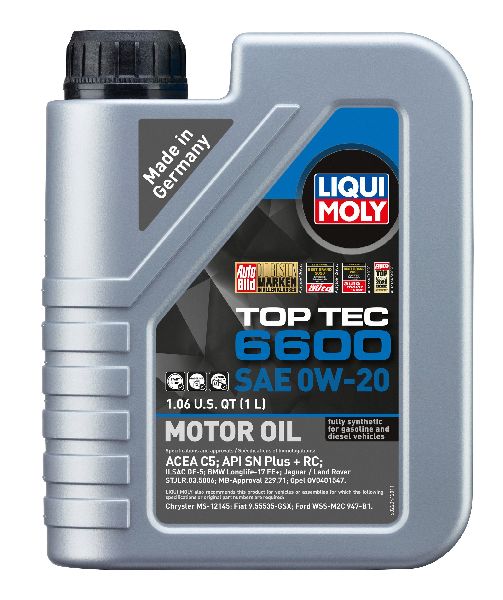
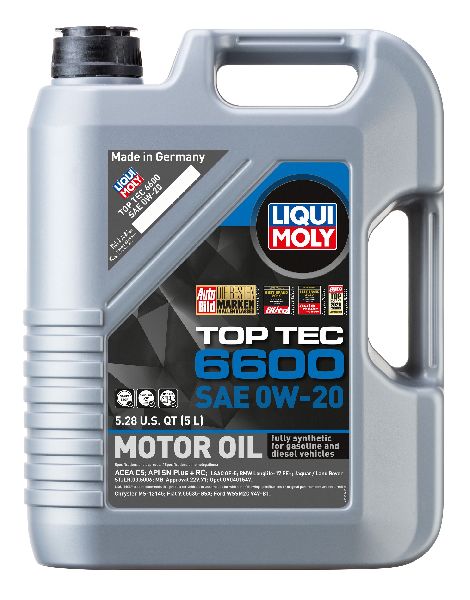
- Always check your engine oil first. A simple oil change with the correct 0W-20 synthetic oil resolves P0014 more often than not.
- The second most likely culprit is the exhaust Oil Control Valve (OCV), which is relatively inexpensive and accessible for cleaning or replacement.
- Do not immediately assume a catastrophic timing chain failure. While possible, it is a low-probability cause and should only be investigated after ruling out oil and OCV issues.
- Driving with the light on can lead to poor performance and, if the underlying cause is severe, potential engine damage. Get it diagnosed promptly.
What's Unique About the 2013-2024 Mazda CX-5

Mazda's SKYACTIV-G engines use a sophisticated Variable Valve Timing (VVT) system. It's important to know that the intake cam is controlled by an electric motor, while the exhaust cam (relevant to P0014) is controlled by hydraulic oil pressure. This distinction is key. While the P0014 code is generic, on the CX-5 it is very frequently linked to the health of the engine oil and the exhaust-side Oil Control Valve (OCV). Unlike some platforms where timing chain stretch is an immediate primary suspect, for the CX-5 the diagnostic path almost always starts with the simpler, oil-related components first.
Generation note: This guide covers the first generation (KE: 2013-2016) and second generation (KF: 2017-2024) Mazda CX-5. The fundamental causes of P0014 are the same for both, as they both use SKYACTIV-G engines with a hydraulic exhaust VVT system. However, some later 2.5L engines in the KF generation feature cylinder deactivation, which adds complexity but does not fundamentally change the diagnosis for this specific code.
Symptoms You May Notice
- Check Engine Light is on
- Rough or unstable idle
- Engine hesitation or stumbling on acceleration
- Reduced fuel economy
- Engine may sound louder or different than usual, sometimes with a knocking or rattling noise
- Hard starting
- Engine stalling
- Replacing the camshaft position sensor when the actual problem is the Oil Control Valve (OCV).
- Assuming a stretched timing chain before thoroughly checking the engine oil level/condition and the OCV first.
- Confusing the hydraulic exhaust VVT system (for P0014) with the electric intake VVT system (which would trigger P0012) and attempting to replace a non-existent intake OCV.
Most Likely Causes

- Low or Dirty Engine Oil 🔴 High Probability The SKYACTIV exhaust VVT system is highly dependent on clean oil of the correct viscosity (typically 0W-20) to operate the actuators. Sludge or low oil pressure prevents the system from accurately controlling cam timing, and is the most common trigger for this code.
How to confirm: Check the engine oil dipstick. The oil should be at the full mark and look clean (honey-colored, not black and thick).
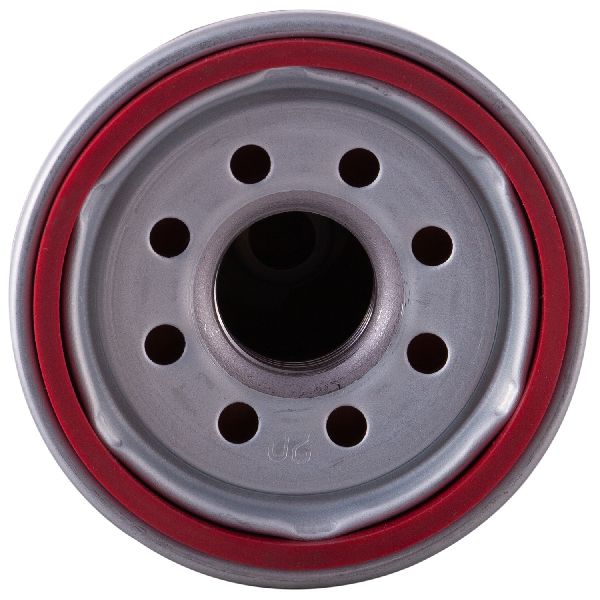
Typical fix: Perform an engine oil and filter change using a high-quality synthetic oil that meets Mazda's specifications.
Est. part cost: $40-$80 - Failing Exhaust Oil Control Valve (OCV) / VVT Solenoid 🟡 Medium Probability This solenoid controls the oil flow to the VVT actuator. It can become clogged with sludge or fail electrically, causing it to stick and default to an over-advanced position.
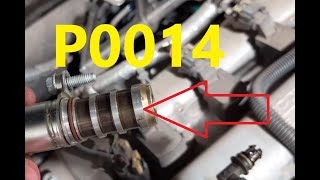
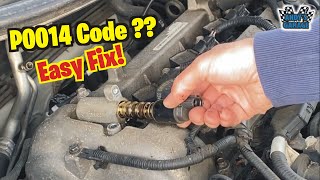
How to confirm: Remove the OCV (located on the valve cover). Inspect its small screen for debris. You can test its resistance with a multimeter (typically 5-15 Ω). 🎬 Watch: How to test and replace the VVT solenoid You can also apply 12V to see if the internal plunger clicks. A common diagnostic trick is to swap it with the identical intake OCV and see if the code changes to P0011 (Intake Cam Over-Advanced).
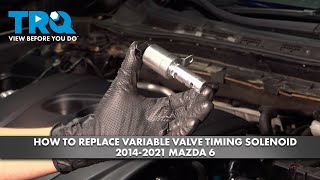
Typical fix: Clean the OCV with electronics or mass air flow sensor cleaner. If cleaning doesn't work or the valve fails testing, it must be replaced. The OEM part number is PE01-14-420A. 🎬 See this walkthrough for replacing the valve timing solenoid
Est. part cost: $50-$150 - Stretched Timing Chain or Failing Tensioner ⚪ Low Probability While the SKYACTIV-G uses a durable timing chain, high mileage (typically over 100,000-150,000 miles) or poor maintenance can cause it to stretch or the hydraulic tensioner to weaken. This creates slack, altering the base camshaft timing and triggering codes. This is a much less common cause than oil or OCV issues.
How to confirm: This is difficult to confirm without significant disassembly. A key symptom is a rattling noise from the engine, especially on cold starts, that goes away after a few seconds. A mechanic would need to remove the valve cover to inspect for chain slack or check cam/crank correlation with a scope.
Typical fix: Replacement of the timing chain, guides, and tensioner. This is a labor-intensive job.
Est. part cost: $300-$600
Rare But Worth Checking
- Faulty Camshaft Position Sensor (CMP): The sensor that reads the camshaft's position can fail, but it's more likely to throw its own specific circuit code (e.g., P0365). It's worth considering if all other causes are ruled out.
- Clogged Oil Passages: In engines with a history of infrequent oil changes, sludge can build up and block the small oil passages leading to the VVT actuator, starving it of the pressure needed for control.
- Failing VVT Actuator (Cam Phaser): The actuator itself, located on the end of the camshaft, can fail internally and get stuck. This is an expensive and labor-intensive repair, so it should be the last consideration after ruling out the OCV and oil issues.
Diagnosis Steps

- Read the code with an OBD-II scanner to confirm P0014 is present and note any other codes. 🎬 Watch: A quick overview of P0014 causes and fixes
- Check the engine oil level and condition. If low, dirty, or the wrong viscosity, perform an oil and filter change with the correct spec oil (e.g., Mazda 0W-20). Clear the code and drive to see if it returns.
- If the oil is good, locate the exhaust Oil Control Valve (OCV) on the valve cover. Inspect the electrical connector and wiring for damage.
- Remove the OCV. Inspect the mesh screens for sludge or metallic debris. Clean it thoroughly with a suitable cleaner like MAF or electronics cleaner.
- Test the OCV. Check its resistance with a multimeter (spec is typically 5-15 Ω). Carefully apply 12V power to listen for a distinct click. If it's silent or the resistance is out of spec, it has failed.
- If the OCV seems functional, consider swapping it with the intake OCV (they are identical parts, PE01-14-420A). Clear the codes and drive. If the code changes to P0011, you have confirmed the OCV is faulty.
- If the code persists, listen for a timing chain rattle on cold starts. If present, the issue may be a stretched chain or failing tensioner.
- If no other cause is found, the issue may be a faulty VVT actuator (phaser) or, rarely, a PCM issue. At this point, professional diagnosis is recommended.
Parts You'll Likely Need

- Engine Oil and Filter — The VVT system is hydraulic. Incorrect, low, or dirty oil is the most common cause of P0014.
Trusted brands: Mazda Genuine, Mobil 1, Castrol EDGE
OEM price range: $50-$90
Aftermarket price range: $40-$80 - Exhaust Oil Control Valve (VVT Solenoid)
(OEM #PE01-14-420A)— This is the most common mechanical part to fail for this code. It gets stuck or clogged, preventing proper control of the cam timing.
Trusted brands: Mazda Genuine, Dorman, Hitachi
OEM price range: $100-$180
Aftermarket price range: $50-$120
Related Codes That Often Appear With This One
- P0011 — If the intake camshaft ('A') is also having timing issues, you might see P0011. This could point to a more systemic problem like low oil pressure affecting both VVT actuators.
- P0015 — This is for 'Exhaust Camshaft Position - Timing Over-Retarded'. Seeing it with P0014 could indicate an erratic OCV or a sensor that is failing to read the position correctly.
Technical Service Bulletins (TSBs) & Recalls
- TSB 01-014/19: While for code P0012 on 2018 CX-5 and Mazda6 models, this TSB is relevant as it shows Mazda has addressed VVT-related codes by reprogramming the PCM due to improper control logic. This suggests a PCM update could be a potential, though rare, fix if all mechanical causes are ruled out.
- Recall 3719F (NHTSA 19V453000): A recall for a PCM software error that could cause stalling on 2018-2019 models. While not directly for P0014, ensuring your vehicle's software is up to date is a good practice.
- Recall 5321K (NHTSA 22V431000): Recall for a failing low-pressure fuel pump on 2018-2019 models, which can cause stalling. Unrelated to P0014 but important for vehicle health.
Platform-Specific Known Issues
- While P0014 relates to the hydraulic exhaust cam, it's notable that the intake cam on these engines is controlled by an electric VVT actuator. This electric actuator is a known failure point that causes code P0012 ('A' Camshaft Over-Retarded). TSB 01-007/15 was issued for 2015 Mazda6 models for this exact issue. This highlights that VVT system components are a known area of weakness, though the specific part differs between intake and exhaust codes.
Mechanic-Grade Diagnostic Values
- Oil Control Valve (OCV) / VVT Solenoid Resistance — expected: 5 - 15 Ω. Failure: A reading outside this range, or an open circuit, indicates a failed solenoid.
- Mazda M-MDS PCM Precondition: Engine Coolant Temperature — expected: 60 °C {140 °F} or more. Failure: The PCM will not run the self-test for P0014 until the engine is at operating temperature.
- Mazda M-MDS PCM Precondition: Engine Speed — expected: 5,000 rpm or less. Failure: The self-test for this DTC is performed under normal operating RPMs, not at redline.
- Mazda M-MDS Malfunction Determination Threshold — expected: Difference between target valve timing and actual valve timing is 20 degrees or less.. Failure: If the PCM detects a difference greater than 20 degrees for approximately 5 seconds, it will store the DTC.
Scan Tool Commands That Help
- Mazda M-MDS (Mazda Modular Diagnostic System): Datalogger (PID Monitoring) — Use to monitor live data PIDs for target vs. actual camshaft timing, engine speed, and coolant temperature to confirm the conditions under which the fault occurs.
- Mazda M-MDS (Mazda Modular Diagnostic System): CMDTC Self Test — This function forces the PCM to run the onboard diagnostic tests for continuous memory DTCs, which can help verify if a repair was successful without extensive driving.
- FORScan (aftermarket): VVT Solenoid Bidirectional Control — While Mazda's factory software has limited bidirectional controls for older models, FORScan may offer the ability to command the OCV on and off to test its mechanical function while observing changes in engine idle or timing PIDs.
Wiring & Ground Locations
- Engine Ground Point (Passenger Side) — On the passenger side of the engine bay, there is a primary body ground point near the power steering reservoir (on applicable models) and a ground on the passenger motor mount.. A poor ground at these locations can cause erratic voltage signals for sensors and actuators on that side of the engine, including the PCM and its control over the VVT system.
- Transmission Ground Points — There are multiple ground points on the transmission housing, typically one on top and two on the front.. The engine and transmission are a single unit in terms of electrical grounding. A loose or corroded ground on the transmission can affect the entire powertrain control system, leading to intermittent and hard-to-diagnose codes like P0014.
- OCV Connector — The 2-pin electrical connector plugs directly into the Oil Control Valve, which is located on the front of the valve cover, on the exhaust side.. This is the direct connection for the solenoid. Check for secure fitment, corrosion on the pins (A and B), and any damage to the wiring harness leading to it. The resistance test is performed across these two pins.
Real Owner Repair Stories
- Reddit user @Aggravating_Owl4910 (2021 Mazda CX-5 Grand Touring, 34.5k miles) — Car dumped oil on the highway shortly after a dealer oil change. Later, at 40.5k miles, the Check Engine Light came on with code P0014.
❌ Tried (didn't work) The user checked the oil level, and it was within the normal operating range at the time the P0014 code appeared.
✅ What actually fixed it The user towed the car back to the dealer. The strong implication is that the initial oil starvation event (caused by a double-sealed oil filter from the botched oil change) caused damage to the VVT system that took several thousand miles to manifest as a fault code. The resolution would be a dealer repair of the damaged component, likely the OCV or VVT actuator, under the assumption the dealer accepted responsibility for the initial incident.
OEM Part Supersession History
pe0114420→PE01-14-420A— Standard part number update and revision. The 'A' suffix denotes a revision to the original part, which could involve minor changes in manufacturing, materials, or internal design to improve reliability.
Heads up: The two part numbers are interchangeable, with PE01-14-420A being the currently supplied replacement.
Diagnostic Flowchart
Other Known Issues on This Vehicle
Issues unrelated to this code that are worth knowing about as an owner of this generation:
- Infotainment 'Ghost Touch' and System Malfunctions 🟠 Medium — Common on 2016-2020 models. The screen registers phantom touches, causing random station changes, calls, and settings adjustments. (Ref: TSB 09-003/22; Mazda also has a Customer Service Program (CSP13) extending the warranty for this issue on certain VINs.)
- LED Daytime Running Light (DRL) Failure 🟠 Medium — Very common on the 2016 model year. The DRLs flicker or fail completely due to corrosion caused by a faulty sealing gasket. (Ref: Recall 4320A (NHTSA Campaign 20V063000) was issued for 2016 models to replace the gasket and/or headlight assembly.)
- Intake Valve Carbon Buildup 🟡 Low — A potential long-term issue for all direct-injection (GDI) engines, including SKYACTIV-G. Onset is typically over 100,000 miles and can be accelerated by frequent short trips. Mazda's design mitigates it better than some other brands, and many owners report no issues.
- Premature Brake Wear 🟡 Low — Some owners of earlier models (approx. 2013-2016) reported needing to replace brake pads and rotors sooner than expected, sometimes under 40,000 km.
- Cracked/Fragile Windshields 🟡 Low — Owners of first-generation (2013-2016) models have reported that windshields seem prone to cracking from small impacts or even temperature changes.
Used vs. New Parts: Buying Guide for This Vehicle
When a used part is the smart pick: A used Oil Control Valve (OCV) is generally not recommended. The part is a common failure item due to internal wear and clogging from oil contaminants. The cost savings of a used part are minimal compared to the risk of installing a part that is already near the end of its service life. The labor to replace it is simple, but you don't want to do it twice.
Donor-vehicle mileage cap: roughly under 50000 miles for the part to have meaningful remaining life.
What to inspect on the donor part:
- If considering a used OCV, it should come from a low-mileage, documented wreck.
- Inspect the mesh screens on the valve; they should be perfectly clean and free of any metallic debris or sludge.
- The electrical connector should be free of corrosion or damage.
OEM-only on this vehicle (don't cheap out):
- VVT Actuator (Cam Phaser)
- Timing Chain Components (Chain, Guides, Tensioner)
Aftermarket brands forum-validated for this vehicle:
- Hitachi (Often the OEM supplier)
- Denso
Brands owners have reported issues with on this vehicle:
- Unnamed, no-brand 'white box' parts from online marketplaces. Forum and user reviews often cite premature failure of ultra-low-cost solenoids. While Dorman is a common brand, for critical components like VVT solenoids, sticking to OEM or a known OEM-supplier like Hitachi is a safer bet.
Real Owner Stories
Aggregated from forums and TSBs cited above. Mileages and costs reflect what owners reported in those sources.
2016.5 Mazda CX-5 2.5L
Symptoms: The owner was quoted for a timing chain replacement after receiving a correlation code.
What fixed it: Correcting the oil level; the vehicle was two quarts low on oil, which caused a transient VVT code.
Source hint: Mazdas247 Forum - '2016.5 CX-5 2.5L Timing chain skipped a tooth?'
2021 Mazda CX-5
Symptoms: P0014 code triggered.
What fixed it: The diagnostic path identified low oil, incorrect viscosity, or a faulty camshaft actuator as the primary causes.
Source hint: Reddit r/CX5 - 'P0014 code on Mazda cx5'
2015 Mazda 6 2.5L
Symptoms: VVT system component failure causing timing-related codes.
What fixed it: Replacement of the VVT actuator as outlined in manufacturer service communications regarding known weaknesses in the VVT system.
Source hint: TSB 01-007/15
Related OBD-II Codes
Frequently Asked Questions
Can I swap parts to diagnose P0014 on my CX-5?
Is there a TSB for VVT issues on the 2015 Mazda CX-5 or Mazda6?
Does TSB 01-014/19 apply to my 2018 CX-5 for timing codes?
What specific oil should I use in my SKYACTIV-G engine to prevent P0014?
Could my stalling issue be related to a recall instead of the P0014 code?
Is the P0014 code common on other Mazdas with the 2.0L or 2.5L engine?
Helpful Videos

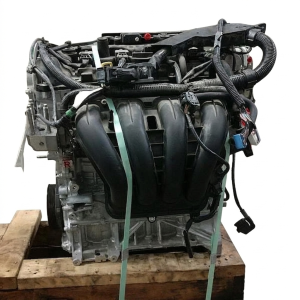
Used OEM Parts in Stock


New Aftermarket Parts Available

The information in this article is provided for general reference and educational purposes only. Vehicle specifications, procedures, and part compatibility can vary by production date, trim level, and region. Always consult your vehicle's factory service manual and verify part numbers before purchasing or performing repairs. Safety-critical components such as airbags, seat belts, and braking systems should be installed by a qualified professional.
- Mazda CX-5:
- 🎬 Helpful Videos
- 🛍️ Shop This Part
- What's Unique About the 2013-2024 Mazda CX-5
- Symptoms You May Notice
- Most Likely Causes
- Rare But Worth Checking
- Diagnosis Steps
- Parts You'll Likely Need
- Related Codes That Often Appear With This One
- Technical Service Bulletins (TSBs) & Recalls
- Platform-Specific Known Issues
- Mechanic-Grade Diagnostic Values
- Scan Tool Commands That Help
- Wiring & Ground Locations
- Real Owner Repair Stories
- OEM Part Supersession History
- Diagnostic Flowchart
- Other Known Issues on This Vehicle
- Used vs. New Parts: Buying Guide for This Vehicle
- Real Owner Stories
- 2016.5 Mazda CX-5 2.5L
- 2021 Mazda CX-5
- 2015 Mazda 6 2.5L
- Related OBD-II Codes
- Frequently Asked Questions
- 🎟️ Get 5% Off