

P0014 on 2013-2019 Ford Escape EcoBoost: Exhaust Cam Timing Causes and Fixes
On a 2013-2019 Ford Escape, P0014 is most often caused by low/dirty engine oil or a faulty exhaust VCT solenoid. Start by checking your oil. If the oil is clean and full, replacing the exhaust VCT solenoid (approx. $40-$80 aftermarket, $70-$120 OEM) is the most likely fix and is a DIY-friendly job. On EcoBoost models, this code can be an early warning of the serious coolant intrusion engine defect.
- Always check your engine oil level and condition first. A simple oil change is the most common and cheapest fix.
- The exhaust VCT solenoid is the next most likely culprit and is a relatively easy part to replace for a DIYer.
- Do NOT immediately replace the camshaft position sensor; it is rarely the cause of this code.
- Be aware of the possibility of coolant intrusion on 1.5L and 2.0L engines. Unexplained coolant loss with this code is a serious symptom that requires immediate attention.
What's Unique About the 2013-2019 Ford Escape
For this generation of Ford Escape, code P0014 is a very common and well-documented issue. Ford has issued multiple Technical Service Bulletins (TSBs) acknowledging that small debris in the engine oil can cause the VCT solenoids to stick, making this the most probable cause after low or dirty oil. More critically, on the 1.5L and 2.0L EcoBoost engines, this code can be an early warning sign of coolant intrusion into the engine oil due to a known engine block design flaw. This contamination creates sludge that clogs the VCT system, making P0014 a potential symptom of a much more serious problem that could lead to catastrophic engine failure, a sentiment echoed by many owners in online forums.
Symptoms You May Notice
- Check Engine Light is on
- Rough engine idle
- Engine stalling or difficulty starting
- Reduced engine power and sluggish acceleration
- Poor fuel economy
- Rattling noise from the engine, especially on startup
- Replacing the Camshaft Position Sensor. The sensor is accurately reporting the timing deviation it sees. P0014 is almost always a mechanical or hydraulic issue within the VCT system (oil, solenoid, phaser), not an electrical failure of the sensor itself.
Most Likely Causes
- Low, Dirty, or Incorrect Viscosity Engine Oil 🔴 High Probability The Ford Ti-VCT system is entirely dependent on oil pressure and cleanliness to function. EcoBoost engines can be hard on oil, and any sludge, debris, or low levels will immediately impact the VCT phasers and solenoids, causing them to respond slowly or stick.
How to confirm: Check the engine oil dipstick. Note the level, color, and consistency. One owner on a forum noted the code appeared when oil was so low it didn't register on the dipstick. If the oil is low, dark black, or appears milky (a sign of coolant), this is the likely cause.
Typical fix: Perform an engine oil and filter change using the manufacturer-specified oil (typically a full synthetic 5W-20 or 5W-30 for EcoBoost engines) and a quality filter. This is the first, cheapest, and most important diagnostic step.
Est. part cost: $50-$90 - Faulty Exhaust VCT Solenoid (Oil Control Valve) 🔴 High Probability Ford has issued multiple TSBs (e.g., SSM 48423) stating that small debris in the oil can cause the VCT solenoid to get stuck, a very common failure on this platform. Manufacturer bulletin SSM 47170 also confirms that P0014 may be due to small debris causing the VCT solenoid to stick. The solenoid has fine mesh screens that can easily become clogged by oil sludge or particles, preventing it from controlling oil flow to the cam phaser correctly.
How to confirm: After confirming good oil, locate the exhaust VCT solenoid on the valve cover. It can be removed and its screens inspected for debris. Test its mechanical function by applying 12V power and listening for a 'click'. Resistance should measure between 5-15 Ohms. A common DIY diagnostic is to swap the exhaust solenoid with the identical intake solenoid. If the code changes to P0011 (Intake Cam Over-Advanced), you've confirmed the solenoid is bad.
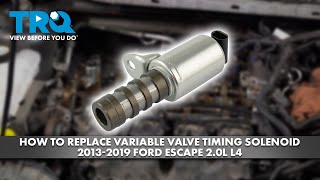
Typical fix: Replace the Bank 1 exhaust VCT solenoid. It is accessible on top of the engine and secured by a single bolt, making it a simple replacement. 🎬 Watch: How to replace the exhaust solenoid on a 2.0L engine
Est. part cost: $40-$120
Rare But Worth Checking
- Engine Coolant Intrusion (1.5L/2.0L EcoBoost): This is a critical, well-documented issue. A design flaw in the open-deck engine block can cause coolant to leak into the cylinders and contaminate the oil. This creates sludge that clogs oil passages and the VCT system, triggering P0014. Check for unexplained coolant loss, white exhaust smoke, or milky oil. This issue often requires a new long block engine as per Ford's TSB 19-2346.
- Stretched Timing Chain or Faulty Cam Phaser: While less common than oil or solenoid issues, mechanical timing components can fail, especially with extended oil change intervals. A key symptom is a rattling noise on cold startups that goes away after a few seconds. If the code persists after addressing oil and the VCT solenoid, a stretched chain or a failing cam phaser could be the cause. This is a much more complex and expensive repair requiring specialized tools.
- Internal Engine Damage: In some cases, P0014 can be accompanied by severe mechanical failure. NHTSA ODI #11519186 describes a situation where an owner was informed of holes in vital engine parts and contact between the camshaft and fuel pump while experiencing this code.
Diagnosis Steps
- Verify Oil Level and Condition: Check the dipstick. Is the oil full, clean, and of the correct viscosity (e.g., 5W-30 Full Synthetic)? If not, perform an oil and filter change, clear the code, and drive to see if it returns. This is the first and most important step.
- Inspect VCT Solenoid Connector: Check the electrical connector for the exhaust VCT solenoid for any damage, corrosion, or loose pins. Ensure it's securely plugged in.
- Test/Swap the VCT Solenoid: Remove the exhaust solenoid (top of the valve cover, held by one bolt). Inspect its mesh screens for metal shavings or sludge. A definitive DIY test is to swap it with the intake solenoid. Clear the codes. If the code returns as P0011, 🎬 Watch: A guide to diagnosing and fixing the P0014 code the solenoid is faulty and needs replacement.
- Check for Coolant Intrusion (1.5L/2.0L): Check the coolant reservoir level. Is it low without any visible external leaks? Check the oil cap and dipstick for a milky, frothy appearance. Look for white smoke from the exhaust after startup. These are classic signs of the engine block defect.
- Professional Diagnosis for Mechanical Timing: If the oil is good, the solenoid is confirmed working, and there are no signs of coolant intrusion, the problem may be a stretched timing chain or a faulty cam phaser. Listen for startup rattle. This requires specialized tools and should be diagnosed by a professional mechanic. Manufacturer bulletin SSM 54366 suggests referring to Pinpoint test HK in the Powertrain Control and Emissions Diagnosis (PC/ED) manual for these timing codes.
Parts You'll Likely Need
- Engine Variable Camshaft Timing (VCT) Solenoid (Exhaust)
(OEM #CN1Z6M280B (may be superseded by CN1Z6M280D, CN1Z6M280E))— This is the most common failed component for P0014 after ruling out oil issues. It gets stuck from debris or sludge in the oil, a problem acknowledged by Ford in service bulletins.
Trusted brands: Motorcraft, Dorman, NGK/NTK
OEM price range: $70-$120
Aftermarket price range: $40-$80 - Engine Oil and Filter — The VCT system is dependent on clean oil at the correct pressure. An oil and filter change is the first step and often the complete fix for this code. Use of a Motorcraft filter and specified full synthetic oil is recommended.
Trusted brands: Motorcraft, Mobil 1, Valvoline, Castrol
OEM price range: $50-$90
Aftermarket price range: $40-$70
Related Codes That Often Appear With This One
- P0011 — This is the equivalent 'over-advanced' code for the intake camshaft. Seeing both P0011 and P0014 together points to a systemic issue affecting the whole VCT system, like severe oil contamination, low oil pressure, or a potential timing chain issue.
- P0300, P0301, P0302, P0303, P0304 — Cylinder misfire codes. When seen with P0014 on an EcoBoost engine, this combination is a strong warning sign of the coolant intrusion issue. Coolant in the cylinder disrupts combustion, causing misfires, and the resulting oil contamination triggers the VCT code.
- P0012, P0015 — These are 'over-retarded' codes for the intake and exhaust cams. Seeing them alongside P0014 suggests an erratic VCT system, possibly due to very dirty oil, a failing phaser, or incorrect timing after a repair like a timing belt change.
Technical Service Bulletins (TSBs) & Recalls
- SSM 48423: States that P0014 and other VCT codes may be caused by small debris causing the VCT solenoid to stick. Advises running a specific diagnostic test (Pinpoint Test HK11) to cycle the affected solenoid 10 times to try and clear it before replacement.
- TSB 19-2346: The critical bulletin for 2.0L EcoBoost engines (including 2017-2019 Escape) that exhibit low coolant, white smoke, and misfire codes (P0300-P0304). It identifies coolant intrusion into cylinders as the cause and prescribes a complete long block engine replacement as the fix.
- Customer Satisfaction Program 21N12: An extension of warranty coverage for some 1.5L engines (up to 7 years/84k miles) for the specific coolant intrusion issue.
- SSM 47170: Notes that diagnostic trouble codes including P0014 may be due to small debris causing the VCT solenoid to stick and advises technicians to check for this before attempting other repairs.
- SSM 54366: Recommends using Pinpoint test HK in the Powertrain Control and Emissions Diagnosis (PC/ED) for vehicles exhibiting MIL illumination with codes such as P0014.
Platform-Specific Known Issues
- EcoBoost Coolant Intrusion: On 1.5L and 2.0L engines, a known engine block design flaw can lead to coolant leaking into the cylinders. This severe contamination triggers VCT codes like P0014 and can lead to catastrophic engine failure. Ford addressed this with TSB 19-2346, which recommends a long block replacement.
Mechanic-Grade Diagnostic Values
- VCT Solenoid Internal Resistance — expected: 5 to 15 Ohms (some sources state a tighter range of 8 to 12 Ohms). Failure: A reading outside this range, or an open circuit (OL), indicates a faulty solenoid coil.
- VCT Solenoid Circuit Voltage (Key On, Engine Off) — expected: Approximately 12V (Battery Voltage). Failure: No voltage or low voltage suggests a wiring issue, a blown fuse (e.g., F34 in the battery junction box), or a PCM power supply problem.
- Scan Tool PID: VCT_EXH_ERR (Exhaust Camshaft Timing Error) — expected: Should hover near 0 degrees at idle and under steady load.. Failure: A consistent error value greater than +/- 5 degrees for an extended period indicates the phaser is not reaching its commanded position, pointing to a hydraulic or mechanical fault.
- Scan Tool PIDs: VCT_EXH_CMD vs. VCT_EXH_ACT — expected: The 'Actual' (ACT) PID should closely track the 'Commanded' (CMD) PID as engine RPM and load change.. Failure: Significant lag or a complete lack of response from the ACT PID when the CMD PID changes confirms a VCT system malfunction.
Scan Tool Commands That Help
- Ford IDS (Integrated Diagnostic System) / FORScan: Pinpoint Test HK11: Cycle VCT Solenoid — As per Ford's own Special Service Message (SSM 48423), this command should be used before replacing a VCT solenoid. It cycles the solenoid rapidly 10 times to dislodge small debris that may be causing it to stick. If the code clears and does not return after this test, it can prevent an unnecessary part replacement.
Wiring & Ground Locations
- G104 / G105 — Left side of the engine compartment, on or near the frame rail/shock tower.. These are primary engine grounds. A loose or corroded ground at this location can cause erratic behavior in various engine sensors and actuators, including the PCM's ability to accurately control and monitor the VCT solenoids. While not a direct cause of P0014, poor grounding can create phantom electrical issues that mimic component failure.
- C2280B / C2280C — Connectors at the Body Control Module (BCM), located at the bottom right center of the dash.. These connectors carry CAN bus network signals between the BCM and PCM. While a fault here is rare, damage or corrosion could disrupt communication, potentially leading to various DTCs, including timing codes if PCM operation is affected.
Real Owner Repair Stories
- Reddit user in r/fordescape (2018 Ford Escape Titanium 2.0L EcoBoost, ~50,000 miles) — Check Engine Light with P0014, accompanied by misfire codes (P030x) and unexplained coolant loss.
❌ Tried (didn't work) Initial diagnosis pointed towards common causes like oil or VCT solenoid, but the presence of coolant loss and misfires shifted the focus.
✅ What actually fixed it The root cause was diagnosed as the known coolant intrusion issue outlined in TSB 19-2346. The entire engine had to be replaced with a new long block assembly to permanently resolve the problem. - NHTSA ODI #11727408 — An owner reported that their engine started rattling and smoking. A dealership pulled codes P0302, P0304, P0012, and P0014, which the owner linked to the known coolant intrusion issue despite the dealer attempting to blame lack of maintenance.
OEM Part Supersession History
CN1Z-6M280-A→CN1Z-6M280-B, CN1Z-6M280-C, CN1Z-6M280-D, CN1Z-6M280-E, CN1Z-6M280-F— Incremental revisions by Ford to improve durability and resistance to sticking from oil debris. Each new part number replaces the previous ones.
Heads up: All listed part numbers are generally interchangeable for the 1.5L/1.6L engines, but it is always recommended to use the latest available revision (e.g., -F) for the most updated design.
Model Year Variations Within This Range
- 2013-2016: These years primarily used the 1.6L EcoBoost engine. While also susceptible to VCT issues, the most notorious problem was a risk of overheating and engine fires due to a different coolant-related design flaw, which led to recalls.
- 2017-2019: The 1.6L was replaced by the 1.5L EcoBoost engine for the SE and Titanium trims. These 1.5L and the updated 2.0L engines are the primary subjects of TSB 19-2346 for coolant intrusion into the cylinders, making P0014 a more significant warning sign on these later models.
Diagnostic Flowchart
Other Known Issues on This Vehicle
Issues unrelated to this code that are worth knowing about as an owner of this generation:
- Engine Coolant Intrusion 🔴 High — Common on 1.5L, 1.6L, and 2.0L EcoBoost engines from this era. Often occurs between 60,000-100,000 miles. The defect allows coolant to leak into cylinders, causing misfires and eventual engine failure. (Ref: TSB 19-2346, Customer Satisfaction Program 21N12)
- 6F35 Transmission Failure 🔴 High — Widespread issue for this generation. Symptoms like shuddering, slipping, and harsh shifts can appear as early as 40,000 miles, with many failures reported before 100,000 miles. A class-action lawsuit was filed over these issues. (Ref: NHTSA Recall 22V413000 (Shift Cable Bushing))
- 1.6L EcoBoost Engine Overheating & Fire Risk 🔴 High — A significant number of early models (2013-2014) with the 1.6L engine were recalled due to risks of overheating, cracking the cylinder head, and causing oil leaks that could lead to fire. (Ref: Ford Recalls 13S12, 17S09)
- Carbon Buildup on Intake Valves 🟠 Medium — A common side effect of direct-injection engines. Becomes noticeable after 80,000-100,000 miles, causing rough idle, hesitation, and gradual power loss.
- Cracked Flexplate 🟠 Medium — Owners report a loud rattling or knocking noise at idle, which can damage the torque converter or transmission pump if not addressed.
Used vs. New Parts: Buying Guide for This Vehicle
When a used part is the smart pick: For this specific repair, purchasing a used VCT solenoid is NOT recommended. The primary failure mode is internal contamination or sticking due to oil sludge and debris. A used part from a salvage yard carries a very high risk of having the same or worse contamination as the part being replaced.
What to inspect on the donor part:
- Not applicable, as used VCT solenoids are not a viable option for this repair.
OEM-only on this vehicle (don't cheap out):
- While not strictly 'OEM-only', using a genuine Motorcraft VCT solenoid is strongly recommended by many technicians and forum members. The cost difference is often minimal compared to the labor of replacing it twice if a cheap aftermarket part fails prematurely.
Aftermarket brands forum-validated for this vehicle:
- Dorman (often offers a direct replacement with a good warranty)
- NGK/NTK (A reputable OEM supplier for many other electronic parts)
Brands owners have reported issues with on this vehicle:
- No-name, unbranded solenoids from online marketplaces should be avoided. They often lack proper quality control and may fail quickly or not perform to OEM specifications, causing the code to return.
Real Owner Stories
Aggregated from forums and TSBs cited above. Mileages and costs reflect what owners reported in those sources.
2017 Ford Escape 1.5L EcoBoost
Symptoms: The owner directly linked the appearance of code P0014 to the known coolant intrusion issue and the larger engine defect.
What fixed it: The source highlights this as a symptom of the engine block defect requiring significant repair or replacement.
Source hint: NHTSA Complaint #11727408
2018 Ford Escape 1.5L EcoBoost — 90000 miles
Symptoms: Overheating event followed by codes P0012, P0014, and a cylinder 1 misfire. The coolant reservoir was empty with no external leaks.
What fixed it: The engine required replacement due to coolant intrusion.
Source hint: Reddit: r/fordescape - 2018 Ford Escape coolant leak
2017 Ford Escape (Engine not specified)
Symptoms: Owner was told they needed a new engine due to the known coolant leak into cylinders.
What fixed it: New engine (long block replacement).
Cost: $8,000-$12,000
Source hint: Reddit: r/fordescape - Escape Known Issue
Related OBD-II Codes
Frequently Asked Questions
Does TSB 19-2346 apply to my 2017-2019 Ford Escape with the 2.0L EcoBoost?
Can I just swap the VCT solenoids to diagnose P0014 on my EcoBoost engine?
Is there a specific diagnostic test Ford recommends for a sticking VCT solenoid?
What kind of oil should I use in my Ford Escape to prevent P0014?
Is there any extended warranty coverage for the coolant intrusion issue on the 1.5L engine?
Could a rattling noise on startup be related to my P0014 code?
Helpful Videos
Used OEM Parts in Stock
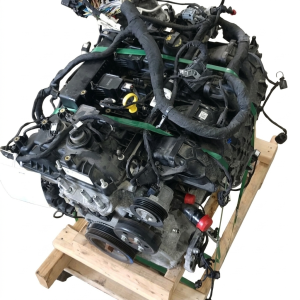
New Aftermarket Parts Available


The information in this article is provided for general reference and educational purposes only. Vehicle specifications, procedures, and part compatibility can vary by production date, trim level, and region. Always consult your vehicle's factory service manual and verify part numbers before purchasing or performing repairs. Safety-critical components such as airbags, seat belts, and braking systems should be installed by a qualified professional.
- Ford Escape:
- 🎬 Helpful Videos
- 🛍️ Shop This Part
- What's Unique About the 2013-2019 Ford Escape
- Symptoms You May Notice
- Most Likely Causes
- Rare But Worth Checking
- Diagnosis Steps
- Parts You'll Likely Need
- Related Codes That Often Appear With This One
- Technical Service Bulletins (TSBs) & Recalls
- Platform-Specific Known Issues
- Mechanic-Grade Diagnostic Values
- Scan Tool Commands That Help
- Wiring & Ground Locations
- Real Owner Repair Stories
- OEM Part Supersession History
- Model Year Variations Within This Range
- Diagnostic Flowchart
- Other Known Issues on This Vehicle
- Used vs. New Parts: Buying Guide for This Vehicle
- Real Owner Stories
- 2017 Ford Escape 1.5L EcoBoost
- 2018 Ford Escape 1.5L EcoBoost — 90000 miles
- 2017 Ford Escape (Engine not specified)
- Related OBD-II Codes
- Frequently Asked Questions
- 🎟️ Get 5% Off