

P0012 on 2012-2026 Subaru Forester: Intake Cam Timing Over-Retarded Causes and Fixes
On a Subaru Forester with an FA or FB engine, code P0012 is most often caused by low, dirty, or incorrect viscosity engine oil. Start by checking your oil; an oil and filter change is the most likely and cheapest fix. If that doesn't work, the next most common culprit is a faulty passenger-side intake Oil Control Valve (OCV), which costs about $90-$150 for the OEM part.
- Always check your engine oil first. Low, old, or incorrect oil is the #1 cause of P0012 on a Subaru Forester.
- If an oil change doesn't fix the code, the passenger-side intake Oil Control Valve (OCV) is the next most likely culprit.
- This is a very common and usually inexpensive code to fix, often manageable for a DIYer with basic tools.
- Do not ignore the code, as it can lead to poor performance, bad fuel economy, and potential engine damage over time.
What's Unique About the 2012-2026 Subaru Forester
Subaru's FA and FB boxer engines feature dual overhead cams with variable valve timing on both intake and exhaust, a system Subaru calls AVCS (Active Valve Control System). This system is entirely hydraulic, using engine oil pressure to adjust camshaft phasers. The system's reliance on clean oil flowing through very small passages makes it extremely sensitive to oil level, condition, and viscosity. While P0012 is a generic code, Subaru's TSB 02-163-16R specifically addresses AVCS-related DTCs for these engines, underscoring that the number one cause is almost always an oil-related issue which can starve the system or clog the Oil Control Valve (OCV) solenoid.
Generation note: The 2012-2026 year range covers the SJ (2012-2018) and SK (2019-present) Forester generations. The SJ generation included the naturally aspirated FB25 engine and the turbocharged FA20F engine (in XT models). The SK generation primarily uses an updated FB25 engine. The causes and diagnostic procedures for P0012 are consistent across these generations and engine types as they all rely on the oil-dependent AVCS system, as confirmed by Subaru TSB 02-163-16R which applies to all of them.
Symptoms You May Notice
- Check Engine Light illuminated
- Rough engine idle, sometimes causing vehicle vibration
- Engine stalling, especially at low speeds or when coming to a stop
- Noticeable loss of power and poor acceleration
- Decreased fuel efficiency
- Rattling or knocking noises from the engine bay, especially on cold starts
- Replacing the camshaft position sensor before checking the oil or OCV.
- Assuming a major mechanical failure 🎬 Watch this before you start replacing expensive engine parts. (e.g., timing chain) before ruling out the much more common oil and OCV issues.
- Replacing the timing chain when the issue was a less-expensive clogged OCV or banjo bolt filter.
Most Likely Causes
- Low, Dirty, or Incorrect Viscosity Engine Oil 🔴 High Probability The Subaru AVCS system is hydraulic and uses small oil passages that are easily clogged by sludge or restricted by low oil pressure. This is the most frequent cause of AVCS-related codes, and the first thing any technician or TSB recommends checking.
How to confirm: Check the engine oil dipstick for level and inspect the oil's color and consistency. If it is below the 'low' mark, very dark, or appears thick and sludgy, it needs to be changed. Many owners report the code appearing simply when the oil level is at the low end of the operating range.
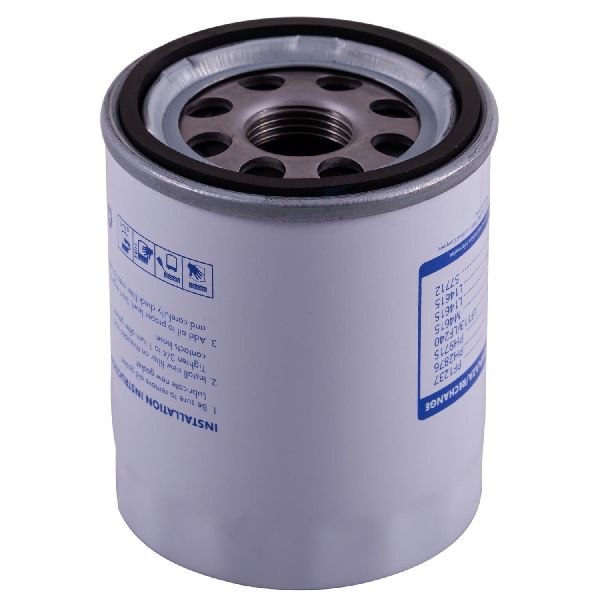
Typical fix: Perform an engine oil and filter change using a high-quality synthetic oil that meets the manufacturer's specified viscosity (e.g., 0W-20 for many FB/FA models). Use a quality OEM filter.
Est. part cost: $50-$100 - Failing Intake Oil Control Valve (OCV) - Bank 1 🟡 Medium Probability The OCV (also called a VVT solenoid) can become clogged with oil debris, get stuck internally, or fail electrically over time, preventing it from properly directing oil flow to the camshaft phaser. It is a common failure point after 75,000 miles, especially if oil changes have been delayed.
How to confirm: After confirming the oil is clean and full, swap the Bank 1 (passenger side) intake OCV with the Bank 2 (driver's side) intake OCV. Clear the codes. If the trouble code changes to P0022 (Bank 2 Over-Retarded), the OCV is faulty. You can also test the solenoid's resistance with a multimeter (typically 6-12 ohms) or apply 12V power to see if it clicks.
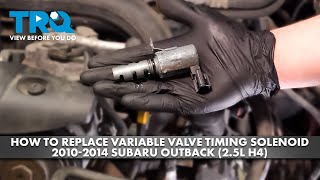
Typical fix: Replace the Bank 1 intake Oil Control Valve. 🎬 See this walkthrough on replacing the variable valve timing solenoid. It is recommended to use an OEM part.
Est. part cost: $80-$150
Rare But Worth Checking
- Stretched Timing Chain or Worn Timing Components: While less common, a timing chain that has stretched over many miles can cause the base engine timing to be incorrect. The AVCS system can't compensate for this mechanical slack, triggering the code. This is often accompanied by a brief rattling sound on cold starts that lasts 2-3 seconds. Verifying this requires checking timing marks, a labor-intensive process.
- Clogged AVCS Oil Screen / Banjo Bolt Filter: Subaru engines have small mesh filter screens in the oil supply lines that feed the AVCS system. On turbo (FA/EJ) models, a critical filter is located in the banjo bolt for the turbo oil feed line, which is notoriously difficult to access. Non-turbo FB engines also have screens in the oil passages. These can become clogged with sludge or debris, starving the OCV and cam phaser of oil. TSB 02-163-16R mentions cleaning oil passages as a diagnostic step.
- Faulty Camshaft Position Sensor: Rarely, the sensor that reads the camshaft's position can fail and send incorrect data to the ECM, causing the computer to think there is a timing issue when there isn't one. This is less common than OCV failure.
- Faulty AVCS Cam Sprocket/Phaser: The hydraulic actuator on the camshaft itself can fail, getting stuck in one position. This is an expensive, mechanically intensive repair and should be considered a last resort after all other causes are ruled out.
Diagnosis Steps
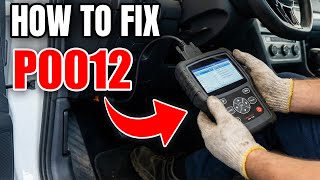
- Verify the code with an OBD-II scanner. 🎬 Watch: A quick overview of diagnosing the P0012 code.
- Check the engine oil level and condition. If low, dirty, or the wrong viscosity, perform an oil and filter change with manufacturer-specified oil (e.g., 0W-20 Synthetic) and an OEM filter. Clear the code and drive. This is the most common fix.
- If the code returns, inspect the wiring and connector for the Bank 1 (passenger side) intake OCV. Look for damage, corrosion, or oil contamination in the connector.
- To confirm a faulty OCV, swap the passenger-side intake OCV with the driver-side intake OCV. They are identical parts. Clear the codes and drive the vehicle. If the code changes to P0022, the OCV you moved is the problem.
- If the OCV is confirmed faulty, replace it with a new OEM part and a new O-ring. The OEM part number for many FB/FA engines is 10921AA231.
- If the code persists, the issue is more complex. The next step is to inspect for clogged AVCS oil screens (banjo bolt filters on turbo models, internal screens on others). This is more invasive.
- If all else fails, consult a professional to diagnose potential mechanical issues like a stretched timing chain or a faulty AVCS cam phaser, which requires specialized tools and knowledge.
Parts You'll Likely Need
- Engine Oil and Filter
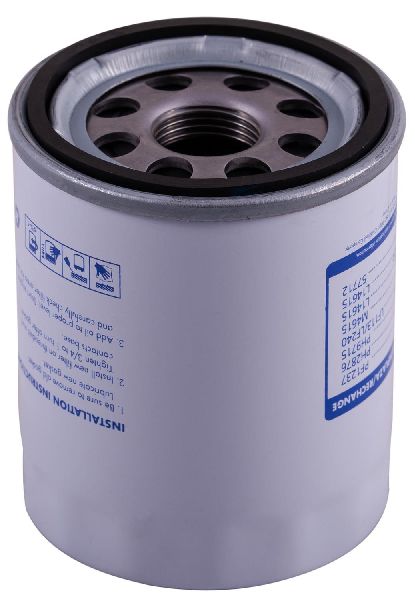
(OEM #e.g., Oil Filter 15208AA15A)— This is the most common cause. The AVCS system requires clean oil at the correct pressure to function.
Trusted brands: Idemitsu (OEM supplier), Subaru (OEM), Mobil 1
OEM price range: $60-$90
Aftermarket price range: $40-$70 - Intake Oil Control Valve (OCV) Solenoid - Bank 1
(OEM #10921AA231 (Verify with VIN, but common for many FB/FA engines))— This is the second most common failure. The solenoid gets clogged or fails electrically, preventing it from adjusting cam timing.
Trusted brands: Subaru (OEM), Denso (Often the OEM manufacturer), Dorman
OEM price range: $90-$150
Aftermarket price range: $70-$120
Related Codes That Often Appear With This One
- P0011 — P0011 is for 'Timing Over-Advanced' on the same camshaft (Bank 1 Intake). Seeing them together or intermittently could point to an erratic OCV or severe oil flow/pressure issue.
- P0022 — This is the same 'Over-Retarded' code but for Bank 2 (driver's side). If you swap OCVs for diagnosis, you expect P0012 to become P0022 if the valve is bad.
- P0021 — This is the 'Over-Advanced' code for Bank 2. Seeing multiple AVCS codes (P0011, P0012, P0021, P0022) simultaneously often points to a systemic issue like extremely low/dirty oil or a failing oil pump.
Technical Service Bulletins (TSBs) & Recalls
- 02-163-16R: This TSB provides revised, detailed diagnostic procedures for a wide range of AVCS-related trouble codes (including P0011, P0012, etc.) on 2011+ Forester models with FA/FB engines. It emphasizes checking oil, OCV function, and even provides steps for checking mechanical timing with a scan tool. The bulletin confirms that these procedures apply to Forester, Impreza, Crosstrek, WRX, and other models.
- Bulletin #09-128-24: This manufacturer service bulletin notes that P0012 can be associated with "A" Camshaft Position - Timing Over-Advanced or System Performance Bank 2 issues, often appearing alongside communication faults like U0100.
- Bulletin #09-128-24R: An updated manufacturer bulletin for Subaru engines further clarifies the relationship between P0012 and camshaft timing system performance on Bank 2, as well as potential links to Evap System Leak Detection Pump Sense Circuit Range/Performance.
Platform-Specific Known Issues
- Subaru's AVCS system is notoriously sensitive to oil maintenance; extending oil change intervals significantly increases the risk of this code appearing.
- On some older Subaru engines, oil was known to wick up through the OCV connector into the wiring harness, causing electrical issues. It's worth inspecting the connector for oil saturation.
- The banjo bolt filters for the turbo oil feed line on XT (turbo) models are a known point of failure due to clogging, which can starve the turbo and AVCS system of oil. Many owners proactively remove them, though this carries its own risks.
Mechanic-Grade Diagnostic Values
- OCV Solenoid Resistance — expected: 5-15 Ω. Failure: A reading outside this range indicates an electrical failure in the solenoid coil.
- Mechanical Timing Check via Scan Tool (per TSB 02-163-16R) — expected: Approx. 0°. Failure: A reading of approximately +/- 10° indicates the timing chain has likely skipped a tooth.
- Scan Tool Live Data: Intake AVCS Advance Angle (Bank 1) — expected: Varies with engine speed and load. Parameter name is 'VVT Adv. Ang. Amount R'.. Failure: Value does not change as commanded by the ECM or is stuck at 0, indicating a lack of response.
Scan Tool Commands That Help
- Subaru Select Monitor (SSM) or equivalent: Current Data Display: 'VVT Adv. Ang. Amount R' — Used as part of TSB 02-163-16R's procedure to check mechanical base timing. With the Bank 1 intake OCV unplugged, start the engine and observe this value at idle. It should be near 0°; a value near +/- 10° suggests a jumped timing chain tooth.
- Subaru Select Monitor (SSM) or equivalent: Live Data Parameter: 'AVCS Intake Activation Post Reset Flag' — After an ECU reflash or reset, this flag will be 'OFF' or '0' until the ECU has relearned AVCS control at idle. If AVCS is not engaging, check this flag to see if the system is pending relearn.
Wiring & Ground Locations
- Primary ECU Ground — Top of the intake manifold.. The ECU gets its main ground reference from the intake manifold. A poor connection here due to corrosion or modification (like plastic TGV deletes) can cause a host of erratic sensor readings and codes, including AVCS faults.
- Chassis Ground Point — The point on the chassis where the negative battery cable connects.. This is the primary return path for the vehicle's electrical system. Ensuring this is clean and tight is a fundamental step in diagnosing any electrical fault.
- Engine Block Ground — Typically a strap from the engine block to the chassis, often located below the battery tray or near the starter.. Provides the main ground path for components mounted directly to the engine block. A weak or corroded strap can cause current to seek other paths, leading to unpredictable electrical issues.
- GE (Engine Ground) — On a 2010 Forester Turbo model, this is designated on the left side of the engine assembly in wiring diagrams.. This is a specific, documented engine ground point in service manuals that should be checked for integrity.
Real Owner Repair Stories
- LegacyGT.com forum user (2004 Subaru Forester XT (similar EJ engine principles apply)) — Not specified, but diagnosing AVCS issues.
❌ Tried (didn't work) Checking the banjo bolt and finding it empty.
✅ What actually fixed it The mesh filter screens had fallen out of the banjo bolts and were stuck inside the AVCS oil passage in the head. They were difficult to spot because they were black and covered in oil, appearing to be part of the passage itself. The user had to dig around in the oil hole to find and remove them. - Reddit user in r/subaru (2010 Subaru Forester XT (EJ255 engine)) — Diagnosing AVCS / Banjo Bolt filter issue.
❌ Tried (didn't work) Concern about needing to remove timing covers to access banjo bolts.
✅ What actually fixed it The user confirmed that for their model, the timing covers did not need to be removed. Access to the passenger side banjo bolt was achieved by removing the airbox, and the driver's side was accessed by removing the battery. This provides a significant labor-saving tip.
"I Checked Everything" — The Actual Cause
- A common pattern for this code is: the oil is clean, the OCV has been tested or swapped, and the code persists. The actual cause is often a clogged oil passage screen (banjo bolt filter) that is starving the AVCS system of oil pressure. On turbo models, a clogged filter in the turbo oil feed line is a known cause of repeat turbo failure, as shops replace the turbo without clearing the restriction that caused the initial failure.
OEM Part Supersession History
10921AA220, 10921AA230→10921AA231— Likely an internal revision for improved reliability. An updated design features a redesigned internal oil seal to prevent oil from leaking into the wiring harness.
Model Year Variations Within This Range
- 2014-2018: In 2014, the FB25 engine was updated. Changes included a higher compression ratio (10.3:1 from 10.0:1), new pistons, redesigned intake ports with larger valves, and a new intake manifold. While the fundamental AVCS system is the same, these internal changes differentiate it from the 2011-2013 engines.
- 2019-2026: Starting with the 2019 model year Forester (SK generation), Subaru introduced the FB25D engine, which features direct fuel injection. This is a significant change from the port-injected FB25B used in prior years.
Diagnostic Flowchart
Related OBD-II Codes
Frequently Asked Questions
Does TSB 02-163-16R apply to my Forester for the P0012 code?
What type of oil should I use to prevent P0012 on my 2012-2026 Forester?
I have a Forester XT turbo. Is there a specific part I should check for this code?
What is the OEM part number for the Oil Control Valve (OCV) on the FB/FA engine?
How can I test if the Bank 1 OCV is causing the P0012 code on my Forester?
Why is there oil inside the wiring connector for my OCV?
Helpful Videos
Used OEM Parts in Stock


New Aftermarket Parts Available


The information in this article is provided for general reference and educational purposes only. Vehicle specifications, procedures, and part compatibility can vary by production date, trim level, and region. Always consult your vehicle's factory service manual and verify part numbers before purchasing or performing repairs. Safety-critical components such as airbags, seat belts, and braking systems should be installed by a qualified professional.
- Subaru Forester:
- 🎬 Helpful Videos
- 🛍️ Shop This Part
- What's Unique About the 2012-2026 Subaru Forester
- Symptoms You May Notice
- Most Likely Causes
- Rare But Worth Checking
- Diagnosis Steps
- Parts You'll Likely Need
- Related Codes That Often Appear With This One
- Technical Service Bulletins (TSBs) & Recalls
- Platform-Specific Known Issues
- Mechanic-Grade Diagnostic Values
- Scan Tool Commands That Help
- Wiring & Ground Locations
- Real Owner Repair Stories
- "I Checked Everything" — The Actual Cause
- OEM Part Supersession History
- Model Year Variations Within This Range
- Diagnostic Flowchart
- Related OBD-II Codes
- Frequently Asked Questions
- 🎟️ Get 5% Off