

P0008 on 2004-2009 Cadillac SRX: Stretched Timing Chain Causes and Fixes
On a 2004-2009 Cadillac SRX with the 3.6L V6, code P0008 almost always means the timing chains have stretched. This is a serious, complex, and expensive repair costing $2,500-$4,000+ and should be addressed immediately to prevent catastrophic engine failure. The root cause is a combination of an early timing chain design and overly optimistic oil life monitor recommendations from GM.
- P0008 on this SRX is a serious code that almost certainly means the timing chains have stretched.
- Do not drive the vehicle. A chain failure can destroy the engine, turning a costly repair into a total loss.
- Do not waste money replacing sensors first; they are rarely the cause of this code.
- The only correct fix is a complete timing chain service, replacing all chains, tensioners, and guides with updated parts. After repair, change oil every 5,000 miles.
- This is a very expensive repair, typically $2,500-$4,000+, due to the high labor involved.
What's Unique About the 2004-2009 Cadillac SRX
The first-generation Cadillac SRX uses the 3.6L LY7 V6 engine, which is notorious for premature timing chain failure. The original timing chains used in these engines were susceptible to stretching, a problem often accelerated by the vehicle's oil life monitoring system, which could recommend overly long oil change intervals (8,000-12,000 miles). This leads to oil degradation and low oil pressure, starving the hydraulic tensioners and causing accelerated chain wear. The issue was so widespread that General Motors issued a Special Coverage Adjustment (11340C) that extended the warranty for this specific repair to 10 years or 120,000 miles, acknowledging the design flaw. Therefore, P0008 on this specific vehicle is a very strong indicator of this well-documented and common failure.
🎬 Watch: Understanding GM timing death codes and diagnostic stepsSymptoms You May Notice
- Check Engine Light illuminated
- Engine running rough or idling poorly
- Noticeable loss of power and sluggish acceleration
- Decreased fuel economy
- Rattling or scraping noise from the front of the engine, especially on cold starts
- Replacing the camshaft position sensors.
- Replacing the crankshaft position sensor.
- Replacing the VVT solenoids (camshaft actuators).
Most Likely Causes
- Stretched Timing Chains 🔴 High Probability The original equipment timing chains on the LY7 engine were of a design prone to premature wear and stretching. This was exacerbated by extended oil change intervals recommended by the oil life monitor, leading to oil breakdown and inadequate lubrication of the chains and tensioners over time. Manufacturer Bulletin #12-06-01-009F specifically addresses the availability of high feature V6 timing chain kits for repairing stretched timing chains that set DTC P0008.
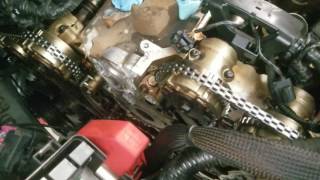
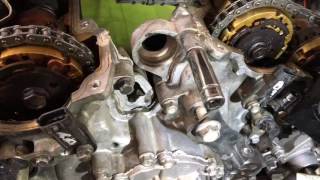
How to confirm: A technician can use an advanced scan tool to view camshaft position deviation data; consistent deviation beyond a few degrees points to a mechanical issue. A definitive diagnosis involves physically inspecting the chains for slack by removing the engine's front timing cover. An oscilloscope can also be used to compare cam and crank sensor signals to a known-good waveform to confirm timing deviation.
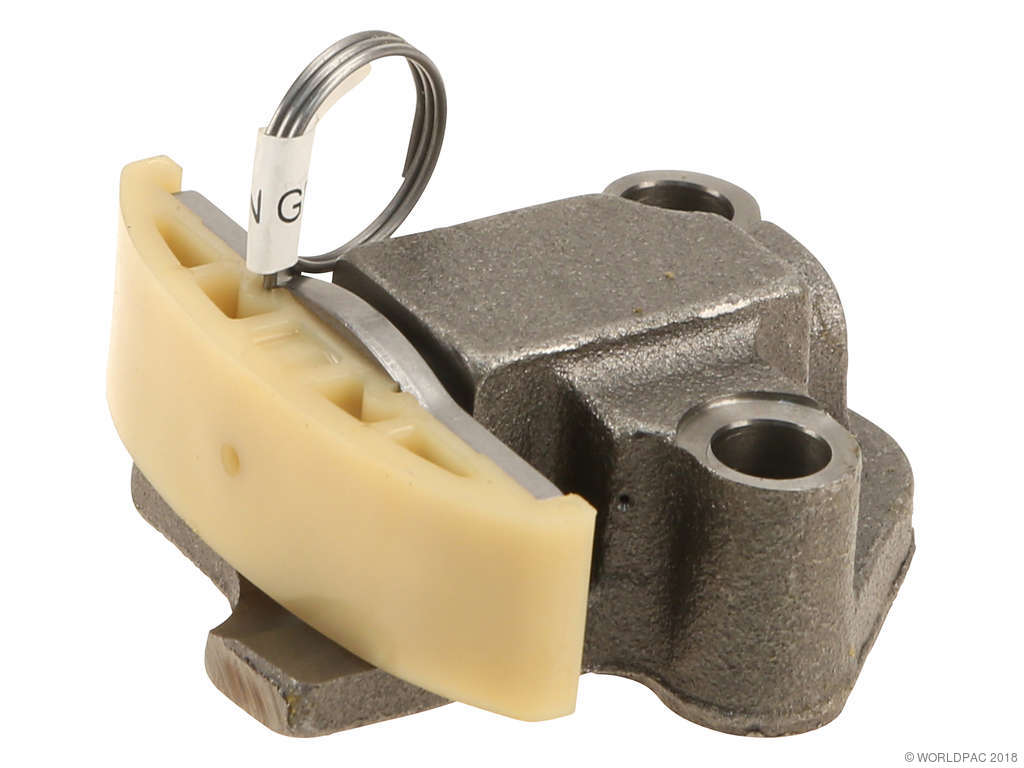
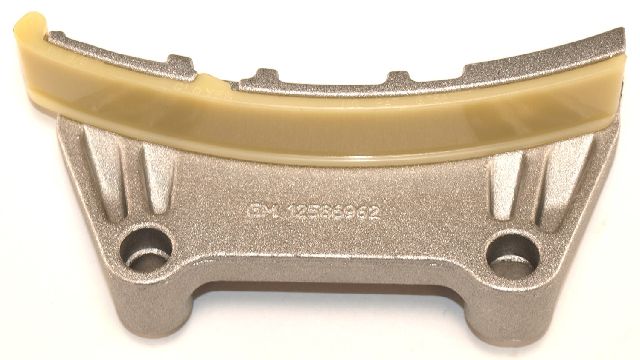
Typical fix: Replace all three timing chains (one primary, two secondary), all timing chain tensioners, and all guides with a new, updated kit. An oil and filter change is mandatory. After the repair, it is highly recommended to ignore the oil life monitor and change the oil every 5,000 miles.
Est. part cost: $300-$700 - Failed Timing Chain Tensioners 🟡 Medium Probability The tensioners, which keep the chains tight, are operated by engine oil pressure. They can lose their hydraulic pressure due to sludge from old oil or fail mechanically, allowing the chains to become slack. Bulletin #PIP3423P notes that technicians should specifically inspect for loose timing chains or tensioners when this code is present.
How to confirm: Usually diagnosed during the inspection for a stretched timing chain. A rattling noise on startup is a strong indicator of a tensioner that is slow to build pressure.
Typical fix: Tensioners are always replaced as part of a complete timing chain service. They are included in quality timing chain kits.
Est. part cost: $100-$200 (part of kit) - Low or Degraded Engine Oil ⚪ Low Probability The timing chain tensioners are hydraulically operated by engine oil pressure. Low or dirty oil can't provide adequate pressure or lubrication, accelerating wear on the entire timing system. The LY7 engine can also consume oil, and if the level drops too low before the recommended change interval, damage can occur.
How to confirm: Check the oil level on the dipstick and inspect its condition. However, by the time P0008 is set, the damage from poor oil maintenance is likely already done and irreversible without parts replacement.
Typical fix: An oil change is critical, but it will not fix a stretched chain. The mechanical damage is permanent and requires parts replacement. Adhering to a 5,000-mile oil change interval with quality synthetic oil is the best prevention for the new parts.
Est. part cost: $50-$100
Rare But Worth Checking
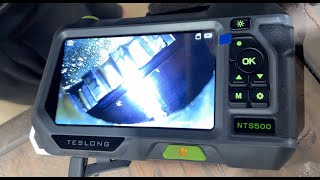
- Slipped Crankshaft Reluctor Wheel: GM issued a Technical Service Bulletin (PIP3423P) for this issue. The reluctor wheel that the crankshaft position sensor reads can move slightly on the crankshaft, causing timing codes even if the chains are good. This is often discovered after a timing chain replacement fails to fix the code. The TSB provides a measurement to check if the wheel has slipped, which can sometimes be done with a borescope through the crank sensor hole. 🎬 Watch: How to inspect the crankshaft tone ring If it has slipped, the crankshaft must be replaced.
Diagnosis Steps
- Verify the code with a quality OBD-II scanner. Note any other codes present, especially P0009, P0016-P0019.
- Check engine oil level and condition. If low or dirty, correct it, but understand this will not fix a mechanical problem.
- Using an advanced scan tool, monitor the camshaft position deviation data for Bank 1. Consistent deviation beyond a few degrees at idle points to a mechanical timing issue.
- Listen for any rattling or scraping noises from the engine's front cover, especially during a cold start, which indicates slack in the chains or bad tensioners.
- If possible, use an oscilloscope to compare the crankshaft sensor signal with the Bank 1 camshaft sensor signals. A delayed camshaft signal relative to a known-good waveform is definitive proof of chain stretch.
- The definitive diagnosis is a visual inspection of the timing chains, tensioners, and guides, which requires significant engine disassembly.
- If timing chain replacement does not resolve the code, investigate the possibility of a slipped crankshaft reluctor wheel as described in TSB PIP3423P.
Parts You'll Likely Need
- Engine Timing Chain Kit
(OEM #12651450 (This part number is for a kit covering multiple 3.6L versions and has been superseded by 12700436, but is widely referenced))— This is the definitive fix. A complete kit ensures all worn components (chains, guides, tensioners, sprockets) are replaced with updated parts to prevent a repeat failure.
Trusted brands: ACDelco (OEM), Cloyes (e.g., 9-0753S)
OEM price range: $400-$600
Aftermarket price range: $250-$450
Related Codes That Often Appear With This One
- P0009 — This is the identical code but for Bank 2. Seeing P0008 and P0009 together strongly points to a stretched primary timing chain that affects both cylinder banks.
- P0016, P0017, P0018, P0019 — These are more specific crankshaft-to-camshaft correlation codes for each individual cam. Their presence further confirms a significant mechanical timing issue caused by stretched chains and helps pinpoint which cam/bank is most affected. Bulletin #12-06-01-009F confirms these codes often appear alongside P0008 when chains are stretched.
Technical Service Bulletins (TSBs) & Recalls
- 11340C: Special Coverage Adjustment for timing chain wear. This bulletin confirms the issue on 2007-2009 SRX models with the LY7 engine and extended the warranty. It also includes instructions to reprogram the ECM.
- 12-06-01-009F: Information on updated V6 timing chain kits for repair. This bulletin announces the availability of high feature V6 timing chain kits and chain guide replacements for repairing stretched timing chains.
- PIP3423P: Diagnostic aid for timing codes (P0008, P0009, P0016-19). Points to either loose chains or a slipped crankshaft reluctor wheel. This is a critical document if a timing chain job doesn't fix the code.
Platform-Specific Known Issues
- The 3.6L LY7 engine is widely known for premature timing chain stretching, which is the root cause of this code in the vast majority of cases.
- GM issued Special Coverage Adjustment #11340C, extending the warranty on timing chain components to 10 years or 120,000 miles, confirming the prevalence of the issue. This has likely expired for all 2004-2009 models.
- Owner forums are filled with stories of this exact failure. Many owners who have had the repair done emphasize the importance of switching to 5,000-mile oil change intervals with full synthetic oil afterward to protect the new chains.
Mechanic-Grade Diagnostic Values
- Scan Tool: Desired vs. Actual Camshaft Position Angle Variance — expected: Less than 2-3 degrees at a steady idle.. Failure: A consistent variance greater than 5-6 degrees for more than 5 seconds indicates a mechanical timing problem.
- Camshaft Position Actuator Solenoid (VVT Solenoid) Resistance — expected: 7 to 13 Ohms at 68°F (20°C).. Failure: A reading of 0 Ohms (short), OL/infinite (open circuit), or a value significantly outside the expected range indicates a failed solenoid coil.
- Crankshaft Reluctor Wheel Position Measurement (per TSB PIP3423P) — expected: 25 to 26 mm from the machined surface of the crankshaft throw to the edge of the reluctor's open space.. Failure: Any measurement other than the specified range indicates the reluctor wheel has slipped on the crankshaft, requiring crankshaft replacement.
Scan Tool Commands That Help
- GDS2 / Tech2: Camshaft Position Actuator Control / Solenoid Test — This bidirectional control allows a technician to command a VVT solenoid ON and OFF while monitoring the 'Desired vs. Actual' camshaft position PIDs. If the actual angle fails to change when commanded, it helps isolate the problem to the solenoid, oil passages, or the phaser itself, ruling out a base timing issue.
- GDS2 / Tech2: ECM Reprogramming — GM issued software updates for the ECM as part of Special Coverage 11340C. This update could adjust the thresholds for setting timing correlation codes, potentially allowing for slightly more chain stretch before illuminating the Check Engine Light. This should be performed after a timing chain replacement to ensure the latest logic is installed.
Wiring & Ground Locations
- ECM (Engine Control Module) — Mounted directly on the engine's right (Bank 1) valve cover.. The ECM is the central component that reads all sensor data and sets the P0008 code. Its location on a hot, vibrating engine makes its connections and internal integrity critical.
- G101 — At the left rear of the engine compartment, on the frame.. This is a primary ground point for the Engine Control Module (ECM). A poor connection here can cause erratic ECM behavior and phantom codes.
- G102 — On the right rear of the engine, on the cylinder head (Bank 1).. This ground is used by the ignition coils. While not a direct cause of P0008, a poor ground on the same bank as the code could contribute to noisy electrical signals that might complicate diagnosis.
- ECM Connectors X1 / X2 — The two main harness connectors plugging into the ECM on the valve cover.. All signals from the camshaft and crankshaft position sensors pass through these connectors. Checking for corrosion or backed-out pins here is a necessary step when diagnosing sensor circuit issues.
Real Owner Repair Stories
- YouTube user 'P0008 Cadillac fix' (Cadillac (model unspecified, but with 3.6L engine and P0008)) — Check Engine Light with code P0008, loss of power, delayed acceleration around 40mph.
❌ Tried (didn't work) The user notes that just changing camshaft sensors sometimes isn't enough and that VVT solenoids can also be a cause.
✅ What actually fixed it The user replaced the two camshaft position sensors on Bank 1. After clearing the codes and test driving, the Check Engine Light did not return. The user states the video would not have been posted if this did not fix the car, providing a confirmed fix. - YouTube channel 'Pine Hollow Auto Diagnostics' (2008 Cadillac SRX, 85k miles) — Check Engine Light with codes P0008 and P0017.
❌ Tried (didn't work) This was a diagnostic video, not a repair attempt. The technician's goal was to differentiate between chain stretch and a slipped reluctor wheel before recommending a repair.
✅ What actually fixed it Diagnosis confirmed timing chain stretch. Using a PicoScope, the technician compared the crankshaft signal to both bank 1 and bank 2 camshaft signals. He found the bank 1 cam signal was retarded relative to the crank and relative to the known-good bank 2 cam. This pattern is indicative of a stretched chain affecting one bank more than the other and ruled out a slipped reluctor wheel (which would affect both banks equally). The final diagnosis was to perform a complete timing chain replacement. - NHTSA ODI #11154307 — An owner reported that when driving, the acceleration is slow to pick up. When the engine light came on, a scan revealed code P0008, indicating an issue with the engine module detecting a problem with the timing between the crankshaft and camshaft.
- NHTSA ODI #10542176 — An owner reported the check engine light was on with a single error code P0008, which indicates an elongation of timing chains. The repair cost was estimated at the $1800 level.
When the Usual Fixes Don't Work
- While the overwhelming majority of P0008 codes on the LY7 engine are caused by stretched timing chains, it is not a 100% certainty. There are confirmed cases where the code was resolved by replacing only the camshaft position sensors. Furthermore, an edge case has been documented where multiple, brand-new OEM sensors were faulty out of the box, leading to a misdiagnosis. Therefore, while timing chain failure is the highest probability cause, a thorough diagnosis that includes testing the sensors and their circuits should not be skipped, as it can occasionally prevent an unnecessary and extremely expensive timing chain replacement.
OEM Part Supersession History
Varies by year, e.g., 12650230 for 2007 models.→12651450, then 12693218, then 12700436.— GM continuously updated the timing chain design to improve durability and reduce stretching. Later kits contain chains made with improved materials and manufacturing processes.
Heads up: While kits may physically fit, it's critical to use the correct kit for the specific model year. TSB 12-06-01-009F explicitly states that for stretched chain repairs, only the chains, guides, and tensioners should be replaced, not the sprockets or actuators, as they are not considered wear items in this specific failure mode.
Model Year Variations Within This Range
- 2007-2009: These model years were specifically called out in GM's Special Coverage Adjustment 11340C for premature timing chain wear, while 2004-2006 models were not, despite using the same LY7 engine. This may indicate a change in chain supplier or design starting in 2007 that exacerbated the issue, or it could have been a business decision by GM to limit the scope of the free repair program.
- 2007: GM TSB 12-06-01-009F lists a specific timing chain kit (12650230) just for 2007 models, indicating a parts difference compared to 2008-2009 vehicles.
Diagnostic Flowchart
Other Known Issues on This Vehicle
Issues unrelated to this code that are worth knowing about as an owner of this generation:
- Leaking Sunroof Drains 🟠 Medium — Very common. The drain tubes are often too short from the factory, causing them to pop out of the firewall grommet, leading to water on the front floorboards.
- Rear Axle Pinion Seal Leak 🟠 Medium — A widely reported issue where the rear differential pinion seal fails, causing fluid loss that can damage the differential if not addressed. (Ref: 07V589000)
- Prematurely Burnt Out Headlight/DRL Bulbs 🟡 Low — Many owners report frequent failure of front turn signal and daytime running light bulbs, sometimes caused by an overheating bulb socket.
- Faulty Steering Wheel Position Sensor 🟠 Medium — Can fail and cause a 'Service Stability System' message to appear, and in some cases, cause random stalling.
- Water Pump Failure 🔴 High — The water pumps on the 3.6L V6 are known to fail, leading to coolant leaks and potential engine overheating if not caught in time.
Used vs. New Parts: Buying Guide for This Vehicle
When a used part is the smart pick: For a P0008 repair, using used parts is strongly discouraged for any timing component (chains, tensioners, guides). The only scenario where a used part is viable is sourcing a complete, low-mileage used engine from a reputable salvage yard if the original engine has suffered catastrophic failure from a broken chain.
Donor-vehicle mileage cap: roughly under 70000 miles for the part to have meaningful remaining life.
What to inspect on the donor part:
- Obtain vehicle history to verify mileage and look for evidence of regular oil changes.
- Remove the oil filler cap and inspect for thick, black sludge, which indicates poor maintenance.
- If possible, get compression test numbers for all cylinders.
- Ask for a warranty from the salvage yard (typically 30-90 days).
OEM-only on this vehicle (don't cheap out):
- Engine Timing Chain Kit: While some aftermarket brands are reputable, the ACDelco (GM Genuine) kit is the safest choice to guarantee the latest design updates and prevent a premature repeat failure.
Aftermarket brands forum-validated for this vehicle:
- Cloyes (e.g., 9-0753S)
- Melling (e.g., 3-753S)
- Dayco (e.g., KTC1391)
Brands owners have reported issues with on this vehicle:
- Unbranded, 'white-box' kits from online marketplaces (e.g., eBay, Amazon). These often use inferior materials that can stretch or fail very quickly, leading to a repeat of this expensive repair.
Real Owner Stories
Aggregated from forums and TSBs cited above. Mileages and costs reflect what owners reported in those sources.
2008 Cadillac SRX 3.6L V6
Symptoms: Technician observed timing chain stretch by comparing cam/crank waveforms using a PicoScope, ruling out other mechanical slips.
What fixed it: Confirmed timing chain stretch via oscilloscope; required full timing chain replacement.
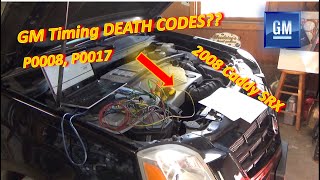
Source hint: YouTube - 'GM Timing DEATH CODES? (P0008 P0017 Cadillac SRX V6)': A detailed diagnostic video by Pine Hollow Auto Diagnostics
2007-2009 Cadillac SRX 3.6L V6 — ~120000 miles
Symptoms: Premature timing chain wear and stretching leading to P0008; often exacerbated by extended oil change intervals from the oil life monitor.
What fixed it: Replacement of timing chain components under Special Coverage Adjustment #11340C (when active) and reprogramming the ECM.
Source hint: 11340C: Special Coverage Adjustment for timing chain wear
2010 GMC Acadia 3.6L V6 (LLT/LY7 variant)
Symptoms: Timing codes P0008, P0009, or P0016-19 persisting after potential chain issues.
What fixed it: Checking for a slipped crankshaft reluctor wheel through the crank sensor hole as per TSB PIP3423P.
Source hint: YouTube - '2010 gmc Acadia hf v6 3.6 LLT crank reluctor wheel check for tsb PIP3423P'
2006 Cadillac SRX
Symptoms: The check engine light (CEL) came on, and a diagnostic scan performed the following day confirmed a P0008 code.
What fixed it: Timing chain repair was required to resolve the P0008 code.
Source hint: NHTSA ODI #10561407
Related OBD-II Codes
Frequently Asked Questions
Is my 2008 Cadillac SRX covered under a warranty extension for the P0008 code?
Can I just change the oil to fix the P0008 code on my 3.6L LY7 engine?
What specific parts should be replaced to resolve the P0008 issue permanently?
What if I replace the timing chains on my SRX but the P0008 code returns?
How often should I change my oil after having the timing chains replaced?
Does the P0008 code affect other Cadillac models with the same engine?
Helpful Videos
We Have This Part in Stock




The information in this article is provided for general reference and educational purposes only. Vehicle specifications, procedures, and part compatibility can vary by production date, trim level, and region. Always consult your vehicle's factory service manual and verify part numbers before purchasing or performing repairs. Safety-critical components such as airbags, seat belts, and braking systems should be installed by a qualified professional.
- Cadillac SRX:
- 🎬 Helpful Videos
- 🛍️ Shop This Part
- What's Unique About the 2004-2009 Cadillac SRX
- Symptoms You May Notice
- Most Likely Causes
- Rare But Worth Checking
- Diagnosis Steps
- Parts You'll Likely Need
- Related Codes That Often Appear With This One
- Technical Service Bulletins (TSBs) & Recalls
- Platform-Specific Known Issues
- Mechanic-Grade Diagnostic Values
- Scan Tool Commands That Help
- Wiring & Ground Locations
- Real Owner Repair Stories
- When the Usual Fixes Don't Work
- OEM Part Supersession History
- Model Year Variations Within This Range
- Diagnostic Flowchart
- Other Known Issues on This Vehicle
- Used vs. New Parts: Buying Guide for This Vehicle
- Real Owner Stories
- 2008 Cadillac SRX 3.6L V6
- 2007-2009 Cadillac SRX 3.6L V6 — ~120000 miles
- 2010 GMC Acadia 3.6L V6 (LLT/LY7 variant)
- 2006 Cadillac SRX
- Related OBD-II Codes
- Frequently Asked Questions
- 🎟️ Get 5% Off