

C1100 on 2007-2014 Ford F-150: ABS Module Failure Causes and Fixes
On a 2007-2014 F-150, code C1100 almost always means the ABS control module has failed internally. The most common and cost-effective fix is to remove the module and send it to a specialist for repair, which typically costs $150-$250 and avoids the need for expensive dealership reprogramming.
- Code C1100 on a 2007-2014 F-150 is almost certainly a failed ABS control module.
- Key symptoms are the ABS/Brake lights on and the ABS pump motor running constantly, even when the truck is off.
- Do not replace the entire expensive ABS hydraulic unit; the problem is the electronic module attached to it.
- The most economical fix is to remove the module and send it to a repair service for rebuilding, which costs around $150-$250 and requires no reprogramming.
- If the pump runs constantly, pull the main ABS fuse in the engine bay fuse box to prevent battery drain while you arrange repairs.
What's Unique About the 2007-2014 Ford F-150

The 2007-2014 F-150 is well-known for this specific failure. Unlike on other vehicles where C1100 might point to wiring or external sensors, on this generation of F-150, the root cause is overwhelmingly an internal failure of the electronic ABS control module itself. The specific point of failure is often a MOSFET transistor on the circuit board that shorts out, causing the ABS pump to run continuously. This has led to a robust market of third-party repair services that can rebuild the original module for a fraction of the cost of a new one, making it a common and well-documented repair for owners.
Generation note: This guide covers two F-150 generations: the 11th (2007-2008) and 12th (2009-2014). The C1100 code pointing to a failed ABS module is a common problem across both generations. While the specific part numbers for the ABS module may differ, the symptoms, diagnosis, and repair path are virtually identical.
Symptoms You May Notice
- ABS warning light is on
- Brake warning light is on
- Traction Control/Stability Control light is on
- ABS pump motor runs continuously, even with the ignition off
- Inability to communicate with the ABS module using a scan tool
- A buzzing or humming noise from the ABS pump area under the hood
- Speedometer may not work or be intermittent (less common symptom)
- Replacing the entire ABS pump/hydraulic unit. The fault is almost always in the electronic module that bolts to the hydraulic block, not the block itself. Replacing the whole assembly is expensive, requires bleeding the entire brake system, and is usually unnecessary.
- Replacing wheel speed sensors. While wheel speed sensor faults are common ABS issues, they generate different codes (e.g., C1145, C1155) and would not be the cause of a C1100 code.
Most Likely Causes

- Internal Failure of the ABS Control Module 🔴 High Probability The electronic components, specifically the power relay solder joints and the main MOSFET transistor on the circuit board within the Bosch-manufactured ABS modules, are known to fail over time due to heat cycles and vibration. The MOSFET failure often creates a short circuit, causing the pump motor to run constantly.
How to confirm: After verifying good power and ground to the module, the inability to clear the code or communicate with the module points to an internal fault. The ABS pump running constantly, even with the key off, is a definitive sign of a failed module on this truck. 🎬 See how to handle an ABS pump motor that won't stop running.
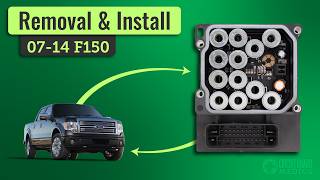
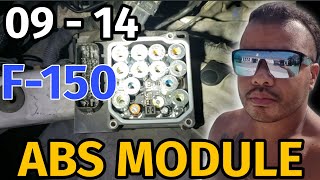
Typical fix: Remove the electronic control module from the ABS hydraulic unit (using an E5 or E6 Torx socket) and send it to a specialized repair service. This is far more economical than replacement and does not require reprogramming.
Est. part cost: $150-$250 for a repair service. - Damaged Wiring or Corroded Connector ⚪ Low Probability The ABS module is located in the engine bay on the driver's side frame rail, exposed to the elements. Connectors can become corroded, and wiring can be damaged from heat, chafing, or impact, though this is much less common than module failure.
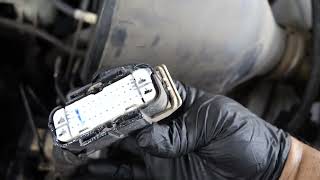
How to confirm: Visually inspect the large wiring harness and connector (C135) going to the ABS module for any signs of corrosion, moisture, or damage. Use a multimeter to test for battery voltage at the power pins (Pin 1, YE-RD wire) and a solid ground connection at the ground pins (Pin 13, BK-YE wire), according to a wiring diagram.
Typical fix: Repair the damaged section of wiring or clean the corroded terminals on the connector and module.
Est. part cost: $5-$30 for wiring supplies.
Rare But Worth Checking
- Failed ABS Pump Motor: While the C1100 code references the pump circuit, the electronic module is the much more common failure point. The motor itself is generally robust. A direct motor failure might be suspected if the module has been confirmed good or repaired and the problem persists. In some cases, a user on f150forum.com reported needing to replace the pump/motor assembly after a module repair did not solve the issue.
Diagnosis Steps
- Confirm the presence of code C1100 using an OBD-II scanner capable of reading ABS codes.
- Listen for the ABS pump. With the key removed from the ignition, listen under the hood near the driver's side firewall. If the ABS pump is constantly running or buzzing, this is a very strong indicator of a failed control module.
- If the pump is running constantly, pull the main ABS fuse to prevent battery drain. This is typically a large 60A fuse (Fuse #47 in the under-hood fuse box for 2009-2014 models). This allows you to drive the truck (without ABS) while arranging for repair.
- If the pump is not running, check the main ABS fuses in the engine bay fuse box. For 2009-2014 models, this includes Fuse #36 (30A) and Fuse #54.
- Inspect the main electrical connector (C135) at the ABS module for any signs of corrosion, moisture, or damage.
- Using a multimeter and a vehicle-specific wiring diagram, verify that the ABS module is receiving proper battery voltage and has a good ground connection. Check for battery voltage at Pin 1 (YE-RD wire) and continuity to ground (less than 1 ohm) at Pin 13 (BK-YE wire) of connector C135.
- If power and ground are good, and the fuses are intact, the ABS control module is faulty and is the source of the C1100 code.
- At this point, the recommended fix is to remove the module (requires an E5 or E6 external Torx socket) and send it for repair.
Parts You'll Likely Need

- ABS Control Module Repair Service — This is the most common and cost-effective solution. The original module is removed, repaired by a specialist, and reinstalled, which avoids the high cost and programming requirements of a new part.
Trusted brands: Module Master, Circuit Board Medics, Module Repair Pro, ECU Testing
OEM price range: $800-$1500 for a new module
Aftermarket price range: $150-$250 for a repair service - ABS Control Module (New or Remanufactured)
(OEM #7L3Z-2C219-A, 9L3Z-2C219-B, BL3Z-2C219-B, DL3Z-2C215-C (Varies significantly by year, 2WD/4WD, and options). Bosch numbers include: 0265951725, 0265951840, 0265951980, BL342C405BF.)— Required if the original module is physically damaged or cannot be repaired. A new module from Ford or a pre-remanufactured unit is an option, but will be more expensive and may require programming.
Trusted brands: Ford (OEM), Bosch (OEM), Dorman
OEM price range: $800-$1500
Aftermarket price range: $300-$600
Related Codes That Often Appear With This One
- B1342 — This code means 'ECU is Defective' or 'Internal Fault'. It is a generic internal module fault code that often appears alongside C1100 when the ABS module has failed and can no longer perform its self-check.
- B1596 — This code relates to 'ABS Service Continuous'. It is another common companion code indicating the module has detected a continuous operational fault, reinforcing the diagnosis of a failed module. 🎬 Watch: How to remove the module when facing codes C1266 or B1596.
- U0121 — This code means 'Lost Communication with ABS Control Module'. It is set by other modules in the vehicle (like the PCM or instrument cluster) when they can no longer receive a signal from the ABS module, which is a classic symptom of a completely dead or internally shorted module.
Technical Service Bulletins (TSBs) & Recalls
- No specific TSB from Ford directly addresses the C1100 code or the widespread ABS module failure. The issue is primarily documented through owner forums and the prevalence of third-party repair services catering to this specific failure.
Platform-Specific Known Issues
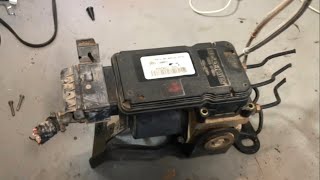
- DIY Repair of the Circuit Board: A popular thread on F150forum.com titled 'DIY: ABS Module Rebuild (ABS pump won't shut off issue solved)' details how a user successfully diagnosed the internal failure, cut open the module, and replaced the failed MOSFET transistor (part number HUF76137S3S) to fix the constantly running pump for a few dollars. This is a high-skill repair but demonstrates the precise nature of the common failure.
- Difficulty with Mounting Bolts: The four E5 (or sometimes E6) external Torx bolts holding the electronic module to the hydraulic block are notoriously difficult to remove. They are prone to stripping, especially the two on the bottom which have limited access. Owners often resort to using vice grips or cutting a slot in the bolt head to remove them after they strip.
- Owner Experience: Repair Service is the Way to Go: On Ford F150 Forum, a user experiencing multiple ABS-related codes (C1300, C1963) sent their module for repair. The repair service fixed issues on the board but the user still had issues, highlighting that while module repair is the primary fix, it's part of a larger diagnostic process. Most users in forum threads recommend the mail-in repair service as the first and most effective step.
Mechanic-Grade Diagnostic Values
- ABS Module Power Supply Voltage — expected: Battery Voltage (approx. 12.6V with key on, engine off). Failure: Voltage significantly below battery voltage or 0V indicates a power supply issue (fuse, wiring).
- ABS Module Ground Circuit Resistance — expected: Less than 1.0 Ohm. Failure: A reading higher than 1.0 Ohm (or Open Line/OL) indicates a poor or broken ground connection, which can cause intermittent or total module failure.
Scan Tool Commands That Help
- Ford IDS (Integrated Diagnostic System) or equivalent professional scanner (some high-end Foxwell, Autel, Launch models): Programmable Module Installation (PMI) — This function is used when installing a new or used replacement ABS module. For 2009-2012 models, the PMI process often requires connecting the original module first to extract its configuration data, then swapping to the new/used module to transfer the data. This ensures the replacement module is correctly configured for the truck's specific features (2WD/4WD, traction control options, etc.).
- Ford IDS or equivalent: ABS Self-Test (On-Demand) — After a repair, this command initiates a comprehensive internal check of the ABS module, pump, and solenoids to confirm the system is functioning correctly and to help clear persistent fault codes.
- Ford IDS or equivalent: Actuator Test / Pump Motor Activation — To test the ABS pump motor independently of the module. If the pump can be activated by the scan tool but does not run during normal operation, it points towards a control module fault rather than a pump motor failure.
Wiring & Ground Locations

- C135 — The main electrical connector that plugs directly into the ABS control module, located on the driver's side frame rail under the air intake housing.. This is the primary interface for all power, ground, and communication signals to the ABS module. Testing for power at Pin 1 and ground at Pin 13 is a critical first step in diagnosing a C1100.
- G108 — On the driver's side (Left) fender, near the air intake tube.. This is a primary grounding point for components in the engine bay. While wiring diagrams point to a specific ground wire in the harness, a corroded or loose G108 can cause widespread electrical issues, including problems for the ABS module.
- Under-hood Fuse Box (Power Distribution Box) — Located in the engine compartment, typically above the radiator.. This box contains the main fuses for the ABS system. For 2009-2014 models, this includes a 30A fuse at position #36 and a 60A J-case fuse at position #47 that provide power to the module and pump. A blown fuse here will cause a loss of function and codes.
Real Owner Repair Stories
- Ford F150 Forum user 'Gabgar80' (2009 F-150 5.4 4x4) — ABS, parking brake, and traction control lights on with codes C1300 and C1963.
❌ Tried (didn't work) Sent original module for repair, but it came back with new codes (C1266, B1596)., Installed a used ABS module from a 2010 F-150, which resulted in different codes (C109E, C1805), likely due to incompatibility between model years (different vacuum sensor systems).
✅ What actually fixed it The user's final resolution was not posted in the thread, but the experience serves as a critical lesson: using a junkyard module from a different model year (even if it's close) can introduce new compatibility problems, and even professional repairs can sometimes fail. - Ford F150 Forum user 'bthorup' (2016 F-150 (Post-rebuild)) — Inability to communicate with the original ABS module after rebuilding a totaled truck.
❌ Tried (didn't work) Taking a used (eBay) ABS module to the dealership, who claimed they 'cannot reprogram ABS modules' and that a new one was required.
✅ What actually fixed it The advice from another forum member (a former Ford tech) was to go to a different dealer and specifically request a 'Programmable Module Installation (PMI)' on the used module. This process copies the vehicle's configuration to the replacement module. The key takeaway is that many dealerships have a policy against programming used modules, but the technical capability exists with the right tools and technician.
OEM Part Supersession History
9L3Z-2C219-B, 9L3Z-2C219-D, 9L3Z-2C219-F→9L3Z-2C219-H— Part revision and consolidation by Ford.
Heads up: These part numbers are specific to early 2009 model year trucks. Using a module from a later build date or different drivetrain may cause programming issues.9L3Z-2C405-C, 9L3Z-2C405-E→9L3Z-2C215-B (This is a hydraulic unit that includes the module)— Part revision by Ford.
Heads up: Illustrates the difference in part numbers between 2WD and 4WD models. It's critical to match the part to the vehicle's drivetrain.
Model Year Variations Within This Range
- 2009-2010 vs 2011-2014: The introduction of Electric Power Assisted Steering (EPAS) in 2011 is a major factor. An ABS module from a pre-2011 truck installed in a 2011+ truck may work for the ABS functions but will set communication faults with the steering system (EPAS), causing Hill Descent and Steering fault messages.
- 2009-2012: When replacing an ABS module on these model years, Ford's diagnostic software (IDS/FJDS) may require the original module to be connected first to extract As-Built data before it can be transferred to the replacement (new or used) module. This makes replacement impossible if the original module is completely dead or has been discarded.
Diagnostic Flowchart
Other Known Issues on This Vehicle
Issues unrelated to this code that are worth knowing about as an owner of this generation:
- Ford 5.4L 3V Cam Phaser Rattle/Knock 🔴 High — Extremely common on 5.4L 3V engines, often starting as a light ticking noise around 80-120k miles. If ignored, it can lead to timing chain failure and catastrophic engine damage. (Ref: Multiple TSBs exist, including 06-19-8, which describes the noise and diagnostic procedure. Another TSB acknowledges the noise between 800-1200 RPM as a 'normal characteristic' but pronounced knocking indicates a problem.)
- Fuel Pump Fuse #27 Meltdown (2009-2014) 🔴 High — A widespread issue where the small 20A micro fuse in slot 27 of the battery junction box overheats, melting the fuse and its housing. This leads to intermittent or permanent crank-no-start conditions or stalling. (Ref: Ford TSB 15-0137 addresses this by providing a procedure and part number for a relocation kit (Part No. EL3Z-14293-A) to move the circuit to a larger, more robust fuse slot.)
- Integrated Wheel End (IWE) System Failure 🟠 Medium — Common on 4x4 models, especially in regions with road salt. A loss of vacuum due to a faulty solenoid or cracked vacuum lines causes the front hubs to partially engage, creating a grinding or clicking noise while in 2WD.
- 5.4L 3V Spark Plug Breakage During Removal 🟠 Medium — A notorious problem on 2004-2008 models with the 5.4L 3V engine. The original two-piece spark plug design can cause the lower barrel to seize in the cylinder head with carbon buildup and break off during removal, requiring a special extraction tool.
- Cracked Exhaust Manifold 🟡 Low — The 4.6L and 5.4L V8 engines can develop exhaust leaks from a cracked manifold or broken mounting studs, resulting in a ticking noise that is most prominent when the engine is cold and diminishes as it warms up.
Used vs. New Parts: Buying Guide for This Vehicle
When a used part is the smart pick: A used ABS module from a junkyard is a potential low-cost alternative to a new OEM part, but it is a significant gamble. It only makes sense if you have access to a professional-level scan tool (like FORScan or Ford IDS) capable of performing a Programmable Module Installation (PMI) and you can source a module from the exact same model year, drivetrain (2WD/4WD), and ideally, engine type.
Donor-vehicle mileage cap: roughly under 120000 miles for the part to have meaningful remaining life.
What to inspect on the donor part:
- Match the part number EXACTLY if possible. If not, match the model year, drivetrain (2WD/4WD), and engine (e.g., Ecoboost vs. NA V8).
- Check the date code on the module. Try to get one from a similar production month/year as your truck.
- Inspect the electrical connector pins for any signs of corrosion or damage.
- Avoid modules from vehicles with obvious signs of flood or fire damage.
OEM-only on this vehicle (don't cheap out):
- For this specific failure, a mail-in REPAIR of your original module is superior to both used and new OEM parts. It is cheaper than new, avoids programming headaches, and is more reliable than a used part of the same failure-prone design.
Aftermarket brands forum-validated for this vehicle:
- Circuit Board Medics (Repair Service)
- Module Master (Repair Service)
- ECU Testing (Repair Service)
Brands owners have reported issues with on this vehicle:
- No specific brands are cited as poor, but extreme caution is advised for pre-remanufactured modules from unknown sellers on platforms like eBay or Amazon, as they may not be correctly repaired or may have compatibility issues.
Real Owner Stories
Aggregated from forums and TSBs cited above. Mileages and costs reflect what owners reported in those sources.
2007-2014 Ford F-150
Symptoms: ABS pump won't shut off issue solved
What fixed it: A DIY, high-skill repair that involved cutting open the module and replacing the failed MOSFET transistor (part number HUF76137S3S).
Source hint: vehicle_specific_issues: 'DIY Repair of the Circuit Board' from F150forum.com
2007-2014 Ford F-150
Symptoms: Experiencing multiple ABS-related codes (C1300, C1963).
What fixed it: Sent the ABS module to a repair service which fixed issues on the circuit board.
Source hint: vehicle_specific_issues: 'Owner Experience: Repair Service is the Way to Go' from Ford F150 Forum
2007-2014 Ford F-150
Symptoms: ABS pump running constantly.
What fixed it: The consensus solution was to pull the main ABS fuse temporarily and send the control module for a mail-in repair.
Source hint: forum_citations: Ford Truck Enthusiasts (FTE)
Documented NHTSA Reports
Cross-Manufacturer Reference
Symptoms: Check engine light with codes C1100 and P0008 appearing shortly after a steering gear issue was identified.
Context: While reported on a different make, NHTSA ODI #10604385 notes the appearance of C1100 alongside engine timing codes.
Cross-Manufacturer Reference
Symptoms: ESP system switched off with codes for front speed sensors.
Context: NHTSA ODI #10534614 describes C1100 as being associated with a left front speed sensor fault on a different manufacturer's platform, suggesting the code's definition can vary by make.
Related OBD-II Codes
Frequently Asked Questions
My ABS pump is running constantly on my 2011 F-150, even with the key off. What can I do to stop it from draining my battery right now?
I'm trying to remove the ABS module for repair. What tool do I need and are there any common problems?
Is it better to repair my original ABS module or buy a new one for my F-150?
I have experience with electronics. Is it possible to repair the ABS module circuit board myself?
Is there an official Ford recall or TSB for the C1100 code and ABS module failure on the 2007-2014 F-150?
My scan tool can't connect to the ABS module. Does this confirm the module has failed?
Does this C1100 issue also affect the Ford Expedition or Lincoln Navigator?
Helpful Videos
We Have This Part in Stock



The information in this article is provided for general reference and educational purposes only. Vehicle specifications, procedures, and part compatibility can vary by production date, trim level, and region. Always consult your vehicle's factory service manual and verify part numbers before purchasing or performing repairs. Safety-critical components such as airbags, seat belts, and braking systems should be installed by a qualified professional.
- Ford F-150:
- 🎬 Helpful Videos
- 🛍️ Shop This Part
- What's Unique About the 2007-2014 Ford F-150
- Symptoms You May Notice
- Most Likely Causes
- Rare But Worth Checking
- Diagnosis Steps
- Parts You'll Likely Need
- Related Codes That Often Appear With This One
- Technical Service Bulletins (TSBs) & Recalls
- Platform-Specific Known Issues
- Mechanic-Grade Diagnostic Values
- Scan Tool Commands That Help
- Wiring & Ground Locations
- Real Owner Repair Stories
- OEM Part Supersession History
- Model Year Variations Within This Range
- Diagnostic Flowchart
- Other Known Issues on This Vehicle
- Used vs. New Parts: Buying Guide for This Vehicle
- Real Owner Stories
- 2007-2014 Ford F-150
- 2007-2014 Ford F-150
- 2007-2014 Ford F-150
- Documented NHTSA Reports
- Cross-Manufacturer Reference
- Cross-Manufacturer Reference
- Related OBD-II Codes
- Frequently Asked Questions
- 🎟️ Get 5% Off