

U0101 on 2010-2013 Mazda 3: Lost Communication With TCM Causes and Fixes
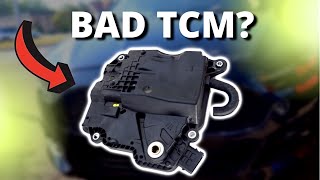
On a 2010-2013 Mazda 3 with the 2.0L or 2.5L non-Skyactiv engine, the U0101 code is almost always caused by a failed Transmission Control Module (TCM). Due to its location directly on the transmission, it fails from heat and vibration. The most common fix is replacing the TCM, which can be done DIY. Owners often use remanufacturing services like UpFix for around $300, or buy a new OEM part for $600+. Relocating the new module off the transmission is highly recommended.
- U0101 on a 2010-2013 Mazda 3 almost certainly means your Transmission Control Module (TCM) has failed.
- The failure is caused by a design flaw where the TCM is mounted to the hot transmission, causing internal components to break from heat and vibration.
- Do not drive the car. It will be in 'limp mode' and is unsafe and unreliable.
- The most common fix is to replace the TCM. A remanufactured unit is a cost-effective option. Consider mounting the new part away from the transmission case to prolong its life.
- Before replacing the TCM, it's wise to quickly check the battery, fuses, and TCM connector for obvious issues, but the module itself is the likely culprit.
What's Unique About the 2010-2013 Mazda 3

The second-generation Mazda 3 (2010-2013, non-Skyactiv) and its sibling, the Mazda 5, are notorious for TCM failures leading to the U0101 code. The primary design flaw is the TCM's mounting location directly on top of the hot, vibrating transmission housing. This constant exposure to thermal cycles and vibration eventually causes internal solder joints on the circuit board to crack and fail. The silicone gel used inside the module to protect from vibration actually traps heat, accelerating the failure. This is not a random electrical glitch; it's a well-documented pattern of failure for this specific vehicle generation. NHTSA ODI #11556887 confirms this, with an owner noting that after a transmission malfunction, the U0101 code appeared, highlighting that this issue is very common for these vehicles.
Symptoms You May Notice
- Check Engine Light is on
- Automatic Transmission ('AT') light is flashing or illuminated
- Transmission is stuck in one gear (usually 3rd gear, known as 'limp mode')
- Harsh 'clunk' or 'jerk' when shifting from Park to Reverse or Drive.
- Gear indicator on the dashboard (P, R, N, D) is blank, incorrect, or does not illuminate.
- Vehicle feels sluggish and lacks power due to being in a high gear.
- In some cases, a temporary loss of throttle response.
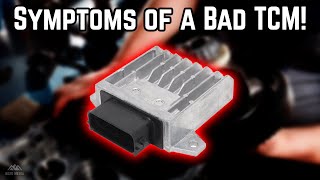
- DSC (Dynamic Stability Control) light may also illuminate. 🎬 Watch: Common signs and symptoms of a failing TCM
- Replacing the entire transmission. The symptoms of harsh shifting and being stuck in gear can mimic a mechanical failure, but U0101 is an electrical/communication code. The transmission itself is usually fine.
- Replacing transmission solenoids or fluid. While these can cause other shifting issues, they will not cause a U0101 communication code.
Most Likely Causes

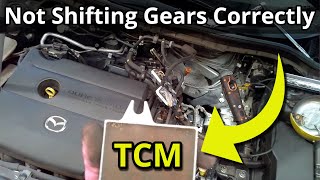
- Failed Transmission Control Module (TCM) 🔴 High Probability The TCM is mounted directly to the hot, vibrating transmission case, which causes internal solder joints to crack over time. 🎬 See how to repair and relocate your TCM to prevent heat damage This is a very common, well-documented failure pattern on this model and the related Mazda 5. NHTSA ODI #11171737 documents this exact scenario where a code scan revealed U0101 and triggered dashboard warning lights.
How to confirm: After verifying the TCM has proper power and ground at its connector and the communication network wires are intact, the module itself is condemned. A professional scan tool will show no communication with the TCM module, and often logs U0101 in multiple other modules like the PCM and Instrument Cluster.
Typical fix: Replace the Transmission Control Module. Options include a new OEM unit, a remanufactured unit from a specialty repair service (like UpFix, Circuit Board Medics, All Computer Resources), or a used part. Remanufactured units are often preferred as they may have reinforced solder joints and are plug-and-play if the original unit is repaired.
Est. part cost: $275-$850 - Poor Power or Ground Connection to TCM ⚪ Low Probability Corrosion can develop on wiring harnesses and ground points in the engine bay over time. A user on the Car Talk Community forums traced their intermittent U0101 to a faulty 15A fuse supplying power to the TCM.
How to confirm: Using a multimeter and a wiring diagram, check for 12V+ battery voltage at the TCM power pins and for continuity to ground on the ground pins at the TCM connector. A wiring diagram shows the TCM is located at the left rear of the engine compartment. A corroded ground point on the passenger side fender brace has been known to cause widespread, intermittent electrical issues.
Typical fix: Clean the corroded ground point connection to the chassis, replace the faulty fuse, or repair the broken power/ground wire.
Est. part cost: $5-$20 - Damaged Wiring Harness (CAN Bus) ⚪ Low Probability Wires can be damaged from rubbing, improper repairs, or rodent damage, though it's not a specific weakness of this platform. The harness runs in a tight engine bay where it can be disturbed during other maintenance.
How to confirm: Visually inspect the wiring harness running to the TCM. Check for continuity on the two CAN bus communication wires between the PCM and the TCM connector. This requires a wiring diagram and multimeter. The resistance between the CAN High and CAN Low wires should be approximately 60 Ohms.
Typical fix: Repair the specific broken or shorted wire in the harness.
Est. part cost: $5-$50
Rare But Worth Checking
- Weak or Failing Vehicle Battery: Low system voltage can cause unpredictable communication errors between modules. Before diving into complex diagnostics, ensure the battery is fully charged and passes a load test. Multiple owners on forums have noted the issue started around the time of a battery failure.
- Poor Pin Tension at TCM Connector: In some cases, the female pins in the large electrical connector that attaches to the TCM can lose their tension, causing a poor or intermittent connection with the male pins on the module itself. A diagnostic video showed this exact issue, which was only found by back-probing the connector and noticing the connection was restored. This can mimic a failed TCM perfectly. The fix is to carefully re-tension the pins or replace the connector pigtail.
Diagnosis Steps
- Scan for Codes: Use an OBD-II scanner to confirm U0101 is the primary code. Perform a full network scan to see which other modules are reporting a loss of communication with the TCM.
- Check Battery Health: Ensure the battery is above 12.4 volts and the charging system is working correctly. A weak battery can cause communication faults.
- Inspect Fuses: Check all fuses related to the transmission and engine control modules, particularly the 15A 'METER' fuse in the engine compartment fuse box which can be a culprit.
- Locate the TCM: The TCM is located under the battery and battery tray, mounted directly on top of the transmission with three 10mm bolts. 🎬 Watch: Step-by-step guide to replacing the Mazda 3 TCM
- Inspect Wiring and Connector: Disconnect the battery. Remove the battery and tray to access the TCM. Disconnect the large TCM connector and visually inspect the pins on both the harness side and the module side for corrosion, moisture, or damage.
- Test Power and Ground: Using a multimeter and a wiring diagram, confirm that the TCM connector is receiving proper battery voltage (12V+) and has a solid connection to ground (<1.0 Ohm) on the appropriate pins. This is the most critical step before condemning the module.
- Test CAN Bus Wires: With the battery disconnected, measure the resistance between the CAN High and CAN Low pins at the TCM connector. A healthy network will read approximately 60 Ω. A reading of 120 Ω indicates an open circuit (likely the TCM itself is disconnected or internally failed). A reading near 0 Ω indicates a short circuit.
- Condemn the TCM: If power, ground, and communication network resistance are all confirmed to be good, the TCM itself has failed internally and must be replaced or repaired.
Parts You'll Likely Need
- Transmission Control Module (TCM)
(OEM #LF8M-18-9E1H)— This is the root cause of the U0101 code in over 90% of cases for this vehicle due to a known design flaw related to heat and vibration. The 'H' version supersedes earlier versions like LF8M-18-9E1C, D, E, F, and G.
Trusted brands: Mazda (OEM), UpFix (Remanufacturing Service), Circuit Board Medics (Remanufacturing Service), All Computer Resources (Remanufacturing Service)
OEM price range: $600-$850
Aftermarket price range: $275-$400 (Remanufactured/Used)
Related Codes That Often Appear With This One
- U0101 (in multiple modules) — When the TCM fails, it can flood the CAN network or go completely silent. As a result, other modules that expect to hear from the TCM (like the PCM, ABS, and Instrument Cluster) will also log a U0101 code. Seeing this code across the system is a strong indicator that the TCM itself is the source of the problem.
- P07xx codes — If the TCM fails intermittently, it may log various transmission-related codes (like for solenoids or sensors) before it fails completely and triggers the U0101.
Technical Service Bulletins (TSBs) & Recalls
- While no TSB directly addresses the U0101 failure, Mazda has issued bulletins for other models from the same era (like TSB 05-001/14 for the CX-9) for shift quality issues requiring TCM reprogramming or replacement, indicating a pattern of TCM-related problems during this period.
Platform-Specific Known Issues
- TCM Relocation is a Common Preventative Fix: Many owners and repair shops strongly recommend mounting the replacement TCM off the transmission case to protect it from the heat and vibration that caused the original to fail. A popular DIY method involves zip-tying the new module to the nearby rigid brake lines on the firewall or using a supplied bolt to mount it to an available hole on the firewall. This isolates the module and dramatically increases its lifespan. NHTSA ODI #11388410 describes an owner who correctly predicted a U0101 code after researching the commonality of this failure and the use of zip-ties for relocation.
- Remanufacturing Services are a Popular Choice: Due to the high cost of a new OEM module, many owners opt to send their original TCM to a repair service like UpFix. These services repair the failed internal components, often reinforcing the solder joints, and send the original unit back. A key advantage is that a repaired original module requires no additional programming and is plug-and-play.
Mechanic-Grade Diagnostic Values
- CAN Bus Network Resistance — expected: ~60 Ω (measured between CAN_H and CAN_L pins at the TCM connector with battery disconnected). Failure: A reading of ~120 Ω indicates an open circuit (likely the TCM itself). A reading near 0 Ω indicates a short circuit in the harness.
- CAN Bus Voltage (Key On, Engine Off) — expected: CAN_H: ~2.5V to 3.5V. CAN_L: ~1.5V to 2.5V.. Failure: A faulty TCM on this platform can pull the bus voltage high, with readings over 4V, corrupting communication.
- TCM Ground Pin Resistance — expected: < 1.0 Ω (measured between the ground pins on the TCM connector and a clean chassis ground). Failure: High or infinite resistance indicates a broken or corroded ground wire, which will prevent the module from operating.
- TCM Power Pin Voltage — expected: ~12.6V (or battery voltage, measured at the TCM power supply pin with key on). Failure: Low or no voltage indicates a blown fuse or a break in the power supply wire.
Hidden / Shadow Codes Worth Checking
- U0101 (logged in multiple modules): This is not a hidden code, but a hidden diagnostic pattern. When the TCM fails, it often causes a network-wide communication failure. Finding U0101 stored in the PCM, ABS module, and Instrument Panel Cluster simultaneously is a strong indicator that the TCM itself is the faulty component, rather than a simple wiring break to a single module. (see via A professional scan tool capable of communicating with all vehicle modules (not just a basic engine code reader).)
Scan Tool Commands That Help
- Mazda IDS (Integrated Diagnostic System): Network Test / Self-Test — To perform a full vehicle network integrity test. If the TCM is offline, the IDS will report 'Fail' for the TCM, confirming it is not communicating on the bus.
- Mazda IDS (Integrated Diagnostic System): Initial Learning — After certain repairs or software updates, this procedure may be required to reset adaptive values and ensure proper transmission operation. It is not always necessary after a simple TCM replacement with a plug-and-play unit.
Wiring & Ground Locations

- TCM Connector Ground Pins — On the large electrical connector that plugs into the TCM, located under the battery tray. The ground wires are typically black.. The TCM requires a solid ground connection to function. A video guide shows two black wires, one on each side of the connector, serving as grounds. Verifying continuity on these pins is a critical diagnostic step before replacing the module.
- Passenger Side Fender Brace Ground — A chassis ground point located on the passenger side of the engine bay, near the headlight.. While not the direct ground for the TCM, corrosion at this point is known to cause widespread, intermittent electrical issues, including ABS and other warning lights. Cleaning this ground can resolve seemingly unrelated communication problems.
- Main Transmission Ground — A ground strap or wire bolted directly to the transmission case.. Ensures the entire transmission assembly, including the mounted TCM, has a proper ground path back to the battery. A loose or corroded connection here can cause a host of electrical issues.
Real Owner Repair Stories
- YouTube channel 'fixitphillip' (2009 Mazda 3, 2.3L, 5-speed automatic) — Intermittent limp mode, harsh shifting, AT and Check Engine lights on, no gear indicator on dash. Code U0101 present in PCM and instrument cluster.
✅ What actually fixed it After confirming all powers, grounds, and CAN bus signals were good at the TCM connector, the TCM was identified as faulty. Replacing the TCM with a known-good used module solved all symptoms and cleared the codes. - YouTube channel 'MAZ TCM' (2011 Mazda 3, 2.0L) — Intermittent U0101, AT and traction control lights, hard shifting. Problem returned two years after replacing TCM with a refurbished unit.
❌ Tried (didn't work) Replacing the TCM with a refurbished unit worked for two years but the problem returned., Initially suspected poor pin fitment at the connector.
✅ What actually fixed it The owner opened the original failed TCM, identified cracked solder joints on the circuit board, and 'reflowed' them with a soldering iron. This DIY repair fixed the problem. He later updated that replacing the 'AT relay' also solved some intermittent U0101 issues. - YouTube channel 'Gears and Gadgets' (2010 Mazda 3) — Check Engine light, AT light, no gear indicator, harsh clunk when shifting, car would not move.
❌ Tried (didn't work) The video is a direct replacement tutorial, not a diagnostic journey.
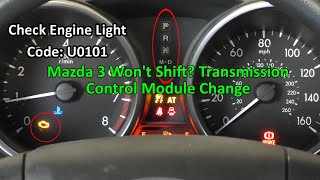
✅ What actually fixed it Replacing the failed Transmission Control Module with a new one. The video clearly shows the dash before (lights on, no gear indicator) and after (all clear, gear indicator working), confirming the fix. - NHTSA ODI #10443803 — An owner reported that driving the vehicle became a major safety issue when the transmission randomly changed gears without warning. Upon plugging in a scanner, they received error code U0101, indicating the computer was failing.
"I Checked Everything" — The Actual Cause
- The electrical equivalent of a 'smoke test clean' scenario is when basic wiring tests pass, but the problem persists. A critical mistake is using multimeter probes that are too large for the TCM connector's female terminals. This spreads the pins, creating a poor connection that perfectly mimics a failed TCM. The fix is to carefully re-tension the spread terminals with a pick tool.
- Another case is a ground wire that appears visually intact but has broken strands inside the insulation, right at the ring terminal crimp. It may test good with no load but will fail intermittently when the engine moves, causing the TCM to lose its ground connection and trigger a U0101.
OEM Part Supersession History
LF8M-18-9E1C, D, E, F, G→LF8M-18-9E1H— Revisions to improve reliability and address the heat/vibration-induced internal failures of earlier versions.
Heads up: All part numbers ending in A through H for the LF8M-18-9E1 series are considered interchangeable for the 2010-2011 Mazda 3 2.0L. The 'H' revision is the latest and most desirable.
Model Year Variations Within This Range
- 2012-2013: The introduction of the 2.0L Skyactiv engine in some 2012-2013 models brought a different 6-speed automatic transmission and a different TCM. These Skyactiv models are not known for this specific U0101 failure pattern. This guide applies only to the non-Skyactiv 2.0L and 2.5L models.
Diagnostic Flowchart
Used vs. New Parts: Buying Guide for This Vehicle
When a used part is the smart pick: A used part from a junkyard is a high-risk, low-reward option. Given the known design flaw, a used TCM is likely to have significant wear and may fail soon for the same reason as the original. It only makes sense as a very temporary fix or for diagnostic purposes to confirm the TCM is the fault before buying a more permanent solution.
Donor-vehicle mileage cap: roughly under 50000 miles for the part to have meaningful remaining life.
What to inspect on the donor part:
- Look for a donor vehicle with the lowest possible mileage.
- Inspect the TCM casing for excessive corrosion, though some surface corrosion is normal.
- Ensure the electrical connector pins on the used module are straight and clean.
- If possible, get history on the donor car to see if it was wrecked for reasons unrelated to the powertrain.
OEM-only on this vehicle (don't cheap out):
- While not strictly OEM-only, a new OEM Mazda TCM (part LF8M-18-9E1H) is the highest quality, but also the most expensive option.
Aftermarket brands forum-validated for this vehicle:
- Remanufacturing services are the most popular and cost-effective solution. Sending your original module for repair is ideal as it guarantees compatibility and requires no programming. Reputable services include: UpFix, Circuit Board Medics, and Module Repair Pro.
Brands owners have reported issues with on this vehicle:
- Be wary of generic 'universal' modules from marketplaces like eBay or Amazon that do not guarantee an exact OEM part number match. An incorrect module will not communicate with the vehicle.
Real Owner Stories
Aggregated from forums and TSBs cited above. Mileages and costs reflect what owners reported in those sources.
2010 Mazda 3 — 91000 miles
Symptoms: U0101 code, loss of throttle, and both AT and DSC lights were on.
What fixed it: Sent the original TCM to UpFix for repair, which solved the problem.
Cost: $275-$275
Source hint: Mazdas247.com - Thread 'Threw a U0101 code: Lost Communication With Transmission Control Module'
2010 Mazda 3
Symptoms: Intermittent limp mode and U0101 code.
What fixed it: After extensive diagnosis, the owner discovered the TCM was not receiving voltage and traced the problem to an oxidized 15A fuse. Replacing the fuse resolved the issue completely.
Source hint: Car Talk Community - 'U0101 Lost Communication with TCM'
2010-2013 Mazda 3
Symptoms: Symptoms consistent with U0101, leading to a dealer quote of $1500-$2000 for TCM replacement.
What fixed it: The owner used UpFix's exchange program for a remanufactured TCM and replaced the part themselves in about 2 hours.
Cost: $300-$300
Source hint: Reddit (r/mazda3) - 'Mazda 3 TCM (Transmission Control Unit) Fix'
Related OBD-II Codes
Frequently Asked Questions
My mechanic says I need a new TCM for my 2010 Mazda 3. Is there a cheaper option than buying a new one from the dealer?
I'm replacing the Transmission Control Module on my Mazda 3. Is there anything I should do to prevent the new one from failing?
Why is the U0101 code so common on the 2010-2013 Mazda 3?
My 2011 Mazda 5 has the same U0101 code and is stuck in limp mode. Does this information apply to my vehicle?
Besides the Check Engine Light, what are the most common symptoms of a failing TCM on this Mazda 3?
My car has a U0101 code. Should I just replace the TCM right away?
Helpful Videos

Used OEM Parts in Stock

New Aftermarket Parts Available


The information in this article is provided for general reference and educational purposes only. Vehicle specifications, procedures, and part compatibility can vary by production date, trim level, and region. Always consult your vehicle's factory service manual and verify part numbers before purchasing or performing repairs. Safety-critical components such as airbags, seat belts, and braking systems should be installed by a qualified professional.
- Mazda 3:
- 🎬 Helpful Videos
- 🛍️ Shop This Part
- What's Unique About the 2010-2013 Mazda 3
- Symptoms You May Notice
- Most Likely Causes
- Rare But Worth Checking
- Diagnosis Steps
- Parts You'll Likely Need
- Related Codes That Often Appear With This One
- Technical Service Bulletins (TSBs) & Recalls
- Platform-Specific Known Issues
- Mechanic-Grade Diagnostic Values
- Hidden / Shadow Codes Worth Checking
- Scan Tool Commands That Help
- Wiring & Ground Locations
- Real Owner Repair Stories
- "I Checked Everything" — The Actual Cause
- OEM Part Supersession History
- Model Year Variations Within This Range
- Diagnostic Flowchart
- Used vs. New Parts: Buying Guide for This Vehicle
- Real Owner Stories
- 2010 Mazda 3 — 91000 miles
- 2010 Mazda 3
- 2010-2013 Mazda 3
- Related OBD-II Codes
- Frequently Asked Questions
- 🎟️ Get 5% Off