

U0101 on 2017-2020 Ford F-150: Lost Communication With TCM Causes and Fixes
On a 2017-2020 Ford F-150, code U0101 is most often caused by a damaged transmission wiring harness, as noted in Ford TSBs SSM 48563 and SSM 47097. Inspecting the harness for chafing where it runs from the rear of the engine down to the transmission is the primary fix, costing significantly less than replacing control modules.
- For a 2017-2020 F-150, U0101 strongly points to a wiring issue, not a failed module.
- Always start your diagnosis with a full visual inspection of the transmission wiring harness for any signs of chafing or damage.
- Check for other communication codes (U-codes) that are listed in Ford's TSBs, as they often appear together.
- Do not replace the expensive Transmission Control Module (TCM) unless all wiring and connector issues have been completely ruled out.
What's Unique About the 2017-2020 Ford F-150

For this specific generation of F-150 (2015-2020), Ford has issued multiple Technical Service Bulletins (TSBs) that directly link code U0101 to problems with the transmission wiring harness. Unlike a generic vehicle where the cause could be anything from a fuse to a bad module, on these trucks, the harness is a well-documented weak point. TSBs SSM 48563 and SSM 47097 state the harness may not be properly secured, leading to chafing and damage where it runs from the rear of the engine down to the transmission. This makes the harness the primary suspect by a wide margin.
Diagnostic Flowchart
Tap your situation to follow the diagnostic path that matches what you're seeing on this vehicle.
Symptoms You May Notice
- Check Engine Light and/or Powertrain Malfunction (Wrench) light illuminated.
- Harsh, erratic, or delayed shifting.
- Transmission gets stuck in one gear (limp mode).
- Sudden loss of power or stalling.
- Gear position indicator on the dashboard may be blank or incorrect.
- Speedometer reads 0 mph while driving.
- No-crank/no-start condition.
- Replacing the Transmission Control Module (TCM) without first inspecting the wiring harness. The TSBs strongly indicate the harness is the most likely culprit, and replacing an expensive module won't fix a wiring problem.
- Condemning the entire transmission. U0101 is an electrical communication code, not a mechanical failure code. The issue lies in the control system, not the internal gears or clutches, although internal transmission issues can sometimes cause erratic behavior that is misdiagnosed as a communication fault.
Most Likely Causes

- Damaged Transmission Wiring Harness 🔴 High Probability Ford TSBs SSM 48563 and SSM 47097 specifically state that the '15525 transmission wire harness' can cause code U0101 due to improper securing or routing. The harness can chafe against the frame, engine components, or exhaust, leading to broken wires or short circuits. Forum users have reported this harness getting damaged near the catalytic converter or at various clips along the frame.
How to confirm: Visually inspect the entire length of the transmission wiring harness, from the transmission itself to where it connects to the main vehicle body. Pay close attention to the routing at the rear of the engine down to the transmission, as specified in the TSBs. Look for chafed insulation, exposed copper wires, or corrosion, especially near hot exhaust components.
Typical fix: Repair the damaged section of the wire(s) using solder and heat-shrink tubing or replace the entire harness section if the damage is extensive. Reroute the harness to prevent future contact and secure it properly. Ford TSBs point to this as the primary fix.
Est. part cost: $5-$20 for wire repair supplies, $150-$300 for a new harness section. - Poor Connection at TCM or PCM 🟡 Medium Probability Connectors can become loose or suffer from water intrusion, leading to corrosion on the pins. A Ford technician demonstrated in a video that a simple 'pin fitment issue' (a loose connection) at the TCM connector on the passenger side frame rail was the sole cause of a U0101 on a 2018 F-150. 🎬 Watch: Technician demonstrates how a loose connector causes a no-start.
How to confirm: Disconnect the electrical connectors at the Transmission Control Module (located on the passenger side frame rail, sometimes under a plastic cover) and the Powertrain Control Module. Inspect the pins and sockets for any signs of corrosion (green or white powder), moisture, or damage. Ensure the pins feel snug when reconnected.
Typical fix: Clean the connector pins with a specialized electronic cleaner. If pins are corroded or loose, the connector may need to be re-pinned or replaced. Applying a light film of dielectric grease before reconnecting can help prevent future moisture intrusion and ensure a good connection.
Est. part cost: $10-$30 - Low Battery Voltage or Bad Ground ⚪ Low Probability Modern vehicles are highly sensitive to voltage. A weak battery or a corroded ground connection can cause unpredictable communication errors between modules. Multiple forum users have reported a cascade of communication codes, including U0101, after a low battery event.
How to confirm: Test the battery voltage with a multimeter; a healthy battery should read at least 12.4V-12.6V with the engine off. With the engine running, the alternator should produce 13.5-14.5V. Inspect the main battery ground cable, body/frame ground straps, and the TCM ground circuit for tightness and corrosion.
Typical fix: Charge or replace the battery if it's weak. Clean or replace corroded ground straps to ensure a solid connection. 🎬 See how to inspect and clean notorious Ford ground points.
Est. part cost: $100-$250 for a new battery.
Rare But Worth Checking
- Faulty Transmission Control Module (TCM): While possible, module failure is far less common than wiring or connection issues. The TCM should only be suspected after all wiring, connectors, and power/ground sources have been thoroughly checked and confirmed to be good. A scan tool that cannot communicate with the TCM at all is a strong indicator, but only after the wiring is verified.
- Leaking Transmission Bulkhead Connector Sleeve: On some Ford transmissions, particularly the older 6R80, the electrical connector sleeve that passes through the transmission case can leak fluid into the connector, causing a short and communication loss. While less documented on the 10R80, fluid contamination in the main harness connector from any source can cause the same U0101 code.
Diagnosis Steps

- Scan for all diagnostic trouble codes (DTCs) in all vehicle modules, not just the PCM. Note any other communication (U-prefix) codes, as they can point to the source of the failure.
- Check and record the battery voltage with the engine off (should be >12.4V) and running (should be 13.5-14.5V) to rule out power supply issues.
- Perform a thorough visual inspection of the '15525' transmission wiring harness. Per TSBs 48563 and 47097, focus on the area from the rear of the engine down to the transmission, checking for chafing, melting, or corrosion.
- Disconnect and inspect the main electrical connector at the TCM (passenger side frame rail) and the PCM. Check for corrosion, bent pins, or signs of water intrusion.
- If a wiring diagram is available, check for proper power (12V+) and ground (less than 1 Ω resistance to chassis ground) at the TCM connector.
- Check the CAN bus network integrity. With the key off, measure the resistance between the CAN High and CAN Low pins at the DLC (pins 6 and 14); it should be approximately 60 ohms. If it's 120 ohms, there's a break in the circuit, often at the TCM connector. 🎬 Watch: Step-by-step diagnosis of a TCM communication failure.
- If all wiring, connectors, power, and grounds are good, the problem may be with the TCM itself, but this should be the last step in the diagnosis.
Parts You'll Likely Need

- Transmission Wiring Harness
(OEM #JL1Z-7C078-B)— This is the most common failure point for this code on this vehicle, as documented by Ford's own Technical Service Bulletins (SSM 48563, SSM 47097). Damage to this harness directly causes the communication loss with the TCM.
Trusted brands: Motorcraft
OEM price range: $150-$300
Aftermarket price range: $100-$200 - Dielectric Grease — Used to protect electrical connectors from moisture and corrosion after inspection or repair. A technician noted this was part of his fix for a pin fitment issue causing U0101.
Trusted brands: Permatex, CRC
OEM price range: $5-$15
Aftermarket price range: $5-$15
Related Codes That Often Appear With This One
- U0140 — Lost Communication With Body Control Module. Both codes are mentioned in TSB SSM 48563 and SSM 47097, indicating a widespread network issue often stemming from the same harness problem.
- P061A — Internal Control Module Torque Performance. This code is also listed in the same TSBs, suggesting the PCM is setting it as a result of not being able to properly control the transmission due to the communication loss.
- U0401 — Invalid Data Received From ECM/PCM. This code, also from the TSBs, indicates that other modules are receiving implausible data from the engine/powertrain controller, likely because it's missing critical data from the TCM.
- U0074 — Control Module Communication Bus B Off. Also listed in TSB SSM 48563, this points to a general CAN bus failure which is consistent with a damaged main harness.
Technical Service Bulletins (TSBs) & Recalls
- SSM 48563
- SSM 47097
Platform-Specific Known Issues
- TSB #SSM 48563: For 2017-2020 F-150s, notes that a no-crank/no-start, MIL illumination, and transmission shift concerns can be caused by the 15525 transmission wire harness not being properly secured. It lists U0101, P061A, U0140, U0401, U0074, and U0037 as possible codes.
- TSB #SSM 47097: For 2017-2018 F-150s built before 29-Sep-2017, explicitly states that codes including U0101 may be due to the '15525 transmission wire harness not being properly' secured, leading to damage. The recommended action is to visually inspect the harness from the rear of the engine to the transmission and repair as necessary.
Mechanic-Grade Diagnostic Values
- CAN Bus Network Resistance — expected: Approximately 60 Ω. Failure: A reading of 120 Ω indicates an open circuit or that a terminating module (like the TCM) is disconnected from the network.
- CAN Bus Voltage (Key On, Engine Off) — expected: CAN-High (Pin 6 to ground) should be ~2.5-3.5V. CAN-Low (Pin 14 to ground) should be ~1.5-2.5V.. Failure: Voltages that are stuck high, low, or at 0V indicate a short or open on the bus lines.
- TCM Connector to DLC Pin Continuity — expected: Near 0 Ω resistance.. Failure: Ford specifies anything over 3 Ω is a fault, but technicians recommend looking for less than 1 Ω. High resistance indicates a break or corrosion in the wire.
- TCM Ground Circuit Resistance — expected: Less than 0.5 Ω.. Failure: Higher resistance indicates a poor ground connection, which can cause intermittent module operation and communication faults.
Scan Tool Commands That Help
- Ford IDS (or equivalent professional scanner): Network Test / TCM Self-Test — After verifying power and ground to the TCM, use this function to actively ping the module. A 'No Communication' response from the tool, when wiring is known-good, points strongly toward a faulty TCM.
Wiring & Ground Locations
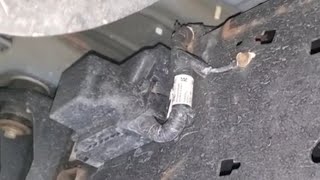
- TCM (Transmission Control Module) — On the passenger side frame rail, often located under a protective plastic cover.. This is the module that has lost communication. Its connector is a primary point for checking power, ground, and network signals, and is known for having 'pin fitment' issues.
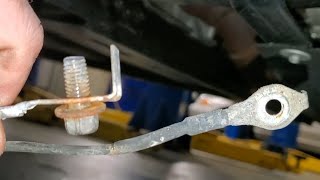
- Body-to-Frame Ground Strap — On the passenger side, a braided strap going from the aluminum body down to the steel frame.. These grounds are known to corrode and fail prematurely, even on low-mileage trucks, causing intermittent communication codes as modules lose a reliable ground path.
- PCM Grounds — Located on the firewall in the engine compartment.. A poor ground for the PCM can cause a wide range of communication issues, as it is the central computer managing the network.
- Main Battery Ground — In the engine bay, just in front of the washer fluid reservoir.. This is the primary ground for the entire vehicle's electrical system. Corrosion or a loose connection here can cause widespread, unpredictable electronic faults.
Real Owner Repair Stories
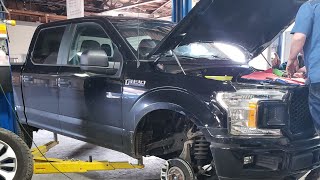
- YouTube video from a technician (2018 Ford F-150) — No-start, wrench light, hill climb assist warning, parking brake warning, and cylinder head temperature light warnings.
❌ Tried (didn't work) The technician immediately suspected a communication issue based on the cluster warnings.
✅ What actually fixed it A 'pin fitment issue' at the main TCM connector on the passenger side frame rail. The technician performed continuity and voltage tests which all passed once the connector was manipulated. The final fix was to unplug the connector, clean it, ensure good pin contact, apply a light film of dielectric grease, and reconnect it securely. The truck started and functioned normally afterward. - YouTube video from a technician (2020 Ford F-150 with 7,000 miles) — Intermittent check engine light with communication codes, passenger heated seat not working intermittently.
❌ Tried (didn't work) The owner had been to several shops who could not diagnose the intermittent issue.
✅ What actually fixed it A corroded body-to-frame ground strap on the passenger side. The technician found the braided cable had already rotted and was making a poor connection, causing the intermittent communication faults.
Model Year Variations Within This Range
- 2017-2020: On some F-150 models within this range, the TCM is a distinct module located on the passenger frame rail. On other models (notably seen on a 2020), the TCM's functions are integrated directly into the Powertrain Control Module (PCM). This is a critical diagnostic difference, as on integrated models, there is no external TCM to inspect.
Helpful Videos
Used OEM Parts in Stock


New Aftermarket Parts Available


The information in this article is provided for general reference and educational purposes only. Vehicle specifications, procedures, and part compatibility can vary by production date, trim level, and region. Always consult your vehicle's factory service manual and verify part numbers before purchasing or performing repairs. Safety-critical components such as airbags, seat belts, and braking systems should be installed by a qualified professional.
- Ford F-150:
- 🎬 Helpful Videos
- 🛍️ Shop This Part
- What's Unique About the 2017-2020 Ford F-150
- Diagnostic Flowchart
- Symptoms You May Notice
- Most Likely Causes
- Rare But Worth Checking
- Diagnosis Steps
- Parts You'll Likely Need
- Related Codes That Often Appear With This One
- Technical Service Bulletins (TSBs) & Recalls
- Platform-Specific Known Issues
- Mechanic-Grade Diagnostic Values
- Scan Tool Commands That Help
- Wiring & Ground Locations
- Real Owner Repair Stories
- Model Year Variations Within This Range
- 🎟️ Get 5% Off