

U0101 on 2009-2014 Ford F-150: Lost Communication with TCM Causes and Fixes
On a 2009-2014 F-150 with the 6R80 transmission, code U0101 is most often caused by a faulty internal transmission molded lead frame. This part contains sensors and wiring that can fail, causing communication loss. Ford has acknowledged this widespread issue with recalls and extended warranties. Expect to pay a professional to replace it, as it's an internal transmission component requiring removal of the valve body.
- Code U0101 on a 2009-2014 F-150 almost always points to a problem with the 6R80 transmission's internal molded lead frame.
- Symptoms are severe and include limp mode and potential sudden downshifts, making the truck unsafe to drive.
- Check for recalls and extended warranties, as Ford has acknowledged this issue on millions of trucks. Your vehicle may be eligible for a free or reduced-cost repair.
- Do not replace the PCM or the entire transmission before diagnosing the lead frame and external wiring.
- This is not a beginner-friendly DIY repair. It requires dropping the transmission pan and valve body, so professional service is strongly recommended.
What's Unique About the 2009-2014 Ford F-150

The 2009-2014 Ford F-150 primarily uses the 6R80 automatic transmission, which has a well-documented, widespread history of issues with its internal molded lead frame. This single component, which houses the output shaft speed (OSS) sensor, turbine speed sensor, and temperature sensor, is the number one cause of communication and shifting problems. The failure is so common that Ford issued Safety Recall 19S07 (a PCM software update to prevent sudden downshifts) and Customer Satisfaction Program 19N01, which extended the warranty on the lead frame to 10 years or 150,000 miles for certain model years. This makes the lead frame the primary suspect for a U0101 code on this specific truck, far more so than a generic wiring or module issue.
Symptoms You May Notice
- Check Engine Light and/or Wrench Light illuminated
- Transmission stuck in one gear (limp mode), often 3rd or 5th
- Harsh, erratic, or delayed shifting
- Sudden, unexpected downshift to a low gear (often 1st or 2nd).
- Speedometer reads 0 mph while driving
- Odometer displays dashes (---) instead of mileage
- Traction control light may illuminate
- Vehicle may not start or crank
- Transmission temperature gauge drops to 'C' or shows no reading.
- Backup/reverse lights may not work.
- Replacing the entire transmission when only the internal lead frame is faulty.
- Replacing the PCM without thoroughly testing the wiring and the lead frame.
- Replacing an external Transmission Control Module (TCM), not realizing the TCM function is integrated into the PCM on this vehicle and the primary failure point (lead frame) is internal to the transmission.
Most Likely Causes


- Faulty Transmission Molded Lead Frame 🔴 High Probability This is a well-documented, widespread failure point on the 6R80 transmission. Ford's Customer Satisfaction Program 19N01 and Safety Recall 19S07 were created specifically to address failures of the internal Output Shaft Speed (OSS) sensor traces on the lead frame. Thermal stress and vibration cause the electrical connections within the molded plastic to fail over time.
How to confirm: Scan for other codes like P0720 (OSS Circuit), P0722 (OSS No Signal), or P0731 (Gear 1 Incorrect Ratio), which specifically point to the OSS sensor on the lead frame. The presence of these codes alongside U0101 makes a failed lead frame the almost certain cause. Diagnosis requires ruling out external issues first, then proceeding with internal transmission inspection.
Typical fix: Replace the molded lead frame inside the transmission. This involves draining the fluid, dropping the pan, removing the valve body, and replacing the lead frame. The valve body separator plate should also be replaced at the same time as its bonded gaskets can delaminate.
Est. part cost: $150-$300 - Leaking Bulkhead Connector Sleeve 🟡 Medium Probability The o-rings on the pass-through connector sleeve where the wiring enters the transmission can degrade, allowing transmission fluid to leak out. This fluid can wick into the electrical connector pins, disrupting the CAN bus communication and triggering a U0101 code.
How to confirm: Visually inspect the round electrical connector on the passenger side of the transmission for signs of red or brown oily residue. If fluid is present, the sleeve is leaking.
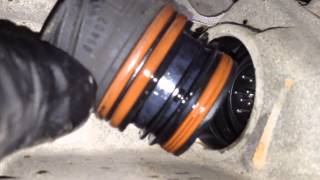
Typical fix: Replace the bulkhead connector sleeve and its o-rings. The connector must be thoroughly cleaned with electrical contact cleaner before reassembly. The updated seal kit part number is BL3Z-7Z276-A. 🎬 See how to repair a leaking bulkhead connector sleeve.
Est. part cost: $20-$40 - Damaged External Wiring Harness ⚪ Low Probability While less common than the lead frame failure, wiring can still be damaged by heat from the exhaust, chafing against the frame or crossmembers, or corrosion, leading to an open or short in the CAN bus wires.
How to confirm: Visually inspect the entire length of the transmission wiring harness for any melted, chafed, or broken wires. Pay close attention to where it runs near the exhaust or has sharp bends. Use a multimeter to check for continuity on the CAN High and CAN Low wires between the PCM and the transmission bulkhead connector.
Typical fix: Repair the damaged section of the wiring harness using solder and heat-shrink tubing. In severe cases, the entire harness may need replacement.
Est. part cost: $10-$500 - Low Battery Voltage or Poor Grounds ⚪ Low Probability
How to confirm: Test the battery voltage (should be >12.4V engine off, 13.5-14.5V engine running). Inspect and clean the main battery terminals and chassis ground connections, especially the main ground on the frame rail near the transmission.
Typical fix: Charge or replace the battery. Clean or repair ground connections.
Est. part cost: $0-$250
Rare But Worth Checking
- Faulty Powertrain Control Module (PCM): While possible, the PCM is rarely the cause of this specific code. All other possibilities, especially the lead frame and wiring, should be exhausted before considering PCM replacement.
- Cracked or Damaged Valve Body Separator Plate: The separator plate sits between the two halves of the valve body and contains bonded gaskets. If these gaskets delaminate or the plate cracks, it can cause internal pressure leaks that lead to erratic shifting, which can sometimes be misdiagnosed as an electronic fault. It is best practice to replace this plate during a lead frame service.
Diagnosis Steps

- Scan for All Codes: Use a professional scan tool to check for codes in all modules. Note any codes that accompany U0101, especially P0720, P0722, or P0731, as these strongly indicate a failed lead frame.
- Check for TSBs and Recalls: Enter your vehicle's VIN into the NHTSA or Ford website to check for Safety Recall 19S07 or eligibility for Customer Satisfaction Program 19N01. If eligible, a dealer may perform the repair for free.
- Check Battery and Grounds: Ensure the battery has a full charge (>12.4V) and the charging system is working correctly (13.5-14.5V). Inspect the battery terminals and main chassis grounds for corrosion and tightness.
- Inspect the Bulkhead Connector: Visually inspect the main transmission harness connector on the passenger side of the transmission. Look for any signs of transmission fluid leakage, which indicates a failed bulkhead sleeve.
- Inspect External Wiring: Carefully inspect the transmission wiring harness from the transmission to the PCM. Look for any signs of melting near the exhaust, chafing on the frame, or corrosion in connectors.
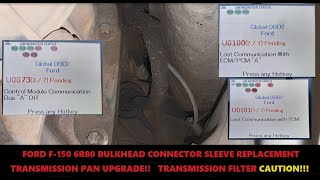
- Internal Inspection (Professional Recommended): If all external checks pass and lead-frame-related codes (P0720, P0722) are present, the cause is almost certainly internal. The next step is to drop the transmission pan and replace the molded lead frame and valve body separator plate. This step is best left to a professional. 🎬 Watch this walkthrough for bulkhead sleeve replacement and pan upgrades.
Parts You'll Likely Need
- Transmission Molded Lead Frame
(OEM #AL3Z-7G276-D)— This is the most common failure point on the 6R80 transmission that causes communication codes and erratic shifting.
Trusted brands: Motorcraft, Dorman
OEM price range: $130-$200
Aftermarket price range: $100-$180
Related Codes That Often Appear With This One
- P0720 — Output Speed Sensor (OSS) Circuit. This sensor is part of the molded lead frame. Ford's extended warranty program 19N01 specifically looks for this code to authorize a lead frame replacement.
- P0722 — Output Speed Sensor (OSS) No Signal. Also directly related to the failure of the lead frame and is a qualifying code for warranty replacement under 19N01.
- P0731 — Gear 1 Incorrect Ratio. The PCM sets this when the transmission speed sensors provide conflicting information, often due to a failing lead frame. This is another qualifying code for program 19N01.
- U0100 — Lost Communication with ECM/PCM. This can sometimes appear with U0101 during a major network communication failure, sometimes pointing to a broader wiring or power supply issue.
Technical Service Bulletins (TSBs) & Recalls

- TSB 13-6-8: Addresses symptoms like starting in 5th gear, speedometer at zero, and wrench light, pointing towards lead frame issues for 2011-2013 F-150s.
- Customer Satisfaction Program 19N01: Extended warranty coverage for the transmission molded leadframe on 2011-2013 F-150s.
Platform-Specific Known Issues
- Ford Customer Satisfaction Program 19N01 extended the warranty on the molded lead frame for certain 2011-2013 F-150s to 10 years or 150,000 miles.
- Safety Recall 19S07 was issued for 2011-2013 F-150s to reprogram the PCM to prevent an unintended downshift if the lead frame failed. However, this did not replace the faulty part unless it had already failed.
- The failure of the Output Shaft Speed (OSS) sensor, which is integrated into the lead frame, is the root cause of the sudden downshifts that prompted recalls.
Mechanic-Grade Diagnostic Values
- HS-CAN Bus Resistance — expected: 60 Ω (± 10%). Failure: A reading of ~120 Ω indicates an open circuit or one of the two terminating resistors is offline. A reading near 0 Ω indicates a short between the CAN High and CAN Low wires.
- CAN Bus Voltage — expected: CAN-H: ~2.7V, CAN-L: ~2.3V (Key On, Engine Off). Failure: Voltages that are stuck high (5V), low (0V), or mirror each other indicate a short to power, short to ground, or short between the two lines.
- Ground continuity at transmission bulkhead connector — expected: < 0.5 Ω. Failure: High resistance indicates a corroded or broken ground wire, which can cause communication failures.
Scan Tool Commands That Help
- Ford IDS (Integrated Diagnostic System): Network Test — This is a primary step when diagnosing any U-code. The tool pings all modules on the network and provides a visual map of which modules are communicating and which are not. For U0101, this test will quickly confirm that the TCM (integrated within the PCM but tested via the lead frame connection) is offline.
- Ford IDS (Integrated Diagnostic System): TCM Self-Test — If communication can be intermittently established, running a TCM self-test can retrieve specific internal fault codes from the transmission components (solenoids, sensors) that may not be broadcast as standard P-codes, helping to confirm a lead frame failure.
Wiring & Ground Locations
- G100 / G104 — Located on the upper radiator support on the LH side and on the rear of the LH fender apron, respectively. These are primary engine compartment grounds.. The PCM and other critical engine bay electronics rely on these grounds. Corrosion or looseness at G100/G104 can cause unstable voltage to the PCM, leading to network communication errors like U0101.
- C175T — This is the transmission-specific connector at the Powertrain Control Module (PCM), located on the firewall in the engine bay.. This is the termination point for the transmission harness. The CAN bus wires (CAN-H and CAN-L) from the transmission lead frame connect here. It's a key location for testing continuity and voltage of the CAN circuit between the PCM and transmission.
- C167 (or C1575) — This is the main 16-pin round bulkhead connector on the passenger side of the 6R80 transmission case.. This is the single point of electrical connection to the transmission. All power, ground, and communication signals for the internal lead frame pass through it. It's a common point for fluid intrusion from a failed internal sleeve and a primary location for checking for signal from the PCM.
- Fuse 27 (in Battery Junction Box) — Under the hood, in the power distribution box. This fuse powers the fuel pump.. While not directly related to the transmission, the terminal for this fuse is known to overheat and melt, causing a short or voltage drop that can disrupt the entire power network in the fuse box, sometimes leading to random communication codes, including U0101, as other modules lose stable power.
Real Owner Repair Stories
- Ford F150 Forum & TSB 15-0137 (2009-2014 Ford F-150 (all engines)) — Crank no-start, intermittent stalling, wrench light, multiple communication codes including U0101 and U0109.
❌ Tried (didn't work) Checking battery and grounds., Scanning for codes without inspecting physical components., Assuming the U0101 was a primary transmission fault.
✅ What actually fixed it The root cause was the fuel pump power fuse (Fuse 27) in the under-hood fuse box overheating and melting its socket. This created voltage instability and network disruptions. The fix was performing the procedure in TSB 15-0137, which involves installing a relocation kit to move the fuel pump circuit to a more robust, empty slot (position 70) in the fuse box. - YouTube Automotive Diagnostician (2018 F-150 (demonstrates a common issue also applicable to 2009-2014)) — No start, multiple warnings on the dash, U0101 code present.
❌ Tried (didn't work) Initial scan pointed to TCM, but the technician suspected a connection issue.
✅ What actually fixed it The technician disconnected the main transmission bulkhead connector (C167), inspected the pins, applied dielectric grease, and reconnected it firmly. The simple act of reseating the connector restored communication. This points to poor pin fitment or minor corrosion as the cause, not a failed part.
OEM Part Supersession History
AL3Z-7G276-A, AL3Z-7G276-B→AL3Z-7G276-D— Revisions to improve the durability and reliability of the internal sensor traces and electronics to prevent the common OSS sensor failures.
Heads up: The A, B, and D revisions are generally interchangeable for the 2009-2014 model years. Always order the latest 'D' revision to get the most updated and robust part.
Model Year Variations Within This Range
- 2009-2010: Early models in this generation offered the 4.6L 2V V8 with a 4-speed 4R75E automatic transmission, and the 4.6L 3V and 5.4L 3V V8s with the 6-speed 6R80. The U0101 lead frame issue is specific to the 6R80.
- 2011-2014: In 2011, Ford introduced a completely new engine lineup (3.7L V6, 5.0L V8, 6.2L V8, 3.5L EcoBoost V6). All of these engines were exclusively paired with the 6R80 6-speed automatic transmission, making the lead frame issue a potential problem across the entire engine range for these years.
- 2009-2011: The valve body separator plate was updated in 2009, eliminating some dampers. A further update occurred for 2011+ models with the addition of a one-way clutch to smooth 1-2 shifts, which also involved changes to the case, valve body, and lead frame strategy. While parts are similar, using the correct vintage is important.
Diagnostic Flowchart
Used vs. New Parts: Buying Guide for This Vehicle
When a used part is the smart pick: A used wiring harness from a junkyard can be a cost-effective solution if your original harness is physically damaged (e.g., melted or cut), provided the donor vehicle shows no signs of flood or fire damage. A complete used transmission is also an option if the cost is close to the repair of the old one, but it carries the risk of having the same lead frame issue.
Donor-vehicle mileage cap: roughly under 80000 miles for the part to have meaningful remaining life.
What to inspect on the donor part:
- For a wiring harness: Check for uncut connectors, flexible (not brittle) loom, and no signs of rodent damage or backyard splice repairs.
- For a complete transmission: Look for a clean unit from a collision-damaged vehicle (indicating it was likely running at the time of the accident). Check the fluid on the dipstick if possible—it should be bright red, not brown or burnt-smelling. Ask the salvage yard if they have the mileage and VIN of the donor vehicle to check its history.
OEM-only on this vehicle (don't cheap out):
- Molded Lead Frame: Given that this is a high-failure item due to a design flaw, installing a used one is a major gamble. Always buy this part new to get the latest revision (AL3Z-7G276-D).
- Bulkhead Connector Sleeve: This is an inexpensive seal. It makes no sense to use an old, hardened rubber seal from a junkyard. Buy new.
Aftermarket brands forum-validated for this vehicle:
- Motorcraft (for OEM parts like the lead frame)
- Dorman (Offers a lead frame replacement, often with its own design improvements)
Brands owners have reported issues with on this vehicle:
- Unbranded, no-name lead frames from online marketplaces. The quality control on the internal electronics is critical, and failure can mean having to perform the entire labor-intensive job a second time.
Real Owner Stories
Aggregated from forums and TSBs cited above. Mileages and costs reflect what owners reported in those sources.
2009 F-150
Symptoms: The owner experienced the wrench light, traction control light, speedometer reading 0, and the transmission temperature gauge dropping to cold.
What fixed it: The owner noted these symptoms occurred after they had recently replaced the bulkhead connector sleeve for a transmission fluid leak, highlighting the connection between a fluid leak at the connector and the communication code.
Source hint: f150forum.com thread titled 'U0101???'
2009 F-150 5.4L
Symptoms: The truck had an intermittent crank-no-start condition, would go into limp mode, the speedometer would not work, and it threw a U0101 code.
What fixed it: The owner reported these complex symptoms began after having the bulkhead connector gasket replaced for a leak, indicating a potential issue with the repair or related wiring.
Source hint: f150forum.com thread titled '2009 F150 5.4L Intermittent Crank no start. U0101 Code'
Related OBD-II Codes
Frequently Asked Questions
What is the most common cause of a U0101 code on a 2009-2014 F-150?
My 2012 F-150 suddenly downshifted to first gear on the highway. Is this related to the U0101 code?
Are there any recalls or warranty extensions for the U0101 problem on my F-150?
My truck has codes P0720 and P0722 along with U0101. What does this mean?
I found transmission fluid on the main electrical connector. Could that cause a U0101?
If I have to replace the molded lead frame, is there an updated part I should use?
My speedometer reads zero and the odometer shows dashes. Are these symptoms of the U0101 code?
Helpful Videos
Used OEM Parts in Stock

New Aftermarket Parts Available


The information in this article is provided for general reference and educational purposes only. Vehicle specifications, procedures, and part compatibility can vary by production date, trim level, and region. Always consult your vehicle's factory service manual and verify part numbers before purchasing or performing repairs. Safety-critical components such as airbags, seat belts, and braking systems should be installed by a qualified professional.
- Ford F-150:
- 🎬 Helpful Videos
- 🛍️ Shop This Part
- What's Unique About the 2009-2014 Ford F-150
- Symptoms You May Notice
- Most Likely Causes
- Rare But Worth Checking
- Diagnosis Steps
- Parts You'll Likely Need
- Related Codes That Often Appear With This One
- Technical Service Bulletins (TSBs) & Recalls
- Platform-Specific Known Issues
- Mechanic-Grade Diagnostic Values
- Scan Tool Commands That Help
- Wiring & Ground Locations
- Real Owner Repair Stories
- OEM Part Supersession History
- Model Year Variations Within This Range
- Diagnostic Flowchart
- Used vs. New Parts: Buying Guide for This Vehicle
- Real Owner Stories
- 2009 F-150
- 2009 F-150 5.4L
- Related OBD-II Codes
- Frequently Asked Questions
- 🎟️ Get 5% Off