

U0100 on 2010-2013 Mazda 3: Causes and Fixes for Lost Communication with ECM/PCM
On a 2010-2013 Mazda 3, code U0100 is most often caused by a failing Transmission Control Module (TCM), not the engine computer (PCM). The faulty TCM, mounted on the hot transmission case, develops internal failures that disrupt the vehicle's communication network. The fix is typically a replacement or repair of the TCM, costing around $300-$500 for a remanufactured unit, and does not require reprogramming.
- Code U0100 on a 2010-2013 Mazda 3 almost always points to a bad Transmission Control Module (TCM), not the main computer (PCM).
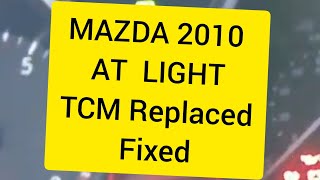
- Symptoms include the 'AT' light, harsh shifting, and getting stuck in gear. A no-start condition is also possible.
- The most cost-effective solution is to replace the TCM with a remanufactured unit or have your original one repaired, which costs significantly less than a new part from a dealer.
- Always check for code U0101 (Lost Communication with TCM) as well, as its presence strongly confirms the diagnosis.
- Before replacing any parts, check the battery and ground connections, as simple electrical issues can sometimes cause communication codes.
What's Unique About the 2010-2013 Mazda 3

For the second-generation Mazda 3 (2010-2013), the U0100 code is a classic case of misdirection. While the code points to the PCM, the actual culprit is almost always a failing Transmission Control Module (TCM). The TCM is mounted directly on the hot, vibrating transmission case, which causes internal solder joints to crack and electronic components to fail over time. This internal failure floods the vehicle's communication network (CAN bus) with bad data or causes the module to go completely offline, making it appear as though the PCM has stopped communicating.
Symptoms You May Notice
- Check Engine Light and 'AT' (Automatic Transmission) light are both illuminated
- Vehicle gets stuck in 3rd gear (limp-home mode)
- Harsh, sudden, or erratic shifting, especially when the car is warm
- A hard 'kick' or 'clunk' when shifting from Park into Reverse or Drive
- Engine may not crank or start
- Stalling at idle or while driving
- Multiple warning lights on the dashboard (ABS, Traction Control/DSC) may appear simultaneously
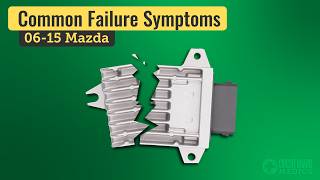
- Loss of throttle response, where pressing the accelerator does not increase engine RPM 🎬 Watch: A breakdown of common TCM symptoms and repair options
- Replacing the Powertrain Control Module (PCM) without first investigating the TCM. This is a very expensive mistake, as a faulty TCM is the much more likely cause.
- Replacing the battery without properly testing it or without performing a full system reset afterwards. Sometimes a low voltage event can set persistent codes that need to be cleared properly.
Most Likely Causes

- Failing Transmission Control Module (TCM) 🔴 High Probability The TCM is mounted directly on the transmission, where it is exposed to constant heat and vibration. This leads to the failure of internal solder joints and electronic components over time. This is a widely acknowledged design flaw for this platform.
How to confirm: With a professional scan tool, check for U0101 (Lost Communication with TCM) alongside U0100. If both are present, the TCM is the prime suspect. The definitive diagnostic step is to disconnect the TCM's main electrical connector. After disconnecting it, clear the codes and re-scan. If communication with the PCM is restored and U0100 is gone (though U0101 will now be actively present), this confirms the TCM was crashing the network.
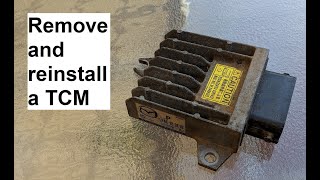
Typical fix: Replace the faulty TCM with a remanufactured unit or send the original unit out for repair. This is a plug-and-play part on this vehicle and does not require dealer reprogramming. Many owners and repair shops recommend relocating the new TCM to a cooler spot, such as zip-tying it to the nearby brake lines, to prevent a repeat failure. 🎬 See this walkthrough for removing and relocating your TCM
Est. part cost: $275-$500 for a remanufactured or repaired unit. - Low Battery Voltage or Poor Connections 🟡 Medium Probability
How to confirm: Test the battery voltage with a multimeter; it should be above 12.4 volts with the engine off. A weak or failing battery can cause a host of unpredictable electronic issues, including CAN bus communication faults. Inspect battery terminals for corrosion and ensure they are tight. Even if a new battery is installed, it's a good idea to perform a full ECU reset by disconnecting the battery cables and touching them together for several minutes.
Typical fix: Clean the battery terminals and cable ends, or replace the battery if it fails a load test.
Est. part cost: $100-$250 for a new battery. - Corroded or Loose Ground Wires ⚪ Low Probability
How to confirm: Visually inspect the main ground straps from the battery to the chassis and from the engine/transmission to the chassis. Look for fraying, corrosion, or looseness. A bad ground can cause intermittent communication issues that mimic module failure.
Typical fix: Clean the contact points with a wire brush and re-secure the ground strap. Replace the strap if it is damaged.
Est. part cost: $15-$50
Rare But Worth Checking
- Damaged CAN Bus Wiring Harness: Rodent damage, previous accident repairs, or chafing can cause an open or short in the CAN bus wiring, disrupting communication between all modules. This should be investigated if disconnecting the TCM does not isolate the fault.
- Faulty Powertrain Control Module (PCM): While the U0100 code directly points to the PCM, it is rarely the actual point of failure on this platform. This should only be considered after the TCM and all wiring have been definitively ruled out.
Diagnosis Steps

- Check Battery Health: Ensure the battery has a full charge (12.4V+ engine off) and that terminals are clean and tight. A weak battery is a common cause of network codes.
- Scan for All Codes: Use a scan tool capable of reading codes from all modules (PCM, TCM, ABS, etc.). Note if U0101 and U0073 are present with U0100, as this strongly points to the TCM.
- Check Fuses: Inspect fuses related to the PCM and TCM. A blown fuse can cut power and communication.
- Locate and Isolate the TCM: The TCM is located on the front of the transmission case, directly under the battery and battery tray. To access it, you must disconnect the battery, remove it, and then unbolt and remove the battery tray (typically three 10mm bolts). 🎬 Watch: How to access and replace the TCM on a 2.0L
- Disconnect the TCM Connector: Unplug the main electrical connector from the TCM. This involves pressing a release tab and sliding a latch guide back.
- Re-Scan the Network: With the TCM disconnected, reconnect the vehicle's battery, clear all DTCs, and re-scan the vehicle's modules. If communication with the PCM is restored and the U0100 code disappears (though a U0101 will now be present and expected), this provides 100% confirmation that the TCM was causing the network to crash.
- Inspect Wiring: If disconnecting the TCM does not resolve the issue, perform a visual inspection of the wiring harnesses to the PCM and TCM for any signs of damage, corrosion, or chafing.
- Check Power and Ground at the PCM: If wiring appears okay, a technician will verify that the PCM itself is receiving proper power and has a solid ground connection.
- Final Diagnosis: If all wiring, grounds, and the TCM have been ruled out, the PCM may be faulty, but this is the least likely scenario.
Parts You'll Likely Need

- Transmission Control Module (TCM)
(OEM #LF8M-18-9E1x (2.0L), L539-18-9E1x (2.5L). The final letter (e.g., A, B, C through H) denotes revisions, but they are generally interchangeable for the specified engine.)— This is the most common point of failure for this code on this vehicle due to its mounting location causing heat and vibration damage.
Trusted brands: Mazda (OEM Remanufactured), UpFix (Remanufacturing Service), Circuit Board Medics (Remanufacturing Service), Module Repair Pro (Exchange Service)
OEM price range: $1000-$2000
Aftermarket price range: $275-$500 (Remanufactured/Repaired)
Related Codes That Often Appear With This One
- U0101 — Stands for 'Lost Communication with TCM'. Its presence is a strong indicator that the TCM is the root cause of the network failure.
- U0073 — Stands for 'Control Module Communication Bus 'A' Off'. This is a general network code indicating the entire CAN bus is down, often triggered by a single faulty module like the TCM.
- P07xx — Various transmission-related codes for shift solenoids (e.g., P0753, P0758) or sensors may accompany the U-codes, further pointing to an internal TCM or transmission issue.
Technical Service Bulletins (TSBs) & Recalls
- While no TSB directly addresses the U0100/TCM failure on the Mazda 3, TSB 05-004/16 exists for 2013-2014 CX-5 and 2014 Mazda6 models for an issue where the ignition won't turn off. This is caused by a faulty shifter switch (Part KDY0-46-040) and is unrelated to the U0100 code, though it represents another known electrical issue on Mazda vehicles of the era.
Platform-Specific Known Issues
- The placement of the TCM directly on the transmission housing is a known design flaw that leads to a high failure rate from heat and vibration. Many mechanics and owners strongly recommend relocating the replacement TCM to a cooler location, such as securing it to the nearby brake lines on the firewall with zip ties, to prevent repeat failures.
Mechanic-Grade Diagnostic Values
- CAN Bus Network Resistance — expected: 50-70 Ω (typically ~60 Ω). Failure: A reading of ~120 Ω indicates an open circuit or one missing terminating resistor. A reading below 50 Ω may indicate a short circuit or a faulty module.
- TCM Power Supply Pin Voltage — expected: Battery Voltage (B+), typically 12.4V+. Failure: Voltage below B+ indicates a problem with the power supply wire or the AT main relay.
- TCM Ground Pin Voltage — expected: Below 1.0 V. Failure: Voltage significantly above 0V indicates a poor ground connection, which can cause module malfunction.
- CAN Bus Line Voltage (Key On, Engine Off) — expected: Approximately 2.5V on both CAN-H and CAN-L. Failure: Significant deviation from 2.5V on either line suggests a network problem. Note: A multimeter may give misleading readings; an oscilloscope is the preferred tool for accurate diagnosis. The Mazda service manual notes that a valid voltage determination is not possible with a standard voltmeter.
Scan Tool Commands That Help
- FORScan: Module Reset / Clear All DTCs — After a low battery event or battery replacement, spurious U-codes can be stored across multiple modules. A tool like FORScan can perform a more thorough reset of all modules than a generic OBD-II scanner, potentially clearing persistent but non-active communication faults.
- Mazda IDS (or equivalent professional scanner): Network Test / Module Self-Test — To actively poll all modules on the CAN bus and receive their status. This can quickly identify which module is not responding, confirming if the TCM, ABS, or another module is offline, which is more precise than just interpreting stored codes.
Wiring & Ground Locations

- DLC (OBD-II Port) — Under the driver's side dashboard.. This is the primary access point for network diagnostics. Measuring resistance between Pin 6 (CAN-H) and Pin 14 (CAN-L) tests the integrity of the main communication bus and its terminating resistors.
- TCM Connector Pins L & M — At the Transmission Control Module, located under the battery tray.. These are the dedicated ground pins for the TCM. Verifying continuity to ground or measuring voltage (should be near 0V) at these pins is a critical step to rule out a bad ground as the cause of the module's failure to communicate.
- TCM Connector Pin J — At the Transmission Control Module, located under the battery tray.. This is the main power supply pin from the battery. Verifying battery voltage (B+) at this pin confirms the module is receiving power.
Real Owner Repair Stories
- Reddit user Oldninja in r/mazda3 (2010 Mazda 3, failed at ~140k miles) — Dreaded TCM failure.
✅ What actually fixed it Replaced the TCM with a refurbished unit for ~$250 after core return. The user specifically noted that no reprogramming was needed, it was plug-and-play. They also followed the common advice to prevent recurrence: 'mounted it near the brake lines with metal zip ties' instead of back on the hot transmission. The fix was still working well years later. - Reddit user Mysterious-Sign9685 in r/mazda3 (2011 Mazda 3) — TCM failure issue.
✅ What actually fixed it Bought a used TCM from another 2011 Mazda 3. It worked perfectly without needing to be programmed. This confirms that for this specific platform, programming is often not required if the replacement part is from a compatible donor. - NHTSA ODI #10781946 — An owner reported that their vehicle came to a complete stop while running on the highway, immobilizing all systems. A scan detected code U0100, and while a recall for wiring was checked and found to be okay, the problem persisted even after replacing "burn out parts."
- NHTSA ODI #11196097 — In a report involving a Mazdaspeed3, an owner noted a pending U0100 code with no PCM communication. Investigation revealed a loose wire from the air bag system, where a connector was unclipped during assembly and not properly reinstalled, potentially contributing to the communication fault.
"I Checked Everything" — The Actual Cause
- While not a smoke test issue, a similar pattern exists for electrical diagnosis. A user with a 2016 Mazda 3 reported a recurring U0100 code that their mechanic suspected was caused by a recently installed aftermarket radio. This is a classic example of a non-OEM device interfering with or crashing the CAN bus, which would not be found by inspecting the vehicle's original wiring or modules.
OEM Part Supersession History
LF8M-18-9E1A through LF8M-18-9E1G→LF8M-18-9E1H (and later revisions)— Revisions to address internal component failures and improve reliability.
Heads up: For the 2.0L non-Skyactiv engine, part numbers ending in A through H are generally interchangeable. It is plug-and-play, and programming is not required.L539-18-9E1A through L539-18-9E1H→L539-18-9E1J (and later revisions)— Revisions to address internal component failures and improve reliability.
Heads up: For the 2.5L engine, these part numbers are generally interchangeable. It is plug-and-play, and programming is not required.
Model Year Variations Within This Range
- 2012-2013: The 2012 model year introduced a facelift and the optional 2.0L Skyactiv-G engine. This TCM failure is primarily associated with the non-Skyactiv 2.0L MZR and 2.5L MZR engines. While a 2012-2013 model can still have the 2.5L MZR engine and suffer this failure, models with the Skyactiv powertrain have a different transmission and control system and are not prone to this specific issue.
- 2010-2011 vs 2012-2013: The 2010-2011 models are pre-facelift. The 2012-2013 models are post-facelift with minor interior and exterior styling changes. The Bluetooth module was also updated in late 2011/early 2012 to support more features. While not directly causing U0100, this highlights that electrical components and software can differ within the 2010-2013 range.
Diagnostic Flowchart
Used vs. New Parts: Buying Guide for This Vehicle
When a used part is the smart pick: A used TCM is a risky but potentially budget-friendly option if it can be sourced from a low-mileage, same-year donor car. However, because the failure is due to a design flaw (heat/vibration), even a used part is susceptible to the same fate. It makes the most sense for a high-mileage vehicle where the owner is trying to get a few more years of life out of it for minimal cost.
Donor-vehicle mileage cap: roughly under 80000 miles for the part to have meaningful remaining life.
What to inspect on the donor part:
- Verify the part number (e.g., LF8M-18-9E1x) matches exactly or is a known compatible revision.
- Ask the seller for the mileage of the donor vehicle if possible; lower is always better.
- Inspect the connector pins for any signs of corrosion, moisture, or physical damage.
- Avoid parts with excessive external corrosion, although some surface corrosion on the case is considered normal for these units.
OEM-only on this vehicle (don't cheap out):
- Powertrain Control Module (PCM) - If the PCM were ever the actual cause, replacing it with anything other than a new, correctly programmed OEM unit would be extremely risky.
Aftermarket brands forum-validated for this vehicle:
- UpFix (Remanufacturing Service)
- Circuit Board Medics (Remanufacturing Service)
- Module Repair Pro (Exchange Service)
Brands owners have reported issues with on this vehicle:
- Unnamed, no-warranty 'knockoff' modules from marketplaces like eBay or AliExpress can be a gamble. While some may work, others may not have the correct firmware, leading to continued diagnostic issues even if they are 'plug-and-play'.
Real Owner Stories
Aggregated from forums and TSBs cited above. Mileages and costs reflect what owners reported in those sources.
2010 Mazda 3
Symptoms: No communication with the engine computer (PCM), multiple CAN bus trouble codes, engine would not crank, and the security light was flashing.
What fixed it: Repaired an open circuit in the wire between the main relay in the fuse box and the PCM, which had cut power to the computer.
Source hint: ScannerDanner - 2010 Mazda 3 No Communication With PCM, No Start, No Crank - YouTube
2010 Mazda 3 1.8L MZR
Symptoms: Car began stalling at stoplights without warning. The check engine light came on, revealing codes P0606 and U0100.
What fixed it: Replaced the Transmission Control Module (TCM).
Source hint: AliExpress (Blog/Article)
Related OBD-II Codes
Frequently Asked Questions
Why does the Transmission Control Module (TCM) fail so often on the 2010-2013 Mazda 3?
If I replace the TCM, do I have to relocate the new one?
Does a replacement TCM for my Mazda 3 need to be programmed by the dealer?
How can I be certain the TCM is the cause of my U0100 code before buying a new one?
Are other vehicles known for this same U0100 TCM failure?
Does Mazda TSB 05-004/16 apply to the U0100 code on my car?
Helpful Videos
Used OEM Parts in Stock

New Aftermarket Parts Available

The information in this article is provided for general reference and educational purposes only. Vehicle specifications, procedures, and part compatibility can vary by production date, trim level, and region. Always consult your vehicle's factory service manual and verify part numbers before purchasing or performing repairs. Safety-critical components such as airbags, seat belts, and braking systems should be installed by a qualified professional.
- Mazda 3:
- 🎬 Helpful Videos
- 🛍️ Shop This Part
- What's Unique About the 2010-2013 Mazda 3
- Symptoms You May Notice
- Most Likely Causes
- Rare But Worth Checking
- Diagnosis Steps
- Parts You'll Likely Need
- Related Codes That Often Appear With This One
- Technical Service Bulletins (TSBs) & Recalls
- Platform-Specific Known Issues
- Mechanic-Grade Diagnostic Values
- Scan Tool Commands That Help
- Wiring & Ground Locations
- Real Owner Repair Stories
- "I Checked Everything" — The Actual Cause
- OEM Part Supersession History
- Model Year Variations Within This Range
- Diagnostic Flowchart
- Used vs. New Parts: Buying Guide for This Vehicle
- Real Owner Stories
- 2010 Mazda 3
- 2010 Mazda 3 1.8L MZR
- Related OBD-II Codes
- Frequently Asked Questions
- 🎟️ Get 5% Off