

U0074 on 2017-2020 Ford F-150: Causes and Fixes for Communication Bus Failure
On a 2017-2020 Ford F-150, code U0074 is most often caused by a chafed or improperly secured transmission wiring harness (part family 15525), frequently rubbing on a transmission bellhousing stud or the transfer case. Inspecting and securing this harness is the most likely fix, often costing little to nothing in parts if caught early.
- U0074 on a 2017-2020 F-150 means there's a communication breakdown between major control modules.
- Before suspecting any expensive modules, your first step should always be to inspect the transmission wiring harness for chafing, as specified in Ford's own service bulletins. [Bulletin #SSM 47097]
- Symptoms are serious and can include transmission shifting problems or the truck failing to start.
- The fix is often simple and cheap: repairing and securing a chafed wire.
- Ignoring this code can lead to unpredictable vehicle behavior and potential damage to the transmission.
What's Unique About the 2017-2020 Ford F-150
For the 2017-2020 F-150, this code is frequently linked to a specific, documented issue. Ford issued Technical Service Bulletins (TSBs) highlighting that the transmission wiring harness can be improperly secured from the factory. This allows the harness to rub against other components, particularly a transmission bellhousing stud or the transfer case housing, leading to chafed wires and network failures that trigger code U0074 and other related communication codes.
Diagnostic Flowchart
Tap your situation to follow the diagnostic path that matches what you're seeing on this vehicle.
Symptoms You May Notice
- Check Engine Light (Malfunction Indicator Lamp) is on
- Powertrain malfunction indicator lamp (wrench light) is on
- Harsh or erratic transmission shifting
- Transmission getting stuck in one gear or going into limp mode
- PRNDL (gear indicator) on the dash may be blank or show dashes
- Vehicle may crank but not start, or fail to crank at all.
- Multiple other warning lights (ABS, traction control, Hill Descent Control Fault) may appear simultaneously
- Auto Start/Stop system may be inoperative.
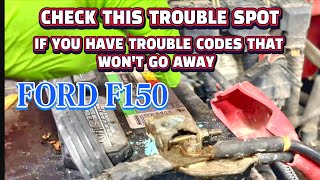
- Replacing the Transmission Control Module (TCM) 🎬 See a real-world diagnosis of a TCM communication failure. without inspecting the wiring harness first.
- Replacing the Powertrain Control Module (PCM) when the issue is a simple chafed wire.
- Replacing a wheel speed sensor when the ABS light is on, without first checking for network communication codes.
Most Likely Causes
- Transmission Wiring Harness Chafing or Damage 🔴 High Probability As documented in Ford TSB SSM 47097 and SSM 48563, the 15525 transmission wire harness may not be properly secured, causing it to rub against other components and wear through the insulation. Forum users frequently report the chafing occurs on a stud on the transmission bellhousing or against the transfer case housing.
How to confirm: Visually inspect the entire length of the transmission wiring harness, which runs from the back of the engine down to the transmission. Pay close attention to any points where it comes close to the frame, exhaust, or engine/transmission components. Look for scuffs, bare wires (especially twisted pairs), or pinch points. A common failure point is where the harness passes over the transmission.
Typical fix: If chafing is found, repair the damaged wires using solder and heat shrink. Then, properly secure the harness away from the contact point using high-quality zip ties or wiring loom clips to prevent future damage. Some owners add protective conduit to the harness in the affected area.
Est. part cost: $5-$25 for repair materials - Loose or Corroded Connectors 🟡 Medium Probability Connectors for the PCM, TCM, and ABS modules are exposed to engine bay heat and moisture, which can lead to corrosion or pins backing out over time. The main bulkhead connector (C175T) and transmission connectors are common areas to inspect.
How to confirm: Disconnect the main connectors at the PCM (typically on the firewall), TCM (on the transmission), and other related modules. Inspect for green or white corrosion, bent pins, or pins that have pushed back into the connector. Check for moisture intrusion.
Typical fix: Clean corroded pins with a specialized electrical contact cleaner. If pins are damaged or backed out, the connector may need to be repinned or replaced. Apply dielectric grease before reconnecting to prevent future moisture intrusion.
Est. part cost: $10-$30 - Faulty Control Module ⚪ Low Probability
How to confirm: This is a diagnosis of exclusion. If the wiring, connectors, and network integrity (checked with a multimeter for 60-ohm resistance) are all confirmed to be good, a module may be at fault. A technician can use an advanced scan tool to try and communicate with individual modules to see which one is offline.
Typical fix: Replace the faulty module (e.g., PCM, TCM, ABS module). The new module will require programming to the vehicle's VIN.
Est. part cost: $400-$1500
Rare But Worth Checking
- Aftermarket Electronics: Improperly installed remote starters, alarms, or audio equipment can be spliced into the CAN bus wiring, causing interference or shorts that bring down the network.
- Water Intrusion into Body Control Module (BCM): Known F-150 issues like leaking windshields, clogged sunroof drains, or a blocked A/C evaporator drain can allow water to drip onto the BCM, located in the passenger-side kick panel. This can cause corrosion and short circuits on the BCM's internal board or at its connectors (e.g., C2280B), leading to a flood of communication codes, including U0074.
Diagnosis Steps
- Read all Diagnostic Trouble Codes (DTCs) 🎬 Watch this guide on diagnosing random transmission and sensor codes. from all modules using a capable OBD-II scanner.
- Review the provided NHTSA TSBs (SSM 48563 and SSM 47097) which directly address this code and its common cause.
- Perform a thorough visual inspection of the transmission wiring harness (part family 15525) for any signs of chafing, rubbing, or damage, particularly where it routes over the transmission bellhousing and near the transfer case.
- If damage is found, repair the wiring and secure the harness properly.
- If no harness damage is visible, inspect the main electrical connectors at the PCM, TCM, and BCM for corrosion, moisture, or backed-out pins.
- (Advanced) With the battery disconnected, use a multimeter to measure the resistance between Pin 6 (CAN-High) and Pin 14 (CAN-Low) at the OBD-II port. A healthy network should read approximately 60 ohms.
- (Advanced) If the resistance is 120 ohms, it indicates a break in the wiring or that one of the two terminating resistors (modules) is disconnected from the network. If the resistance is near 0 ohms, the CAN-High and CAN-Low wires are shorted together. Isolate modules one by one to find the source of the fault.
- (Advanced) Check for water damage at the BCM in the passenger kick panel, a known issue that causes these codes.
- After any repair, clear all DTCs and perform a test drive to ensure the fault does not return.
Parts You'll Likely Need
- Transmission Wiring Harness Repair Supplies — Used to fix chafed wires in the existing harness, which is the most common failure point.
Trusted brands: 3M, Motorcraft
OEM price range: $10-$30
Aftermarket price range: $5-$20 - Transmission Wiring Harness
(OEM #Varies by configuration (e.g., JL3T-15525-, JL3Z-15525-). Must match to VIN.)— Required if the original harness is too damaged to be reliably repaired.
Trusted brands: Motorcraft
OEM price range: $150-$300
Aftermarket price range: $100-$200
Related Codes That Often Appear With This One
- U0101 — Lost Communication with TCM. This code is often set alongside U0074 because the TCM is a primary module on the network affected by the harness issue.
- U0140 — Lost Communication with Body Control Module. This indicates the communication failure is affecting multiple vehicle systems.
- P061A — Internal Control Module Torque Performance. This code can be triggered when the PCM receives implausible data from the TCM due to the communication breakdown.
- U0401 — Invalid Data Received From ECM/PCM. This is often logged by other modules (like the TCM or ABS) that are not receiving correct information from the main engine computer.
Technical Service Bulletins (TSBs) & Recalls
- SSM 48563: Addresses various DTCs including U0074, transmission shift concerns, and no-start issues related to the wiring harness on 2017-2020 models.
- SSM 47097: Specifically calls out the 15525 transmission wire harness not being properly secured as a cause for U0074 and other codes on 2017-2018 models.
Platform-Specific Known Issues
- TSB-Documented Harness Chafing: TSB SSM 47097 and SSM 48563 directly link U0074 and a cluster of other communication codes to the 15525 transmission wire harness not being properly secured, leading to chafing and symptoms like transmission shift concerns or a no-start condition.
- Owner Repair Story: Harness Rubbing on Transmission: An owner of a 2018 F-150 on f150forum.com documented a no-start condition with codes U0101, U0074, and P061A. The cause was found to be the transmission harness rubbing through on the transmission housing itself. The repair involved soldering the damaged wires and securing the harness, which resolved all codes.
- Owner Repair Story: Harness Melted by Catalytic Converter: On f150forum.com, a user with multiple communication DTCs and no-start issues traced the problem to the same wiring harness, which had come loose and made contact with the hot catalytic converter, melting the loom and shorting the wires.
Mechanic-Grade Diagnostic Values
- HS-CAN Bus Resistance at OBD-II Port (Pins 6 & 14) — expected: ~60 Ohms (with battery disconnected). Failure: 120 Ohms indicates an open circuit or one terminating resistor is offline. ~0 Ohms indicates a short between CAN High and CAN Low wires.
- HS-CAN High Voltage at OBD-II Port (Pin 6 to Ground) — expected: ~2.6V to 3.0V (Key On, Engine Off, network active). Failure: Voltage outside this range, or 2.5V if shorted to CAN Low, can indicate a fault.
- HS-CAN Low Voltage at OBD-II Port (Pin 14 to Ground) — expected: ~2.0V to 2.4V (Key On, Engine Off, network active). Failure: Voltage outside this range, or 2.5V if shorted to CAN High, can indicate a fault.
- CAN Line Resistance to Ground — expected: Megaohms (MΩ) or Open Line (OL). Failure: Low resistance (Kilo-ohms or less) indicates a short to ground on either the CAN High or CAN Low wire.
Scan Tool Commands That Help
- Ford IDS (Integrated Diagnostic System): Self Test > All CMDTCs (Continuous Memory Diagnostic Trouble Codes) — To retrieve all stored fault codes from every module on the vehicle, which helps identify which modules are offline or reporting communication errors.
- Ford IDS (Integrated Diagnostic System): Toolbox > Network Test — To perform a live test of the CAN networks, which provides a visual map of all modules and shows which ones are not communicating, helping to isolate the source of the U0074 code.
- Ford IDS / ForScan: GWM (Gateway Module) Configuration — In rare cases, particularly after other repairs or module replacements, the Gateway Module may lose its configuration, causing widespread network failures. Re-running the configuration can restore communication.
Wiring & Ground Locations
- Terminating Resistors — The two 120-ohm terminating resistors for the main HS-CAN bus are located internally within the Powertrain Control Module (PCM) and the Instrument Panel Cluster (IPC).. The network requires exactly two terminating resistors to function. If the PCM or IPC is disconnected or internally faulty, the total network resistance will change from 60 ohms to 120 ohms, causing communication to fail.
- PCM Grounds — Located on the firewall in the engine bay. There may be one or two ground studs depending on the model year and engine.. A poor ground at the PCM can cause it to malfunction, disrupting its role as a terminating resistor and a key communicator on the network, leading to code U0074.
- BCM Ground — Located inside the cab, in the passenger-side footwell area, near the Body Control Module (BCM).. The BCM is a major hub for multiple CAN buses. A bad ground can cause it to send corrupt data or stop communicating, triggering network codes.
- G401 — A frame ground stud located on the frame rail, under the driver's side door.. This is a critical ground point for the MS-CAN bus. While U0074 is an HS-CAN code, corrosion at G401 is a known cause for widespread communication issues (like U0140) that can occur alongside U0074, especially in regions with road salt.
- C2280B — One of the main multi-pin connectors on the Body Control Module (BCM) in the passenger kick panel.. Water intrusion from a leaking windshield or clogged A/C drain can corrode the pins in this connector, causing multiple network and body-related faults.
Real Owner Repair Stories
- YouTube channel 'Ford Boss Me - Auto / Politics / Family' (2017 Ford F-150) — Intermittent no-start condition with a flood of communication codes.
❌ Tried (didn't work) Initial diagnosis pointed towards a general network failure with no obvious cause.
✅ What actually fixed it The Front Control Interface Module (FCIM), the panel with the radio and climate controls, was internally shorting and bringing down the communication network. Replacing the FCIM resolved the issue. - YouTube channel 'Ford Boss Me - Auto / Politics / Family' (2017 Ford F-150 3.5L EcoBoost) — Intermittent no-start, power steering assist fault, multiple communication codes including U0131.
❌ Tried (didn't work) Technicians were unable to diagnose the intermittent electrical issue after multiple attempts.
✅ What actually fixed it A missing 10A fuse in location F37 of the interior fuse panel (Body Control Module) was the root cause. This fuse is the wake-up circuit for modules on the HS2 CAN network, including the power steering module. Installing the correct fuse restored all communications and fixed the no-start condition. - Reddit user in r/MechanicAdvice (2018 F-150 3.0L Powerstroke, ~60k miles) — Sudden loss of power, truck stuck in first gear, wrench light, and a list of codes including U0074, U0101, and others after driving in a snowstorm.
❌ Tried (didn't work) Restarting the truck did not resolve the issue.
✅ What actually fixed it The user did not post the final fix, but the symptoms (multiple U-codes, limp mode) after driving in snow strongly point to the TSB-documented issue of the transmission harness getting wet and chafing, causing a short circuit.
Helpful Videos
Used OEM Parts in Stock


New Aftermarket Parts Available


The information in this article is provided for general reference and educational purposes only. Vehicle specifications, procedures, and part compatibility can vary by production date, trim level, and region. Always consult your vehicle's factory service manual and verify part numbers before purchasing or performing repairs. Safety-critical components such as airbags, seat belts, and braking systems should be installed by a qualified professional.
- Ford F-150:
- 🎬 Helpful Videos
- 🛍️ Shop This Part
- What's Unique About the 2017-2020 Ford F-150
- Diagnostic Flowchart
- Symptoms You May Notice
- Most Likely Causes
- Rare But Worth Checking
- Diagnosis Steps
- Parts You'll Likely Need
- Related Codes That Often Appear With This One
- Technical Service Bulletins (TSBs) & Recalls
- Platform-Specific Known Issues
- Mechanic-Grade Diagnostic Values
- Scan Tool Commands That Help
- Wiring & Ground Locations
- Real Owner Repair Stories
- 🎟️ Get 5% Off