

U0037 on 2017-2020 Ford F-150: Causes and Fixes for Communication Bus Faults
On a 2017-2020 F-150, code U0037 often points to a damaged or improperly secured transmission wiring harness. This is a known issue covered by Ford's Special Service Messages (SSMs). Inspecting and securing or repairing this harness, specifically where it runs down the back of the engine to the transmission, is the most common fix.
- Code U0037 on a 2017-2020 F-150 is most likely caused by a damaged transmission wiring harness, a known issue documented by Ford.
- Before replacing any expensive modules, perform a detailed visual inspection of the wiring harness running from the engine to the transmission.
- This code is often accompanied by other communication codes (U0101, U0140) and powertrain codes (P061A).
- Ensure the vehicle's battery is in good health and all ground connections are clean and tight, as low voltage can also trigger network faults.
What's Unique About the 2017-2020 Ford F-150
For the 2017-2020 F-150, this code is strongly linked to a specific, documented problem. Ford issued technical bulletins (SSM 47097 and SSM 48563) highlighting that the transmission wiring harness (part of the 15525 circuit) can be improperly secured. This allows it to rub against other components, leading to chafed wires, short circuits, and a loss of communication between essential modules like the PCM and TCM, triggering U0037 and other related codes.
Diagnostic Flowchart
Tap your situation to follow the diagnostic path that matches what you're seeing on this vehicle.
Symptoms You May Notice
- Check Engine Light or Malfunction Indicator Lamp (MIL) is on
- Powertrain malfunction indicator lamp (wrench light) is on.
- Transmission shifting issues (harsh shifts, getting stuck in gear, delayed shifts).
- Vehicle won't start or has a no-crank condition.
- Auto Start-Stop system is inoperative.
- Multiple unrelated warning lights on the instrument cluster (ABS, traction control, hill assist).
- Loss of power windows, door locks, or interior lighting.
- Tachometer drops to zero while driving.
- Sudden loss of acceleration or stalling.
- Replacing the Transmission Control Module (TCM) or Powertrain Control Module (PCM) without first thoroughly inspecting the wiring harness. The harness issue is far more common than module failure for this code on these trucks.
- Replacing the throttle body. While a faulty throttle body can cause a wrench light, it typically won't generate a U-series communication code.
Most Likely Causes
- Transmission Wiring Harness Damaged or Improperly Secured 🔴 High Probability As documented in Ford's Special Service Messages (SSM 47097 & 48563), the harness at the rear of the engine going to the transmission was not always properly secured from the factory, leading to chafing and wire damage. This harness is identified as the 15525 circuit.
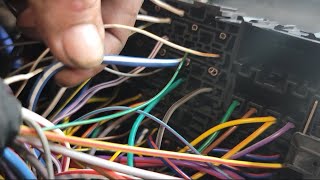
How to confirm: Visually inspect the transmission wiring harness (circuit 15525) for signs of rubbing, chafing, exposed wires, or loose connections, particularly where it runs down the back of the engine and along the transmission case. Look for areas where the plastic loom is worn through, exposing the wires inside. Wiggling the harness while the engine is running may trigger the symptoms.
Typical fix: Secure the harness with zip ties to prevent movement. If wires are damaged, they must be repaired by splicing, soldering, and heat-shrinking. In severe cases, the entire harness section may need replacement. Some owners have reported the harness being on backorder, indicating the frequency of this issue.
Est. part cost: $10-$50 for repair materials, $200-$600 for a replacement harness section. - Failing Battery or Poor Ground Connection 🟡 Medium Probability Modern trucks like the F-150 have a Battery Management System (BMS) and numerous modules that are highly sensitive to voltage. A weak battery can cause unpredictable communication errors across various networks. Poor ground connections are also a known issue that can cause widespread electrical problems.
How to confirm: Test the battery's voltage and load capacity. A healthy battery should be above 12.4V at rest. Check the main battery terminals and chassis ground points for corrosion or looseness. A known problematic ground point is located on the body up front. Weird communication faults are a trademark of a dying battery on these trucks.
Typical fix: Replace the battery if it fails a load test. Clean all ground connections and battery terminals until they are bright metal and secure them tightly. A BMS reset is required after battery replacement to ensure proper charging and system function; this involves letting the truck sit locked and undisturbed for at least 8 hours.
Est. part cost: $150-$350 for a new AGM battery. - Failed Control Module ⚪ Low Probability
How to confirm: This requires advanced diagnostics with a scan tool capable of communicating with individual modules. If a specific module (e.g., PCM, TCM, BCM, ABS) does not respond on the network and the wiring to it is confirmed to be good, the module itself is likely faulty. A technician can perform a continuity test from the OBD-II port to the module connector to rule out a wiring break.
Typical fix: Replace the failed module. This often requires programming the new module to the vehicle's VIN.
Est. part cost: $500-$1200 depending on the specific module.
Rare But Worth Checking
- Corroded Connector Pins: Water intrusion into a major harness connector can cause corrosion on the pins for the CAN bus wires, leading to high resistance and communication loss. This can happen at the BCM, PCM, or bulkhead connectors. Water leaking from a windshield seal has been anecdotally linked to these types of electrical issues.
- Software Corruption: A failed reprogramming attempt or a random glitch can sometimes corrupt a module's software, preventing it from communicating correctly on the network. A dealer may attempt a "battery reset" or module reprogram as a first step.
Diagnosis Steps
- Scan for all DTCs in all modules. Note all communication (U-prefix) codes that are present, as they are key to diagnosing this issue.
- Perform a thorough visual inspection of the transmission wiring harness (circuit 15525), from the back of the engine down to the transmission, as specified in Ford SSM 47097 and 48563.
- Look for any areas where the harness is rubbing against metal parts, pinched, or unsecured. Pay close attention to the plastic loom for wear marks. The chafing often occurs at the rear of the engine.
- If damage is found, repair the affected wires and securely fasten the harness away from any moving or sharp parts using high-quality zip ties.
- If no harness damage is visible, test the battery and charging system. Ensure the battery is fully charged and passes a load test. Many forum users report that a failing battery is the source of multiple, random communication codes.
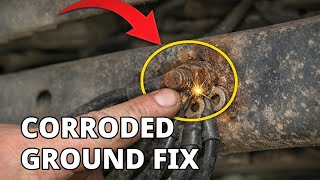
- Inspect and clean the main battery terminals and chassis ground connections. A common ground point to check is near the base of the A-pillar inside the cab or on the frame near the front of the vehicle. 🎬 See how to fix a common MS-CAN bus ground issue.
- If the battery and wiring appear good, use an advanced scan tool to check for communication with individual modules (PCM, TCM, BCM, ABS). The module that is not communicating is the likely source of the problem.
- As a final step, check for resistance on the CAN bus at the OBD-II port. With the battery disconnected, measure resistance between Pin 6 (CAN-High) and Pin 14 (CAN-Low). A healthy bus should have a resistance of approximately 60 ohms. A reading of 120 ohms indicates a break in the circuit or a missing terminating resistor, while a reading near zero indicates a short between the two wires. 🎬 Watch: A professional guide to Ford CAN-bus diagnostics and testing.
Parts You'll Likely Need
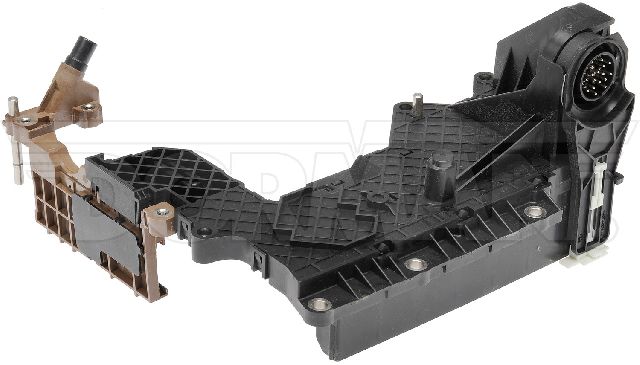
- Transmission Wiring Harness
(OEM #JL3T-15525-JH, JL3T-15525-BG (Part numbers vary by specific vehicle configuration and year))— This is the most frequent cause of U0037 on this platform due to the factory routing/securing issue. Often only a repair is needed, but sometimes the harness is too damaged.
Trusted brands: Motorcraft
OEM price range: $300-$600
Aftermarket price range: $200-$450 - AGM Battery — A weak or failing battery is a common source of network communication codes on modern vehicles.
Trusted brands: Motorcraft, Duralast, DieHard
OEM price range: $250-$350
Aftermarket price range: $180-$280
Related Codes That Often Appear With This One
- U0140 — Lost Communication With Body Control Module
- U0401 — Invalid Data Received From ECM/PCM
- U0101 — Lost Communication with TCM
- U0074 — Control Module Communication Bus B Off
- P061A — Internal Control Module Torque Performance
Technical Service Bulletins (TSBs) & Recalls
- SSM 48563: Affects 2017-2020 F-1
Platform-Specific Known Issues
- Transmission Harness Chafing (SSM 47097 & 48563): Ford Special Service Messages directly address the cause of U0037 and other codes being triggered by an improperly secured 15525 transmission wire harness on 2017-2020 F-150s. The bulletins instruct technicians to visually inspect the harness for damage where it runs from the rear of the engine down to the transmission and repair as necessary.
Mechanic-Grade Diagnostic Values
- HS-CAN Bus Resistance (Battery Disconnected) — expected: ~60 Ω between Pin 6 (CAN-H) and Pin 14 (CAN-L) of the OBD-II port.. Failure: A reading of ~120 Ω indicates an open circuit or a module/terminating resistor is offline. A reading near 0 Ω indicates a short between the CAN-H and CAN-L wires.
- HS-CAN Bus Voltage (Key On, Engine Off) — expected: CAN-High (Pin 6): ~2.6V. CAN-Low (Pin 14): ~2.4V. The bus is idle when both lines are steady at ~2.5V.. Failure: During data transmission, CAN-H should rise to ~3.5V and CAN-L should drop to ~1.5V. Voltages stuck at 0V, battery voltage, or that do not mirror each other indicate a short to ground, short to power, or an open circuit.
Scan Tool Commands That Help
- Ford IDS (Integrated Diagnostic System): All Modules Network Test — This is a primary function to run at the start of diagnosis. It polls all modules on the network and provides a topology map showing which modules are communicating and which are not, quickly identifying the source of the 'Bus Off' message.
- Ford IDS (Integrated Diagnostic System): Retrieve Continuous Memory DTCs — Use this function to pull all stored codes from every module, which can provide context for the U0037 code. Often, a fault in one module will set communication codes in many other modules.
- Ford IDS (Integrated Diagnostic System): Module Self-Test — If a specific module is suspected (e.g., PCM, BCM), this command can be run to query that individual module for internal faults, separate from network communication issues.
Wiring & Ground Locations
- BCM Ground — In the passenger-side footwell, to the right of the Body Control Module (BCM) itself. Accessed by removing the plastic kick panel.. The BCM is a central hub for multiple CAN networks. A poor ground at this location can cause the BCM to malfunction and disrupt network communications, leading to U-codes.
- PCM Grounds — Located on the firewall in the engine bay. There may be one or two ground studs depending on the engine and model year.. The Powertrain Control Module is a critical node on the HS-CAN bus. A bad ground can cause it to stop communicating, triggering a bus-off fault.
- Main Battery Ground — In the engine bay, on the body just in front of the washer fluid reservoir.. This is the primary ground for the entire vehicle's electrical system. Corrosion or looseness here can cause system-wide low voltage and unpredictable electronic faults, including communication codes.
- Body-to-Frame Ground Strap — Underneath the truck, there is a ground strap connecting the aluminum body to the steel frame. One is often located near the left engine mount bracket.. This strap is critical for ensuring all body-mounted modules have a solid ground path. It is exposed to the elements and prone to corrosion, which can create intermittent and hard-to-diagnose electrical issues.
Real Owner Repair Stories
- Ford F150 Forum (2018 Ford F-150) — Dash cluster and infotainment screen went black, erratic automatic shifting, front power windows inoperative.
❌ Tried (didn't work) Initial inspection of factory harnesses.
✅ What actually fixed it The owner discovered a module and messy wiring under the dash that had been kicked and partially disconnected. It was identified as a poorly installed aftermarket alarm and remote start system. Securing the loose connections of the aftermarket device resolved the symptoms. - Reddit r/f150 (2018 Ford F-150) — After a PCM recall flash, a check engine light appeared (P0430). This was followed by numerous random electrical issues: traction control turning off, false low washer fluid warnings, slow cranking, and rattling gauges on startup.
❌ Tried (didn't work) The owner was told they needed a new catalytic converter based on the P0430 code.
✅ What actually fixed it The owner replaced the aging battery. After the new battery was installed, all the random electrical gremlins disappeared, and even the check engine light for the catalytic converter did not return. The root cause was a dying battery causing widespread, intermittent faults.
"I Checked Everything" — The Actual Cause
- A technician may inspect the common transmission harness (SSM 47097/48563) and find no damage, and all module grounds may appear clean. The actual cause can be an aftermarket device, like a remote starter or alarm, that was improperly spliced into a CAN bus line under the dashboard. These splices can corrode or come loose, taking down the network, but are often overlooked during a standard diagnostic procedure that focuses on factory wiring.
Helpful Videos
Used OEM Parts in Stock


New Aftermarket Parts Available


The information in this article is provided for general reference and educational purposes only. Vehicle specifications, procedures, and part compatibility can vary by production date, trim level, and region. Always consult your vehicle's factory service manual and verify part numbers before purchasing or performing repairs. Safety-critical components such as airbags, seat belts, and braking systems should be installed by a qualified professional.
- Ford F-150:
- 🎬 Helpful Videos
- 🛍️ Shop This Part
- What's Unique About the 2017-2020 Ford F-150
- Diagnostic Flowchart
- Symptoms You May Notice
- Most Likely Causes
- Rare But Worth Checking
- Diagnosis Steps
- Parts You'll Likely Need
- Related Codes That Often Appear With This One
- Technical Service Bulletins (TSBs) & Recalls
- Platform-Specific Known Issues
- Mechanic-Grade Diagnostic Values
- Scan Tool Commands That Help
- Wiring & Ground Locations
- Real Owner Repair Stories
- "I Checked Everything" — The Actual Cause
- 🎟️ Get 5% Off