

U0001 on 2004-2009 Hyundai Tucson: High-Speed CAN Bus Failure Diagnosis and Fixes
The U0001 code on a 2004-2009 Hyundai Tucson indicates a complete breakdown in the High-Speed CAN bus communication network. This is most often caused by wiring issues, such as corrosion or damage, a weak battery, or a faulty control module, particularly the ABS module on this platform. Diagnosis is complex and often requires professional tools to isolate the fault.
- U0001 is a critical network failure code indicating that your Tucson's main computers cannot communicate.
- Do not drive the vehicle, as essential systems like the engine, transmission, and ABS can become unresponsive or behave erratically.
- The most common causes are wiring/ground issues, a weak battery, or a failed control module.
- For the 2004-2009 Tucson, the ABS module is a known weak point that can cause this specific code and should be investigated early in the diagnostic process.
What's Unique About the 2004-2009 Hyundai Tucson
The first-generation Hyundai Tucson (JM) uses a standard CAN bus system for its era. While there are no unique design flaws, a notable weak point is the ABS (Anti-lock Brake System) module. This specific module is known to fail internally, causing it to either stop communicating or flood the network with erroneous data, which can bring down the entire CAN bus and trigger a U0001 code. Additionally, as these vehicles age, they are highly susceptible to corrosion, particularly in the front and rear subframes, which can compromise critical ground connections essential for stable CAN bus operation.
Symptoms You May Notice
- Check Engine Light is on
- Multiple warning lights on the dashboard (ABS, Airbag, Traction Control, ESP OFF)
- Engine may stall or not start
- Transmission may not shift correctly or may go into 'limp mode'
- Loss of power windows, door locks, or other interior electronics
- Inability to communicate with one or more modules using a scan tool
- Erratic or malfunctioning dashboard gauges
- Replacing the ECM or another control module without first thoroughly testing the wiring harness and power/ground connections. The problem is often in the wiring between modules, not the module itself.
- Overlooking the ABS module as the primary culprit. Given its known failure rate on this platform, the ABS module should be one of the first components checked during diagnosis.
Most Likely Causes
- CAN Bus Wiring or Connector Fault 🔴 High Probability As vehicles age, wiring harnesses can become brittle, and connectors can suffer from corrosion due to moisture intrusion. Physical damage from previous repairs or road debris can also cause an open or short in the CAN wiring. Poor ground connections, often exacerbated by chassis rust, are a key cause of network instability.
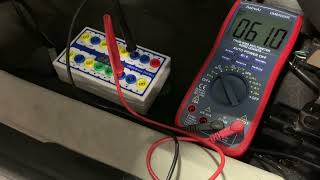
How to confirm: Perform a visual inspection of the main wiring harnesses and ground points. With the battery disconnected, use a multimeter to check for continuity and resistance on the CAN High and CAN Low wires at the OBD-II port. A healthy bus should have a resistance of approximately 60 ohms. 🎬 Watch: How to test CAN bus resistance with a multimeter A reading of 120 ohms suggests an open circuit, while a reading near 0 ohms indicates a short.
Typical fix: Repair or replace the damaged section of the wiring harness. Clean or replace corroded connectors. Ensure all chassis and module ground points are clean and secure.
Est. part cost: $10-$200 - Faulty ABS Control Module 🟡 Medium Probability The ABS pump and module assembly on the 2004-2010 Tucson is a documented common failure point. It can fail internally in a way that either prevents it from communicating or causes it to disrupt the entire CAN network, leading to a U0001 code.
How to confirm: A primary symptom is the illumination of the ABS and/or ESP warning lights. A professional scan tool may be unable to communicate with the ABS module specifically. A diagnostic test involves disconnecting the ABS module connector and re-checking if communication is restored between the other modules.
Typical fix: Replace or rebuild the ABS pump and module. Rebuilt units are a common and cost-effective solution. The replacement unit typically does not require programming.
Est. part cost: $250-$800 (Rebuilt), $1000+ (New) - Weak or Failing Battery / Poor Connections 🟡 Medium Probability Low system voltage can cause unpredictable behavior in electronic modules, leading to communication dropouts on the network. Corroded or loose battery terminals are a common culprit on any aging vehicle.
How to confirm: Test the battery voltage with a multimeter; it should be above 12.4 volts with the engine off. Ensure terminals are clean and tight. Load test the battery to check its health. Also, check the alternator output to ensure it's charging correctly.
Typical fix: Clean the battery terminals and cable ends thoroughly. Charge or replace the battery if it fails a load test.
Est. part cost: $5-$250 - Faulty Control Module (Other than ABS) ⚪ Low Probability Any single control module (ECM, TCM, BCM, etc.) on the network can fail internally, causing it to either stop communicating or flood the network with bad data, bringing the entire system down.
How to confirm: This is difficult without an advanced scan tool. The diagnostic process involves disconnecting modules one by one to see if communication on the network is restored.
Typical fix: Replace the faulty module. The new module will likely require programming to the vehicle's VIN.
Est. part cost: $200-$1000+
Rare But Worth Checking
- Aftermarket Electronics Interference: A poorly installed aftermarket stereo, alarm system, or remote starter that is improperly connected to the vehicle's wiring can interfere with the CAN bus signals and cause a U0001 code.
Diagnosis Steps
- Check the battery. Ensure it is fully charged (above 12.4V) and the terminals are clean and tight. Check alternator output.
- Perform a visual inspection of the main wiring harnesses, especially around the engine bay, under the dashboard, and near the main control modules. Look for any signs of damage, corrosion, or loose connectors.
- Inspect chassis ground connections for tightness and corrosion, particularly the main engine-to-chassis ground strap.
- Use a quality OBD-II scanner to check for any other 'U' codes. A series of codes pointing to a loss of communication with multiple modules confirms a network-wide issue.
- Disconnect the battery. Using a multimeter, measure the resistance between Pin 6 (CAN High) and Pin 14 (CAN Low) on the OBD-II diagnostic port. A reading of approximately 60 ohms indicates the terminating resistors and main wiring are likely intact. A reading of 120 ohms suggests an open circuit or a missing terminating resistor, while a reading near 0 ohms indicates a short between the CAN lines.
- If the resistance reading is correct, the issue is likely a module. Given the platform's history, the ABS module is a prime suspect. Disconnect the main electrical connector to the ABS module and see if communication between other modules (like ECM and TCM) is restored.
- If disconnecting the ABS module does not resolve the issue, consult a vehicle-specific wiring diagram to locate other modules on the high-speed CAN bus and disconnect them one by one until communication is restored. This step is best left to a professional.
Parts You'll Likely Need
- ABS Pump and Module
(OEM #58900-2E150, 58920-2E150, 58900-2E000 (Verify by VIN))— This is a common failure item on the 2004-2010 Tucson that can cause a total CAN bus failure.
Trusted brands: Hyundai (OEM), Cardone (Remanufactured), ECU Testing (Rebuild Service)
OEM price range: $1000+
Aftermarket price range: $250-$800 (Remanufactured/Rebuilt) - Engine Control Module (ECM) — If the ECM fails internally, it can bring down the entire CAN network. This is a last resort after all wiring and other modules have been ruled out.
Trusted brands: Hyundai (OEM)
OEM price range: $600-$1200
Aftermarket price range: $300-$700 (Remanufactured) - Wiring Harness Connectors/Pigtails — Corrosion or damage at a key connector is a frequent cause of network failure.
Trusted brands: Dorman, Standard Motor Products
OEM price range: $30-$100
Aftermarket price range: $15-$50
Related Codes That Often Appear With This One
- U0100 — Lost Communication With ECM/PCM
- U0101 — Lost Communication with TCM
- U0121 — Lost Communication With Anti-Lock Brake System (ABS) Control Module
- C2402 — Hydraulic Pump Motor fault, often stored in the ABS module before it fails completely and stops communicating.
Platform-Specific Known Issues
- A known issue with the 2004-2010 Hyundai Tucson is the internal failure of the ABS pump and module. This can manifest as an inability to communicate with the module or cause the module to disrupt the entire CAN network, triggering code U0001. Symptoms often include ABS and ESP warning lights. Rebuilding the original unit is a common and effective repair.
Mechanic-Grade Diagnostic Values
- CAN Bus Network Resistance (Battery Disconnected) — expected: ~60 Ohms. Failure: 120 Ohms indicates an open circuit or one terminating resistor is offline. Near 0 Ohms indicates a short between CAN High and Low wires.
- CAN High Voltage (Key On, Engine Off) — expected: ~2.6 - 2.7 Volts DC. Failure: Voltage stuck at 0V, 5V, or a static ~2.5V with no fluctuation indicates a fault.
- CAN Low Voltage (Key On, Engine Off) — expected: ~2.3 - 2.4 Volts DC. Failure: Voltage stuck at 0V, 5V, or a static ~2.5V with no fluctuation indicates a fault.
- Alternator Charging Voltage (Engine Running) — expected: ~13.5 - 14.5 Volts DC. Failure: Voltage below 13.2V or above 15.0V can cause communication issues with modules.
Scan Tool Commands That Help
- Hyundai GDS (Global Diagnostic System): DTC Analysis — To perform a full network scan and retrieve all manufacturer-specific 'U' codes from every module. The GDS provides more detailed fault information than generic scanners.
- Hyundai GDS (Global Diagnostic System): Live Data / Current Data — To monitor the status of individual modules on the CAN bus. A technician can observe which modules are actively communicating and which are offline, helping to pinpoint the source of the network failure.
- Advanced Scan Tool: Network Test / Bus Diagnosis — This function, available on high-end scanners, can sometimes map out the CAN network and show which modules are responding. It's used to systematically identify the point of failure without having to physically disconnect each module initially.
Wiring & Ground Locations
- OBD-II DLC (Data Link Connector) — Under the driver's side dashboard, typically to the left of the steering column.. This is the primary access point for testing the entire CAN bus. Pin 6 is CAN High and Pin 14 is CAN Low. Resistance and voltage measurements are taken here to assess the health of the network backbone.
- ABS Module Connector — In the engine bay, typically on the driver's side, attached to the hydraulic ABS block.. Disconnecting this connector is a key diagnostic step. If communication is restored to other modules after unplugging it, the ABS module itself is the source of the network failure.
- Instrument Cluster (Gateway) — Behind the steering wheel, within the dashboard.. The instrument cluster often acts as a gateway, routing messages between different vehicle networks. A failure within the cluster or its connector can bring down the high-speed CAN bus. It is also one of the two modules containing a 120-ohm terminating resistor.
- ECM (Engine Control Module) — Typically located in the engine bay, often near the battery or firewall.. The ECM is a critical node on the high-speed CAN bus and contains the second 120-ohm terminating resistor. A fault here or in its wiring can cause a U0001 code.
OEM Part Supersession History
58900-2E150→N/A— This part number appears to be stable for the specified model years.
Heads up: Multiple part numbers exist for the ABS module based on features like TCS/ESP. It is critical to match the part number exactly from the original unit. For example, 58900-2E150 and 58920-2E150 are both listed for this vehicle but may not be interchangeable.
Diagnostic Flowchart
Other Known Issues on This Vehicle
Issues unrelated to this code that are worth knowing about as an owner of this generation:
- Front and Rear Subframe Corrosion 🔴 High — Very common, especially in 'Salt Belt' regions. Can become structurally unsafe. (Ref: Hyundai conducted a service campaign (Recall 113 / NHTSA 13V-354) for rear crossmember corrosion, but issues persist on many vehicles.)
- Crankshaft Position Sensor Failure 🟠 Medium — A common failure item as the vehicle ages, typically after 80,000 miles. Leads to no-start or stalling conditions. (Ref: No specific recall, but it is a widely documented failure. Often presents with code P0335.)
- AC Compressor or Clutch Failure 🟡 Low — Fairly common. The AC compressor clutch may fail, or the compressor itself may seize, leading to a loss of air conditioning.
- Sensor Failures (Various) 🟡 Low — Owners report various sensor failures over the vehicle's life, including oxygen sensors and ambient air temperature sensors, leading to check engine lights or erratic climate control behavior.
Used vs. New Parts: Buying Guide for This Vehicle
When a used part is the smart pick: For the most common cause, a failed ABS module, a used part from a reputable salvage yard is a very smart choice. These modules are generally reliable aside from the specific internal failure mode, and a used unit can offer significant savings over a new or even a remanufactured one.
Donor-vehicle mileage cap: roughly under 120000 miles for the part to have meaningful remaining life.
What to inspect on the donor part:
- Verify the part number on the used module EXACTLY matches your original.
- Inspect the electrical connector pins for any signs of corrosion or damage.
- Choose a donor vehicle from a dry climate if possible to minimize the risk of corrosion issues.
- Ensure the seller offers a warranty or return policy in case the part is non-functional.
OEM-only on this vehicle (don't cheap out):
- Engine Control Module (ECM)
Aftermarket brands forum-validated for this vehicle:
- Cardone (Remanufactured ABS Modules)
- ECU Testing (ABS Module Rebuild Service)
Brands owners have reported issues with on this vehicle:
- Unknown, no-name brands for electronic modules from online marketplaces should be avoided due to quality control concerns.
Real Owner Stories
Aggregated from forums and TSBs cited above. Mileages and costs reflect what owners reported in those sources.
2004-2010 Hyundai Tucson
Symptoms: ABS and/or ESP warning lights illuminated; the module failed internally in a way that prevented communication or disrupted the entire CAN network, leading to a U0001 code.
What fixed it: Replace or rebuild the ABS pump and module. Rebuilt units are noted as a common and cost-effective solution.
Cost: $250-$800
Source hint: vehicle_specific_issues
2004-2009 Hyundai Tucson
Symptoms: Multiple threads discuss rear subframe rust issues which can affect grounding points and network stability.
What fixed it: Subframe replacement; one user noted Hyundai offered a 'backdoor' warranty to cover the replacement even after the official campaign ended.
Source hint: Hyundai-Forums.com: Multiple threads discuss the rear subframe rust issue
Related OBD-II Codes
Frequently Asked Questions
Is there a recall for the subframe rust that might be affecting my 2004-2009 Tucson's ground connections?
My Tucson has ABS and ESP OFF lights on along with U0001; is the ABS module the likely culprit?
Can I use a used ABS module from a salvage yard to fix the U0001 code on my Tucson?
Does the 2004-2009 Tucson ABS module require programming after replacement?
Could a bad crankshaft position sensor be related to my communication issues?
What should the resistance be when testing the CAN bus at the OBD-II port on my Tucson?
Helpful Videos
We Have This Part in Stock



The information in this article is provided for general reference and educational purposes only. Vehicle specifications, procedures, and part compatibility can vary by production date, trim level, and region. Always consult your vehicle's factory service manual and verify part numbers before purchasing or performing repairs. Safety-critical components such as airbags, seat belts, and braking systems should be installed by a qualified professional.
- Hyundai Tucson:
- 🎬 Helpful Videos
- 🛍️ Shop This Part
- What's Unique About the 2004-2009 Hyundai Tucson
- Symptoms You May Notice
- Most Likely Causes
- Rare But Worth Checking
- Diagnosis Steps
- Parts You'll Likely Need
- Related Codes That Often Appear With This One
- Platform-Specific Known Issues
- Mechanic-Grade Diagnostic Values
- Scan Tool Commands That Help
- Wiring & Ground Locations
- OEM Part Supersession History
- Diagnostic Flowchart
- Other Known Issues on This Vehicle
- Used vs. New Parts: Buying Guide for This Vehicle
- Real Owner Stories
- 2004-2010 Hyundai Tucson
- 2004-2009 Hyundai Tucson
- Related OBD-II Codes
- Frequently Asked Questions
- 🎟️ Get 5% Off