

P2702 on 2017-2023 Ford F-150: Transmission Friction Element 'C' Causes and Fixes
On a 2017-2023 F-150, code P2702 almost always points to an internal issue with the 10R80 transmission, specifically the CDF clutch drum. This is a widespread, well-documented design flaw where an internal sleeve moves, causing hydraulic pressure loss. Ford has issued multiple Technical Service Bulletins (TSBs) and an updated part (JL3Z-7H351-B) to address it. The fix requires transmission overhaul to replace the drum and is not a DIY job, often costing $2,500-$6,000+.
- P2702 on a 2017-2023 F-150 is not a simple sensor or fluid issue; it strongly indicates a known mechanical failure inside the 10R80 transmission.
- The most likely culprit is a faulty CDF clutch drum, a problem so common that Ford has issued multiple TSBs and an updated part.
- This is a serious issue requiring professional diagnosis and repair. Do not ignore it, as continued driving can cause more extensive transmission damage.
- Repair involves removing the transmission to replace the CDF drum and will be costly if the vehicle is out of warranty.
- When speaking to a repair shop, mention the code P2702 and the known issues with the 10R80 CDF drum to guide the diagnosis.
What's Unique About the 2017-2023 Ford F-150
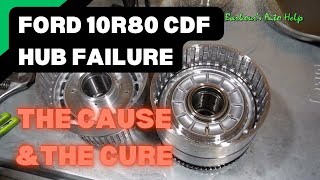
The 2017-2023 F-150 predominantly uses the Ford 10R80 10-speed automatic transmission, which was co-developed with General Motors. This specific transmission is known to have a design flaw with the C-D-F (CDF) clutch drum. A bushing/sleeve inside the drum can 'walk' or move axially out of position, uncovering hydraulic fluid passages and tearing Teflon seals. This causes a significant loss of hydraulic pressure to the clutch pack, leading to the exact symptoms of P2702—harsh shifts, delayed engagement, and slipping. Ford has issued multiple Technical Service Bulletins (TSBs) like TSB 24-2254, acknowledging the issue and providing a repair path that involves replacing the drum with an updated part.
Diagnostic Flowchart
Tap your situation to follow the diagnostic path that matches what you're seeing on this vehicle.
Generation note: This issue affects both the 13th generation (2017-2020) and 14th generation (2021-2023) F-150, as both widely use the 10R80 transmission where this fault is common. The root cause is tied to the transmission model, not a specific vehicle generation. 🎬 See a deep dive into why these 10-speeds fail Ford introduced a revised CDF drum part in vehicles built after August 15, 2022, but earlier models remain susceptible.
Symptoms You May Notice
- Harsh, jerky, or delayed shifting, especially between gears that use the 'C' clutch (e.g., 3-4 shift).
- A jolt, shudder, or clunking noise during gear changes, sometimes feeling like being rear-ended when coming to a stop.
- Transmission slipping, where engine RPMs increase without a corresponding increase in vehicle speed (a 'flare' between shifts).
- Illuminated Malfunction Indicator Lamp (MIL) or Check Engine Light.
- Vehicle may enter 'limp mode,' limiting available gears.
- Delayed engagement when shifting from Park into Drive or Reverse.
- Symptoms are often more pronounced when the transmission is cold.
- Replacing only the shift solenoids or the valve body without addressing the underlying CDF drum issue, leading to a repeat failure.
- Performing a fluid flush and TCM reset. While sometimes a preliminary step, it will not fix the mechanical 'bushing walk' issue in the CDF drum.
- Assuming a complete transmission replacement is needed when only the CDF drum, associated seals, and a valve body cleaning are required. Some dealers may recommend full replacement for expediency.
Most Likely Causes
- Internal Failure of the CDF Clutch Drum 🔴 High Probability A well-documented design flaw in the 10R80 transmission where a sleeve within the CDF clutch drum can walk out of position, exposing fluid ports and causing hydraulic pressure leaks. This is the subject of multiple Ford TSBs (e.g., TSB 24-2254) and is widely discussed in owner forums as the primary cause for P2702.
How to confirm: A technician must perform a transmission pressure test as outlined in TSB 24-2254 to confirm hydraulic leakage in the clutch circuits. Visual inspection upon disassembly will clearly show the displaced sleeve and likely wear on the drum and seals.
Typical fix: The transmission must be removed and partially disassembled to replace the faulty CDF clutch drum with the updated part (JL3Z-7H351-B). 🎬 Watch: See the CDF hub failure and the updated fix This often involves a minor transmission overhaul, including replacing seals and inspecting related clutches.
Est. part cost: $200-$400 for the drum assembly - Sticking Valves in Main Control Valve Body 🟡 Medium Probability Debris from the failing CDF drum can contaminate the valve body, causing solenoids and valves to stick. TSB 24-2254 also lists the valve body as a potential cause alongside the CDF drum. In some cases, the valve body itself can warp or have cross-leaks.
How to confirm: After checking fluid, a technician may inspect and test the valve body. Often, this is diagnosed and repaired concurrently with the CDF drum, as contamination is a linked failure.
Typical fix: Cleaning or replacing the main control valve body assembly. Some shops may replace the separator plate with an upgraded version.
Est. part cost: $500-$1200 - Low or Contaminated Transmission Fluid ⚪ Low Probability While not specific to this platform, low fluid can cause pressure drops and shifting issues. Contaminated fluid (often with clutch material from the failing drum) is a symptom of the larger problem rather than the root cause.
How to confirm: Check the transmission fluid level and condition. Fluid should be at the correct level, red, and not smell burnt or contain excessive metal particles ('glitter'). Use only Motorcraft MERCON ULV fluid.
Typical fix: Top off the fluid or perform a transmission fluid and filter change using the correct Motorcraft MERCON ULV fluid. This is rarely a permanent fix for P2702 and is usually done as part of a larger repair.
Est. part cost: $150-$300 for fluid and filter
Rare But Worth Checking
- TCM Software/Calibration Error: Sometimes, the adaptive learning strategy in the TCM can become corrupted. A software update or reset is a preliminary step a dealer will take, as outlined in TSBs, before authorizing a mechanical repair.
- Faulty Shift Solenoid: While less common than the systemic CDF drum failure, an individual solenoid responsible for actuating the 'C' clutch can fail electrically or mechanically. However, this is often misdiagnosed when the root cause is the pressure loss from the drum.
Diagnosis Steps
- Verify the code with a professional OBD-II scanner that can read transmission-specific codes.
- Check the transmission fluid level and condition. Ensure it is clean, at the correct level, and does not smell burnt. Use only MERCON ULV.
- Check for any available Technical Service Bulletins (TSBs) for your specific VIN. TSB 24-2254 is highly relevant and outlines the entire diagnostic and repair procedure.
- Scan for TCM software updates. A dealer or qualified shop can perform this as a first step.
- Perform a transmission hydraulic pressure test using specialized equipment (as detailed in TSB 24-2254) to check for leaks in the clutch circuits. This is the key step to definitively confirm the CDF drum issue.
- If pressure tests fail or are inconclusive, the next step is transmission removal for visual inspection and replacement of the CDF clutch drum and any other damaged components like seals or the valve body.
Parts You'll Likely Need
- CDF Clutch Cylinder Hub Assembly
(OEM #JL3Z-7H351-B)— This is the updated Ford part designed to fix the sleeve-walking issue. It features a machined lip to hold the bushing in place. It supersedes older part numbers like HL3Z-7H351-A and JL3Z-7H351-A.
Trusted brands: Motorcraft (Ford OEM)
OEM price range: $200-$400
Aftermarket price range: $150-$300 - Transmission Valve Body Assembly — May be required if valves are sticking due to contamination from the failing drum or if solenoids have failed. Often replaced as a precaution during a CDF drum repair.
Related Codes That Often Appear With This One
- P0761 — Shift Solenoid 'C' Performance/Stuck Off. Directly related to the same clutch circuit and often set concurrently.
- P07F7 — Unable to Engage Gear 7. Often logged alongside P2702, pointing to a failure in the C/F clutch application.
- P0731 — Gear 1 Incorrect Ratio. General shifting errors often accompany specific clutch apply time faults.
- P0732 — Gear 2 Incorrect Ratio. General shifting errors often accompany specific clutch apply time faults.
- P0733 — Gear 3 Incorrect Ratio. General shifting errors often accompany specific clutch apply time faults.
- P2700 — Transmission Friction Element 'A' Apply Time. Multiple clutch apply time faults often point to the systemic CDF drum issue.
- P2701 — Transmission Friction Element 'B' Apply Time. Multiple clutch apply time faults often point to the systemic CDF drum issue.
- P2703 — Transmission Friction Element 'D' Apply Time. The 'D' clutch is part of the same CDF drum assembly, so this code is highly related.
- P2704 — Transmission Friction Element 'E' Apply Time. Multiple clutch apply time faults often point to the systemic CDF drum issue.
Technical Service Bulletins (TSBs) & Recalls
- TSB 24-2254: Supersedes previous TSBs. Specifically addresses harsh/delayed shifts and numerous DTCs including P2702 on 2021-2022 F-150s (and other models) built on or before Aug 15, 2022. It attributes the cause to axial movement of the CDF clutch cylinder sleeve and provides a detailed procedure for pressure testing and replacement.
- TSB 23-2250: A widely referenced bulletin covering 2017-2023 F-150s (and others) for the same list of codes and symptoms. It identifies potential causes as TCM software, sticking valves in the valve body, and the CDF clutch cylinder sleeve movement.
- TSB 26-2046 / 25-2018 / 25-2302: Earlier TSBs that also list a large cluster of transmission codes, including P2702, related to harsh shifting, indicating this has been a long-standing documented issue.
Platform-Specific Known Issues
- A known design defect in the 10R80 transmission's CDF clutch drum where an internal sleeve can move ('walk'), causing hydraulic leaks. This is acknowledged in Ford TSBs like 23-2250 and 24-2254.
- Owner complaints frequently cite harsh shifting between gears, slipping, and sudden loss of power, directly pointing to the CDF drum defect as confirmed by mechanics.
- Ford has released an updated CDF drum part (JL3Z-7H351-B or superseding numbers) that includes a machined lip to physically prevent the sleeve from moving, providing a permanent mechanical fix.
Mechanic-Grade Diagnostic Values
- Shift Solenoid Resistance (A, B, C, D, E, F) — expected: 5.0-5.4 ohms at 68°F (20°C). Failure: Resistance outside of this range indicates a faulty solenoid coil.
- Transmission Fluid Temperature (TFT) Sensor Resistance — expected: 37k-16k Ohms (69°F-104°F) or 2.7k-1.5k Ohms (195°F-230°F). Failure: Readings that do not correlate with the actual fluid temperature suggest a faulty sensor.
- Line Pressure (at service port) — expected: Approximately 110–120 psi at no-throttle and 230–260 psi at wide-open throttle in key gears.. Failure: Significantly lower pressure, especially in the 'C' clutch circuit, points to internal leaks (like the CDF drum).
Hidden / Shadow Codes Worth Checking
- P2702-00: The '-00' suffix is a sub-code indicating a 'No Sub Type Information' status, often seen on dealer-level scanners. While not providing extra detail itself, its presence alongside the main P2702 code confirms the fault is current or was recently detected by the TCM. (see via Ford IDS/FDRS or other professional-grade scan tools.)
Scan Tool Commands That Help
- Ford IDS/FDRS: Solenoid Body Strategy and Identification — When replacing the valve body or solenoids, the 13-digit strategy number from the new part must be programmed into the TCM. Failure to do so will cause erratic shifting.
- Ford IDS/FDRS: Adaptive Transmission Shift Strategy Relearn — After any transmission repair, including CDF drum replacement or software updates, the adaptive learning tables must be reset. The technician then performs a specific drive cycle to allow the TCM to learn the new components' characteristics.
- Ford IDS/FDRS with VCMM: CDF Drum Leakage Calculator (per TSB 25-2018) — This is a specific diagnostic function where a technician uses pressure transducers to measure hydraulic pressure and inputs the values into a calculator. The tool determines the percentage of leakage at the CDF drum to definitively confirm the failure without disassembly.
Wiring & Ground Locations
- Transmission Case Connector (Bulkhead) — On the main transmission case, where the internal wiring harness connects to the vehicle harness.. This is the primary electrical interface for all solenoids and sensors. A loose or corroded pin for the Clutch 'C' solenoid (Solenoid SSC) or its power supply could cause P2702, though it's less common than the mechanical drum failure.
- TCM (Transmission Control Module) — On many F-150 models, the TCM is an external module mounted to the passenger side frame rail, sometimes under a plastic cover.. All diagnostic logic for P2702 originates here. While TCM failure is rare, checking for a secure connection and no corrosion at its connectors is a valid diagnostic step if communication codes are also present.
- Ground G102 — Right front side of the engine compartment.. This is a key ground point for various systems. While not directly tied to the transmission in all diagrams, poor engine or body grounds can cause electrical noise and unpredictable behavior in control modules.
Real Owner Repair Stories
- NHTSA Owner Complaint ODI #11689469 (2020 Ford F-150) — Rough shifts between 2-4 and 7-8 gear.
❌ Tried (didn't work) A transmission fluid flush was performed, which only slightly improved symptoms.
✅ What actually fixed it A diagnostic test revealed codes P0761 and P2702. The technician identified the issue as a known CDF drum defect, which is addressed by several Ford TSBs. The implied fix is the replacement of the CDF drum.
OEM Part Supersession History
HL3Z-7H351-A→JL3Z-7H351-A— Initial design prone to bushing 'walk-out'.JL3Z-7H351-A→JL3Z-7H351-B— Final revised design which adds a machined lip to physically prevent the bushing from walking out of its bore. This is the definitive fix.
Heads up: JL3Z-7H351-B is the correct and recommended replacement for all prior versions.
Model Year Variations Within This Range
- 2017 - Mid-2022: Vehicles built on or before August 15, 2022, were likely assembled with the defective CDF clutch drum design that does not have the retaining lip for the bushing.
- Late 2022 - 2023: Vehicles built after August 16, 2022, are expected to have the updated CDF drum (part JL3Z-7H351-B or similar) from the factory, making them much less likely to experience this specific failure.
Helpful Videos


Used OEM Parts in Stock


New Aftermarket Parts Available


The information in this article is provided for general reference and educational purposes only. Vehicle specifications, procedures, and part compatibility can vary by production date, trim level, and region. Always consult your vehicle's factory service manual and verify part numbers before purchasing or performing repairs. Safety-critical components such as airbags, seat belts, and braking systems should be installed by a qualified professional.
- Ford F-150:
- 🎬 Helpful Videos
- 🛍️ Shop This Part
- What's Unique About the 2017-2023 Ford F-150
- Diagnostic Flowchart
- Symptoms You May Notice
- Most Likely Causes
- Rare But Worth Checking
- Diagnosis Steps
- Parts You'll Likely Need
- Related Codes That Often Appear With This One
- Technical Service Bulletins (TSBs) & Recalls
- Platform-Specific Known Issues
- Mechanic-Grade Diagnostic Values
- Hidden / Shadow Codes Worth Checking
- Scan Tool Commands That Help
- Wiring & Ground Locations
- Real Owner Repair Stories
- OEM Part Supersession History
- Model Year Variations Within This Range
- 🎟️ Get 5% Off