

P2701 on 2025 Ford F-150: Transmission Clutch Performance Explained
On a 2025 Ford F-150, code P2701 is a serious transmission code often indicating an internal failure within the 10R80 10-speed automatic. A Ford Technical Service Bulletin points to a damaged one-way clutch (OWC) as a primary cause, which prevents the truck from shifting past second gear. Other known widespread issues with the 10R80, like a faulty valve body or a failed CDF clutch drum, are also highly probable causes. This repair requires professional transmission service and should be addresse
- P2701 on a 2025 F-150 is a serious code that indicates a significant performance issue within the 10R80 transmission.
- Do not continue to drive the vehicle. You risk catastrophic transmission failure and potentially dangerous situations like wheel lock-up.
- A Ford TSB strongly suggests the cause is a damaged one-way clutch, especially if code P0757 is also present and the truck is stuck in gear.
- Other highly likely causes are a faulty main control valve body or a failed CDF clutch drum, both well-documented issues with the 10R80 transmission.
- This is not a DIY repair. Diagnosis and repair should be handled by a qualified transmission specialist who is aware of the specific TSBs for the 10R80.
What's Unique About the 2025-2025 Ford F-150
For the F-150 and other vehicles using the 10R80 transmission, Ford has issued multiple Technical Service Bulletins (TSBs) that directly address P2701. TSB 26-2112 specifically links P2701 appearing with code P0757 to a damaged one-way clutch (OWC) when the truck is stuck in lower gears. [⭐ TSB 26-2112, 12, 28] Furthermore, other prevalent TSBs (like 24-2046 and 22-2139) group P2701 with a host of other codes caused by two other well-documented failure points: sticking valves in the main control valve body and axial movement of the CDF clutch cylinder sleeve, which causes internal hydraulic leaks. This provides several highly probable mechanical and hydraulic failure points for this truck, moving beyond generic possibilities.
🎬 Watch: Overview of common 10R80 transmission failures and problemsDiagnostic Flowchart
Tap your situation to follow the diagnostic path that matches what you're seeing on this vehicle.
Symptoms You May Notice
- Inability to upshift past second gear [⭐ TSB 26-2112]
- Transmission is unable to achieve third gear [⭐ TSB 26-2112]
- Illuminated Malfunction Indicator Lamp (MIL) or Wrench Light [⭐ TSB 26-2112, 35]
- Transmission enters 'limp mode', staying in a single gear
- Harsh, erratic, clunking, or delayed shifting
- Transmission slipping, where engine RPMs rise without an increase in speed
- Sudden rear wheel lock-up (reported in severe failure cases on platform mates)
- Delayed engagement when shifting from Park to Drive or Reverse
- Replacing only a shift solenoid when the actual problem is a deeper mechanical failure like the one-way clutch or a systemic hydraulic issue caused by the valve body or CDF drum.
- Assuming the entire transmission needs to be replaced without confirming the specific internal fault. Many issues can be resolved by replacing the valve body or updating the CDF drum.
- Performing a fluid change and expecting it to fix a major internal mechanical or hydraulic fault. While correct fluid is critical, it cannot fix a broken part.
- Failing to program the new solenoid body strategy into the vehicle's computer after replacing the valve body, which will lead to continued shifting problems.
Most Likely Causes
- Damaged One-Way Clutch (OWC) 🔴 High Probability A specific Ford TSB (#TSB 26-2112) identifies this as a known issue for the 10R80 transmission when P2701 is present with P0757 and the vehicle cannot shift past second gear. [⭐ TSB 26-2112, 12, 28]
How to confirm: Diagnosis requires a transmission specialist to confirm the specific symptoms and associated codes. The ultimate confirmation is through transmission disassembly and internal inspection, checking if the clutch freewheels in one direction and locks in the other.
Typical fix: The transmission must be removed and disassembled to replace the failed one-way clutch and any other damaged components. This is a major repair.
Est. part cost: $100-$400 for the clutch component itself, but labor costs will be significant. - Faulty Main Control Valve Body 🔴 High Probability The 10R80 valve body is a known weak point, prone to sticking valves and internal wear that causes hydraulic pressure loss. Multiple TSBs (e.g., TSB 24-2046, TSB 22-2139, TSB 20-2403) list this as a primary cause for a wide range of shift performance codes, including P2701.
How to confirm: A technician will check for a large number of associated DTCs and inspect the transmission pan for excessive debris. A valve body replacement is often recommended by TSBs as a primary corrective action for these symptoms. A technician may first attempt a 'Transmission Accelerated Main Control Break-In' routine with a scan tool to free sticking valves.
Typical fix: Replacement of the entire main control valve body assembly. The new solenoid body strategy must be programmed into the PCM/TCM after installation.
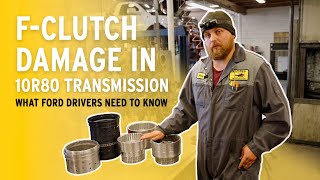
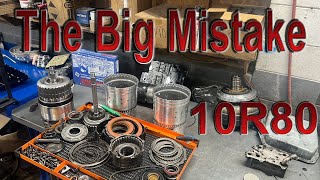
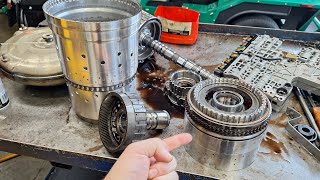
Est. part cost: $900-$1500 for an OEM Motorcraft valve body assembly. - Failed CDF Clutch Drum Assembly 🟡 Medium Probability A well-documented design defect in 10R80 transmissions (especially pre-2023 models) where a sleeve inside the C-D-F drum can 'walk' out of position, causing a major internal hydraulic leak. This triggers numerous shift codes, including P2701. Ford has since released an updated part with a machined lip to prevent this. As a 2025 model, 🎬 Watch: 10R80 teardown showing the CDF drum bushing failure the F-150 should have the updated part, making this a lower probability than on older trucks, but still possible.
How to confirm: This failure requires transmission teardown to visually inspect the CDF drum and its internal sleeve. A technician may use Ford's FDRS software to perform a 'Transmission Clutch Circuit Leak Test' before disassembly.
Typical fix: The transmission must be disassembled to replace the old CDF drum with the updated part (e.g., part JL3Z-7H351-B or newer).
Est. part cost: $300-$600 for the drum assembly. - Low or Dirty Transmission Fluid ⚪ Low Probability The 10R80 transmission is extremely sensitive to fluid level and condition. It requires a specific fluid, Motorcraft Mercon ULV. Using the wrong fluid or running it low can cause a wide range of shifting issues.
How to confirm: Check the transmission fluid level and condition. The fluid should be at the correct level, red, and not smell burnt. Any deviation warrants a fluid service. Gray or glittery fluid indicates serious internal mechanical wear.
Typical fix: Perform a transmission fluid drain-and-fill or a complete fluid exchange. Use only the specified Motorcraft Mercon ULV fluid.
Est. part cost: $150-$300 for fluid and a new filter.
Rare But Worth Checking
- Transmission Control Module (TCM) Failure: While less common for this specific code, a software glitch or internal TCM hardware failure can cause incorrect commands or readings, triggering a P2701 code. This is often a last resort after mechanical and hydraulic issues have been ruled out. Sometimes a PCM/TCM software reflash is the first step recommended by a TSB.
- Damaged Wiring Harness: Corrosion or physical damage to the wiring between the TCM and the transmission's internal solenoids can cause intermittent signals and trigger the code. The internal transmission harness, located inside the oil pan, can also fail and is a specific replacement part.
Diagnosis Steps
- Scan the TCM for all stored trouble codes. Note if P2701 is accompanied by P0757, which strongly suggests an OWC failure per TSB 26-2112. [⭐ TSB 26-2112, 12]
- Check for the presence of a large cluster of other transmission codes, which may point towards a valve body or CDF drum issue per TSB 24-2046.
- Check the level and condition of the automatic transmission fluid. It must be the correct Motorcraft Mercon ULV type. Burnt-smelling or dark fluid indicates internal wear.
- Inspect the transmission wiring harness and connectors for any signs of damage, corrosion, or loose connections.
- If external checks do not reveal the cause, the issue is almost certainly internal to the 10R80 transmission. Professional service is required.
- A technician will likely follow TSB guidelines, which may involve dropping the pan to inspect for debris. Significant metal debris points to a hard part failure (like the OWC or CDF drum).
- Based on the combination of codes and symptoms, the technician will proceed with either a valve body replacement or a full transmission teardown to inspect and replace the OWC or CDF drum.
Parts You'll Likely Need
- Main Control Valve Body Assembly
(OEM #JL3Z-7A100-B (verify by VIN, may be superseded))— A primary cause of P2701 and other shift codes, as documented in multiple Ford TSBs.
Trusted brands: Motorcraft
OEM price range: $900-$1500
Aftermarket price range: $600-$1200 - CDF Clutch Drum Assembly (Updated)
(OEM #JL3Z-7H351-B (verify by VIN))— Required to fix the common 'walking' sleeve issue on pre-2023 10R80 transmissions that causes hydraulic leaks and triggers this code.
Trusted brands: Motorcraft
OEM price range: $300-$600
Aftermarket price range: $250-$500 - Transmission One-Way Clutch (OWC)
(OEM #F-606118.02 / D105650AA (verify by VIN))— This is the primary suspected cause according to Ford's TSB 26-2112 when P2701 and P0757 are present and the truck is stuck in low gears. [⭐ TSB 26-2112, 12, 28]
Trusted brands: Ford OEM
OEM price range: $100-$400
Related Codes That Often Appear With This One
- P0757 — This code for 'Shift Solenoid 'B' Stuck On' is explicitly mentioned in TSB 26-2112 as appearing with P2701 when the one-way clutch has failed, often resulting in the vehicle being stuck in 2nd gear. [⭐ TSB 26-2112, 28]
- P0729, P0731-P0736, P2700-P2705 — A wide range of gear ratio and other friction element performance codes often appear alongside P2701. When multiple codes are present, it strongly points towards a systemic issue like a faulty main control valve body or a failed CDF drum, as outlined in TSBs 24-2046 and 22-2139.
Technical Service Bulletins (TSBs) & Recalls
- TSB 26-2112: Notes that DTCs P0757 and P2701 with symptoms of no upshift past second gear may be due to a damaged one-way clutch (OWC).
- TSB 24-2046 / 22-2139: Address a large group of shift performance codes (including P2701) caused by sticking valves in the main control valve body or axial movement of the CDF clutch cylinder sleeve.
Platform-Specific Known Issues
- A known issue documented in TSB 26-2112 points to a damaged one-way clutch causing P2701 and P0757, preventing shifts beyond second gear.
- The 10R80 transmission is subject to widespread issues, including faulty main control valve bodies and a defective CDF clutch drum sleeve (on models built before late 2022), both of which can trigger P2701.
- Class-action lawsuits have been filed regarding the 10R80 transmission's performance, citing harsh shifting, jerking, and hesitation.
Mechanic-Grade Diagnostic Values
- Shift Solenoid Resistance — expected: 5.0 - 5.4 Ohms at 20°C (68°F). Failure: A reading outside of this range indicates a faulty solenoid coil.
Hidden / Shadow Codes Worth Checking
- Cluster of P07xx / P27xx codes: While not a single hidden code, the appearance of P2701 with a large group of other gear ratio (P0729, P0731-P0736) and friction element (P2700-P2705) codes is a strong indicator of a systemic hydraulic failure, such as the main valve body or CDF drum, rather than an isolated clutch issue. (see via Any advanced OBD-II scanner capable of reading Transmission Control Module (TCM) codes.)
Scan Tool Commands That Help
- FORScan, Ford IDS/FDRS, or other professional scan tools: Clear Transmission Adaptive Tables — This is required after any major transmission repair, such as replacing the valve body, clutches, or the entire transmission. It erases the TCM's learned values, forcing it to start a new learning process with the new components.
- N/A - Manual Procedure: Adaptive Learning Drive Cycle — Immediately after clearing the adaptive tables. It is a specific, multi-step driving procedure involving a series of light accelerations, stops, and gear selections to allow the TCM to properly relearn clutch apply times and shift pressures. Skipping this can result in continued poor shift quality.
- Ford IDS/FDRS: Transmission Accelerated Main Control Break-In — As a diagnostic step for suspected sticking valves in the main control body. This routine, specified in TSBs, cycles the solenoids with the vehicle on a lift to attempt to free them without disassembly.
- Ford IDS/FDRS: Solenoid Body Strategy Programming — This is mandatory after installing a new main control (valve body) assembly. A 13-digit number from a tag on the new part must be entered into the TCM to load the correct calibration for that specific solenoid body. Failure to perform this step will result in poor shifting.
Wiring & Ground Locations
- C175T — The main electrical connector at the Powertrain Control Module (PCM), typically located on the firewall.. This is a primary point for technicians to test continuity and resistance of the transmission solenoids and sensors from outside the transmission, helping to differentiate between a wiring fault and an internal component failure.
- C177 — The main internal transmission connector located inside the transmission, connecting the valve body solenoids to the external harness.. This connector and the associated internal harness can be a point of failure. Problems here require dropping the transmission pan for access and can mimic solenoid or other internal failures.
Real Owner Repair Stories
- Monster Transmission case study (2020 Ford F-150 with 60,000 miles) — Long delays shifting into reverse and a flare (RPM surge) between 4th and 5th gear.
❌ Tried (didn't work) Not specified, but the problem required a full teardown.
✅ What actually fixed it A transmission rebuild that included replacing the failed CDF drum (the sleeve had separated) with a revised version and installing an upgraded valve body. - Reddit user in r/AskMechanics (2019 Ford F-150 3.5L) — Not specified, but required internal transmission work.
❌ Tried (didn't work) Not specified.
✅ What actually fixed it Replacement of the internal transmission wiring harness located inside the oil pan.
When the Usual Fixes Don't Work
- While software updates and clearing adaptive tables are common first steps, they often fail to resolve the issue permanently if a mechanical or hydraulic fault is present. One owner noted that a dealer reflash and fluid additives were only temporary fixes, and the root cause was likely wear in the valve body or other internal components. If a 'Clear Transmission Adaptive Tables' procedure followed by the full 'Adaptive Learning Drive Cycle' does not resolve the harsh shifting, the problem is almost certainly mechanical and requires further teardown and diagnosis.
OEM Part Supersession History
Various (pre-2023 parts)→JL3Z-7H351-B (or newer)— The original CDF clutch drum design allowed an internal sleeve to 'walk' out of position, causing a major hydraulic leak. The updated part has a machined lip to physically prevent the sleeve from moving.Standard aluminum outer shell→Anodized/hardened outer shell— The original softer aluminum shell was prone to wear from the F-clutch pack, creating grooves that caused erratic shifting. The updated shell is hardened to resist this wear.
Model Year Variations Within This Range
- 2017 - Mid-2022: Vehicles built on or before August 15, 2022, are equipped with the original CDF clutch drum design and are at high risk for the sleeve migration failure. The 2025 F-150 should have the updated part from the factory, making this specific failure less likely.
Helpful Videos
We Have This Part in Stock



The information in this article is provided for general reference and educational purposes only. Vehicle specifications, procedures, and part compatibility can vary by production date, trim level, and region. Always consult your vehicle's factory service manual and verify part numbers before purchasing or performing repairs. Safety-critical components such as airbags, seat belts, and braking systems should be installed by a qualified professional.
- Ford F-150:
- 🎬 Helpful Videos
- 🛍️ Shop This Part
- What's Unique About the 2025-2025 Ford F-150
- Diagnostic Flowchart
- Symptoms You May Notice
- Most Likely Causes
- Rare But Worth Checking
- Diagnosis Steps
- Parts You'll Likely Need
- Related Codes That Often Appear With This One
- Technical Service Bulletins (TSBs) & Recalls
- Platform-Specific Known Issues
- Mechanic-Grade Diagnostic Values
- Hidden / Shadow Codes Worth Checking
- Scan Tool Commands That Help
- Wiring & Ground Locations
- Real Owner Repair Stories
- When the Usual Fixes Don't Work
- OEM Part Supersession History
- Model Year Variations Within This Range
- 🎟️ Get 5% Off