

P2700 on 2017-2023 Ford F-150: Transmission Apply Time Fault Causes and Fixes
P2700 on a 2017-2023 F-150 almost always indicates a serious internal issue with the 10R80 10-speed transmission. The most common causes are a failed CDF clutch drum or a faulty main control valve body. This is a complex and expensive repair, often costing between $4,000 and $7,000 and requiring a transmission specialist or dealer service.
- P2700 on a 2017-2023 F-150 is a serious code that points to a known internal problem with the 10R80 transmission.
- The most likely culprits are a failed CDF clutch drum or a bad valve body, not a simple sensor or fluid issue.
- This is not a DIY-friendly repair. It requires a professional transmission shop with experience in Ford 10-speed transmissions.
- Repair is expensive, often ranging from $1,200 for a valve body replacement to over $7,000 for a full rebuild if the failure is severe.
- Do not ignore this code. Driving with these symptoms can lead to complete transmission failure.
What's Unique About the 2017-2023 Ford F-150

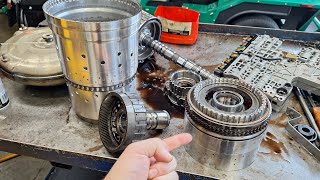
This code is particularly significant on 2017-2023 Ford F-150s because of widespread, well-documented issues with the 10R80 10-speed automatic transmission. 🎬 Watch: Overview of common 10R80 transmission failures and problems Unlike a simple sensor failure on other vehicles, P2700 on this platform often points directly to a known mechanical failure detailed in Ford TSB 24-2254. The primary culprit is a design flaw where a sleeve inside the CDF (Clutch D/F) drum assembly can move axially, or 'walk out,' blocking hydraulic passages and causing a severe pressure loss. This prevents clutches from applying correctly. A faulty main control valve body is the second most common cause.
Diagnostic Flowchart

Tap your situation to follow the diagnostic path that matches what you're seeing on this vehicle.
Generation note: This issue affects both the thirteenth (2017-2020) and fourteenth (2021-2023) generations of the F-150, as the common link is the 10R80 10-speed automatic transmission used across these years. While Ford has issued updated parts and TSBs, vehicles built before mid-August 2022 are particularly susceptible to the CDF drum failure.
Symptoms You May Notice

- Harsh, clunky, or delayed shifts, sometimes feeling like being rear-ended.
- Delayed engagement when shifting from Park into Drive or Reverse, often taking 2-3 seconds.
- Transmission slipping or flaring, where engine RPMs rise without an increase in vehicle speed, especially between gears.
- Illuminated Malfunction Indicator Lamp (Check Engine Light) or Wrench Light.
- Vehicle entering "limp mode," where it gets stuck in a single gear (e.g., 4th gear).
- Pronounced shifting issues when the transmission is cold, which may improve slightly as it warms up.
- Replacing only a single shift solenoid. The issue is more commonly with the entire valve body or the CDF drum, not an individual solenoid. The solenoids are factory-calibrated to the valve body, and replacing the entire assembly is the standard procedure.
- Assuming a simple software update will fix it. While software updates (re-flashes) were issued to improve shift quality, they cannot fix the underlying mechanical or hydraulic failure (like a walked-out bushing) that causes P2700.
- Performing only a fluid flush. If internal components have failed and contaminated the fluid, a simple flush will not solve the problem and the symptoms will quickly return.
- Not performing the adaptive learning drive cycle after a repair. Failing to complete the specific, multi-step drive cycle after clearing adaptive tables can result in continued erratic shifting even with new parts.
Most Likely Causes

- Failed CDF (Clutch D/F) Drum Assembly 🔴 High Probability A widely documented design flaw in 10R80 transmissions built before mid-August 2022 involves a sleeve within the CDF drum that can move out of position ('walk out'). This blocks hydraulic passages, causing pressure loss and damaging the seals. Ford acknowledges this in TSB 24-2254 and has released an updated drum assembly to correct it.
How to confirm: This requires transmission disassembly and visual inspection. 🎬 See a teardown showing the CDF drum bushing failure A technician will look for a dropped sleeve and damaged seals on the drum assembly. Hydraulic pressure tests may also point to an internal leak in this area, as outlined in TSB 24-2254.
Typical fix: The transmission must be removed and disassembled to replace the CDF drum with the updated part. This is a major repair often requiring a full rebuild or replacement 🎬 Watch: Quick overview of the CDF drum replacement process of the transmission if other components were damaged by debris.
Est. part cost: $200-$400 for the drum assembly - Faulty Main Control (Valve Body) Assembly 🔴 High Probability The valve body is the hydraulic 'brain' of the transmission. Sticking solenoids, internal wear in the aluminum bores, or clogged passages can cause erratic pressure control, leading to apply time faults. This is another common failure point on the 10R80, sometimes failing independently or as a result of debris from another failure.
How to confirm: A technician can perform pinpoint pressure tests. Often, if no obvious issue is found with the CDF drum, or if codes persist after a drum replacement, the valve body is replaced as the next most likely culprit. Burnt fluid or significant debris in the pan also points to internal failure. In some cases, technicians find valves physically sticking in the valve body bores upon disassembly.
Typical fix: Replacement of the entire valve body assembly, which includes all solenoids. This is less intensive than a CDF drum replacement but still requires removing the transmission pan and fluid. After installation, the new valve body's 'Solenoid Strategy' must be programmed into the vehicle's computer using a Ford-specific scan tool. In some cases, both the valve body and CDF drum are replaced together.
Est. part cost: $800-$1500 - Low or Degraded Transmission Fluid (Mercon ULV) ⚪ Low Probability While rarely the root cause on its own, low fluid from a leak can cause a loss of hydraulic pressure and trigger this code. Burnt or debris-filled fluid is a strong indicator of a more serious mechanical failure like the CDF drum or clutches.
How to confirm: Check the transmission fluid level and condition. The 10R80 has a specific procedure for checking the fluid. Burnt smell or visible metal shavings in the fluid confirm internal damage.
Typical fix: Top off the fluid to the correct level and repair any leaks. If the fluid is burnt or contains debris, a transmission overhaul is necessary.
Est. part cost: $20-$30 per quart of Mercon ULV fluid
Rare But Worth Checking
- Engine Misfire: In some documented cases, an engine misfire that is not severe enough to set a misfire code (P030x) can be misinterpreted by the transmission control logic, leading to shift-related codes like P2704 (a related code). This is rare but highlights the deep integration between engine and transmission controls.
Diagnosis Steps
- Verify the code with a quality OBD-II scanner that can read transmission-specific codes.
- Check for any available Powertrain Control Module (PCM) or Transmission Control Module (TCM) software updates using a Ford-specific scan tool (like FORScan or at a dealer). While not a fix for mechanical issues, it's a required first step.
- Check the transmission fluid level and condition. A burnt smell or significant metallic debris in the pan is a definitive sign of internal mechanical failure.
- Review applicable TSBs like 24-2254 to understand the manufacturer's recommended diagnostic procedure.
- If symptoms and codes align with TSB 24-2254, the next step is an internal inspection of the transmission, focusing on the main control valve body and the CDF drum assembly for the specific 'walked-out' sleeve failure.
- A hydraulic pressure test of the clutch circuits may be performed to confirm an internal leak before disassembly. However, be aware that in some cases, a vehicle can pass a pressure test but still have a faulty valve body with sticking internal valves.
Parts You'll Likely Need
- CDF Clutch Drum Assembly
(OEM #JL3Z-7H351-B (Updated 'anti-walk' part))— The primary cause of P2700 due to a known design flaw causing internal hydraulic leaks. The updated part has a machined lip to prevent the bushing from moving.
Trusted brands: Motorcraft
OEM price range: $200-$400
Aftermarket price range: $150-$300 - Transmission Main Control Valve Body
(OEM #JL3Z-7A100-D (or superseding part like JL3Z-7A100-D))— The second most common cause, responsible for controlling hydraulic pressure. Failure of its internal solenoids or valves leads to shifting issues. Part number can vary by model year and must be programmed to the vehicle.
Trusted brands: Motorcraft
OEM price range: $1000-$1500
Aftermarket price range: $700-$1200 - Transmission Fluid (Mercon ULV)
(OEM #XT-12-QULV)— Required for any internal transmission service. Using the correct fluid is critical for the 10R80 transmission.
Trusted brands: Motorcraft
OEM price range: $20-$30/quart
Aftermarket price range: $15-$25/quart - Transmission Filter and Pan Gasket — Should be replaced any time the transmission pan is removed for service.
Trusted brands: Motorcraft
OEM price range: $50-$80
Aftermarket price range: $30-$60
Related Codes That Often Appear With This One
- P0751, P0756, P0761, P0766, P0771 — These are performance codes for other shift solenoids (A, B, C, D, E). TSB 24-2254 groups them with P2700 as they all can be triggered by the same root causes like the CDF drum or valve body failure.
- P0729, P0731, P0732, P0733, P0734, P0735 — These are gear ratio error codes for gears 6, 1, 2, 3, 4, and 5, respectively. They indicate slipping and are often set alongside apply-time faults when a clutch fails to engage properly.
- P2701, P2702, P2703, P2704, P2705 — These are apply-time performance codes for the other friction elements (B, C, D, E, F). A widespread hydraulic issue will often affect multiple clutch packs, causing a variety of these codes to appear together.
Technical Service Bulletins (TSBs) & Recalls
- TSB 24-2254: This is the most current TSB, superseding several previous versions. It directly addresses harsh/delayed shifts and a long list of DTCs including P2700. It identifies the cause as 'axial movement of the CDF clutch cylinder sleeve causing hydraulic circuit leaks' and provides procedures to inspect and replace the CDF drum on various 2020-2023 models, including the F-150.
- TSB 23-2123 / 21-2357: These earlier TSBs also address harsh shifts and the same group of DTCs. They focus on overhauling the main control valve body and performing an adaptive learning drive cycle, pointing to the valve body as a primary cause before the CDF drum issue was more widely identified as the root mechanical flaw.
Platform-Specific Known Issues
- Multiple Ford Technical Service Bulletins (TSBs) have been released, with TSB 24-2254 being the most current and relevant. It specifically points to the CDF drum sleeve as the cause for P2700 and a host of other shifting codes.
- Class-action lawsuits have been filed against Ford concerning the 10R80 transmission's performance and reliability, citing harsh shifting, hesitation, and safety concerns across multiple vehicle models including the F-150.
- Owner forums are filled with accounts of repeated repairs, starting with valve bodies and often ending with a full transmission rebuild or replacement once the CDF drum failure is identified.
Mechanic-Grade Diagnostic Values
- Shift Solenoid Resistance — expected: 5.0 - 5.4 Ohms at 20°C (68°F) for all solenoids.. Failure: A reading outside of this range indicates a faulty solenoid coil.
- Line Pressure Control (LPC) Solenoid Current — expected: Inversely proportional. Low/no current (~50 mA) results in full pressure; high current (~850 mA) results in low pressure.. Failure: Scan tool data showing current that doesn't correspond with commanded pressure indicates a control or solenoid issue.
- Torque Converter Clutch (TCC) Solenoid Current — expected: Directly proportional. Low/no current (~50 mA) results in low pressure; high current (~850 mA) results in high pressure.. Failure: Scan tool data showing current that doesn't correspond with commanded pressure indicates a control or solenoid issue.
Scan Tool Commands That Help
- FORScan / Ford IDS: Clear Transmission Adaptive Tables (Reset KAM) — This service function is required after any major transmission repair, fluid change, or valve body replacement. It erases the learned shift pressure and timing values, forcing the TCM to start fresh. It must be followed by the Adaptive Learning Drive Cycle.
- Ford IDS / J2534 tool with FJDS: PCM - Transmission Strategy Download — This is mandatory when replacing the main control (valve body). The new valve body has a unique 13-digit solenoid strategy code that must be programmed into the PCM/TCM. Failure to do so will result in harsh shifts and driveability problems.
- FORScan: Halt Transmission Adaptive Learning — Some owners use this function to prevent the transmission from 'learning' bad habits that can lead to harsh shifting over time. It essentially locks in the current shift strategy. This is an advanced user function and should be used with caution.
- FORScan / Ford IDS: Adaptive Learning Drive Cycle — This is not a scan tool command, but a mandatory procedure to perform after clearing adaptive tables. It involves a specific sequence of accelerations, stops, and gear selections to allow the TCM to properly relearn clutch fill times and pressures.
Real Owner Repair Stories
- Reddit user on r/f150 (2019 F-150 Lariat 2.7L 4x4) — Initially harsh up/downshifts. After a reflash, developed a 2-3 second delay when shifting from Park to Drive or Reverse.
❌ Tried (didn't work) Initial TSB reflash and 'some parts swapped' did not fix the final issue.
✅ What actually fixed it The engagement delay was fixed by replacing the CDF drum. However, 900km later, a new symptom of very hard shifts into 3rd gear appeared, which was then fixed by replacing the valve body assembly. This shows both components can fail in succession. - Reddit user on r/f150 (2018+ F-150) — Erratic shifting.
❌ Tried (didn't work) Reprogramming and clearing KAM/shift tables did not resolve the issue.
✅ What actually fixed it The vehicle passed a pressure test. The technician then removed and disassembled the main control (valve body) and found several valves were physically sticking in their bores. Overhauling the main control and performing the adaptive road test procedure fixed the shifting. - Ford F150 Forum user (2018 F-150) — Vehicle in a no-shift state after installing a new valve body.
❌ Tried (didn't work) Attempting to program the new solenoid strategy using both FORScan and the official Ford FJDS software.
✅ What actually fixed it The problem was unresolved in the thread, but highlights a critical failure point in the repair process: receiving a 'Solenoid Not Found' error from Ford's servers when trying to program the new valve body strategy. This can halt a repair even with the correct parts and tools.
"I Checked Everything" — The Actual Cause
- A documented repair story shows a vehicle can pass a formal transmission pressure test, yet still have a critical fault within the main control valve body. A technician found the issue only after disassembling the valve body and discovering internal valves were physically sticking in their bores, a fault that a pressure test did not reveal.
OEM Part Supersession History
HL3Z-7H351-A, JL3Z-7H351-A→JL3Z-7H351-B— The original CDF drum assembly had a design flaw where an internal sleeve could 'walk' out of position. The updated JL3Z-7H351-B part features a machined lip that physically prevents the sleeve from moving, providing a permanent fix.JL3Z-7A100-B→JL3Z-7A100-D— Part revision and update by the manufacturer.
Heads up: Different valve bodies exist for different models/shifter types (e.g., JL3Z-7A100-C for some column-shift models). Always verify the correct part number for the specific vehicle VIN. The new valve body requires mandatory solenoid strategy programming.
Model Year Variations Within This Range
- 2017 - Mid-2022: Vehicles built before approximately August 15, 2022, are susceptible to the CDF drum sleeve 'walking' out. Vehicles built after this date are expected to have the updated drum (JL3Z-7H351-B) from the factory.
- 2020: For the F-150, the A-Clutch housing was changed to a one-piece welded unit as a cost-saving measure, while S550 Mustang applications retained the original two-piece design for better high-speed capability.
- Summer 2021: Prior to the final 'lipped' drum design, Ford tightened the press-fit tolerance of the CDF drum sleeve to reduce the likelihood of it walking out. This was an interim improvement before the final hardware fix.
Helpful Videos

Used OEM Parts in Stock


New Aftermarket Parts Available


The information in this article is provided for general reference and educational purposes only. Vehicle specifications, procedures, and part compatibility can vary by production date, trim level, and region. Always consult your vehicle's factory service manual and verify part numbers before purchasing or performing repairs. Safety-critical components such as airbags, seat belts, and braking systems should be installed by a qualified professional.
- Ford F-150:
- 🎬 Helpful Videos
- 🛍️ Shop This Part
- What's Unique About the 2017-2023 Ford F-150
- Diagnostic Flowchart
- Symptoms You May Notice
- Most Likely Causes
- Rare But Worth Checking
- Diagnosis Steps
- Parts You'll Likely Need
- Related Codes That Often Appear With This One
- Technical Service Bulletins (TSBs) & Recalls
- Platform-Specific Known Issues
- Mechanic-Grade Diagnostic Values
- Scan Tool Commands That Help
- Real Owner Repair Stories
- "I Checked Everything" — The Actual Cause
- OEM Part Supersession History
- Model Year Variations Within This Range
- 🎟️ Get 5% Off