

P2227 on 2011-2014 Hyundai Sonata: Barometric Pressure Sensor Causes and Fixes
On a 2011-2014 Sonata, code P2227 is almost always caused by a faulty Manifold Absolute Pressure (MAP) sensor, which contains the Barometric Pressure (BARO) sensor. Replacing the MAP sensor is the most common fix, costing around $30-$60 for an aftermarket part and is a simple DIY job. Before replacing, verify the failure by checking the BARO reading on a scan tool with the key on and engine off; it should match your local atmospheric pressure.
- P2227 on a 2011-2014 Sonata points to the MAP sensor, not a separate BARO sensor.
- The most likely fix is replacing the MAP sensor, which is an inexpensive and easy DIY repair that takes less than 30 minutes.
- Before replacing the sensor, check the live data with a scan tool (Key On, Engine Off) to confirm the BARO reading is incorrect for your altitude.
- The MAP sensor is located on the intake manifold and is held in by a single 10mm bolt.
- Ensure the wiring and connector are secure and free of corrosion before condemning the sensor.
What's Unique About the 2011-2014 Hyundai Sonata
For the 2011-2014 (YF generation) Hyundai Sonata, the barometric pressure (BARO) sensor is not a standalone part. Instead, its function is integrated into the Manifold Absolute Pressure (MAP) sensor. The MAP sensor performs a 'double duty' by reading the atmospheric pressure when the key is first turned on (before the engine starts and creates a vacuum) to get a BARO reading. Therefore, a P2227 code on this vehicle points directly to a problem with the MAP sensor or its circuit, not a separate BARO sensor you might find on other vehicles.
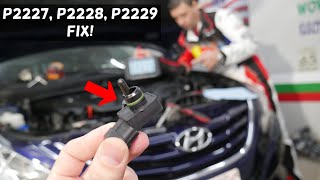
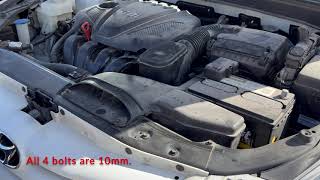
🎬 Watch: How to fix P2227, P2228, and P2229 codes on your Sonata.Symptoms You May Notice
- Check Engine Light is on
- Rough or fluctuating idle
- Hesitation or sluggish acceleration, particularly at higher altitudes
- Reduced fuel economy
- Engine may stall at low speeds
- Black smoke from the exhaust due to a rich fuel mixture
- Difficulty starting the engine
- Replacing the Mass Air Flow (MAF) sensor. The 2011-2014 Sonata uses a MAP sensor system for engine load calculation, not a MAF sensor.
- Replacing oxygen sensors. While a bad oxygen sensor can cause similar symptoms, it will typically set its own specific trouble codes, such as P0138.
Most Likely Causes
- Faulty Manifold Absolute Pressure (MAP) Sensor 🔴 High Probability The BARO sensor is integrated into the MAP sensor, making it the single point of failure for this function. It is the most commonly reported fix for this code on this platform, as confirmed in multiple owner forums and mechanic videos.
How to confirm: Use a scan tool to compare the BARO reading with the key on and engine off (KOEO). The reading should be very close to the actual atmospheric pressure for your altitude (e.g., ~101 kPa or 14.7 PSI at sea level). If it's significantly different or reads 0, the sensor is likely bad. The sensor should output a voltage between 0.5V and 4.5V; a fixed reading of 0V or 5V often indicates a failed sensor or wiring issue.
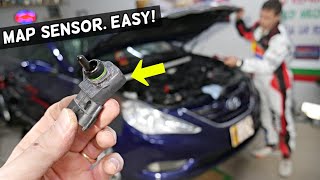
Typical fix: Replace the MAP sensor. It is located on the intake manifold and held in by a single 10mm bolt, making it a very simple DIY repair. 🎬 See this step-by-step walkthrough for replacing the MAP sensor.
Est. part cost: $30 - $80 - Damaged Wiring or Loose Connector 🟡 Medium Probability Engine vibration and heat can cause wiring to become brittle or connectors to loosen over time.
How to confirm: Visually inspect the MAP sensor's wiring harness and connector for any signs of damage, corrosion, or loose pins. Use a multimeter to check for a 5V reference signal, a good ground, and signal continuity back to the ECM. Wiggle the harness while monitoring the live data on a scan tool to see if the reading fluctuates, indicating an intermittent connection.
Typical fix: Repair the damaged section of the wiring harness or clean the connector terminals. Apply dielectric grease to protect the connection.
Est. part cost: $5 - $25 - Vacuum Leak ⚪ Low Probability While not specific to this platform, vacuum leaks from cracked hoses or a faulty PCV valve can cause implausible sensor readings that may trigger this code, although usually accompanied by other codes like P0106.
How to confirm: A significant vacuum leak could potentially cause implausible sensor readings. Check for cracked vacuum hoses (especially the intake hose) or leaking intake manifold gaskets. A smoke test is the most effective way to find a leak.
Typical fix: Replace the leaking hose or gasket.
Est. part cost: $10 - $100
Rare But Worth Checking
- Faulty Powertrain Control Module (ECM): This is extremely rare and should only be considered a last resort. The ECM should only be replaced after all other possibilities, including the sensor, wiring, and potential software updates, have been thoroughly tested and ruled out.
Diagnosis Steps
- Connect an OBD-II scanner and confirm P2227 is present. Check for any other codes, especially P2228, P2229, or P0106, and address them first if present.
- With the Key On, Engine Off (KOEO), view the live data for the BARO sensor on the scanner. Compare this reading to the known atmospheric pressure for your current location and altitude. A significant discrepancy (more than 1-2 kPa or 0.5 PSI) points to a sensor or circuit issue.
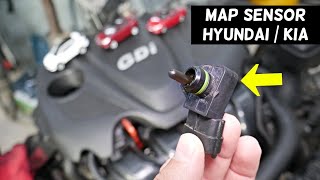
- Visually inspect the MAP sensor and its electrical connector, which is located on the top of the plastic intake manifold. 🎬 Watch: Locate and swap the sensor on a 2.4 GDI engine. Look for cracks, corrosion, oil contamination, or any signs of damage to the wiring harness.
- If the visual inspection is clear, disconnect the sensor and check the circuit. Verify you have a 5-volt reference signal and a good ground at the connector with the ignition on.
- If the wiring and power/ground are good, the MAP sensor is the most likely culprit. Replace the MAP sensor.
- After replacement, clear the code with the scanner and perform a test drive, ideally including some changes in elevation if possible, to ensure the code does not return.
Parts You'll Likely Need
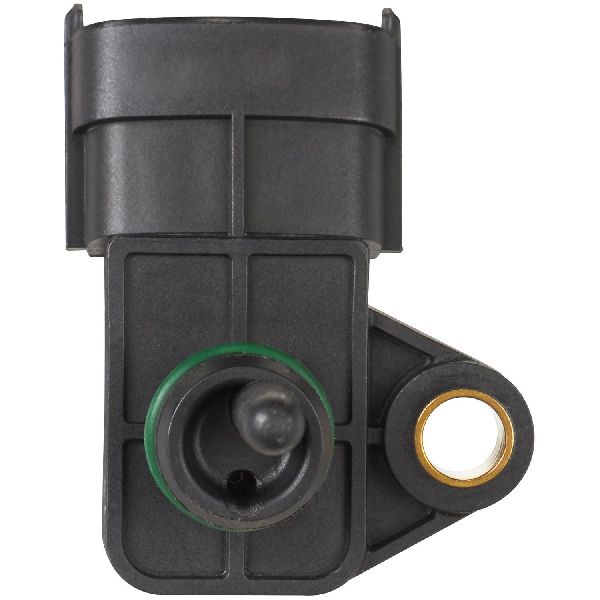
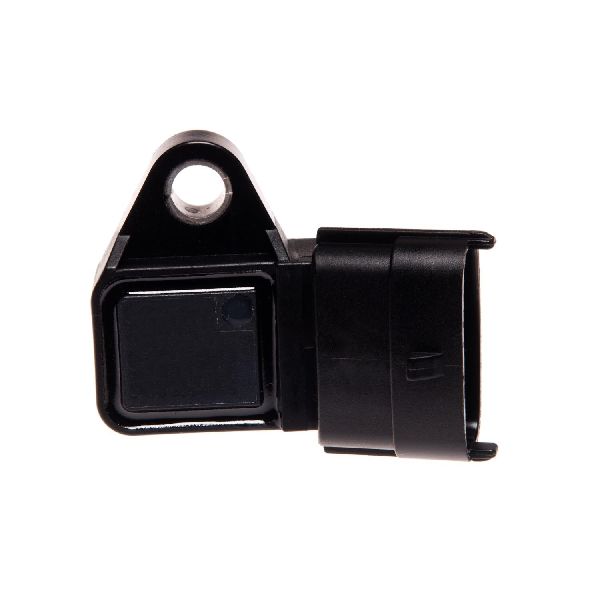
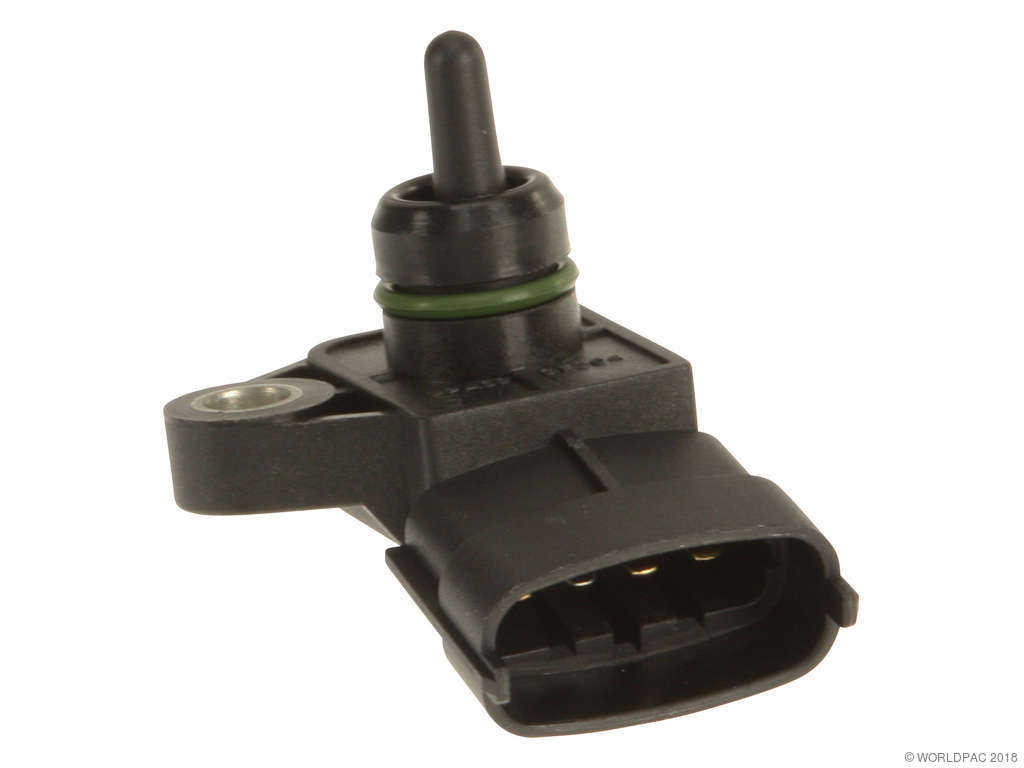
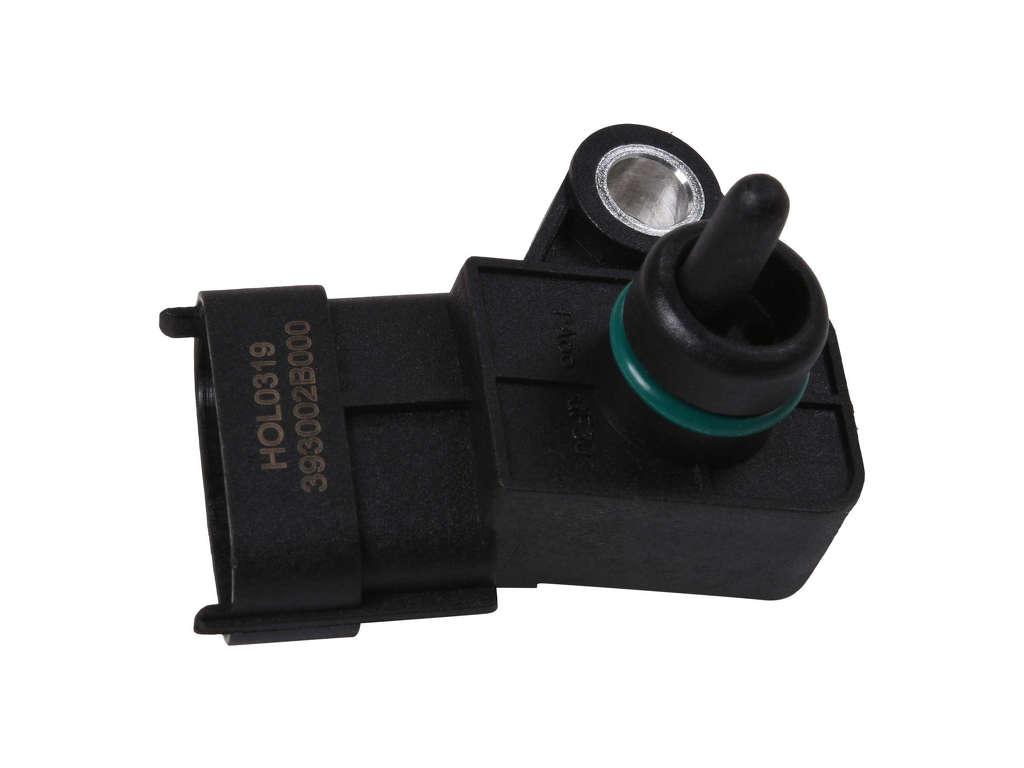
- Manifold Absolute Pressure (MAP) Sensor
(OEM #39300-2B000)— This part contains the integrated Barometric Pressure (BARO) sensor and is the most common failure point for code P2227 on this vehicle.
Trusted brands: Hyundai (OEM), Bosch, Delphi, NTK, Walker Products
OEM price range: $70-$140
Aftermarket price range: $25-$65
Related Codes That Often Appear With This One
- P2228 — This code indicates 'BARO Sensor Circuit Low', pointing to a short to ground or an electrical issue within the same sensor circuit.
- P2229 — This code indicates 'BARO Sensor Circuit High', pointing to an open circuit or a short to power within the same sensor circuit.
- P0106 — This code for 'Manifold Absolute Pressure/Barometric Pressure Circuit Range/Performance' is often seen with P2227 because the PCM compares the MAP and BARO readings to ensure they are plausible. A fault in the shared sensor can trigger both.
Platform-Specific Known Issues
- Owner Experience: DIY Replacement: Multiple owners on forums and in video comments confirm that replacing the MAP sensor (part #39300-2B000) is a straightforward fix taking less than 15 minutes. It involves removing the engine cover, unplugging the sensor, removing a single 10mm bolt, and swapping the part. This almost universally resolves the P2227 code and associated symptoms like rough idle and hesitation.
- Real World Diagnosis: A common diagnostic step shared by owners is to use a smartphone app with a barometer function to get the current local atmospheric pressure and compare it directly to the 'BARO' reading from an OBD-II scanner with the key on, engine off. A significant difference confirms the sensor's reading is inaccurate.
Mechanic-Grade Diagnostic Values
- 5V Reference Wire Voltage — expected: 4.8V - 5.2V DC with key on, engine off (KOEO), measured between the reference wire and chassis ground.. Failure: A reading of 0V indicates an open or short to ground in the circuit. A reading significantly outside the range could indicate an ECM fault.
- Ground Wire Resistance — expected: Less than 5 Ohms between the ground pin on the connector and a known good chassis ground.. Failure: High resistance (or an open circuit) indicates a faulty ground connection, which can cause incorrect sensor readings.
- Signal Wire Voltage (KOEO) — expected: Approximately 4.6V DC. The ECM supplies voltage which the sensor will pull down once the engine is running.. Failure: A reading of 0V or 5V could indicate a short or open in the signal wire or a failed sensor.
- Signal Wire Voltage (Engine at Idle) — expected: Approximately 1.0V - 2.0V DC. Voltage should decrease from the KOEO reading as engine vacuum is created.. Failure: Voltage that remains high (near the KOEO reading) or does not change when the throttle is snapped open indicates a non-responsive sensor.
Scan Tool Commands That Help
- Hyundai GDS (Global Diagnostic System): Reset Adaptive Values — After replacing the MAP sensor, this special function in the engine control menu can be used to clear the old learned fuel trim and sensor values, forcing the ECM to relearn with the new sensor's data.
- Hyundai GDS (Global Diagnostic System): Flight Record / Trigger Module — For diagnosing intermittent P2227 codes. This function allows a technician to record sensor data on a test drive and trigger the recording when the symptom occurs, capturing the exact data stream at the moment of the fault.
- Hyundai GDS (Global Diagnostic System): Actuation Test — While there isn't a direct actuation test for the MAP sensor itself, the GDS allows for actuation of related components (like the electronic throttle control motor) to verify their function and see the corresponding reaction on the MAP sensor's live data, helping to isolate the fault.
Wiring & Ground Locations
- MAP Sensor Connector — On the top of the black plastic intake manifold, near the throttle body.. This is the primary connection point for the sensor. It is often a 4-pin connector that houses both the MAP and IAT (Intake Air Temperature) sensor signals. Damage or corrosion here will directly cause P2227. Pin 1: IAT Signal, Pin 2: MAP Signal, Pin 3: 5V Reference, Pin 4: Sensor Ground.
- GE01 / GE02 — Bolted to the chassis in the left front of the engine compartment, near the strut tower or inner fender.. These are the main engine wiring harness ground points. A loose or corroded connection at this location can cause a floating ground, leading to erratic voltage readings from multiple sensors, including the MAP sensor, triggering a range/performance code.
Real Owner Repair Stories
- Reddit user, r/MechanicAdvice (2015 Hyundai Sonata Hybrid (similar Theta II engine and PCV system)) — Lean surges when maintaining speed. Idle was smooth.
❌ Tried (didn't work) Cleaning the MAP sensor would temporarily fix the issue., Replacing the PCV valve did not solve the problem.
✅ What actually fixed it The root cause was excessive engine blow-by forcing oil through the PCV system and repeatedly contaminating the MAP sensor. The ultimate fix required addressing the underlying engine issue causing the blow-by, not just cleaning or replacing the sensor.
When the Usual Fixes Don't Work
- While replacing the MAP sensor is the most common fix, be aware of faulty new parts, especially with non-OEM brands. There are documented cases where installing a new aftermarket sensor immediately triggered a P2227 or P2228 code because the new part was defective or had slightly different calibration from the original. If the code appears immediately after a replacement, consider the new sensor itself as the problem before proceeding to more complex wiring or ECM diagnosis.
OEM Part Supersession History
39300-2B000→39300-2B100— Part revision or alternative supplier.
Heads up: None. Parts are considered interchangeable for the 2011-2014 Sonata application. Both part numbers are often sold for the same vehicle fitment.
Model Year Variations Within This Range
- 2011-2014: Many Sonatas in this generation, including the 2.4L non-hybrid, use a 4-pin combined Manifold Absolute Pressure (MAP) and Intake Air Temperature (IAT) sensor. This differs from a traditional 3-pin MAP sensor. A failure of this component can potentially set both MAP-related codes (like P2227) and IAT-related codes (like P0113).
Diagnostic Flowchart
Other Known Issues on This Vehicle
Issues unrelated to this code that are worth knowing about as an owner of this generation:
- Theta II Engine Failure (Rod Bearing Failure) 🔴 High — Very common across 2.0L Turbo and 2.4L GDI engines, particularly in 2011-2014 models. Can occur at various mileages, often preceded by engine knocking. (Ref: Subject of multiple recalls (e.g., Recall 132), class-action lawsuits, and a lifetime warranty extension for the engine short block, contingent on the KSDS (Knock Sensor Detection System) software update being performed.)
- Steering Coupler Failure 🟠 Medium — Extremely common. The flexible rubber coupler in the electronic power steering column disintegrates, causing a noticeable 'clicking' or 'clunking' sound and excessive play in the steering wheel when turning. (Ref: Covered by Hyundai's extended warranty TXXA (10 years/100,000 miles). The part itself is inexpensive, but labor can be involved.)
- Transmission Temperature Sensor Failure 🟡 Low — A known issue where the internal transmission temperature sensor fails, which can cause harsh shifting, delayed engagement, and may trigger a check engine light. It is part of the internal transmission wiring harness. (Ref: There is a Technical Service Bulletin (TSB) for this issue.)
- Subframe Corrosion (in Salt Belt States) 🔴 High — While more prominent in the prior generation (up to 2004), vehicles operated in states with heavy road salt usage can experience premature and severe corrosion of the front subframe. (Ref: Subject of past recalls and warranty extensions for older models (e.g., Campaign 089), but owners of 2011-2014 models in salt belt regions should remain vigilant.)
- Parking Lights Remain On 🟡 Low — A less common but documented issue where an internal malfunction in the cabin fuse box (Junction Block) causes the parking lights to stay on, draining the battery.
Used vs. New Parts: Buying Guide for This Vehicle
When a used part is the smart pick: Not recommended. Given the low cost of new, quality aftermarket sensors ($30-$60) and the electronic nature of the part, the risk of getting a failing used sensor from a junkyard outweighs the minimal cost savings.
Donor-vehicle mileage cap: roughly under 100000 miles for the part to have meaningful remaining life.
What to inspect on the donor part:
- Check for physical cracks or damage to the sensor housing and connector.
- Ensure the connector pins are straight, clean, and free of any green or white corrosion.
- Inspect the sensor's measurement port for any signs of oil contamination; if oil is present, reject the part as it may have been subjected to excessive engine blow-by from the donor vehicle.
OEM-only on this vehicle (don't cheap out):
- Engine Control Module (ECM)
Aftermarket brands forum-validated for this vehicle:
- Bosch
- Delphi
- NTK
- Walker Products
Brands owners have reported issues with on this vehicle:
- Unbranded, no-name sensors from online marketplaces, as quality control can be poor, leading to immediate or premature failure.
Real Owner Stories
Aggregated from forums and TSBs cited above. Mileages and costs reflect what owners reported in those sources.
2011-2014 Hyundai Sonata
Symptoms: rough idle and hesitation
What fixed it: Replacing the MAP sensor (part #39300-2B000). The repair involved removing the engine cover, unplugging the sensor, removing a single 10mm bolt, and swapping the part.
Source hint: vehicle_specific_issues: Owner Experience: DIY Replacement
2013 Hyundai Sonata
Symptoms: Check Engine Light on
What fixed it: The issue was confirmed to be the MAP sensor, which was replaced.
Source hint: forum_citations: YouTube - World Mechanics / Auto Repair Guys: A video titled 'HYUNDAI CODE P2227 P2228 P2229 ENGINE LIGH ON FIX...'
YF Hyundai Sonata (2011-2014)
Symptoms: Check Engine Light on with code P2227.
What fixed it: The overwhelming consensus was a successful fix via MAP sensor replacement, with owners frequently citing part number 39300-2B000.
Source hint: forum_citations: Hyundai-Forums.com: Numerous threads discuss P2227 on the YF Sonata...
Related OBD-II Codes
Frequently Asked Questions
What is the specific part number for the MAP sensor that usually fixes code P2227 on my 2011-2014 Sonata?
Where is the BARO sensor located on my Sonata? I can't find it.
How difficult is it to replace the MAP sensor myself to fix this code?
How can I test the sensor on my Sonata before buying a new one?
I have a 2012 Kia Optima with a P2227 code. Does this article apply?
Besides this sensor issue, are there any major recalls I should know about for my 2013 Sonata?
Helpful Videos
We Have This Part in Stock


The information in this article is provided for general reference and educational purposes only. Vehicle specifications, procedures, and part compatibility can vary by production date, trim level, and region. Always consult your vehicle's factory service manual and verify part numbers before purchasing or performing repairs. Safety-critical components such as airbags, seat belts, and braking systems should be installed by a qualified professional.
- Hyundai Sonata:
- 🎬 Helpful Videos
- 🛍️ Shop This Part
- What's Unique About the 2011-2014 Hyundai Sonata
- Symptoms You May Notice
- Most Likely Causes
- Rare But Worth Checking
- Diagnosis Steps
- Parts You'll Likely Need
- Related Codes That Often Appear With This One
- Platform-Specific Known Issues
- Mechanic-Grade Diagnostic Values
- Scan Tool Commands That Help
- Wiring & Ground Locations
- Real Owner Repair Stories
- When the Usual Fixes Don't Work
- OEM Part Supersession History
- Model Year Variations Within This Range
- Diagnostic Flowchart
- Other Known Issues on This Vehicle
- Used vs. New Parts: Buying Guide for This Vehicle
- Real Owner Stories
- 2011-2014 Hyundai Sonata
- 2013 Hyundai Sonata
- YF Hyundai Sonata (2011-2014)
- Related OBD-II Codes
- Frequently Asked Questions
- 🎟️ Get 5% Off