

P2227 on 2023-2024 Chevrolet Equinox 1.5L: Causes for Barometric Pressure Sensor Faults
On the 2023-2024 Equinox 1.5L Turbo, code P2227 is most often caused by moisture collecting and freezing inside the charge air cooler (CAC), especially in cold weather below 20°F/-7°C. This well-documented issue is covered by GM TSB 18-NA-020, which has multiple revisions. The code is almost always accompanied by P0299 (Turbo Underboost). The fix varies by build date and climate, ranging from replacing the CAC with an updated part (GM P/N 85046823), installing a thermostatic shutter, or an ECM r
- P2227 on a 2023-2024 Equinox 1.5L, especially with P0299 in cold weather, is almost certainly caused by the charge air cooler icing issue described in GM TSB 18-NA-020.
- Do not immediately replace the BARO/MAP sensor; the problem is most likely airflow-related, not electronic.
- The official fix is not a simple part swap and may involve consulting the TSB for a specific procedure based on the vehicle's build date, which could include a new CAC, a shutter, or an ECM flash.
- This issue is also common on the GMC Terrain with the same engine.
What's Unique About the 2023-2024 Chevrolet Equinox
For this specific Equinox with the 1.5L turbo engine, P2227 is strongly linked to a known design issue with the charge air system. General Motors has issued multiple revisions of Technical Service Bulletin (TSB) #18-NA-020, which states that moisture from the PCV system and humid air can accumulate inside the charge air cooler (CAC). In cold temperatures, this moisture can freeze, creating a blockage that leads to illogical pressure readings, triggering P2227 along with underboost (P0299) and misfire (P0300) codes. The official GM fix has evolved and is now a multi-step process depending on the vehicle's build date and climate, which may involve replacing the CAC, installing a special shutter, adding a grill cover, and/or reprogramming the ECM to alter transmission shift patterns in cold weather.
Symptoms You May Notice
- Check Engine Light is on
- "Engine Power Reduced" message on the driver information center
- Reduced engine power or sluggish acceleration, especially when trying to merge or accelerate hard.
- Engine hesitation, stumbling, or jolting forward after a delay.
- Rough or erratic idle
- Increased fuel consumption
- Symptoms are most likely to appear or worsen in cold weather (typically below 20°F / -7°C), especially after the vehicle has sat overnight.
- Replacing the BARO/MAP sensor without first inspecting the charge air cooler. Given the known TSB, the sensor is often blamed incorrectly when the root cause is the airflow restriction from the CAC.
- Replacing the turbocharger for the P0299 underboost code without first confirming the CAC is clear and not leaking.
Most Likely Causes
- Faulty or Icing Charge Air Cooler (CAC) 🔴 High Probability Per multiple revisions of GM TSB #18-NA-020, the design of the air-to-air charge air cooler on this small displacement turbo engine makes it susceptible to internal moisture accumulation and freezing in cold climates.
How to confirm: Check for associated codes P0299 or P0300. Review freeze-frame data for cold ambient temperatures. Perform a smoke test on the intake system to rule out external leaks. If no leaks are found and symptoms occur in the cold, the CAC is the prime suspect. The ultimate confirmation is removing the CAC and draining a significant amount of water/ice (TSB 18-NA-069 considers >100mL significant).
Typical fix: The fix depends on the vehicle build date and TSB revision. It may include one or more of the following: 1) Replacing the charge air cooler with an updated, wider design (GM P/N 85046823). 2) Installing a thermostatic shutter in front of the CAC. 3) Reprogramming the ECM for a revised cold-weather shift strategy. 4) In some cases, simply cleaning and draining the existing CAC is recommended if it is not leaking.
Est. part cost: $200-$450 - Faulty Barometric Pressure (BARO) Sensor ⚪ Low Probability On this engine, the BARO sensor is integrated into one of the MAP sensors. While sensor failure is possible and has been reported by some owners as the sole cause, it is a much less common culprit for this code on this vehicle than the CAC issue.
How to confirm: With a scan tool, view live data for the BARO sensor with the Key On, Engine Off. Compare the reading to the actual atmospheric pressure for your location and altitude. If the reading is significantly different, the sensor is likely faulty. The TSB also recommends removing the boost sensor and wiping it clean of any residual moisture.
Typical fix: Replace the faulty MAP/BARO sensor. There are typically two on this engine: one on the intake manifold and one on the charge pipe before the throttle body.
Est. part cost: $30-$80 - Wiring or Connector Issue ⚪ Low Probability
How to confirm: Visually inspect the wiring harness and connectors for the MAP/BARO sensors. Look for corrosion, bent pins, or physical damage, especially after any front-end collision repair. Use a multimeter to test for proper voltage and ground at the sensor connector according to the service manual.
Typical fix: Repair the damaged wiring or clean/replace the connector.
Est. part cost: $5-$50
Rare But Worth Checking
- Clogged Catalytic Converter:
Diagnosis Steps
- Use an OBD-II scanner to confirm P2227 and check for other codes, especially P0299 and P0300.
- Review the freeze-frame data to note the engine conditions and ambient temperature when the code was set. Cold temperatures (below 20°F / -7°C) strongly point towards the TSB issue.
- Following TSB #18-NA-020, perform a smoke test of the charge air system from the turbocharger outlet to the throttle body to check for any air leaks. Repair any leaks found.
- Consult the TSB's diagnostic chart based on your vehicle's build date. For earlier models, if no leaks are present, the fix is likely replacing the CAC. For later models, further diagnosis is required.
- If the CAC is suspected of being frozen, allow the vehicle to thaw in a warm garage. If a large amount of water can be drained, this confirms the issue.
- As per the TSB, remove the boost pressure sensor and wipe it clean of any moisture.
- If the CAC is not the suspected cause, inspect the wiring and connectors for both MAP sensors for damage or corrosion.
- With the key on and engine off, use a scan tool to compare the BARO reading to your local atmospheric pressure. A significant deviation indicates a faulty sensor.
Parts You'll Likely Need
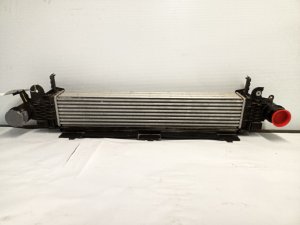
- Charge Air Cooler
(OEM #85046823)— This is the most common failure point for this code on this specific vehicle due to moisture collection and freezing. Part number 85046823 is the current genuine GM part that supersedes several previous numbers.
Trusted brands: GM Genuine Parts, ACDelco
OEM price range: $250-$450
Aftermarket price range: $150-$300 - Manifold Absolute Pressure (MAP) Sensor
(OEM #25203477)— This sensor contains the barometric pressure sensor function. It is a potential but less likely cause of the code. One owner reported this as the sole fix.
Trusted brands: ACDelco, Delphi, NTK
OEM price range: $50-$80
Aftermarket price range: $30-$60
Related Codes That Often Appear With This One
- P0299 — This 'Turbocharger/Supercharger Underboost' code is triggered because a frozen/restricted charge air cooler prevents the engine from receiving the commanded amount of boost pressure. It is the most common companion code to P2227 for this issue.
- P0300 — This 'Random/Multiple Cylinder Misfire Detected' code can be set because the incorrect airflow and pressure readings lead to an improper air-fuel mixture, or because a slug of melted water is ingested by the engine upon heavy acceleration, causing unstable combustion.
Technical Service Bulletins (TSBs) & Recalls
- 18-NA-020 (Multiple Revisions): The primary document for this issue. Details the cause (CAC moisture/freezing) and provides an evolving, complex diagnostic and repair procedure based on build date and climate. Solutions range from CAC replacement to installing shutters and reprogramming the ECM.
- 18-NA-069: A related bulletin for the Chevrolet Malibu with the 1.5L LFV engine, describing a nearly identical CAC icing problem that also causes P2227.
Platform-Specific Known Issues
- A known issue, documented in multiple revisions of GM TSB #18-NA-020, involves moisture accumulating and freezing in the charge air cooler during cold weather. This restricts airflow and triggers codes P2227, P0299, and/or P0300. The official fix is complex and depends on the vehicle's build date, potentially requiring a new CAC, an add-on shutter, and/or an ECM reprogram.
Mechanic-Grade Diagnostic Values
- BARO Sensor Signal Voltage — expected: 0.5 V to 4.5 V. Failure: A voltage reading outside of this range will trigger the P2227 fault code.
- BARO vs. MAP/TIP Correlation at Ignition ON — expected: BARO PID should correlate with Throttle Intake Pressure (TIP) or Manifold Absolute Pressure (MAP) PIDs.. Failure: If the values do not correlate at key-on, the test fails and P2227 is set.
Scan Tool Commands That Help
- GDS2 (or equivalent professional scan tool): Charge Air Cooler System Test (Smoke Test) — As per TSB 18-NA-020, this is the first diagnostic step to check for physical leaks in the charge air system before suspecting internal icing or sensor failure.
- GDS2 (or equivalent professional scan tool): ECM Reprogramming/Calibration Update — For the LYX 1.5L engine, TSB 18-NA-020 specifies a new calibration that enables a revised transmission shift pattern in cold weather to prevent the CAC icing condition from forming. This is part of the official repair procedure.
Wiring & Ground Locations
- BAP/MAP Sensor 1 (Boost Pressure) — Located on the charge air pipe leading to the throttle body. This sensor reads the pressure post-intercooler.. This sensor's reading is compared against the second MAP sensor. A discrepancy, often caused by a CAC restriction, triggers P2227. TSB 18-NA-020 advises removing and cleaning this sensor of moisture.
- MAP Sensor 2 — Located on the intake manifold, just to the left of the throttle body.. This sensor provides the primary manifold pressure reading which is compared to the boost pressure sensor and the calculated barometric pressure. A fault here or in its wiring can directly cause P2227.
- Engine Compartment Fuse Block — Located in the engine bay, this block protects essential powertrain circuits, including the ECU and its sensor inputs.. A compromised fuse or connection in this block could interrupt power or signal from the BARO/MAP sensors to the ECM.
Real Owner Repair Stories
- Equinox Forum user 'JA Freud' (2019 Chevrolet Equinox 1.5L, 80,000 miles) — P0299 (Turbo Underboost), likely accompanied by P2227.
❌ Tried (didn't work) Initial diagnosis pointed towards common causes like the charge air cooler, which was inspected and found to be okay.
✅ What actually fixed it The root cause was a clogged catalytic converter. Replacing it resolved the underboost code.
"I Checked Everything" — The Actual Cause
- In at least one documented case for the companion code P0299, the charge air system passed inspection (implying a smoke test would be clean), but the actual cause was a clogged catalytic converter creating backpressure that confused the boost readings.
OEM Part Supersession History
23270538, 84454110, 85163204, 87830393, 87863765→85046823— GM updated the charge air cooler design to mitigate the moisture accumulation and freezing issue documented in TSB 18-NA-020.
Heads up: Using an older part number, even if new-old-stock, will re-introduce the original design flaw. Only the latest part number should be used for replacement.
Model Year Variations Within This Range
- 2023 vs 2024: The core powertrain, including the 1.5L LYX engine and 6-speed automatic transmission, remained the same between the 2023 and 2024 model years. No significant changes affecting the P2227 diagnosis have been documented. Minor changes included new paint color options and expanded availability of a driver-assist package.
Diagnostic Flowchart
Other Known Issues on This Vehicle
Issues unrelated to this code that are worth knowing about as an owner of this generation:
- Brake System Malfunction 🔴 High — Reported on very low-mileage vehicles. Complaints mention brake failure, pedal going to the floor, and multiple brake-related warning lights illuminating simultaneously.
- Electrical System Faults 🟠 Medium — Owners report multiple random warning lights (Check Engine, ECM, Traction Control), loss of communication codes, and intermittent no-start or no-shut-off conditions.
- Drivetrain Vibration/Noise 🟡 Low — Some owners have reported a noticeable vibration and loud noise from the driveline at moderate speeds (35-40 mph).
- Reduced Engine Power / Misfires 🟠 Medium — Reports exist of the vehicle entering 'Engine Power Reduced' mode with flashing check engine lights due to multiple cylinder misfires, even when the CAC issue is not the cause.
Used vs. New Parts: Buying Guide for This Vehicle
When a used part is the smart pick: A used Charge Air Cooler (CAC) is a risky purchase due to the known internal icing defect. It should only be considered if it can be verified to be the latest OEM part number (85046823) and comes from a donor vehicle in a warm, dry climate with low mileage. Used sensors are generally not recommended due to their low cost new and the difficulty in verifying their condition.
Donor-vehicle mileage cap: roughly under 30000 miles for the part to have meaningful remaining life.
What to inspect on the donor part:
- Verify the part number sticker on the CAC is '85046823'.
- Inspect the cooler fins for significant damage or bending.
- Look inside the inlet and outlet ports for signs of excessive oil or moisture, which could indicate a problem with the donor vehicle's PCV system or turbo.
- Ensure all mounting tabs and hose connection points are intact and not cracked.
OEM-only on this vehicle (don't cheap out):
- Charge Air Cooler (CAC) - Due to the specific design updates to fix the icing issue, only the latest genuine GM part (85046823) is recommended to ensure a permanent fix.
Aftermarket brands forum-validated for this vehicle:
- ACDelco (for sensors)
- Delphi (for sensors)
- NTK (for sensors)
Brands owners have reported issues with on this vehicle:
- Unbranded or 'white-box' Charge Air Coolers from online marketplaces may not incorporate the revised design and are likely to fail again in cold climates.
Real Owner Stories
Aggregated from forums and TSBs cited above. Mileages and costs reflect what owners reported in those sources.
2019 Chevrolet Equinox 1.5L Turbo
Symptoms: Experienced P0299 and P2227 codes during cold weather operation.
What fixed it: The issue was resolved by replacing a faulty MAP sensor rather than the charge air cooler.
Source hint: Reddit thread in r/MechanicAdvice titled 'codes_p0299_p2227_where_to_start_any_help/'
Chevrolet Equinox 1.5L Turbo
Symptoms: P2227 and P0299 codes appeared following a front-end accident.
What fixed it: Installation of an aftermarket charge air cooler replacement.
Source hint: equinoxforum.com thread 'codes-p0299-and-p2227-after-accident.40345/'
Related OBD-II Codes
Frequently Asked Questions
Why does my 2023-2024 Equinox lose power specifically when it's very cold outside?
Is there an updated part to fix the P2227 icing issue on my Equinox?
Does the P2227 code always mean I need a new Charge Air Cooler?
My Equinox is throwing P2227 after a front-end collision; could this be related to the TSB?
What does the 'Engine Power Reduced' message mean alongside code P2227?
Can I just drain the water out of my current charge air cooler?
Used OEM Parts in Stock

New Aftermarket Parts Available


The information in this article is provided for general reference and educational purposes only. Vehicle specifications, procedures, and part compatibility can vary by production date, trim level, and region. Always consult your vehicle's factory service manual and verify part numbers before purchasing or performing repairs. Safety-critical components such as airbags, seat belts, and braking systems should be installed by a qualified professional.
- Chevrolet Equinox:
- 🛍️ Shop This Part
- What's Unique About the 2023-2024 Chevrolet Equinox
- Symptoms You May Notice
- Most Likely Causes
- Rare But Worth Checking
- Diagnosis Steps
- Parts You'll Likely Need
- Related Codes That Often Appear With This One
- Technical Service Bulletins (TSBs) & Recalls
- Platform-Specific Known Issues
- Mechanic-Grade Diagnostic Values
- Scan Tool Commands That Help
- Wiring & Ground Locations
- Real Owner Repair Stories
- "I Checked Everything" — The Actual Cause
- OEM Part Supersession History
- Model Year Variations Within This Range
- Diagnostic Flowchart
- Other Known Issues on This Vehicle
- Used vs. New Parts: Buying Guide for This Vehicle
- Real Owner Stories
- 2019 Chevrolet Equinox 1.5L Turbo
- Chevrolet Equinox 1.5L Turbo
- Related OBD-II Codes
- Frequently Asked Questions
- 🎟️ Get 5% Off