

P2068 on 2011-2021 Jeep Grand Cherokee: Fuel Level Sensor 'B' Circuit High Causes and Fixes
This code indicates a problem with the secondary fuel level sensor, usually located on the driver's side of the fuel tank. The most common fix is replacing the auxiliary/secondary fuel level sending unit, as the sensor itself often fails. Expect to pay between $70 and $150 for an aftermarket part. Before replacing, check wiring and connectors for corrosion.
- P2068 on a WK2 Grand Cherokee points specifically to the secondary fuel level sensor on the driver's side of the fuel tank.
- The most likely cause is a failed sensor, which requires replacing the entire auxiliary sending unit (Mopar P/N 05145583AE).
- Before replacing parts, always inspect the wiring and connector for damage or corrosion, and test the ground circuit, as this is a common and cheaper fix.
- You can continue driving, but you cannot trust your fuel gauge. Use your trip odometer to estimate your remaining fuel to avoid getting stranded.
What's Unique About the 2011-2021 Jeep Grand Cherokee

The 2011-2021 Jeep Grand Cherokee (WK2 generation) and its platform-mate, the Dodge Durango, use a saddle-style fuel tank that straddles the driveshaft. This design requires two separate fuel level sensors to get an accurate reading from both lobes of the tank. Sensor 'A' is part of the primary fuel pump module on the passenger side, while Sensor 'B' (which triggers P2068) is part of the auxiliary sending unit on the driver's side. A failure in the 'B' sensor or its circuit is a documented issue on these vehicles.
Symptoms You May Notice
- Check Engine Light is on
- Fuel gauge reads incorrectly (may be stuck on full or empty, or fluctuate wildly).
- Low fuel warning light may illuminate even with a full tank.
- The vehicle's distance-to-empty calculation will be inaccurate.
- Fuel gauge does not move from full after driving a significant distance.
- Replacing the primary fuel pump (passenger side). The P2068 code specifically refers to the 'B' sensor, which is the secondary/auxiliary unit on the driver's side. However, if the root cause is a fuel transfer issue, the primary pump assembly may be at fault.
Most Likely Causes

- Failed Secondary Fuel Level Sensor ('B' Sensor) 🔴 High Probability The resistive strip on the sensor can wear out, corrode, or fail, causing an open circuit or resistance reading outside of the expected range. This is a common failure point for in-tank components.
How to confirm: Access the driver's side fuel tank sending unit. Disconnect it and measure the resistance across the sensor's terminals with a multimeter. A healthy secondary sensor should read approximately 75 ohms when full and 281 ohms at half-tank. An infinite reading (OL) or a value wildly out of this range indicates a failed sensor.
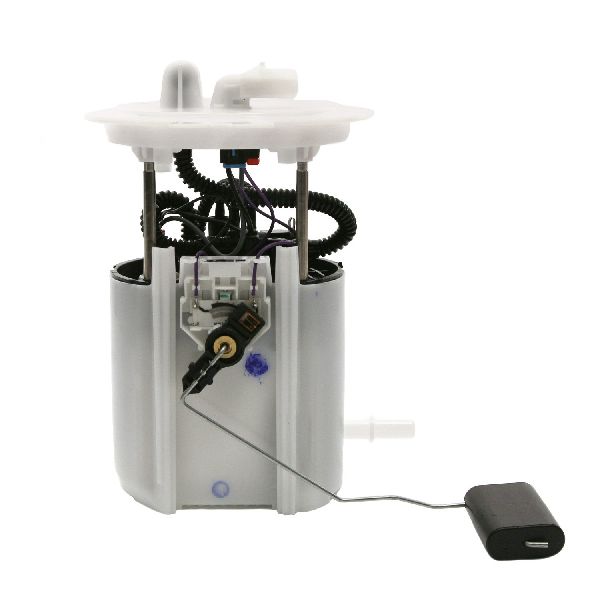
Typical fix: Replace the auxiliary fuel level sending unit module. This part is located on the driver's side of the fuel tank and is accessed via a panel under the rear seat.
Est. part cost: $70-$150 - Damaged Wiring or Loose Connector 🟡 Medium Probability The wiring harness runs underneath the vehicle and is exposed to road debris and corrosion, which can damage wires or the connector at the fuel tank. A short-to-power or an open in the ground circuit are common culprits for a 'Circuit High' code.
How to confirm: Visually inspect the wiring harness leading to the driver's side fuel sending unit. Check the connector for corrosion, backed-out pins, or damage. A voltage drop test on the ground circuit can identify a bad ground; resistance to chassis ground should be under 5 ohms.
Typical fix: Repair the damaged section of the wiring harness or clean/replace the connector.
Est. part cost: $10-$50 - Stuck Sensor Float Arm ⚪ Low Probability Less common, but the float arm can become physically stuck in the full position due to debris in the tank or deformation of the arm, causing a constant high reading.
How to confirm: After removing the sending unit from the tank, observe if the float arm moves freely through its full range of motion.
Typical fix: Free the stuck arm. If the arm is damaged, the entire sending unit must be replaced.
Est. part cost: $0-$150 - Fuel Transfer Issue ⚪ Low Probability The saddle tank uses a jet pump (siphon) to move fuel from the secondary (driver's) side to the primary (passenger's) side where the main fuel pump is. If this transfer fails, the secondary tank can remain full. The PCM may set a P2068 rationality code if it sees the Sensor 'B' reading never decrease after significant driving.
How to confirm: This is harder to diagnose. It often requires monitoring sensor levels over a drive cycle. If Sensor 'A' level drops but Sensor 'B' level does not change at all, a transfer issue is possible. This can sometimes be seen in conjunction with P2066 (Fuel Level Sensor 'B' Performance).
Typical fix: The transfer jet/siphon is often part of the primary fuel pump assembly. This may require replacing the primary fuel pump module on the passenger side.
Est. part cost: $200-$400
Rare But Worth Checking
- Faulty Body Control Module (BCM) or Powertrain Control Module (PCM): This is very rare. The BCM typically processes the fuel level signals before sending the information to the PCM and instrument cluster. Before suspecting a control module, all other possibilities (sensor, wiring, connectors) must be exhaustively ruled out.
Diagnosis Steps

- Read the trouble codes with an OBD-II scanner to confirm P2068 is present.
- Using a scan tool with live data, observe the voltage for 'Fuel Level Sensor B'. A reading stuck at or near 5 volts indicates a circuit high condition. A normal sensor typically outputs between 0.5V (empty) and 4.5V (full).
- Gain access to the top of the fuel tank. On the Grand Cherokee, this is done by removing the rear seat lower cushion to expose two black circular access panels.
- Identify the auxiliary sending unit on the driver's side. Disconnect its electrical connector.
- Inspect the connector and wiring harness for any signs of corrosion, damage, or loose pins.
- Using a multimeter set to Ohms, measure the resistance between the signal and return pins on the sending unit itself. A healthy secondary sensor will show changing resistance as you move the float arm (approx. 75-950 Ohms). An open circuit (infinite resistance) confirms a failed sensor.
- If the sensor tests good, check for 5V reference voltage and a good ground at the harness connector coming from the vehicle. An open or high resistance on the ground circuit is a common cause for this code.
- If wiring and the sensor are confirmed to be good, the fault may lie with the Body Control Module (BCM), but this is highly unlikely.
Parts You'll Likely Need

- Auxiliary Fuel Level Sending Unit
(OEM #05145583AD)— This is the most common failure point for a P2068 code. The sensor is integrated into this module, which sits on the driver's side of the fuel tank. This part number has been superseded multiple times; the latest version is 05145583AE. Previous numbers include 5145583AA, 5145583AB, and 5145583AC.
Trusted brands: Mopar, TRQ, Spectra Premium, Delphi, Carter
OEM price range: $120-$180
Aftermarket price range: $70-$120
Related Codes That Often Appear With This One
- P0463 — P0463 is 'Fuel Level Sensor 'A' Circuit High'. Seeing both codes together could indicate a shared wiring or ground problem affecting both sensors, or a more complex issue with the BCM.
- P2066 — P2066 is 'Fuel Level Sensor 'B' Performance/Rationality'. This code can be set if the fuel level on the secondary sensor doesn't change as expected (e.g., it's stuck high due to a failed fuel transfer from the secondary side to the primary side).
Platform-Specific Known Issues
- A TSB for some GM vehicles (18-NA-365) with similar saddle tanks and codes (including P2068) points to a blocked transfer jet in the primary pump, preventing fuel from moving from the secondary side to the primary side. While this TSB is not for Jeep, the principle is relevant: if the secondary side never empties, the sensor reading won't change, which can sometimes trigger rationality faults like P2066 or P2068.
Mechanic-Grade Diagnostic Values
- Secondary Fuel Level Sensor ('B') Resistance — expected: Approximately 75 Ohms (Full) to 281 Ohms (Half-Full). The full range extends to ~950 Ohms (Empty).. Failure: An infinite resistance reading (OL) indicates an open in the sensor's resistor card. A reading that is stuck and does not change when the float is moved also indicates failure.
- Primary Fuel Level Sensor ('A') Resistance — expected: Approximately 93 Ohms (Full) to 20 Ohms (3/4 Full).. Failure: While not directly for P2068, comparing sensor 'A' and 'B' can be useful. A major discrepancy can point to a wiring issue common to both.
- Fuel Level Sensor Signal Voltage at BCM — expected: A normally functioning system will show a raw signal voltage between ~0.5V (full) and ~4.5V (empty).. Failure: A 'Circuit High' fault like P2068 is set when the voltage is stuck high. With an open circuit, the signal voltage can read as high as 12.0V, though the scan tool data may be clipped to display 5.0V.
- Ground Circuit Resistance — expected: Less than 5 Ohms between the sensor's ground pin and a clean chassis ground point.. Failure: A reading higher than 5 Ohms indicates high resistance in the ground circuit, which can cause a floating voltage and trigger a 'Circuit High' code.
Scan Tool Commands That Help
- wiTECH (Chrysler/Jeep Dealer Tool): View BCM Live Data for 'Fuel Level Sensor 2 Signal' — This is the primary method for observing the raw voltage the Body Control Module (BCM) is seeing from the secondary sensor. A reading stuck at 5.0V or higher confirms the 'Circuit High' condition reported by the P2068 code.
- wiTECH (Chrysler/Jeep Dealer Tool): Actuator Test: Fuel Pump 2 On/Off Relay — While not a direct test for the level sensor, this can be used in advanced diagnostics to rule out issues with the auxiliary fuel pump module's power supply, which could be relevant if a fuel transfer problem is suspected alongside the P2068 code.
Wiring & Ground Locations

- Fuel Pump Module Connector (Driver's Side) — Located on top of the fuel tank, accessible by removing the rear driver's side seat cushion and opening a black circular access panel.. This is the main connection point for the 'B' fuel level sensor. Testing for resistance on the sensor side and for voltage/ground on the harness side happens here. Corrosion or pushed-out pins at this connector are a common cause of the fault.
- Body Control Module (BCM) — The BCM is typically located in the passenger compartment, often behind the dashboard or kick panel area.. The fuel level sensor signals are hard-wired directly to the BCM. In rare cases of a wiring issue, a technician may need to test for continuity between the fuel pump connector and the BCM connector.
- Chassis Ground — The fuel pump and sensor modules are grounded to the vehicle's chassis. While a specific ground point (e.g., G-number) is not clearly documented in public sources, the ground strap is typically located on or near the fuel tank itself.. A corroded or loose ground connection is a classic cause of a 'Circuit High' code, as it creates high resistance in the return path, causing the signal voltage to float high.
Real Owner Repair Stories
- Reddit user in /r/GrandCherokee (2017 Jeep Grand Cherokee 3.6L) — Multiple simultaneous electrical failures including dead outlets, non-functional passenger windows, and a host of communication codes (U-codes) along with P0463 and P2068 for both fuel level sensors reading high. The fuel gauge was pegged full.
❌ Tried (didn't work) Initial checks of fuses and grounds did not immediately solve the problem.
✅ What actually fixed it The user discovered that the PCM fuse (P72) was not receiving power. They used an 'add-a-fuse' to temporarily restore power, which fixed most of the electrical issues but left the P0463 and P2068 codes. This indicates the root cause was likely a fault within the Power Distribution Center (PDC, the modern equivalent of a TIPM) that interrupted power to multiple circuits, including the one powering the PCM's monitoring functions for the fuel system. The final fix would be repairing or replacing the PDC.
OEM Part Supersession History
5145583AA, 5145583AB, 5145583AC, 05145583AD→05145583AE— Standard part revision by the manufacturer to improve reliability or address known issues. This part number is for the auxiliary sending unit on the driver's side.
Heads up: The part listed (05145583AE) is often described as the 'Primary' fuel pump module kit, which can be confusing. However, this assembly contains the 'B' sensor for the driver's side. It's critical to order the correct part for the driver (secondary) vs. passenger (primary) side, as they are not interchangeable.
Model Year Variations Within This Range
- 2014-2021: Post-facelift models (2014+) have a different electrical architecture than the 2011-2013 models. For example, the Totally Integrated Power Module (TIPM) was replaced by a Power Distribution Center (PDC) around 2017. While the function of the fuel sensors remains the same, diagnosing complex electrical issues that may cause a P2068 code could involve different modules or power routing depending on the year.
Diagnostic Flowchart
Other Known Issues on This Vehicle
Issues unrelated to this code that are worth knowing about as an owner of this generation:
- Totally Integrated Power Module (TIPM) Failure 🔴 High — Very common on 2011-2013 models, leading to multiple recalls. Can cause stalling, no-start conditions, erratic fuel pump operation, and other electrical chaos. (Ref: Recalls 14V-530, 15V-115, and 19V-813 (V62) were issued to address failing fuel pump relays within the TIPM.)
- Quadra-Lift Air Suspension Leaks 🟠 Medium — Common on higher-trim models (Overland, Summit). Leaks often develop at air line fittings or in the rubber air springs, causing the vehicle to sag overnight, especially in cold weather.
- 3.6L Pentastar V6 Rocker Arm / Lifter Failure 🟠 Medium — Affects earlier models (approx. 2011-2016) most frequently. Characterized by a distinct 'ticking' noise from the valve train. Failure of the rocker arm's needle bearings can lead to camshaft damage if not addressed. (Ref: TSB 09-002-14 Rev B addresses related cylinder head issues on early Pentastars, but rocker arm failure is a widely documented separate problem.)
- Electronic Shifter Confusion / Rollaway Risk 🔴 High — Specific to 2014-2015 models with the 'monostable' electronic shifter. The non-intuitive design led to drivers exiting the vehicle without it being in Park, resulting in numerous rollaway incidents. (Ref: Recall S27 / NHTSA 16V-240 was issued to add software features ('Auto Park') to prevent rollaways.)
- Delaminating Leather Dashboard 🟡 Low — Common on higher-trim models (Overland, Summit) from roughly 2011-2014, where the leather covering the dashboard bubbles and peels away from the underlying structure due to heat and adhesive failure.
Used vs. New Parts: Buying Guide for This Vehicle
When a used part is the smart pick: A used sending unit from a junkyard is generally NOT recommended. The failure is due to wear on a resistive strip, which is a wear-and-tear item. A used part has unknown remaining life and the labor to access the unit (removing the rear seat, opening the tank) is significant enough that you don't want to do the job twice.
Donor-vehicle mileage cap: roughly under 30000 miles for the part to have meaningful remaining life.
What to inspect on the donor part:
- If buying used is the only option, source from the lowest-mileage donor vehicle possible.
- Visually inspect the electrical connector for any signs of corrosion or heat damage.
- Ask the seller if they can test the resistance range with a multimeter before purchase.
OEM-only on this vehicle (don't cheap out):
- While not strictly 'OEM-only', using a Mopar-branded sending unit is highly recommended over budget aftermarket options. Forum discussions often point to higher reliability with the OEM part, which is critical for a part located inside the fuel tank.
Aftermarket brands forum-validated for this vehicle:
- TRQ
- Spectra Premium
- Delphi
- Carter
Brands owners have reported issues with on this vehicle:
- Unnamed, no-brand 'white box' parts from online marketplaces should be avoided due to inconsistent quality control for this specific component.
Related OBD-II Codes
Frequently Asked Questions
Where is the secondary fuel level sensor ('B' sensor) located on my 2011-2021 Grand Cherokee?
My fuel gauge is stuck on full and I have code P2068. What's the most likely cause?
What resistance reading should I get when testing the secondary fuel level sensor?
Could a bad TIPM on my 2012 Grand Cherokee cause the P2068 code?
My mechanic mentioned a 'fuel transfer issue'. What does that mean for my Jeep's saddle tank?
Do Dodge Durangos from the same years have this same P2068 problem?
Helpful Videos
We Have This Part in Stock


The information in this article is provided for general reference and educational purposes only. Vehicle specifications, procedures, and part compatibility can vary by production date, trim level, and region. Always consult your vehicle's factory service manual and verify part numbers before purchasing or performing repairs. Safety-critical components such as airbags, seat belts, and braking systems should be installed by a qualified professional.
- Jeep Grand Cherokee:
- 🎬 Helpful Videos
- 🛍️ Shop This Part
- What's Unique About the 2011-2021 Jeep Grand Cherokee
- Symptoms You May Notice
- Most Likely Causes
- Rare But Worth Checking
- Diagnosis Steps
- Parts You'll Likely Need
- Related Codes That Often Appear With This One
- Platform-Specific Known Issues
- Mechanic-Grade Diagnostic Values
- Scan Tool Commands That Help
- Wiring & Ground Locations
- Real Owner Repair Stories
- OEM Part Supersession History
- Model Year Variations Within This Range
- Diagnostic Flowchart
- Other Known Issues on This Vehicle
- Used vs. New Parts: Buying Guide for This Vehicle
- Related OBD-II Codes
- Frequently Asked Questions
- 🎟️ Get 5% Off