

P1775 on 2006-2012 Dodge Ram 1500 3.7L: Solenoid Switch Valve Fixes
On a Ram 1500 with the 3.7L V6, P1775 is almost always caused by a worn-out bore in the transmission valve body, causing a key valve to stick. This forces the transmission into 'limp mode,' usually stuck in 2nd gear. The fix is replacing the valve body with an updated unit, which costs $400-$800 for the part. This is not a beginner DIY job, and simply replacing the solenoid pack will not fix the root cause.
- P1775 on your Ram 3.7L means the transmission is in 'limp mode' because a critical shift valve is stuck.
- The root cause is almost always a worn-out valve body, a known mechanical flaw with the 42RLE transmission, not just a bad electronic solenoid.
- Do not continue to drive the vehicle, as you can cause severe overheating and damage, leading to a much more expensive transmission rebuild.
- The correct repair is to replace the entire valve body with an updated, remanufactured unit.
- This is a complex job best left to a professional or a very experienced DIY mechanic.
What's Unique About the 2006-2012 Dodge Ram 1500
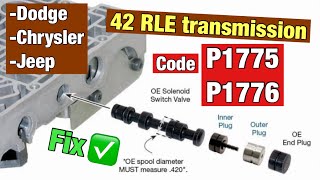
The 3.7L V6 in this generation of Ram 1500 was paired with the 42RLE automatic transmission, which is widely known for this specific problem across many Dodge, Jeep, and Chrysler platforms. The issue is not typically an electrical failure of a solenoid, but a mechanical design flaw. The steel Solenoid Switch Valve constantly moves within a softer aluminum bore in the valve body, eventually wearing the bore into an oval shape. This wear allows the valve to jam, triggering the code. Simply replacing the electronic solenoid pack will not fix this underlying mechanical issue, a common misdiagnosis. Aftermarket companies like Sonnax manufacture repair kits (e.g., part numbers 92835-18K, 92835-32K) with oversized valves and sleeves to permanently correct this flaw, though this requires specialized tools to ream the valve body bore.
Generation note: This guide covers the end of the third generation (2006-2008) and the start of the fourth generation (2009-2012) Ram 1500. Both generations used the 3.7L V6 engine paired with the 42RLE transmission, and the cause of code P1775 is inherent to the transmission's design, making the diagnosis and repair consistent across these model years.
Symptoms You May Notice
- Check Engine Light is illuminated
- Vehicle is stuck in 2nd or 3rd gear ('limp mode')
- Harsh clunk or jerk when slowing to a stop (below 5 mph)
- Sluggish or poor acceleration from a standstill
- Transmission will not shift into 1st gear
- Transmission 'Hot Oil' warning light may illuminate due to increased heat from operating in limp mode
- Replacing only the solenoid pack. The most common mistake is to assume the problem is purely electronic. On the 42RLE transmission, the root cause is almost always the mechanical wear of the valve body bore, and replacing the solenoid pack alone will not fix it. This often leads to the code returning shortly after the repair.
Most Likely Causes
- Worn Solenoid Switch Valve (SSV) Bore in Valve Body 🔴 High Probability The 42RLE transmission uses a steel valve in a softer aluminum housing, which is a known design flaw that leads to premature wear and sticking. Continuous oscillation of the valve wears the bore, allowing pressure loss and letting the valve cock sideways and jam.
How to confirm: Drop the transmission pan and remove the valve body. Physically inspect the SSV and its bore for scoring, wear, and smooth movement. The valve will often be visibly jammed or feel sticky when moved with a small tool.
Typical fix: Replace the entire valve body with a quality remanufactured unit that has an oversized, re-sleeved SSV bore to correct the original flaw. For advanced repair, a transmission shop can ream the original valve body and install a repair kit like the Sonnax 92835-32K. 🎬 Watch: Diagnosing the latched solenoid switch valve
Est. part cost: $400-$800 - Sticking Solenoid Switch Valve (SSV) 🟡 Medium Probability Varnish and debris from old or burnt transmission fluid can cause the valve to stick in its bore, even if the bore itself is not excessively worn. This is exacerbated by the high temperatures generated when driving in limp mode.
How to confirm: After removing the valve body, attempt to manually move the valve. If it feels sticky or gritty, it is not functioning correctly. The bore should be inspected for contamination.
Typical fix: In some cases, the valve body can be thoroughly cleaned, and the valve freed. However, if any bore wear is present, replacement is the more reliable, long-term repair.
Est. part cost: $0 if cleaned, otherwise part of valve body replacement. - Failed Transmission Solenoid / Pressure Switch Assembly ⚪ Low Probability
How to confirm: This is typically diagnosed by exclusion. If the SSV moves freely and the valve body bore is confirmed to be in good condition, the solenoid pack becomes the next likely suspect. It can be tested for correct electrical resistance, but failure is often internal and intermittent.
Typical fix: Replace the solenoid/pressure switch assembly. This is often done at the same time as a valve body replacement for reliability, as it must be removed to access the valve body.
Est. part cost: $150-$300
Rare But Worth Checking
- Low or Contaminated Transmission Fluid: Always check the fluid level and condition first. Burnt or low fluid can cause a wide range of transmission issues, including sticking valves and overheating.
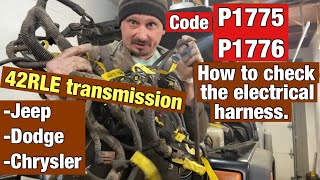
- Faulty Powertrain Control Module (PCM) or Wiring: Extremely rare for this code. Before condemning the PCM, all mechanical and electrical components of the transmission must be ruled out. Check for damaged wiring or corroded connectors leading to the transmission. 🎬 Watch: How to test the electrical harness A detailed video guide by 'Problem Solver Garage' on YouTube shows how to test the harness for these specific codes.
Diagnosis Steps
- Use an OBD-II scanner to confirm P1775 and check for other codes like P0700, P1776, or P0841.
- Check the transmission fluid level and condition. The fluid should be at the correct level, pinkish-red, and not smell burnt. Burnt fluid is a strong indicator of internal wear.
- Per Chrysler TSB 21-001-13 (for the related P1776 code), a capable scan tool can be used to check the 'TRS Code' in the event data. If the code is 'OD', it points towards a sticky solenoid switch valve, confirming an internal issue.
- Check for any available Powertrain Control Module (PCM) software updates with a dealer or qualified shop. While unlikely to be the sole fix, it's a necessary step.
- If the above checks out, drain the transmission fluid and remove the oil pan.
- Inspect the pan magnet for excessive metal shavings. A small amount of fine, grey material is normal, but large flakes or chunks indicate a more severe internal failure requiring a rebuild.
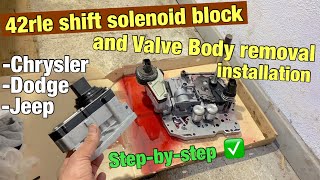
- Carefully remove the transmission valve body. There are detailed step-by-step videos on YouTube from channels like 'Problem Solver Garage' that show this process. 🎬 See this step-by-step valve body removal guide
- On a workbench, inspect the Solenoid Switch Valve and its bore for scoring, wear, and freedom of movement. This is the most critical step to confirm the common failure.
- If the valve is stuck or the bore is worn, replace the valve body. If the valve moves freely and the bore looks good, the solenoid pack is the next likely culprit.
Parts You'll Likely Need
- Transmission Valve Body — This is the most common failure point. A remanufactured unit with a sleeved and updated Solenoid Switch Valve bore is the correct, long-term fix for the known design flaw.
Trusted brands: Sonnax (for rebuild kits, e.g., 92835-32K), Rostra, Mopar (Remanufactured)
OEM price range: $600-$1000 (Remanufactured)
Aftermarket price range: $400-$800 (Remanufactured) - Transmission Solenoid & Pressure Switch Assembly
(OEM #Mopar 4800171AA (supersedes 5143151AA))— While often not the root cause, it's frequently replaced along with the valve body as a preventative measure, as it must be removed anyway and is also a common failure item.
Trusted brands: Mopar, Standard Motor Products (SMP)
OEM price range: $250-$400
Aftermarket price range: $150-$300 - Automatic Transmission Filter Kit
(OEM #Mopar 68059549AA)— A new filter and pan gasket are required anytime the transmission pan is removed for service.
Trusted brands: Mopar, Wix, ATP
OEM price range: $40-$70
Aftermarket price range: $20-$50 - Mopar ATF+4 Automatic Transmission Fluid
(OEM #Mopar 68218057AC (Quart))— The correct fluid type is critical for Chrysler transmissions. A pan drop and valve body replacement will require 5-7 quarts.
Trusted brands: Mopar, Valvoline, Castrol
OEM price range: $10-$15 (Quart)
Aftermarket price range: $8-$12 (Quart)
Related Codes That Often Appear With This One
- P0700 — This is a generic code that simply means the Transmission Control Module (TCM) has detected a fault and has requested the Check Engine Light. It will almost always appear alongside a specific transmission code like P1775.
- P1776 — This is the 'sister code' to P1775, indicating the 'Solenoid Switch Valve Latched in LR Position'. It points to the exact same valve sticking at the opposite end of its travel. Seeing either code strongly suggests a worn valve and bore.
- P0841 — This code relates to the 'Transmission Fluid Pressure Sensor/Switch 'A' Circuit'. Since the computer uses pressure switch readings to confirm the SSV has moved, a fault with the valve can sometimes trigger a pressure sensor code.
Technical Service Bulletins (TSBs) & Recalls
- TSB 21-001-13: While this TSB is primarily for the companion code P1776, it details the diagnostic process for the Solenoid Switch Valve system in the 42RLE transmission. It importantly notes that the SSV is located in the valve body, NOT the solenoid pack. It advises technicians to use a scan tool to check the 'TRS Code' in the event data. An 'OD' reading points to a sticky SSV, confirming the mechanical fault within the valve body.
Platform-Specific Known Issues
- Owner Experience on Jeep Liberty Forum: A user with a 2006 Jeep Liberty (same 42RLE transmission) reported getting both P1775 and P1776 codes, along with transmission overheating. They first tried replacing the solenoid pack and performing a deep clean of the valve body, neither of which solved the problem. The final, successful repair was replacing the entire valve body.
- YouTube Repair Walkthrough: The YouTube channel 'Problem Solver Garage' has a detailed video titled '42rle P1775 P1776 solenoid switch valve latched in the LR or TCC position.' which shows the step-by-step process of removing the valve body and inspecting the solenoid switch valve, confirming it as the common failure point.
Mechanic-Grade Diagnostic Values
- Solenoid Coil Resistance — expected: 1.0 - 3.0 Ohms. Failure: A reading outside this range indicates a faulty solenoid coil.
- L/R, 2/4, and OD Solenoid Resistance (tested through harness) — expected: ~1.7 Ohms (varies with temperature). Failure: A significantly higher or lower reading suggests a problem with the specific solenoid circuit.
- Pressure Switch Resistor Resistance — expected: 270 - 330 Ohms. Failure: Readings outside this range point to a failure within the pressure switch assembly, which is part of the solenoid pack.
Hidden / Shadow Codes Worth Checking
- TRS Code 'OD' or 'TR2': This is not a DTC, but a data value found in the freeze frame/event data for P1775/P1776. An 'OD' code confirms the manual valve was in the correct position, pointing to an internal fault like a stuck SSV. A 'TR2' code indicates the manual valve was NOT fully in the Overdrive position, pointing to a shifter cable adjustment issue as the root cause. (see via Dealer-level scan tool (e.g., DRBIII®, wiTECH) capable of reading detailed event data for transmission codes.)
Scan Tool Commands That Help
- wiTECH or equivalent professional scan tool: Transmission Quicklearn Procedure — This procedure is required after replacing the valve body or solenoid pack. It allows the TCM to learn the hydraulic and electrical characteristics of the new components to ensure proper shift timing and feel.
- wiTECH or equivalent professional scan tool: View DTC Event Data / Freeze Frame — Used during initial diagnosis to view the 'TRS Code' and other transmission parameters at the exact moment the P1775 fault was logged, which can differentiate between an internal failure and an external linkage problem.
Wiring & Ground Locations
- Transmission Solenoid/TRS Assembly Connector — On the left side of the transmission case.. This is the main electrical connection for the entire solenoid pack. Checking for corrosion, damage, or pushed-out pins at this connector is a critical first step before condemning internal parts.
Real Owner Repair Stories
- DodgeForum.com user 'master tech' (2000 Grand Caravan (with similar 41TE transmission, but same code and valve design)) — Harsh 2-1 downshift 'clunk', hesitation, and Check Engine Light with codes P1775 and P0700.
❌ Tried (didn't work) Transmission fluid and filter change, Clearing codes (they returned quickly), Cleaning electrical connectors
✅ What actually fixed it The user 'master tech' advised that P1775 points to the TCC latching and the correct fix is to replace the entire valve body, not just the solenoid pack. - YouTube video by 'Carbo Holic' (Vehicle with 42RLE transmission) — Limp mode with codes P1775 and P1776.
✅ What actually fixed it The video demonstrates the entire valve body removal process, highlighting a critical, often-missed step: the manual valve lever on the valve body must be rotated past the '1' (Low) position to a 'secret' detent. This retracts a pin, allowing the valve body to be removed without breaking the transmission case. The creator ultimately fixed the issue by swapping in a known-good used valve body. - Dodge Dakota Owner Report (NHTSA ODI #10314835) — An owner of a related Dodge platform reported that their vehicle displayed codes P1775 (Solenoid Switch Valve Latched in TCC Position) and P0218 (Transmission High Temp Activated). The diagnostic recommendation was to remove the transmission to find internal failure or replace the transmission entirely.
OEM Part Supersession History
5143151AA→4800171AA— Standard part revision and improvement by the manufacturer.
Heads up: The new part number (4800171AA) is the correct service replacement for the original.
Model Year Variations Within This Range
- 2007-2012: Starting in 2007, the 42RLE transmission was updated to a Variable Line Pressure (VLP) system from the previous static pressure system. This change affects the valve body and solenoid design. It is critical to ensure replacement parts (especially valve bodies and solenoid packs) are specified for VLP or non-VLP applications depending on the vehicle year.
- All: The Solenoid Switch Valve itself can have two different diameters: .420" or .453". When ordering a valve body repair kit like those from Sonnax, the original valve must be measured to ensure the correct oversized replacement kit is purchased.
Diagnostic Flowchart
Other Known Issues on This Vehicle
Issues unrelated to this code that are worth knowing about as an owner of this generation:
- Exhaust Manifold Bolt Failure 🟠 Medium — Common, especially in regions with high humidity or road salt. Often presents as a ticking noise when the engine is cold that may disappear as it warms up.
- Totally Integrated Power Module (TIPM) Failure 🔴 High — A well-documented and common point of failure for many 2006-2012 Chrysler/Dodge/Ram vehicles.
- Front Suspension and Steering Wear 🟠 Medium — Common with higher mileage (75,000+ miles), typical for truck platforms of this era. (Ref: Multiple recalls for tie rods (e.g., NHTSA 13V529000, 13V527000) on related HD and Mega Cab models, highlighting general steering component concerns.)
Used vs. New Parts: Buying Guide for This Vehicle
When a used part is the smart pick: For this specific P1775 code, a used part only makes sense for the solenoid pack, and only if it comes from a very low-mileage donor vehicle with a known history. A used valve body is strongly discouraged.
Donor-vehicle mileage cap: roughly under 60000 miles for the part to have meaningful remaining life.
What to inspect on the donor part:
- For a solenoid pack, ensure the electrical connector pins are straight and free of corrosion.
- For a valve body (if you must), check the fluid that comes out of it. It should be bright red, not brown or black, and have no metallic sheen.
- Ask for the donor vehicle's VIN to verify its model year and confirm if it's a VLP or non-VLP unit.
OEM-only on this vehicle (don't cheap out):
- Transmission Fluid (Mopar ATF+4 is highly recommended to avoid shift quality issues).
Aftermarket brands forum-validated for this vehicle:
- Sonnax (for valve body repair/upgrade kits)
- TransGo (for valve body shift kits)
- Rostra (for remanufactured valve bodies and solenoids)
- Standard Motor Products (SMP) (for solenoid packs)
Brands owners have reported issues with on this vehicle:
- No-name, unbranded valve bodies and solenoid packs from online marketplaces are a significant gamble due to the precision required for these components.
Real Owner Stories
Aggregated from forums and TSBs cited above. Mileages and costs reflect what owners reported in those sources.
2006 Jeep Liberty 3.7L V6
Symptoms: The vehicle was throwing both P1775 and P1776 codes and experiencing transmission overheating. The owner attempted to fix it by replacing the solenoid pack and deep cleaning the valve body, but the problem persisted.
What fixed it: Replacing the entire valve body.
Source hint: Jeep Liberty Forum (libertyjeep.net)
2006-2012 Dodge Ram 1500 3.7L V6 (42RLE)
Symptoms: Solenoid switch valve latched in the LR or TCC position, causing the transmission to malfunction.
What fixed it: Removing the valve body and inspecting/replacing the solenoid switch valve or the valve body itself.
Source hint: YouTube - Problem Solver Garage
Dodge Dakota (42RLE Platform)
Symptoms: An owner reported codes P1775 (Solenoid Switch Valve Latched in TTC Position) and P0218 (Trans-High Temp Activated). The diagnostic findings suggested an internal failure requiring transmission removal.
What fixed it: The report noted that technicians were siding on replacing the transmission due to internal failure.
Source hint: NHTSA ODI #10314835
Related OBD-II Codes
Frequently Asked Questions
Does TSB 21-001-13 apply to my Dodge Ram 1500 if I have code P1775?
Is there a specific part number recommended to fix the worn SSV bore in my 42RLE transmission?
Why does my Ram 1500 feel like it's stuck in 2nd or 3rd gear when P1775 is active?
Can I just replace the solenoid pack to fix P1775 on my 3.7L V6 Ram?
My 'Hot Oil' light came on along with the Check Engine Light; is this related to P1775?
Is the ticking noise from my 3.7L V6 engine related to the transmission code?
Helpful Videos
We Have This Part in Stock


The information in this article is provided for general reference and educational purposes only. Vehicle specifications, procedures, and part compatibility can vary by production date, trim level, and region. Always consult your vehicle's factory service manual and verify part numbers before purchasing or performing repairs. Safety-critical components such as airbags, seat belts, and braking systems should be installed by a qualified professional.
- Dodge Ram 1500:
- 🎬 Helpful Videos
- 🛍️ Shop This Part
- What's Unique About the 2006-2012 Dodge Ram 1500
- Symptoms You May Notice
- Most Likely Causes
- Rare But Worth Checking
- Diagnosis Steps
- Parts You'll Likely Need
- Related Codes That Often Appear With This One
- Technical Service Bulletins (TSBs) & Recalls
- Platform-Specific Known Issues
- Mechanic-Grade Diagnostic Values
- Hidden / Shadow Codes Worth Checking
- Scan Tool Commands That Help
- Wiring & Ground Locations
- Real Owner Repair Stories
- OEM Part Supersession History
- Model Year Variations Within This Range
- Diagnostic Flowchart
- Other Known Issues on This Vehicle
- Used vs. New Parts: Buying Guide for This Vehicle
- Real Owner Stories
- 2006 Jeep Liberty 3.7L V6
- 2006-2012 Dodge Ram 1500 3.7L V6 (42RLE)
- Dodge Dakota (42RLE Platform)
- Related OBD-II Codes
- Frequently Asked Questions
- 🎟️ Get 5% Off