

P1715 on 2012-2016 Subaru Impreza: Understanding This Uncommon Code
The code P1715 is not a recognized or common trouble code for the 2012-2016 Subaru Impreza. It is frequently found on Nissan vehicles, where it indicates an Input Speed Sensor fault or worn CVT belt. If you see this code on your Impreza, double-check the code with a high-quality scanner, as transmission issues on this car typically present as other codes like P2763 or P2764, which point to a failing valve body solenoid.
- P1715 is not a valid or recognized code for a 2012-2016 Subaru Impreza. Its appearance is almost certainly due to a scanner error.
- Do not purchase parts based on a P1715 code definition for another brand like Nissan, where it points to an input speed sensor.
- Transmission problems in this specific Impreza are almost always related to the CVT valve body's lock-up solenoid.
- The actual trouble codes to look for are P2763 and P2764, which confirm a valve body solenoid issue.
- The standard Subaru repair is to replace the entire CVT valve body assembly, but a cheaper DIY option exists by replacing only the aftermarket solenoid.
- Check if your vehicle is covered under Subaru's 10-year/100,000-mile CVT warranty extension (TSB 16-107-17R) before paying for repairs.
What's Unique About the 2012-2016 Subaru Impreza
The 2012-2016 Impreza uses a first-generation Lineartronic TR580 CVT (Continuously Variable Transmission) that is known for specific issues, but P1715 is not one of them. The most widely documented transmission failures on this platform are related to the torque converter lock-up solenoid or the valve body itself. These failures typically trigger codes like P2763, P2764, and the generic transmission fault code P0700. Owners experiencing transmission symptoms should investigate these common failure points rather than focusing on the unverified P1715 code. Subaru extended the warranty on these CVTs to 10 years/100,000 miles due to known issues.
Symptoms You May Notice
- No symptoms are directly associated with P1715 on this vehicle due to the uncertain definition.
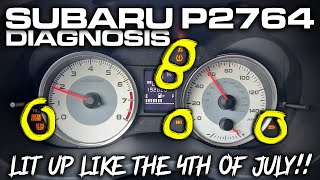
- If the code is a misreading for another issue, you might experience common CVT failure symptoms: hesitation from a stop, shuddering at low speeds, stalling when coming to a stop, a flashing 'AT OIL TEMP' light, or the dashboard lighting up with multiple warnings (often called the 'Christmas tree' effect).
- Replacing the transmission input speed sensor. This is the correct diagnosis for a P1715 on a Nissan, but there is no evidence it applies to a Subaru. An owner might mistakenly order and attempt to replace this part based on generic online information, without fixing the actual underlying problem.
Most Likely Causes
- Scanner Error or Invalid Code 🔴 High Probability The code P1715 is not documented for this vehicle, suggesting the scanner may be misinterpreting the fault or displaying an erroneous code. This is the most likely scenario.
How to confirm: Re-scan the vehicle with a different, high-quality OBD-II scanner, preferably one with Subaru-specific software (like a Subaru Select Monitor) to read the specific codes from the Transmission Control Module (TCM).
Typical fix: Confirm the actual trouble codes stored in the Transmission Control Module (TCM). The real code is likely P2763 or P2764.
Est. part cost: $0 - CVT Valve Body / Lock-Up Solenoid Failure 🔴 High Probability The TR580 CVT is known for failure of the torque converter lock-up duty solenoid, which is integrated into the valve body. This is the most common root cause for transmission-related codes on this platform.
How to confirm: A correct scan will reveal codes P2763 or P2764. The solenoid's resistance can be tested with an ohmmeter; a reading outside the 10-13 ohm range when warm indicates failure.
Typical fix: Subaru's official repair is to replace the entire valve body assembly. Some independent shops or DIYers may replace only the failed solenoid, which is now available from aftermarket suppliers like Dorman.
Est. part cost: $60-$900
Diagnosis Steps
- Confirm the P1715 code with a second, reliable scan tool. Note all other codes present, especially P0700.
- If the code persists and cannot be identified, disregard it and focus on diagnosing any drivability symptoms.
- If symptoms like hesitation, shuddering, or stalling are present, investigate the common valve body/solenoid failure. This is the most probable cause of CVT issues on this platform.
- Check the transmission fluid level and condition. This CVT does not have a traditional dipstick and requires a specific procedure involving checking fluid temperature and using a fill plug.
- If codes P2763 or P2764 are found, the diagnosis points directly to a faulty lock-up solenoid. Test the solenoid's resistance at the transmission connector. A reading significantly different from the 10-13 ohm specification confirms the failure. 🎬 Watch this diagnostic video for P0700 and P2764 code testing
- If the solenoid is confirmed bad, the repair involves replacing either the solenoid itself or the entire valve body assembly.
Parts You'll Likely Need
- CVT Valve Body Assembly
(OEM #31825AA052)— This is the most common point of failure for this transmission, causing codes like P2763/P2764. The solenoids are integrated into the valve body and are not sold separately by Subaru.
Trusted brands: Subaru (OEM)
OEM price range: $750-$900
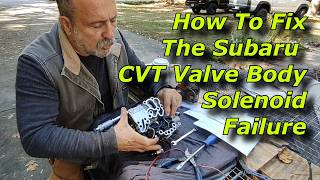
Aftermarket price range: Not commonly available as a full assembly, but individual solenoids are. - Torque Converter Lock-Up Solenoid — This is the specific component on the valve body that fails. While not sold by Subaru, it is available from aftermarket manufacturers and allows for a much cheaper repair if one is willing to open the valve body. 🎬 See how to fix TR580 valve body solenoids yourself
Trusted brands: Dorman
OEM price range: Not sold separately
Aftermarket price range: $60-$100
Related Codes That Often Appear With This One
- P0700 — P0700 is a generic code that means the Transmission Control Module (TCM) has stored a fault. If you see P1715, you will almost certainly see P0700 alongside it. The true, specific code is stored in the TCM.
- P2763 / P2764 — These are the most common codes for this vehicle's transmission issues, pointing to a fault in the torque converter lock-up duty solenoid circuit. A scanner might misinterpret one of these as P1715.
Technical Service Bulletins (TSBs) & Recalls
- TSB 16-107-17R: This bulletin details the CVT Warranty Extension program, extending coverage to 10 years / 100,000 miles for applicable vehicles, including the 2012-2015 Impreza, due to potential issues.
- TSB 02-157-14R: While not directly related to the transmission, this TSB addresses excessive oil consumption on the FB20 engine and is a critical issue for owners of these vehicles to be aware of. The fix involves an oil consumption test and potential short block replacement.
Platform-Specific Known Issues
- The TR580 Lineartronic CVT used in the 2012-2016 Impreza is well-known for failures of the torque converter lock-up solenoid, which is located on the valve body. Subaru does not service the solenoid individually, requiring the replacement of the entire valve body assembly to fix the issue.
- Due to the prevalence of this and other CVT issues, Subaru of America extended the powertrain warranty for the CVT to 10 years or 100,000 miles, whichever comes first, for many models including the 2012-2015 Impreza.
Mechanic-Grade Diagnostic Values
- Torque Converter Lock-Up (TCC) Solenoid Resistance — expected: 10-13.5 Ohms. A common specification is 12-13 Ohms when the engine is cold or at 68°F.. Failure: A reading significantly lower (e.g., 2-7 Ohms) or higher (open circuit) indicates a failed solenoid. The circuit may test good when cold but go open when heated to ~200°F with a heat gun.
- Valve Body Mounting Bolt Torque — expected: 6.5 ft-lbs (80 in-lbs) for the main valve body bolts.. Failure: N/A - This is an installation specification.
- Valve Body Cover Bolt Torque — expected: 6.0 ft-lbs (72 in-lbs).. Failure: N/A - This is an installation specification.
Scan Tool Commands That Help
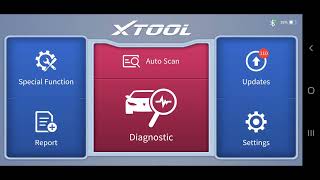
- Subaru Select Monitor (SSM) or compatible aftermarket tool (e.g., XTOOL, Launch): Clear AT Learning Value — This function must be performed after replacing the valve body or individual solenoids to clear the transmission's learned adaptive values.
- Subaru Select Monitor (SSM) or compatible aftermarket tool (e.g., XTOOL, Launch): AT Learning Mode — This is the relearn procedure that must be executed immediately after clearing the learned values. It involves lifting the vehicle, placing it in learning mode via the scan tool, and shifting through gears as prompted to allow the TCM to learn the new components' hydraulic and electrical characteristics.
Wiring & Ground Locations
- TCM (Transmission Control Module) — On the TR580, the TCM is integrated with the valve body assembly, located on top of the transmission under a cover.. The solenoids are directly controlled by the TCM. Knowing its location is key to understanding the repair involves accessing the top of the transmission.
- B11 Connector (Main Transmission Harness Connector) — On top of the transmission, accessible after removing the air intake ducting. It is a large gray connector.. This is the primary external test point. The lock-up solenoid's resistance can be checked here without opening the transmission. The wire is typically red and white.
- Lock-Up Solenoid Test Pin — At the B11 connector, the lock-up solenoid circuit corresponds to the red and white wire. One video specifies it as the 3rd pin from the left on the bottom row. Another specifies the lower-left pin. Technicians should verify the wire color to ensure the correct pin.. This is the specific pin to probe with a multimeter (set to Ohms) against a chassis ground to test the solenoid's resistance.
- Main Engine Ground — A primary ground strap connects from the chassis to the top starter motor bolt on the transmission bellhousing.. A poor ground connection here can cause a variety of electrical issues, including erratic sensor readings and incorrect diagnostic codes. Ensuring this ground is clean and tight is a fundamental step in any electrical diagnosis.
Real Owner Repair Stories
- YouTube video by 'How To Fix Subaru P2764 P2763 Codes' (Subaru Impreza with TR580 Transmission) — Dashboard lit up like a 'Christmas tree', throwing codes P2763/P2764.
❌ Tried (didn't work) The video directly proceeds to diagnosis, confirming the fault via resistance check before attempting repairs.
✅ What actually fixed it The lock-up solenoid was tested and showed 2.5 Ohms, far below the 10-13 Ohm spec. The single faulty solenoid was replaced with an aftermarket Dorman part, and the valve body was reinstalled. This resolved all symptoms and codes for a cost of under $100 for the part. - YouTube video by 'i Perform Subaru CVT Relearn on TR690' (2014 Subaru Forester XT (TR690, similar architecture) with 197,310 miles) — Hard 'gear shifts' at low speeds, codes P2762 and P0700. The same issue had occurred at 88k miles and was fixed under warranty.
❌ Tried (didn't work) Driving the car for 10 miles after replacing the solenoid without performing a relearn resulted in a throttle response that felt 'off' and not smooth.
✅ What actually fixed it After replacing the TCC solenoid, the owner used an XTOOL A30M bidirectional scanner to perform the 'Clear AT Learning Value' and 'AT Learning Mode' functions. This made a 'VERY noticeable difference in driveability' and restored smooth operation.
OEM Part Supersession History
31825AA050, 31825AA051→31825AA052— Standard part revision and consolidation.
Heads up: These part numbers are generally interchangeable for the TR580 valve body assembly within the specified vehicle generation.N/A (Solid Bushing Thrust Washer in Torque Converter)→N/A (Needle Bearing Thrust Washer in Torque Converter)— The original solid bushing-type thrust washer inside the torque converter was prone to wear, causing oil passage restrictions and stalling. It was replaced with a more durable needle bearing type.
Heads up: This is an internal change to the torque converter itself, not a directly swappable part. It's a key differentiator when sourcing a used transmission or torque converter.
Model Year Variations Within This Range
- 2012-2016: The fourth-generation Impreza was introduced for the 2012 model year with the new 2.0L FB20 engine and TR580 CVT.
- 2015-2016: A mid-cycle facelift occurred for the 2015 model year, which included revised styling (grille, headlamps), new touchscreen interfaces, and minor interior trim changes. The underlying TR580 transmission and its common failure points remained the same.
Diagnostic Flowchart
Other Known Issues on This Vehicle
Issues unrelated to this code that are worth knowing about as an owner of this generation:
- Excessive Oil Consumption 🔴 High — Common in early FB20 engines (2012-2014 models). Caused by issues with piston rings. Consumption can be as high as 1 quart per 1,200 miles. (Ref: TSB 02-157-14R; led to a class-action lawsuit and an extended warranty of 8 years/100,000 miles for affected vehicles, often resulting in short block replacement.)
- CVT Valve Body / Solenoid Failure 🔴 High — The most common major failure on the TR580 CVT, typically occurring between 80,000 and 120,000 miles. Triggers codes P2763/P2764 and a flashing AT OIL TEMP light. (Ref: TSB 16-107-17R; Subaru extended the CVT warranty to 10 years/100,000 miles for many affected models.)
- A/C Compressor Clutch Failure or Noise 🟠 Medium — The A/C compressor clutch can become noisy or fail to engage, leading to no cold air. This can be due to a worn clutch, a bad relay, or leaking o-rings at the compressor.
- Minor Engine Oil Seepage 🟡 Low — The boxer engine design can lead to minor oil weeping or seepage from areas like the timing cover or valve covers over time, especially on high-mileage vehicles. Not typically a major leak but can be a nuisance.
Used vs. New Parts: Buying Guide for This Vehicle
When a used part is the smart pick: A used valve body is a significant gamble, as it is a high-failure item. It should only be considered if from a documented low-mileage donor vehicle. Replacing only the faulty solenoid with a new aftermarket part is a much more common and cost-effective repair.
Donor-vehicle mileage cap: roughly under 60000 miles for the part to have meaningful remaining life.
What to inspect on the donor part:
- Verify the donor vehicle's mileage and VIN to check its history.
- Ensure the part number on the valve body matches (e.g., 31825AA052).
- Inspect the electrical connector for any bent or corroded pins.
- Avoid parts from vehicles that show signs of severe impact or flood damage.
OEM-only on this vehicle (don't cheap out):
- While the entire valve body assembly from Subaru is the official fix, the high cost makes alternatives attractive. There is no component for this specific repair that is strictly OEM-only, as the aftermarket has provided a viable solution for the solenoid.
Aftermarket brands forum-validated for this vehicle:
- Dorman: Widely used and documented in multiple DIY repair videos and forums for the individual lock-up solenoid.
- Rostra: Mentioned in forums as a manufacturer of quality replacement solenoids, available through distributors like Transtar Industries.
Brands owners have reported issues with on this vehicle:
- Unbranded, generic valve body assemblies from online marketplaces are risky. Forum discussions indicate they may be rebuilt with low-quality, unnamed solenoids, making their long-term reliability questionable.
Real Owner Stories
Aggregated from forums and TSBs cited above. Mileages and costs reflect what owners reported in those sources.
2015 Subaru Forester (TR580 CVT) — ~100000 miles
Symptoms: Solenoid failure code (P2757) on a vehicle with a similar TR580 transmission.
What fixed it: Replacement of the CVT valve body assembly (OEM part number 31825AA052).
Cost: $1400-$1400
Source hint: Reddit r/subaru - 'CVT valve body replacement'
2012-2014 Subaru Impreza FB20 — ~90000 miles
Symptoms: Excessive oil consumption reaching as high as 1 quart per 1,200 miles.
What fixed it: Short block replacement following an oil consumption test as per TSB 02-157-14R.
Source hint: TSB 02-157-14R
2012-2016 Subaru Impreza 2.0L — ~100000 miles
Symptoms: Hesitation from a stop, shuddering at low speeds, stalling when coming to a stop, and a flashing 'AT OIL TEMP' light.
What fixed it: Replacement of the torque converter lock-up duty solenoid or the entire valve body assembly.
Source hint: vehicle_specific_issues
Related OBD-II Codes
Frequently Asked Questions
Is the P1715 code on my 2012-2015 Impreza covered under a warranty extension?
My scanner shows P1715 but I also have a flashing 'AT OIL TEMP' light. What does this mean for my TR580 transmission?
Can I replace just the failed solenoid on my 2014 Impreza's valve body to save money?
Does TSB 02-157-14R regarding oil consumption apply to my 2013 Impreza with the FB20 engine?
What is the correct resistance for the lock-up solenoid on a 2012-2016 Impreza CVT?
Why is my scanner showing a 'belt slip' definition for P1715 on my Subaru?
Helpful Videos

We Have This Part in Stock

The information in this article is provided for general reference and educational purposes only. Vehicle specifications, procedures, and part compatibility can vary by production date, trim level, and region. Always consult your vehicle's factory service manual and verify part numbers before purchasing or performing repairs. Safety-critical components such as airbags, seat belts, and braking systems should be installed by a qualified professional.
- Subaru Impreza:
- 🎬 Helpful Videos
- 🛍️ Shop This Part
- What's Unique About the 2012-2016 Subaru Impreza
- Symptoms You May Notice
- Most Likely Causes
- Diagnosis Steps
- Parts You'll Likely Need
- Related Codes That Often Appear With This One
- Technical Service Bulletins (TSBs) & Recalls
- Platform-Specific Known Issues
- Mechanic-Grade Diagnostic Values
- Scan Tool Commands That Help
- Wiring & Ground Locations
- Real Owner Repair Stories
- OEM Part Supersession History
- Model Year Variations Within This Range
- Diagnostic Flowchart
- Other Known Issues on This Vehicle
- Used vs. New Parts: Buying Guide for This Vehicle
- Real Owner Stories
- 2015 Subaru Forester (TR580 CVT) — ~100000 miles
- 2012-2014 Subaru Impreza FB20 — ~90000 miles
- 2012-2016 Subaru Impreza 2.0L — ~100000 miles
- Related OBD-II Codes
- Frequently Asked Questions
- 🎟️ Get 5% Off