

P1715 on 1999-2017 Hyundai Accent: Input Speed Sensor (Pulse Generator 'A') Failure Causes and Fixes
On a 1999-2017 Hyundai Accent, code P1715 almost always means the transmission's input speed sensor (also called Pulse Generator 'A') has failed. This causes harsh shifting, a Check Engine Light, and can get the car stuck in 3rd gear (limp mode). The fix is typically replacing the externally-mounted sensor, which is a relatively low-cost part. The OEM part number for many early models is 45955-22701.
- P1715 on a 1999-2017 Accent points directly to a problem with the transmission's input speed sensor or its circuit.
- The most common symptoms are a Check Engine Light, harsh shifting, and the transmission getting stuck in 3rd gear.
- The fix is almost always replacing the input speed sensor, an affordable and externally accessible part. For 1999-2006 models, look for OEM part 45955-22701.
- Before replacing the sensor, always check the transmission fluid level and inspect the sensor's wiring for damage.
- This code does not typically indicate a major internal transmission failure on this vehicle.
What's Unique About the 1999-2017 Hyundai Accent
Unlike some other manufacturers where a P1715 code can signal a major internal transmission failure (like on many Nissans with CVTs), on Hyundai models from this era, the issue is almost always just the sensor itself. The 4-speed and later 6-speed automatic transmissions used in the Accent are known for this specific external sensor failing, but it's typically a simple and affordable component replacement rather than a sign of a doomed transmission.
Generation note: This guide covers three generations of the Hyundai Accent: the LC (1999-2006), MC (2006-2011), and RB (2011-2017). The meaning of code P1715 and the primary cause (a failed input speed sensor) are consistent across these generations. The specific part number for the LC generation is commonly 45955-22701. Later generations may use different part numbers, so verifying with a VIN is crucial. The sensor is typically located on the top or front of the transmission case, accessible after removing the air filter housing and battery tray.
Symptoms You May Notice
- Check Engine Light is on
- Harsh, erratic, or delayed shifting
- Transmission is stuck in 3rd gear (fail-safe or 'limp mode')
- Sluggish acceleration from a stop
- Reduced fuel economy
- Inability to manually shift out of 3rd gear when stopped
- Replacing the entire transmission when only a simple, external sensor is needed.
- Replacing the output speed sensor instead of the input speed sensor. They are often located near each other and look similar.
- Replacing the TCM/PCM without first exhaustively checking the sensor and its wiring.
Most Likely Causes
- Failed Input Speed Sensor (Pulse Generator 'A') 🔴 High Probability This is a very common failure point on many Hyundai automatic transmissions from this period due to age, heat cycles, and internal component wear.
How to confirm: A scan tool can monitor the live data stream for the input speed sensor. If the reading is zero or erratic while the vehicle is in gear and accelerating, the sensor is likely bad. The sensor can be tested with a multimeter for resistance; specifications for a similar sensor show a resistance of around 870-900 Ohms.
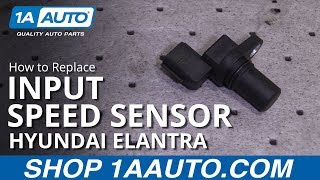
Typical fix: Replace the input speed sensor. On most Accent models, it is located on the exterior of the transmission case, often near the output speed sensor. Access typically requires removing the airbox, battery, and battery tray. The sensor is usually held in by a single 10mm bolt. 🎬 Watch: Step-by-step Accent speed sensor replacement walkthrough
Est. part cost: $20-$80 - Damaged Wiring or Connector 🟡 Medium Probability The wiring harness leading to the sensor can become brittle from age and heat, or damaged by road debris or improper service. The connector pins can also corrode or become loose.
How to confirm: Visually inspect the wiring harness and connector for any signs of cracking, corrosion, chafing, or loose pins. Perform a continuity test on the wires between the sensor and the TCM. Wiggle the harness while monitoring live data to see if the signal cuts out.
Typical fix: Repair the damaged section of the wiring harness or replace the connector pigtail.
Est. part cost: $10-$30 - Low or Dirty Transmission Fluid ⚪ Low Probability While less likely to cause a specific sensor circuit code, extremely low or contaminated fluid can cause erratic transmission behavior that may, in some cases, trigger speed sensor codes. A user on a Hyundai forum noted being a quart low on fluid when experiencing shifting issues.
How to confirm: Check the transmission fluid level and condition using the dipstick (on applicable models). The fluid should be at the correct level and red or pinkish, not brown, black, or smelling burnt.
Typical fix: Top off the fluid to the correct level or perform a transmission fluid drain and fill.
Est. part cost: $40-$100
Rare But Worth Checking
- Faulty Transmission Control Module (TCM): This is very rare. The TCM should only be considered after the sensor and wiring have been thoroughly tested and confirmed to be good. In some cases with similar symptoms, a dealer may need to test with a known-good ECM/TCM.
Diagnosis Steps
- Read the trouble codes with an OBD-II scanner. Note all codes present, especially P1715, P0717, and P1529.
- Check the transmission fluid level and condition. Top off or change if necessary, as very low fluid can cause shifting problems.
- Visually inspect the input speed sensor's wiring harness and connector for any visible damage, corrosion, or loose connections. The sensor is typically on the top or front of the transmission case.
- Use a scan tool with live data capability to monitor the Input Speed Sensor (ISS or PG-A) signal. The reading should increase smoothly with engine RPM when in gear. If it's stuck at zero or reads erratically, the sensor or its circuit is faulty.
- If the scan tool shows no signal, disconnect the sensor and test its internal resistance with a multimeter. Compare the reading to the manufacturer's specification (a similar sensor is around 900 Ohms).
- Check for power and ground at the sensor connector with the key on. If power or ground is missing, trace the wiring back to the TCM to find the open circuit.
- If the wiring and sensor test good, the problem may be with the TCM, but this is highly unlikely and should be the last resort.
Parts You'll Likely Need
- Transmission Input Speed Sensor (Pulse Generator A)
(OEM #45955-22701 (Fits many 1999-2006 models, verify with VIN))— This sensor is the most common failure point for code P1715 on this vehicle.
Trusted brands: Hyundai (OEM), Kia (OEM), Standard Motor Products, NTK, Dorman
OEM price range: $50-$100
Aftermarket price range: $20-$60
Related Codes That Often Appear With This One
- P0717 — This is the generic SAE equivalent of P1715, meaning 'Input/Turbine Speed Sensor 'A' Circuit No Signal'. Some scan tools may show this code alongside or instead of the Hyundai-specific one.
- P1529 — This is a common companion code on Hyundais. It simply means the TCM has sent a request to the Engine Control Module (ECM) to turn on the Check Engine Light due to a transmission fault.
- P0720 — This code is for the Output Speed Sensor. It can appear with P1715 if there is a shared wiring issue or if both sensors fail around the same time due to similar age and operating conditions.
Technical Service Bulletins (TSBs) & Recalls
- While no TSB is specific to P1715, Hyundai has issued several TSBs (e.g., 14-AT-013, 20-AT-003H) for related speed sensor codes like P0717/P0722 on other models. These TSBs confirm the diagnostic procedure of checking live data and inspecting wiring before replacing the sensor/harness, and advise against replacing the entire transmission for these codes.
Platform-Specific Known Issues
- Sensor Location: On many Accent models, the input and output speed sensors are located externally on the top of the transmission housing, making them accessible after removing the air filter assembly and battery tray. They often look identical and are mounted close to each other, so it's critical to identify the correct one (Input/PG-A) 🎬 See this video on locating and replacing both sensors before replacement.
Mechanic-Grade Diagnostic Values
- Input Speed Sensor (Pulse Generator 'A') Resistance — expected: 1kΩ - 2kΩ. Failure: An open circuit (infinite resistance) or a reading significantly outside the expected range.
Scan Tool Commands That Help
- Hyundai GDS (Global Diagnostic System): Resetting Auto T/A values — After replacing the input speed sensor or the TCM, this function should be used to clear the transmission's learned adaptive values. Failing to do so can result in continued harsh shifting even with a new part.
- Hyundai GDS (Global Diagnostic System): AT Adaptation Mode — After resetting the adaptive values, a specific relearn drive cycle must be performed. This involves accelerating smoothly through all gears multiple times while monitoring the throttle position sensor on the GDS to allow the TCM to relearn shift points.
Wiring & Ground Locations
- Transmission to Chassis Ground — A black wire or strap bolted from the transmission case directly to the vehicle's frame rail or inner fender in the engine bay.. A loose or corroded main transmission ground can cause a variety of erratic electronic faults and incorrect sensor readings. While not a primary cause for a specific sensor circuit code, it's a crucial check for any transmission electrical issue.
- Engine Harness Chafe Point — The engine wiring harness may rub against the sharp edge of the metal ECM/TCM mounting bracket in the engine bay.. Over time, vibration can cause the harness to chafe through, potentially shorting or breaking the wires for the input speed sensor that run from the transmission to the control module. This can cause an intermittent or permanent P1715 code.
OEM Part Supersession History
45955-22700→45955-22701— Standard part revision by manufacturer.42620-26000→42620-26001— Standard part revision by manufacturer.
Heads up: This part number is for the 6-speed A6GF1 transmission and is not interchangeable with the 45955-22701 used in earlier 4-speed models.42620-39210→42620-39200— Part number consolidation or revision.
Heads up: This is another part for 4-speed transmissions. Always verify the correct part number with the vehicle's VIN, as multiple designs were used.
Model Year Variations Within This Range
- 1999-2011 (LC & MC Generations with 4-Speed Automatic): These models typically use an externally mounted input speed sensor (like PN 45955-22701) that is located on the top of the transmission case. It is relatively easy to access and replace after removing the battery and air filter housing.
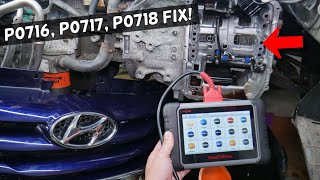
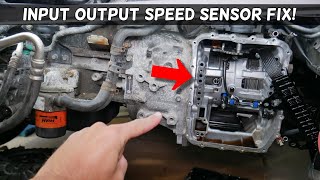
- 2012-2017 (RB Generation with 6-Speed Automatic): The 6-speed automatic transmission (A6GF1) used in these later models has the input and output speed sensors located *inside* the transmission. Replacement requires removing the transmission oil pan and the valve body to access the sensors. This is a significantly more involved and costly repair than on the earlier models.
Diagnostic Flowchart
Other Known Issues on This Vehicle
Issues unrelated to this code that are worth knowing about as an owner of this generation:
- Crankshaft Position Sensor Failure 🔴 High — Common across many early 2000s Hyundai models. Can occur at any mileage, leading to no-start or stalling conditions.
- Peeling White Paint 🟠 Medium — Widespread on many Hyundai models from the 2010s, particularly those with white paint. Peeling can start a few years after purchase. (Ref: Hyundai extended the paint warranty for certain models and years in response to customer complaints and lawsuits.)
- Faulty Brake Light Switch 🟠 Medium — Common on the MC generation (2006-2011), causing brake lights to fail, ESC light to illuminate, and shifter to get stuck in Park. (Ref: Recall 13V113000)
- Premature Shock Absorber Wear 🟡 Low — On the MC generation (2006-2011), factory shock absorbers are known to have a short lifespan, potentially leaking after only 40,000 km (approx. 25,000 miles).
- Excessive Oil Consumption 🟠 Medium — Reported on some RB generation (2011-2017) models at higher mileage, potentially due to worn piston rings.
Used vs. New Parts: Buying Guide for This Vehicle
When a used part is the smart pick: For this repair, a used part is generally not recommended for the sensor itself due to its low cost new and the unknown remaining lifespan of a used electronic component. However, sourcing a used wiring harness pigtail from a junkyard is an excellent and cost-effective option if only the connector is damaged.
Donor-vehicle mileage cap: roughly under 80000 miles for the part to have meaningful remaining life.
What to inspect on the donor part:
- For a wiring pigtail, ensure the plastic is not brittle or cracked.
- Check for any signs of corrosion (green or white powder) on the connector pins.
- Ensure the locking tab on the connector is intact and functional.
- Cut the pigtail with at least 6-8 inches of wire to allow for easy splicing.
Aftermarket brands forum-validated for this vehicle:
- Dorman
- Standard Motor Products (SMP)
- WVE
- NTK
Brands owners have reported issues with on this vehicle:
- No-name, unbranded sensors from online marketplaces should be avoided, as their signal quality and longevity can be questionable, potentially leading to a repeat repair.
Real Owner Stories
Aggregated from forums and TSBs cited above. Mileages and costs reflect what owners reported in those sources.
2002 Hyundai Sonata
Symptoms: The car was revving high at 60mph and then got stuck in 3rd gear. The Check Engine Light was on with codes P1715 and P1529.
What fixed it: The community identified a faulty input speed sensor or improperly cleared codes after a recent replacement.
Source hint: Hyundai-Forums.com thread titled 'check-engine-light-transmission-stuck-in-3rd-gear.91703/'
2002 Hyundai Elantra (XD)
Symptoms: The transmission became stuck in 3rd gear (limp mode) and triggered a P1529 code.
What fixed it: The owner's research confirmed the fix was replacing the input or output speed sensor.
Source hint: Reddit r/MechanicAdvice
Related OBD-II Codes
Frequently Asked Questions
Where is the Input Speed Sensor located on my Hyundai Accent?
Can I use a sensor from a Kia Rio to fix my P1715 code?
Is there a TSB for speed sensor issues on my Hyundai?
What should the resistance be for the input speed sensor if I test it with a multimeter?
My Accent is stuck in 3rd gear and won't shift; is this related to P1715?
Should I buy a used input speed sensor from a junkyard?
Helpful Videos
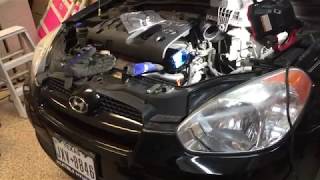
Used OEM Parts in Stock

New Aftermarket Parts Available



The information in this article is provided for general reference and educational purposes only. Vehicle specifications, procedures, and part compatibility can vary by production date, trim level, and region. Always consult your vehicle's factory service manual and verify part numbers before purchasing or performing repairs. Safety-critical components such as airbags, seat belts, and braking systems should be installed by a qualified professional.
- Hyundai Accent:
- 🎬 Helpful Videos
- 🛍️ Shop This Part
- What's Unique About the 1999-2017 Hyundai Accent
- Symptoms You May Notice
- Most Likely Causes
- Rare But Worth Checking
- Diagnosis Steps
- Parts You'll Likely Need
- Related Codes That Often Appear With This One
- Technical Service Bulletins (TSBs) & Recalls
- Platform-Specific Known Issues
- Mechanic-Grade Diagnostic Values
- Scan Tool Commands That Help
- Wiring & Ground Locations
- OEM Part Supersession History
- Model Year Variations Within This Range
- Diagnostic Flowchart
- Other Known Issues on This Vehicle
- Used vs. New Parts: Buying Guide for This Vehicle
- Real Owner Stories
- 2002 Hyundai Sonata
- 2002 Hyundai Elantra (XD)
- Related OBD-II Codes
- Frequently Asked Questions
- 🎟️ Get 5% Off