

P1621 on 2011-2016 Hyundai Elantra: A/C Relay Circuit Fault Causes and Fixes
This code means your A/C won't work due to an electrical issue in the compressor's control circuit. The most common fix is replacing the A/C relay, a small and inexpensive part located in the under-hood fuse box.
- P1621 on your Elantra almost always points to a problem with the A/C relay or its circuit, not a major engine issue.
- The most common symptom is simply that your air conditioning will not turn on.
- Before buying any parts, try swapping the A/C relay with another identical relay (like the horn relay) in the fuse box to quickly diagnose the problem.
- This is a very DIY-friendly repair, with the most likely part (the relay) being inexpensive and easy to replace.
What's Unique About the 2011-2016 Hyundai Elantra

For many other car brands, P1621 can refer to serious immobilizer, fuel system, or control module memory failures. On Hyundai and Kia vehicles of this era, however, the definition is much simpler and less severe, pointing directly to the A/C system's electrical controls. This is a straightforward electrical fault rather than a complex module or software issue, making it significantly easier and cheaper to diagnose and repair.
Symptoms You May Notice
- Air conditioning (A/C) does not blow cold air
- A/C compressor clutch does not engage 🎬 Watch this walkthrough for an Elantra AC that isn't blowing cold. (no 'click' sound when turning on A/C)
- Check Engine Light is illuminated
- Replacing the A/C compressor
- Recharging the A/C refrigerant
- Replacing the A/C pressure switch
Most Likely Causes

- Faulty A/C Compressor Relay 🔴 High Probability Relays are electro-mechanical switches that wear out over time from repeated cycling and exposure to under-hood temperatures. This is the most widely reported failure point for this specific code on this platform.
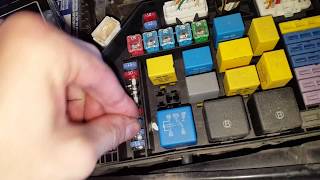
How to confirm: Locate the A/C relay in the engine compartment fuse box. It is often labeled 'A/CON'. Swap it with an identical relay from a non-essential system (e.g., the horn relay, which is usually the same type). If the A/C now works and the horn does not, the relay is bad.
Typical fix: Replace the faulty relay with a new one. The OEM part is a common multi-purpose relay. 🎬 See how to swap the AC relay with the horn relay.
Est. part cost: $10-$25 - Damaged Wiring or Connector 🟡 Medium Probability Vibration and heat in the engine bay can cause wires to chafe or connectors to become loose or corroded over time, especially at the fuse box connector.
How to confirm: Visually inspect the wiring harness and the connector at the A/C relay socket for any signs of damage, corrosion, or loose pins. Use a multimeter to check for proper voltage and ground at the relay socket based on a wiring diagram.
Typical fix: Repair the damaged section of wire or clean/replace the relay socket terminal.
Est. part cost: $5-$50 - Blown A/C Fuse ⚪ Low Probability While less common for this specific code (which points to the relay control circuit), a related fuse issue can sometimes be involved, especially if there's an underlying short circuit.
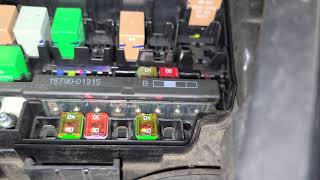
How to confirm: Check the fuses labeled 'A/C' or similar in both the engine compartment and interior fuse panels. A visual inspection or a continuity test with a multimeter will confirm if a fuse is blown.
Typical fix: Replace the blown fuse with a new one of the exact same amperage rating. If the new fuse blows immediately, a short circuit is present that must be diagnosed.
Est. part cost: $1-$5
Rare But Worth Checking
- Faulty Engine Control Module (ECM): This is extremely rare. The ECM's internal driver for the A/C relay can fail. This should only be considered after all other possibilities (relay, wiring, fuses) have been exhaustively ruled out by a professional. Some early models in this generation had TSBs related to PCM logic errors, but not specifically for P1621.
Diagnosis Steps

- Verify the primary symptom: Confirm that the A/C is not blowing cold and the compressor clutch is not engaging.
- Scan for codes: Confirm P1621 is the active or stored code.
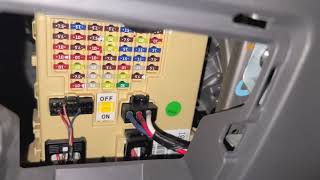
- Inspect Fuses: Check the 10A 'A/C' fuse in the engine compartment fuse box and related fuses in the interior panel. Replace if blown. 🎬 Watch: How to locate and check your Elantra AC fuses.
- Perform Relay Swap Test: Locate the A/C relay in the engine bay fuse box (labeled 'A/CON' on the fuse map). Swap it with an identical relay (like the horn relay). Clear the codes and see if the A/C works. If it does, the original relay is faulty. This is the most likely fix.
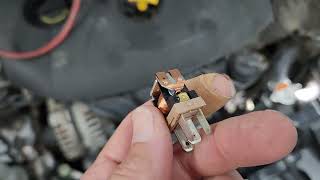
- Inspect Relay Socket and Wiring: If the relay swap doesn't work, remove the relay and inspect the socket terminals for corrosion, spread pins, or damage. Inspect the visible wiring going to the relay for any signs of chafing or breaks.
- Test the Circuit: Using a multimeter and a vehicle-specific wiring diagram, check for battery voltage, ground, and the control signal from the ECM at the relay socket. The ECM provides the ground signal to activate the relay.
- Test the Relay: If the circuit tests okay, test the original relay itself using a multimeter and a 12V power source to see if it clicks and if the switched contacts have continuity when energized.
- Check ECM: If the relay and wiring are confirmed to be good, the final step is to suspect a fault in the ECM's driver circuit, which typically requires professional diagnosis.
Parts You'll Likely Need
- A/C Compressor Relay
(OEM #95224-2D000)— This is the most common failure point for a P1621 code, as the relay is a mechanical part that wears out.
Trusted brands: Hyundai (OEM), Standard Motor Products, Wells, Four Seasons
OEM price range: $15-$30
Aftermarket price range: $10-$20
Technical Service Bulletins (TSBs) & Recalls
- TSB 17-ST-002: Warranty extension for the separate issue of a worn steering coupler, which is a common problem on this platform.
- While no TSBs directly address P1621, searches confirmed none exist for this specific A/C issue, reinforcing that it's a simple component failure rather than a systemic design flaw requiring a bulletin.
Platform-Specific Known Issues
- A/C Relay Location: The A/C Compressor Relay is located in the main fuse/relay box in the engine compartment, on the driver's side. The underside of the box lid has a diagram. The relay is typically labeled 'A/CON' or with an A/C symbol.
Mechanic-Grade Diagnostic Values

- A/C Relay Coil Resistance — expected: 50 to 120 Ohms. Failure: A reading of 'OL' (Open Loop) or infinite resistance indicates a broken coil. A reading of zero indicates a short.
- A/C Relay Switched Contacts Resistance (Energized) — expected: Near 0.0 Ohms. Failure: Any significant resistance (more than 1 Ohm) indicates pitted or corroded internal contacts, and the relay should be replaced even if it clicks.
- A/C Relay Switched Contacts Resistance (De-energized) — expected: 'OL' (Open Loop) / Infinite Resistance. Failure: A reading near zero Ohms indicates the relay is stuck closed.
- ECM Fault Detection Time — expected: N/A. Failure: The ECM will set code P1621 if it detects a short to battery (high voltage) on the relay control circuit for more than 655 seconds when the relay is commanded OFF.
Scan Tool Commands That Help
- Hyundai GDS (or equivalent professional bidirectional scanner): Actuation Test for A/C Compressor Relay — After a relay swap fails to resolve the issue. This command directly tells the ECM to energize the A/C relay. If the relay clicks and the compressor engages, the problem lies in the input side (A/C controls, pressure switches). If it does not click, but the relay and its power supply are good, it points to a faulty ECM driver or a break in the control wire from the ECM.
Wiring & Ground Locations
- A/C Relay Control Circuit Pins — At the A/C relay socket in the engine compartment fuse box.. Testing for power, ground, and the ECM control signal happens here. The ECM provides a switched ground to pin 85 or 86 to activate the relay coil. Pin 30 should have constant or ignition-on power, and pin 87 sends that power to the A/C compressor clutch when the relay is active.
- Gng03 — Top rear of the engine.. This is a primary engine ground. While a failure here would likely cause multiple codes, a poor engine ground can lead to unpredictable electrical behavior, including issues with ECM-controlled components.
- Ge02 — Left front corner of the vehicle, near the strut tower/frame rail.. This is a key body ground point. The ECM and other modules rely on clean body grounds. Corrosion or looseness at this point has been noted to cause intermittent electrical problems on this platform.
OEM Part Supersession History
9522405000, 9522429000, 9522429700, 9522429750, 9522429800→95224-2D000— Part consolidation and minor revisions over many model years. The 95224-2D000 is a widely used multi-purpose 4-pin micro relay across the Hyundai/Kia lineup.
Model Year Variations Within This Range
- 2011-2016: The Elantra received a cosmetic and feature facelift for the 2014-2016 model years. However, the underlying 1.8L Nu engine, electrical architecture, and A/C control logic related to code P1621 remained unchanged. The diagnostic procedure is identical for all years in this range.
Diagnostic Flowchart
Other Known Issues on This Vehicle
Issues unrelated to this code that are worth knowing about as an owner of this generation:
- Engine Ticking / Piston Slap (1.8L Nu) 🔴 High — Widespread issue, often noticeable on cold starts and can progress to engine failure. Onset can be from 70,000 miles. (Ref: Subject of class-action lawsuit (Brown, et al., v. Hyundai Motor America) resulting in warranty extensions (10-year/120,000-mile) for the short block assembly for qualifying vehicles.)
- Worn Steering Coupler 🟠 Medium — Extremely common. Causes a distinct clicking or clunking noise in the steering column when turning. Usually appears after 50,000 miles. (Ref: Hyundai TSB 17-ST-002 extended the warranty for this part to 10 years/100,000 miles. The part itself is inexpensive, but labor is involved.)
- Timing Chain Guide Wear / Failure 🔴 High — Can occur at higher mileage (over 100,000 miles), causing rattling noises or a no-start condition if the chain jumps timing. May be associated with codes P0340 or P0016.
- Peeling 'Self-Healing' Paint 🟡 Low — Common on white and other light-colored vehicles. The top clear coat delaminates and peels, often starting on the roof and hood. (Ref: While not a formal recall, Hyundai has offered goodwill repairs or warranty extensions in some cases.)
- Premature Alternator Failure 🟠 Medium — A noted pattern of alternators failing more frequently than expected for the vehicle class.
Used vs. New Parts: Buying Guide for This Vehicle
When a used part is the smart pick: A used A/C relay from a salvage yard is an excellent and cost-effective choice for this repair. It is a non-critical, external component that is easy to access and test. Since many relays in the fuse box are identical, a single donor vehicle can provide multiple spare options.
Donor-vehicle mileage cap: roughly under 100000 miles for the part to have meaningful remaining life.
What to inspect on the donor part:
- Ensure the donor vehicle's fuse box is free of corrosion, water damage, or signs of fire.
- Physically inspect the relay's pins for any corrosion or discoloration before pulling it.
- If possible, choose a donor vehicle that was involved in a rear-end collision, suggesting the engine bay components were likely functional at the time of the accident.
OEM-only on this vehicle (don't cheap out):
- Engine Control Module (ECM)
Aftermarket brands forum-validated for this vehicle:
- Standard Motor Products (SMP)
- Wells Vehicle Electronics
- Four Seasons
Real Owner Stories
Aggregated from forums and TSBs cited above. Mileages and costs reflect what owners reported in those sources.
2013 Hyundai Elantra
Symptoms: A/C relay circuit open/short; A/C not working.
What fixed it: Replacement of the A/C relay in the engine compartment fuse box.
Source hint: https://www.hyundai-forums.com/threads/2013-elantra-p1621-ac-relay-circuit-open-short.678129/
Related OBD-II Codes
Frequently Asked Questions
Does TSB 17-ST-002 apply to my 2011-2016 Hyundai Elantra if I have code P1621?
Where is the A/C relay located on my Elantra?
Can I use the horn relay to test if my A/C relay is bad?
Is there a TSB for the P1621 code on the 2011-2016 Elantra?
What is the part number for the replacement A/C relay?
Could my P1621 code be related to the 1.8L Nu engine's 'piston slap' issue?
Helpful Videos
We Have This Part in Stock



The information in this article is provided for general reference and educational purposes only. Vehicle specifications, procedures, and part compatibility can vary by production date, trim level, and region. Always consult your vehicle's factory service manual and verify part numbers before purchasing or performing repairs. Safety-critical components such as airbags, seat belts, and braking systems should be installed by a qualified professional.
- Hyundai Elantra:
- 🎬 Helpful Videos
- 🛍️ Shop This Part
- What's Unique About the 2011-2016 Hyundai Elantra
- Symptoms You May Notice
- Most Likely Causes
- Rare But Worth Checking
- Diagnosis Steps
- Parts You'll Likely Need
- Technical Service Bulletins (TSBs) & Recalls
- Platform-Specific Known Issues
- Mechanic-Grade Diagnostic Values
- Scan Tool Commands That Help
- Wiring & Ground Locations
- OEM Part Supersession History
- Model Year Variations Within This Range
- Diagnostic Flowchart
- Other Known Issues on This Vehicle
- Used vs. New Parts: Buying Guide for This Vehicle
- Real Owner Stories
- 2013 Hyundai Elantra
- Related OBD-II Codes
- Frequently Asked Questions
- 🎟️ Get 5% Off