

P1451 on 1997-2014 Ford E-250 5.4L: EVAP Vent Solenoid Circuit Causes and Fixes
On a 1997-2014 Ford E-250, code P1451 almost always points to an electrical problem with the EVAP Canister Vent Solenoid or its wiring. The most common fix is replacing the solenoid itself, which is located near the spare tire. Before replacing it, thoroughly inspect the wiring harness (specifically the Red power wire and Violet/White control wire) for corrosion or chafing against the frame, as a simple wire repair often solves the problem.
- P1451 is an electrical circuit code for the EVAP vent solenoid, not a system leak code. Do not replace the gas cap.
- The most likely causes are a failed vent solenoid or damaged wiring near the spare tire.
- Always inspect the wiring harness for chafing or corrosion before you buy a new solenoid, as a simple wire repair might be the only fix needed.
- The vent solenoid is at the rear of the van by the charcoal canister; the purge valve is in the engine bay. P1451 is for the vent solenoid.
- You will need to lower the spare tire to access the component for testing and replacement.
What's Unique About the 1997-2014 Ford E-250
On Ford E-Series vans, the canister vent solenoid is mounted underneath the vehicle near the spare tire, exposing it and its wiring to road salt, water, and debris. This location makes the wiring harness prone to chafing against the frame or canister bracket, and the electrical connector is susceptible to corrosion. As a result, a wiring fault is just as likely to be the cause as a failed solenoid, making a thorough visual inspection a critical first step. Unlike the F-150 which transitioned to the problematic 3-valve 5.4L engine in 2004, the E-Series vans retained the more robust 2-valve 5.4L Triton for the entire 1997-2014 production run, making platform-level issues like spark plug blowouts (not breakage) consistent across these years.
Generation note: The 1997-2014 model years cover the fourth generation of the Ford E-Series, which received a major facelift and interior update for the 2008 model year. While the function and location of the EVAP vent solenoid remain consistent, the specific part number for the solenoid may differ between the earlier (pre-2003/2004) and later models.
Symptoms You May Notice
- Check Engine Light is on.
- Vehicle will fail an emissions inspection.
- Difficulty filling the fuel tank (gas pump clicks off repeatedly), 🎬 Watch: How to fix a slow-filling fuel tank on E-250s. though this is more common with a mechanically stuck valve, it can be a related symptom if the valve fails to open.
- Replacing the gas cap. P1451 is an electrical circuit code, not a leak code, so a bad gas cap will not cause it.
- Replacing the EVAP Purge Valve/Solenoid. The purge valve is located in the engine bay, while the P1451 code refers to the vent solenoid circuit at the rear of the vehicle near the fuel tank.
Most Likely Causes
- Failed EVAP Canister Vent Solenoid 🔴 High Probability The solenoid is located under the van, where it is exposed to moisture and road salt, leading to internal corrosion and electrical failure of the coil.
How to confirm: Disconnect the solenoid and measure the resistance between its two electrical pins with a multimeter. A good Ford solenoid should measure between 48 and 65 ohms. A reading of infinity (OL) indicates an open coil, while a reading near zero indicates a shorted coil. You can also try applying 12V directly to the pins to see if it makes an audible click.
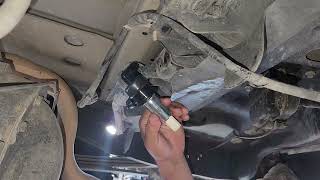
Typical fix: Replace the canister vent solenoid. The part is located on or next to the charcoal canister, which is found by lowering the spare tire.
Est. part cost: $40-$110 - Damaged Wiring or Electrical Connector 🔴 High Probability The wiring harness running to the vent solenoid is known to chafe against the frame or canister mounting bracket, wearing through the insulation and causing a short or open circuit. The connector itself is also highly prone to corrosion, causing pins to break off.
How to confirm: Visually inspect the entire length of the wiring harness from the main loom to the vent solenoid connector. Pay close attention to any point where it touches the frame. Check the connector for green or white corrosion on the pins or for broken wires right at the back of the connector. The power wire is typically Red, and the control wire is often Violet/White.
Typical fix: Repair the broken or chafed wire using a butt connector and heat shrink tubing. Clean the electrical connector with contact cleaner or replace the connector pigtail if corrosion is severe.
Est. part cost: $5-$25 - Blown Fuse or Faulty Relay ⚪ Low Probability
How to confirm: Check the vehicle's fuse box for any blown fuses related to the emissions or EVAP system. On some models, this circuit may share a fuse with the O2 sensor heaters, so other codes like P0135 or P0155 may be present if the fuse is blown.
Typical fix: Replace the blown fuse. If the fuse blows again immediately, it indicates a short circuit in the wiring that must be found and repaired.
Est. part cost: $1-$10
Rare But Worth Checking
- Faulty Powertrain Control Module (PCM): This is very rare, but if the solenoid and wiring are confirmed to be good, the driver circuit inside the PCM may have failed. This should be the last item to consider after all other possibilities are exhausted.
Diagnosis Steps
- Retrieve the P1451 code with an OBD-II scanner.
- Lower the spare tire to gain access to the EVAP charcoal canister and vent solenoid.
- Thoroughly inspect the wiring harness leading to the vent solenoid. Look for any signs of chafing, melting, or corrosion, particularly where the harness may rub against the frame or brackets.
- Inspect the electrical connector at the solenoid for corrosion, moisture, or broken/pushed-out pins.
- If wiring looks good, disconnect the solenoid. With the key on, engine off, use a multimeter to check for battery voltage (~12V) on the power wire at the connector (typically a Red wire).
- With the solenoid still disconnected, measure the resistance across the two pins 🎬 See this walkthrough on diagnosing and fixing the P1451 code. on the solenoid itself. It should be between 48 and 65 ohms. If it's open (OL) or shorted (near 0 ohms), the solenoid is bad and needs to be replaced.
- If the solenoid and wiring test good, the fault may be intermittent or, in rare cases, within the PCM.
Parts You'll Likely Need
- EVAP Canister Vent Solenoid
(OEM #F75Z-9F945-CA (Motorcraft CX2121, for approx. 1997-2003) or 9L1Z-9F945-A (Motorcraft CX2417, for approx. 2004-2008))— This is the most common component to fail, either due to an internal electrical fault or corrosion from its exposed location under the vehicle.
Trusted brands: Motorcraft, Dorman, Standard Motor Products (SMP)
OEM price range: $80-$120
Aftermarket price range: $40-$75 - EVAP Vent Solenoid Connector Pigtail
(OEM #WPT-1254 (Varies by year, always verify))— If the electrical connector is heavily corroded or wires are broken flush with the connector, simply replacing the solenoid won't fix the issue. A new connector pigtail will need to be spliced in.
Trusted brands: Dorman, Motorcraft
OEM price range: $25-$40
Aftermarket price range: $15-$30
Related Codes That Often Appear With This One
- P0446 — P0446 indicates a general EVAP vent control circuit malfunction. P1451 is the more specific Ford code for that same electrical fault.
- P1450 — P1450 means 'Unable to Bleed Up Fuel Tank Vacuum.' If the vent solenoid circuit fails (P1451), the valve may not open, preventing the system from bleeding up and potentially triggering P1450 as well.
- P0443 — This code points to a fault in the EVAP Purge Control Valve circuit in the engine bay. It can sometimes appear with P1451 if there is a shared power or ground issue, or during a comprehensive EVAP system failure.
Platform-Specific Known Issues
- source — A user on Ford-Trucks.com with a 2003 F-150 (similar platform) reported finding the red power wire to the solenoid was broken inside the loom, about halfway up the harness from the connector. Splicing the wire fixed the P1451 code.
- source — An owner on F150forum.com found their persistent P1451 was due to a previous owner's bad repair of the known chafing issue. The wires were simply twisted together with no weatherproofing, which eventually corroded and failed. A proper repair with heat-shrink butt connectors was the final solution.
Mechanic-Grade Diagnostic Values
- EVAP Canister Vent (EVAPCV) Solenoid PID — expected: With the valve commanded open (de-energized), the EVAPCV PID should indicate 0% duty cycle and voltage should be approximately battery voltage. When commanded closed (energized), EVAPCV should indicate 100% duty cycle and voltage should drop by at least 4 volts.. Failure: If the voltage does not change when the solenoid is commanded, it indicates an open/short in the control circuit or a faulty PCM driver. If the voltage is always low, it could be a short to ground.
- Fuel Tank Pressure (FTP) Sensor Voltage (Key On, Engine Off) — expected: Approximately 2.6V to 2.65V. This represents atmospheric pressure.. Failure: A reading significantly different from this baseline with the system at rest could indicate a biased sensor, although this would typically set other codes.
Scan Tool Commands That Help
- Ford IDS (or equivalent high-end bidirectional scanner): Output Test Mode (or Active Command) for EVAP Canister Vent (CV) Solenoid — This is the primary diagnostic command to verify PCM control over the vent solenoid. It allows the technician to manually command the solenoid on and off to listen for an audible click and, more importantly, to measure the voltage change on the control wire to confirm the integrity of the PCM driver, wiring, and solenoid activation.
- Ford IDS (or equivalent): EVAP System Test — This is a comprehensive, automated test that seals the system (by commanding the vent solenoid closed) and uses the purge solenoid to draw a vacuum, monitoring for leaks. While P1451 is an electrical code, running this test can sometimes help confirm if the vent solenoid is responding to commands as part of the overall system check.
Wiring & Ground Locations
- G300 — On the underbody at the left rear of the vehicle.. This is a primary chassis ground point in the vicinity of the EVAP canister and vent solenoid. A corroded or loose G300 could cause intermittent or faulty operation of various rear-mounted components, including the EVAP system.
- G401 / G402 — Located on the underbody at the left rear of the vehicle, near the fuel pump driver module.. Similar to G300, this is another critical ground point for components at the rear of the van. Poor grounding here can lead to unpredictable voltage drops and trigger circuit codes like P1451.
- EVAP Canister Vent Valve Connector — On the EVAP canister vent solenoid, located near the spare tire.. This is the direct connection point. The power wire is typically Red (RD) and receives voltage from the PCM Power Relay. The control wire, often Violet/White (VT/WH), is the ground-side switched wire controlled by the PCM. Testing for voltage and control signal happens at these pins.
Real Owner Repair Stories
- YouTube - GabrielAutoTech (2001 Lincoln Town Car 4.6L (similar Ford platform/system)) — Check Engine Light with code P1451.
❌ Tried (didn't work) Initial diagnosis pointed towards a bad solenoid or wiring.
✅ What actually fixed it The problem was a corroded electrical terminal pin inside the connector. The wire itself was intact, but the pin was no longer making a solid connection. The fix was to remove the bad terminal from the connector housing and solder the wire directly to a new terminal or repair the existing one.
OEM Part Supersession History
F75Z-9F945-CA→This part number, corresponding to Motorcraft CX2121, was used on earlier models (approx. 1997-2003) and does not appear to have a direct official supersession to the later part. It is considered a separate part for a different application range.— Vehicle/system design change.
Heads up: This part is for the earlier generation of the EVAP system and is likely not compatible with 2004+ models.6L3Z-9F945-A→9L1Z-9F945-A (Motorcraft CX2417)— Standard part number update/revision.
Model Year Variations Within This Range
- 1997-2003 (approx.): Uses the earlier style vent solenoid, OEM part number F75Z-9F945-CA (Motorcraft CX2121). The wiring and function are similar, but the physical part is different from later models.
- 2004-2014 (approx.): Uses the later style vent solenoid, with part numbers like 9L1Z-9F945-A (Motorcraft CX2417). The EVAP system underwent some revisions around this time, making part interchangeability between early and late models unlikely.
Diagnostic Flowchart
Other Known Issues on This Vehicle
Issues unrelated to this code that are worth knowing about as an owner of this generation:
- Spark Plug Blowout (2-Valve Engines) 🔴 High — Common on engines around 100,000 miles, especially if plugs were not torqued correctly. The 2-valve heads have few threads, which can strip and eject the spark plug.
- Cracked Exhaust Manifolds / Broken Studs 🟠 Medium — Very common. Owners report a ticking noise on startup that may quiet down as the engine warms up and the metal expands. This is caused by broken exhaust manifold studs.
- Ignition Coil-on-Plug Failure 🟠 Medium — Coil packs are a frequent failure item, leading to misfires (P030X codes). Moisture intrusion into the spark plug wells is a common cause.
- Failing Fuel Pump Driver Module (FPDM) 🔴 High — The FPDM, often mounted to the frame, can corrode and fail, causing no-start or stalling conditions. This is a well-documented issue on many Ford trucks and vans of this era.
Used vs. New Parts: Buying Guide for This Vehicle
When a used part is the smart pick: A used part is generally NOT recommended for the EVAP vent solenoid. It is an electrical component in a highly exposed location prone to corrosion and wear. The cost savings are minimal compared to the risk of premature failure. A used connector pigtail is a viable option if it is clean, free of corrosion, and has ample wire length for splicing.
Donor-vehicle mileage cap: roughly under 80000 miles for the part to have meaningful remaining life.
What to inspect on the donor part:
- For a connector pigtail, inspect for any signs of green or white corrosion on the pins.
- Check that the plastic locking tabs are intact and not brittle.
- Ensure the wires are not cracked or frayed at the back of the connector.
- Avoid parts from vehicles in heavy salt-belt regions if possible.
Aftermarket brands forum-validated for this vehicle:
- Motorcraft (OEM)
- Standard Motor Products (SMP)
- Dorman
Brands owners have reported issues with on this vehicle:
- Unbranded, low-cost parts from online marketplaces can have high failure rates. While some may work, their reliability is questionable for a part located in a difficult-to-access area.
Real Owner Stories
Aggregated from forums and TSBs cited above. Mileages and costs reflect what owners reported in those sources.
2003 E250 5.4L V8 — 76000 miles
Symptoms: Check engine light with P1451, P0316, and P0305. Observed a mild/un-noticeable rough idle and an intermittent shudder at cruising speeds (55-70MPH) or around 30MPH.
What fixed it: The context mentions the P1451 was present alongside misfires; however, the specific fix for this user's P1451 is not completed in the provided text, though the general fix for this vehicle is replacing the solenoid or repairing the red power wire.
Source hint: Ford Truck Enthusiasts Forums
2003 F-150 5.4L V8
Symptoms: P1451 code triggered by a circuit malfunction in the EVAP system.
What fixed it: Splicing the red power wire which was found broken inside the loom about halfway up the harness from the connector.
Source hint: Ford-Trucks.com thread titled 'code p1451-what to do.html'
2001 F-150 5.4L V8
Symptoms: Persistent P1451 code.
What fixed it: A proper repair of the wiring using weatherproof heat-shrink butt connectors after finding a previous owner's improper repair (twisted wires with no weatherproofing) had failed.
Source hint: F150forum.com thread titled 'please help dtc p1451'
1999 F-150 5.4L V8
Symptoms: P1451 code present.
What fixed it: Installation of a new vent solenoid after testing the resistance of the old unit.
Source hint: Ford Truck Enthusiasts (ford-trucks.com)
Related OBD-II Codes
Frequently Asked Questions
Where is the EVAP canister vent solenoid located on my 1997-2014 Ford E-250?
What should the resistance reading be for a healthy vent solenoid on my 5.4L Triton?
Why is the wiring on my E-250 prone to causing the P1451 code?
Can a blown fuse cause P1451 on my Ford van?
I'm having trouble filling my gas tank; is this related to P1451?
What color wires should I look for when inspecting the vent solenoid harness?
Helpful Videos

We Have This Part in Stock



The information in this article is provided for general reference and educational purposes only. Vehicle specifications, procedures, and part compatibility can vary by production date, trim level, and region. Always consult your vehicle's factory service manual and verify part numbers before purchasing or performing repairs. Safety-critical components such as airbags, seat belts, and braking systems should be installed by a qualified professional.
- Ford E-250:
- 🎬 Helpful Videos
- 🛍️ Shop This Part
- What's Unique About the 1997-2014 Ford E-250
- Symptoms You May Notice
- Most Likely Causes
- Rare But Worth Checking
- Diagnosis Steps
- Parts You'll Likely Need
- Related Codes That Often Appear With This One
- Platform-Specific Known Issues
- Mechanic-Grade Diagnostic Values
- Scan Tool Commands That Help
- Wiring & Ground Locations
- Real Owner Repair Stories
- OEM Part Supersession History
- Model Year Variations Within This Range
- Diagnostic Flowchart
- Other Known Issues on This Vehicle
- Used vs. New Parts: Buying Guide for This Vehicle
- Real Owner Stories
- 2003 E250 5.4L V8 — 76000 miles
- 2003 F-150 5.4L V8
- 2001 F-150 5.4L V8
- 1999 F-150 5.4L V8
- Related OBD-II Codes
- Frequently Asked Questions
- 🎟️ Get 5% Off